10 Results for "

phosphorylated p53

" in MedChemExpress (MCE) Product Catalog:
Products (10)

10 Results for "phosphorylated p53" in MCE Product Catalog:

1
1 Cited Publications
Cat. No.: HY-155974
CAS No.: 2308548-54-9
Purity:  99.84%
Target:  

MDM-2/p53

Research Areas:  

Cancer

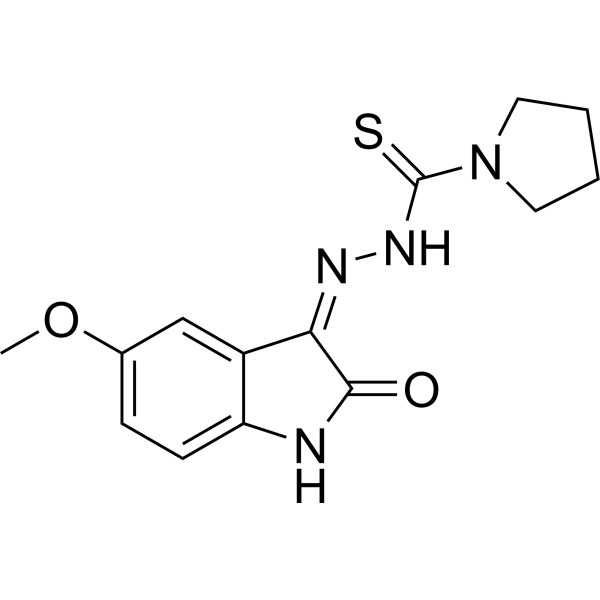
MeOIstPyrd is an anti-skin cancer agent. MeOIstPyrd inhibits cell proliferation, migration, and spheroid formation by activating the mitochondrial intrinsic apoptotic pathway. MeOIstPyrd induces DNA damage. MeOIstPyrd activates p53, and increases the half-life of p53 and stabilizes p53 by phosphorylating it at ser15. MeOIstPyrd binds to MDM2 in the p53 sub-pocket and blocks p53-MDM2 interaction .
loading...
    loading...
Cat. No.: HY-W017982
CAS No.: 55965-84-9
Synonyms: CMI/MI
CMIT/MIT (14.5% in water) (CMI/MI) is a mixture of CMIT and MIT, and is also a preservative and skin sensitizer. CMIT/MIT (14.5% in water) increases the levels of phosphorylated ERK1/2, p38, JNK1/2, p53, p21 and Bax, decreases the level of Bcl-2, and activates the Nrf-2/HO-1 signaling pathway. CMIT/MIT (14.5% in water) increases LDH release and lipid peroxidation levels, impairs antioxidant defense capacity, promotes pro-inflammatory cytokine release, induces apoptosis, triggers cell cycle arrest, exhibits neurotoxicity in neuroblastoma cells, and causes dysregulation of Th2/Th17 immune responses. CMIT/MIT (14.5% in water) can be used in studies related to allergy, atopic dermatitis and lung injury .
loading...
    loading...
Cat. No.: HY-112440
CAS No.: 2240205-30-3
Purity:  99.40%
Synonyms: Methuosis inducer 1
HZX-02-059 is an allosteric inhibitor of PIKFYVE, and a methuosis inducer. HZX-02-059 disrupts the PIKfyve/TFEB axis, suppresses tubulin polymerization, reduces phosphorylated mTOR levels, downregulates p53, PI3K/AKT, c-Myc, and NF-κB pathways. HZX-02-059 induces G2/M cell cycle arrest, apoptosis, and inhibits cancer cell proliferation. HZX-02-059 can be used for the research of lymphoma, double-hit lymphoma, and B-cell acute lymphoblastic leukemia .
loading...
    loading...
Cat. No.: HY-119062
CAS No.: 681245-85-2
Target:  

MetAP CDK

Research Areas:  

Cancer

A-800141 is an orally active, selective, sulfonamide-based MetAP2 inhibitor (IC50=12 nM) that binds reversibly to MetAP2 and interacts with its manganese ions. A-800141 induces the production of N-terminal methionine-unprocessed GAPDH variants, which in turn triggers G1-phase cell cycle arrest, elevates p21 levels, and reduces the levels of phosphorylated Rb and total cyclin A. A-800141 exhibits anti-angiogenic and tumor growth inhibitory effects, and produces synergistic effects when combined with cytotoxic inhibitors or BCL-2 inhibitors. A-800141 has been widely used in scientific research related to B-cell lymphoma, neuroblastoma, prostate cancer, colon cancer, melanoma and other fields .
loading...
    loading...
Cat. No.: HY-169021
CAS No.: 3056388-71-4
Target:  

JNK

Research Areas:  

Cancer

JNK-1-IN-3 (Compound 9e) is an inhibitor of JNK1 that downregulates JNK1 gene expression and inhibits the protein levels of its phosphorylated form, concurrently reducing the expression of its downstream targets, c-Jun and c-Fos, in tumors while restoring p53 activity. JNK-1-IN-3 exhibits broad-spectrum antiproliferative activity, particularly with high inhibitory activity against renal and breast cancer cell lines, demonstrating both in vivo and in vitro anticancer activity .
loading...
    loading...
Cat. No.: HY-161597
CAS No.: 3061366-76-2
Target:  

PROTACs DYRK

Research Areas:  

Cancer

PROTAC DYRK2 degrader 1 is a DYRK2 PROTAC degrader with DC50 values of 1.607 μM (MDA-MB-231 cells) and 3.265 μM (HeLa cells), respectively. PROTAC DYRK2 degrader 1 induces DYRK2 degradation via the ubiquitin-proteasome system. It is applicable to the research of triple-negative breast cancer and cervical cancer .
loading...
    loading...
Cat. No.: HY-162886
Research Areas:  

Cancer

BSO-07 is a ROS/JNK activator with significant anticancer effects, having an IC50 value of 24.81 μM against human breast cancer (BC) cells. BSO-07 induces apoptosis (Apoptosis) and paraptosis by activating JNK and increasing ROS levels, including enhancing the expression of apoptosis-associated proteins such as PARP, Bax, phosphorylated p53, ATF4, and CHOP, while decreasing the levels of anti-apoptotic proteins like Bcl-2, Bcl-xL, and Survivin. BSO-07 holds promise for research in the field of breast cancer .
loading...
    loading...
Cat. No.: HY-W017982A
CAS No.: 55965-84-9
Synonyms: CMI/MI (2.0-2.5% in water)
CMIT/MIT (2.0-2.5% in water) (CMI/MI (2.0-2.5% in water)) is a mixture of CMIT and MIT, and is also a preservative and skin sensitizer. CMIT/MIT (2.0-2.5% in water) increases the levels of phosphorylated ERK1/2, p38, JNK1/2, p53, p21 and Bax, decreases the level of Bcl-2, and activates the Nrf-2/HO-1 signaling pathway. CMIT/MIT (2.0-2.5% in water) increases LDH release and lipid peroxidation levels, impairs antioxidant defense capacity, promotes pro-inflammatory cytokine release, induces apoptosis, triggers cell cycle arrest, exhibits neurotoxicity in neuroblastoma cells, and causes dysregulation of Th2/Th17 immune responses. CMIT/MIT (2.0-2.5% in water) can be used in studies related to allergy, atopic dermatitis and lung injury .
loading...
    loading...
Cat. No.: HY-N20721
CAS No.: 21416-14-8
Pancracine is an alkaloid. Pancracine upregulates p27, phosphorylated p38 MAPK and phosphorylated p53, while downregulating phosphorylated Akt and phosphorylated Rb. Pancracine induces G1 cell cycle arrest and Apoptosis in cells. Pancracine inhibits the replication of pseudotyped HIV-1 and Dengue virus. Pancracine can be used in research related to lung adenocarcinoma, acute lymphoblastic leukemia, cutaneous epidermoid carcinoma, human immunodeficiency virus infection and dengue virus infection .
loading...
    loading...
Cat. No.: HY-186287
CAS No.: 3061366-74-0
Target:  

PROTACs DYRK

Research Areas:  

Cancer

PROTAC DYRK2 degrader-2 is a PROTAC DYRK2 degrader based on curcumin analog A3. It recruits the CRBN E3 ligase to mediate DYRK2 ubiquitination and achieves degradation via the ubiquitin-proteasome system. PROTAC DYRK2 degrader-2 downregulates the expression level of DYRK2 protein in cancer cells. It is applicable to cancer-related research .
loading...
    loading...

