



CMIT/MIT (2.0-2.5% in water)

Based on 1 Customer Validation
CMIT/MIT (2.0-2.5% in water) (CMI/MI (2.0-2.5% in water)) is a mixture of CMIT and MIT, and is also a preservative and skin sensitizer. CMIT/MIT (2.0-2.5% in water) increases the levels of phosphorylated ERK1/2, p38, JNK1/2, p53, p21 and Bax, decreases the level of Bcl-2, and activates the Nrf-2/HO-1 signaling pathway. CMIT/MIT (2.0-2.5% in water) increases LDH release and lipid peroxidation levels, impairs antioxidant defense capacity, promotes pro-inflammatory cytokine release, induces apoptosis, triggers cell cycle arrest, exhibits neurotoxicity in neuroblastoma cells, and causes dysregulation of Th2/Th17 immune responses. CMIT/MIT (2.0-2.5% in water) can be used in studies related to allergy, atopic dermatitis and lung injury.
For research use only. We do not sell to patients.
- CAS No.: 55965-84-9
- Formula: C8H9ClN2O2S2
- Molecular Weight:264.75
-
Storage:
4°C, stored under nitrogen
* In solvent : -80°C, 6 months; -20°C, 1 month (stored under nitrogen)


To place orders, for customer services and technical support, please contact: MedChemExpress USA
Tel: 609-228-6898 E-mail: [email protected] [email protected]


-
 Biological Activity
-
Chemical Information
- Purity & Documentation
- References
-
 Help & FAQs


-

HY-W017982
CMIT/MIT (14.5% in water)Biochemical Assay Reagents -
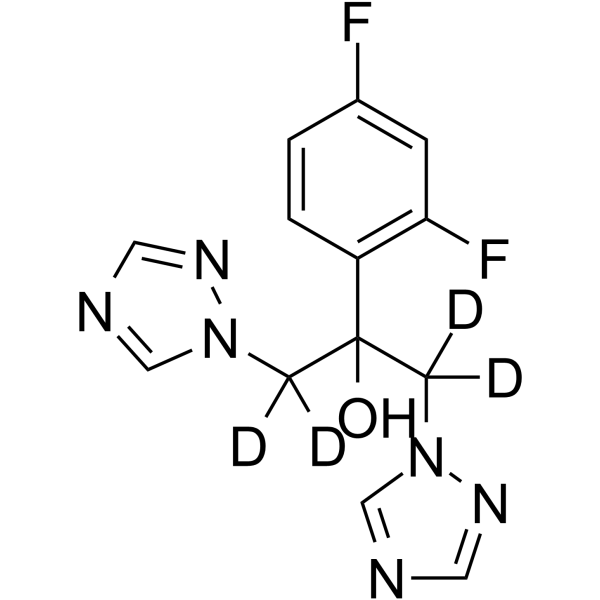
HY-B0101S
Fluconazole-d4Stable Isotope -
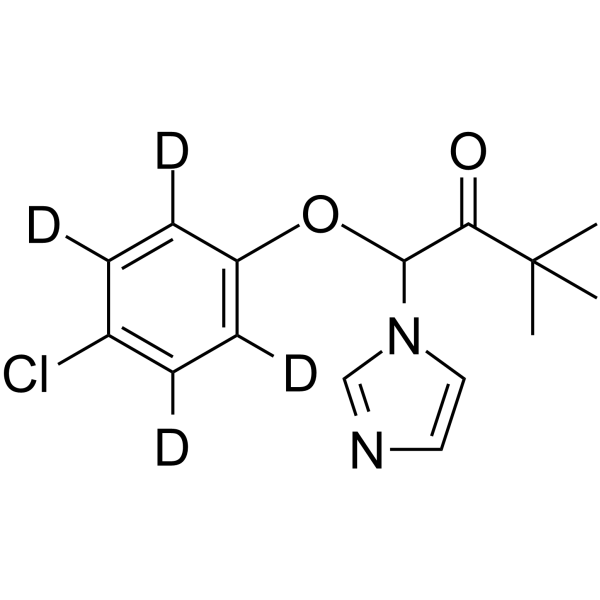
HY-B1151S
Climbazole-d4Stable Isotope -
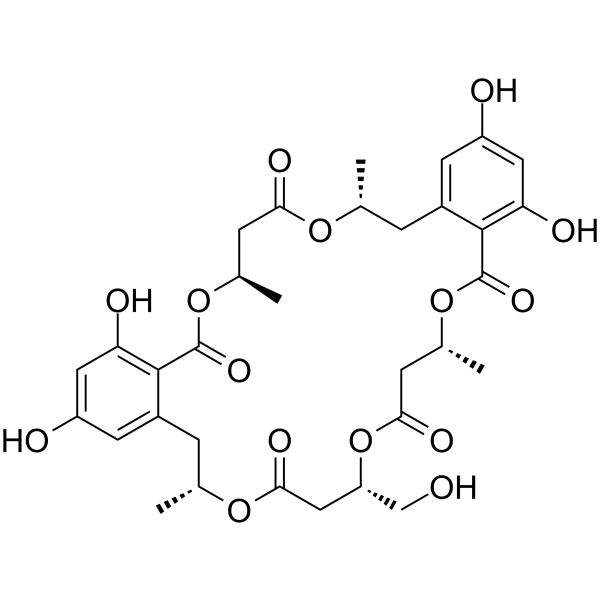
HY-117517
NG-012NGF Potentiator -

HY-121003
Aspyrone -
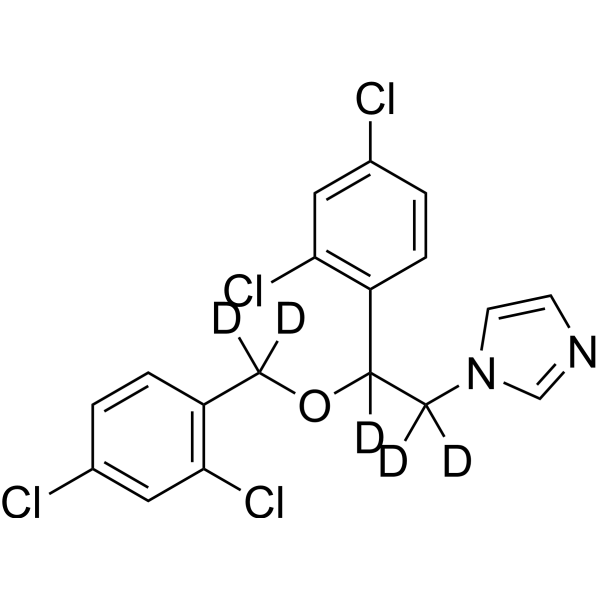
HY-B0454S
Miconazole-d5Stable Isotope -
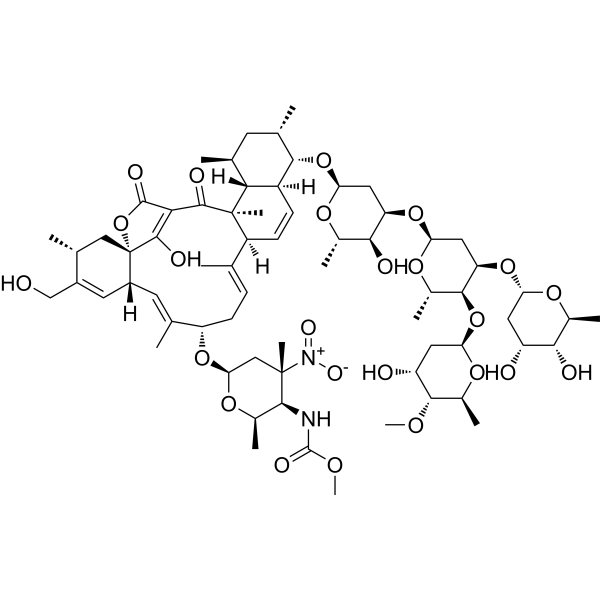
HY-125049
KijanimicinAntibiotic -
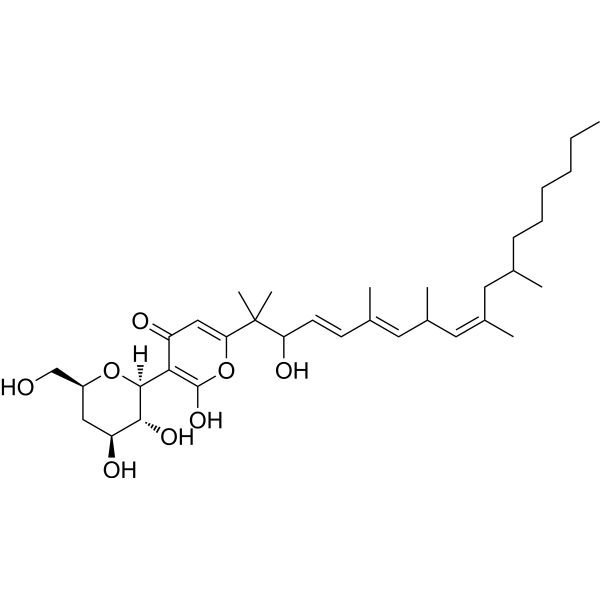
HY-N10273
DeoxyfusapyroneAntifungal Agent -

HY-125322
Reveromycin CPolyketide -
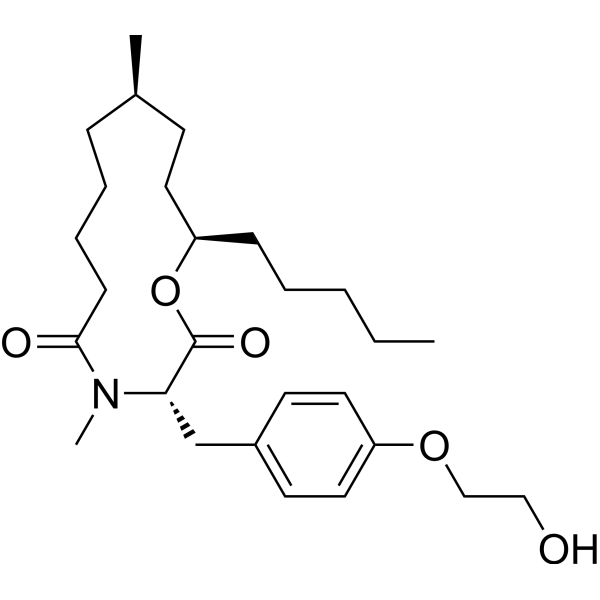
HY-123474
PF-1163BAntifungal Antibiotic -

HY-W793613
DrimendiolAntibiofilm Agent


Biological Activity
Description
|
ERK1 |
ERK2 |
JNK1 |
JNK2 |
Bax |
Bcl-2 |
IL-4 |
IL-17A |
IL-6 |
IL-1β |
In Vitro
CMIT/MIT (2.0-2.5% in water) can increase the levels of phosphorylated ERK1/2, p38, JNK1/2, p53, p21 and Bax, decrease the level of Bcl-2, and activate the Nrf-2/HO-1 signaling pathway[1].
CMIT/MIT (2.0-2.5% in water) increases the mutation frequency of mouse lymphoma cells by up to 10-fold[3].
CMIT/MIT (2.0-2.5% in water) does not induce chromosomal aberrations in Chinese hamster lung fibroblasts, although it causes cytotoxicity at concentrations ranging from 0.015 to 0.12 a.i. μg/mL[3].
CMIT/MIT (2.0-2.5% in water) exhibits high skin permeability in rat skin[3].
MedChemExpress (MCE) has not independently confirmed the accuracy of these methods. They are for reference only.
In Vivo
CMIT/MIT (1.5-15 a.i. mg/kg bw/day; oral administration; daily dosing from gestational day 5 to 15) (2.0-2.5% in water) causes dose-dependent maternal death in pregnant rats, but shows no teratogenicity or reproductive toxicity[3].
CMIT/MIT (1.5-13.3 a.i. mg/kg bw/day; administered orally; daily dosing on gestational days 6-18) (2.0-2.5% in water) causes severe dose-dependent maternal mortality and fetal loss in pregnant rabbits[3].
CMIT/MIT (2.0-2.5% in water) administered orally to dogs at doses ≥3.5 a.i. mg/kg bw/day over a two-week period triggers mild systemic adverse responses such as lowered food intake as well as changes in hematological and serum biochemical indicators[3].
CMIT/MIT (2.0-2.5% in water) causes dose-dependent gastric irritation in rats at doses of 100 and 300 a.i. ppm, but shows no carcinogenicity or systemic toxicity following 2 years of oral administration[3].
CMIT/MIT (2.0-2.5% in water) is a potent skin sensitizer in mice, with an EC3 range of 0.75-2.1 a.i. μg/cm2 in the local lymph node assay; dermal administration at a dose of 400 a.i. ppm for 30 months causes skin hyperplasia and inflammation in mice but no carcinogenicity; dermal administration at a dose of ≥ 0.56 a.i. mg/kg bw/day for 3 weeks induces moderate skin irritation in rabbits without associated systemic toxicity[3].
MedChemExpress (MCE) has not independently confirmed the accuracy of these methods. They are for reference only.
-
Animal Model:BALB/c (female, 5 weeks old, 16-20 g)[2]
-
Dosage:0.1875 mg/kg/day
-
Administration:epicutaneous; 5 days/week; 3 weeks
-
Result:Induced AD-like skin lesions with significantly increased transepidermal water loss (TEWL), total serum IgE levels, mast cell counts, and mast cell degranulation.
Significantly elevated skin mRNA expression of Th2-related cytokines/chemokines: thymic stromal lymphopoietin (TSLP), IL-6, IL-13, and CCL17.
Increased CD4+IL-4+ cell population in skin-draining lymph nodes.
-
Animal Model:BALB/c (female, 5 weeks old, 16-20 g, induced via 3 intraperitoneal sensitizations with ovalbumin (OVA) plus aluminum hydroxide at 1-week intervals, followed by 2 epicutaneous OVA sensitizations at 1-week intervals)[2]
-
Dosage:0.1875 mg/kg/day
-
Administration:epicutaneous; 5 days/week; 3 weeks
-
Result:Aggravated AD-like skin lesions with significantly higher TEWL, clinical scores, inflammatory cell infiltration, mast cell counts, and total serum IgE levels compared to mice treated with OVA alone.
Significantly increased skin mRNA expression of IL-4 and IL-17A compared to mice treated with OVA alone.
Increased CD4+IL-4+ and CD4+IL-17A+ cell populations in skin-draining lymph nodes compared to mice treated with OVA alone.


Chemical Information
-
CAS No. 55965-84-9
-
Appearance Liquid (Density: 1.19 g/cm3)
-
Molecular Weight 264.75
-
Formula C8H9ClN2O2S2
-
SMILES
O=C1C=CSN1C.O=C2C=C(SN2C)Cl
-
Synonyms
CMI/MI (2.0-2.5% in water)
-
Shipping
Room temperature in continental US; may vary elsewhere.
-
Storage
4°C, stored under nitrogen
* In solvent : -80°C, 6 months; -20°C, 1 month (stored under nitrogen)


Purity & Documentation
-
Data Sheet (277 KB)
-
SDS (252 KB)
- Français - FR (252 KB)
- Deutsch - DE (252 KB)
- Norwegian - NO (252 KB)
- Español - ES (252 KB)
- Swedish - SV (252 KB)
- Italian - IT (252 KB)
- Korean - KR (252 KB)
- Portuguese - PT (252 KB)
-
Handling Instructions (2659 KB)
References
[1]. Molinari F, et al. Biocide mixture (CMIT/MIT) induces neurotoxicity through the upregulation of the MAPKs signaling pathways. Journal of neurophysiology. 2025 Jul 01;134(1):183-192. [Content Brief]
[2]. Go HN, et al. Effects of chloromethylisothiazolinone/methylisothiazolinone (CMIT/MIT) on Th2/Th17-related immune modulation in an atopic dermatitis mouse model. Scientific reports. 2020 Mar 05;10(1):4099. [Content Brief]

Calculators
Concentration (start) × Volume (start) = Concentration (final) × Volume (final)


CMIT/MIT (2.0-2.5% in water) Related Classifications
HY-W017982A Related Classifications
 Powered by Bioz
Keywords
- CMIT/MIT (2.0-2.5% in water)
- 55965-84-9
- CMI/MI (2.0-2.5% in water)
- ERK
- JNK
- Bcl-2 Family
- Keap1-Nrf2
- Apoptosis
- Interleukin Related
- Salmonella typhimurium strain TA100
- atopic dermatitis
- mouse lymphoma cells
- humidifier disinfectant-associated lung injury
- Th2/Th17 immune responses
- Chinese hamster lung fibroblasts
- BALB/c mice
- allergic contact dermatitis
- neuroblastoma cells
- primary rat hepatocytes
- Inhibitor
- inhibitor
- inhibit