5 Results for "

rho-1

" in MedChemExpress (MCE) Product Catalog:
Products (5)

5 Results for "rho-1" in MCE Product Catalog:

1
1 Cited Publications
Cat. No.: HY-101359
CAS No.: 182485-36-5
Purity:  98.1%
Target:  

GABA Receptor

Research Areas:  

Neurological Disease

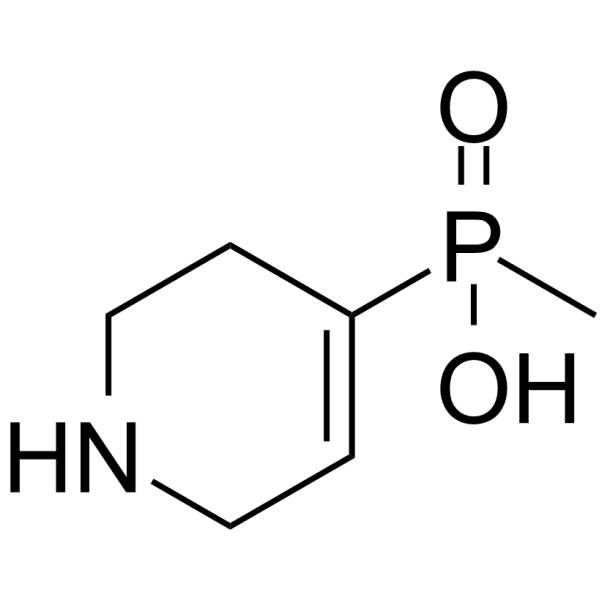
TPMPA, a hybrid of isoguvacine and 3-APMPA, is the first selective antagonist for a GABAC receptor (KB = 2.1 μM), but not to interact with GABAA (KB = 320 μM) or GABAB receptors (EC50 = 500 μM). TPMPA has the potential for the research of suppressing orientation selectivity in ganglion cells [1] .
loading...
    loading...
Cat. No.: HY-W050122
CAS No.: 7013-05-0
Target:  

GABA Receptor

Research Areas:  

Neurological Disease

S-(+)-GABOB is an endogenous ligand with antiepileptic activity. S-(+)-GABOB is a metabolite of GABA and may function as a neurotransmitter. S-(+)-GABOB behaves as a full agonist when bound to the ρ(1) wild-type receptor. S-(+)-GABOB acts as a competitive antagonist in the ρ(1) T244S mutant receptor [1].
loading...
    loading...
Cat. No.: HY-138147
CAS No.: 1001575-98-9
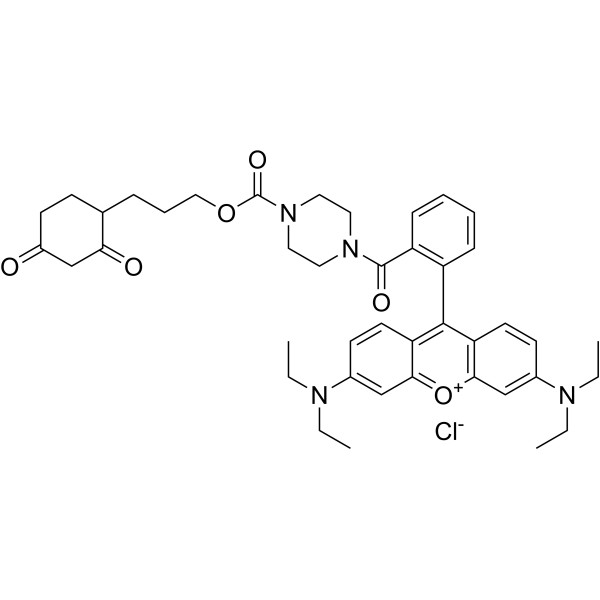
DCP-Rho1 is a rhodamine-labeled probe. DCP-Rho1 can be used for the detection of sulfenic acid-containing proteins. DCP-Rho1 shows λex of 560 nM, λem, 581 nm [1].
loading...
    loading...
Cat. No.: HY-P703132
Purity:  ≥ 95%, as determined by reducing SDS-PAGE.
Synonyms: GABRR1; GABAAR Subunit rho-1; Gamma-Aminobutyric Acid Type A Receptor Subunit rho1; GABA(C) Receptor; Gamma-Aminobutyric Acid (GABA) Receptor, rho 1; BA135P14.1 (Gamma-Aminobutyric Acid (GABA) Receptor, rho 1); Gamma-Aminobutyric Acid Receptor Subunit rho
Species:  
Human
Source:  
HEK293
loading...
    loading...
Cat. No.: HY-129907
CAS No.: 321882-95-5
Synonyms: 2-Aminoethyl methylphosphonate
Target:  

GABA Receptor

Research Areas:  

Neurological Disease

2-AEMP (2-Aminoethyl methylphosphonate) is an anti-GABA(A)-ρ1 receptor compound with antagonist activity. 2-AEMP exhibits competitive inhibition compared to TPMPA with an IC(50) value of 18 μM, compared to 7 μM for TPMPA. The release rate of inhibition at termination of 2-AEMP is significantly higher than that of TPMPA. The preincubation time required for the onset of inhibition of 2-AEMP is much shorter than that of TPMPA. Some analogs of 2-AEMP, especially those with benzyl or n-butyl substituents, show lower potency in terms of biological activity [1].
loading...
    loading...

