
19 Results for "

saliva

" in MedChemExpress (MCE) Product Catalog:
Products (19)

19 Results for "saliva" in MCE Product Catalog:

13
13 Publications Verification
Cat. No.: HY-B0608
CAS No.: 18472-51-0
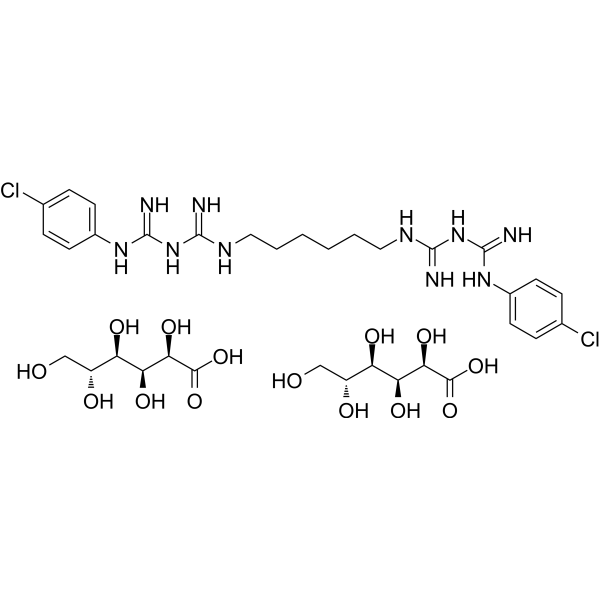
Chlorhexidine digluconate (20% in water) is a orally active cationic antimicrobial agent that targets microbial cell membranes. Chlorhexidine digluconate (20% in water) binds to cell membrane phospholipids non-specifically, destroys membrane structure and induces leakage of cell contents. Chlorhexidine digluconate (20% in water) has broad-spectrum bactericidal activity against both Gram-positive and Gram-negative bacteria. Chlorhexidine digluconate (20% in water) can interfere with membrane permeability, cause protein precipitation and energy metabolism disorders, such as rapid inhibition of microbial growth and induction of cell death (necrosis or apoptosis) .
loading...
    loading...
2
2 Cited Publications
Cat. No.: HY-113228
CAS No.: 320-77-4
Purity:  99.14%
Target:  

Endogenous Metabolite

Research Areas:  

Neurological Disease

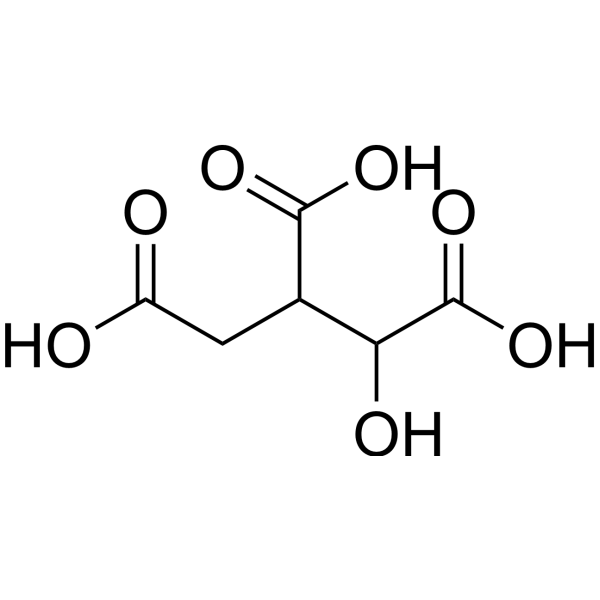
Isocitric acid is an endogenous metabolite present in Saliva and Cellular_Cytoplasm that can be used for the research of Alzheimer's Disease, Lewy Body Dementia and Anoxia .
loading...
    loading...
1
1 Cited Publications
Cat. No.: HY-P0063
CAS No.: 89030-95-5
Synonyms: GHK-Cu
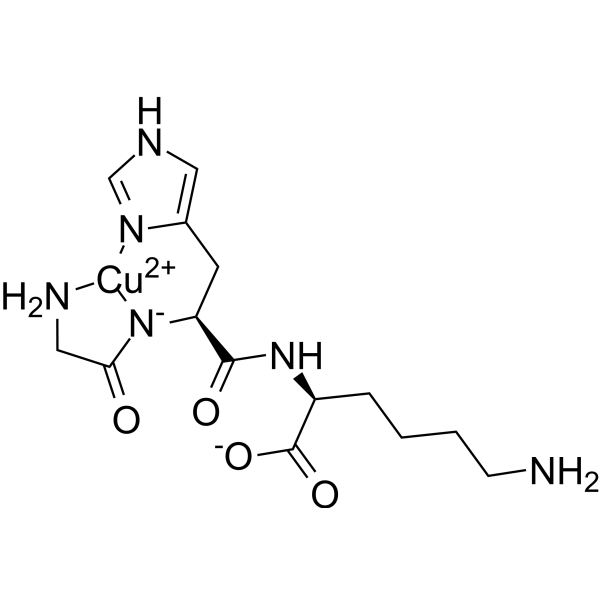
Copper tripeptide (GHK-Cu) is a tripeptide. During wound healing, Copper tripeptide may be freed from existing extracellular proteins via proteolysis and serves as a chemoattractant for inflammatory and endothelial cells. Copper tripeptide has been shown to increase messenger RNA production for collagen, elastin, proteoglycans, and glycosaminoglycans in fibroblasts. Copper tripeptide is a natural modulator of multiple cllular pathways in skin regeneration .
loading...
    loading...
Cat. No.: HY-Y0975
CAS No.: 7775-41-9
Research Areas:  

Others

Silver(I) fluoride is a drug intermediate for synthesis of various active compounds. Silver(I) fluoride is a silver(I) complex that can form hydrates in aqueous solutions and in the solid state, enabling its localized application to the tooth decay area for oral health research .
loading...
    loading...
Cat. No.: HY-B2193A
CAS No.: 9000-90-2
Synonyms: 1,4-alpha-D-Glucan-glucanohydrolase, ptyalin
α-Amylase, Human Saliva (1,4-alpha-D-Glucan-glucanohydrolase) is a hydrolase enzyme that can be isolated from human saliva. α-Amylase, Human Saliva catalyses the hydrolysis of internal α-1, 4-glycosidic linkages in starch to yield products like glucose and maltose. α-Amylase, Human Saliva can be used in life science research .
loading...
    loading...
Cat. No.: HY-113228R
CAS No.: 320-77-4
Isocitric acid (Standard) is the analytical standard of Isocitric acid (HY-113228). This product is intended for research and analytical applications. Isocitric acid is an endogenous metabolite present in Saliva and Cellular_Cytoplasm that can be used for the research of Alzheimer's Disease, Lewy Body Dementia and Anoxia.
loading...
    loading...
Cat. No.: HY-153101
CAS No.: 157381-11-8
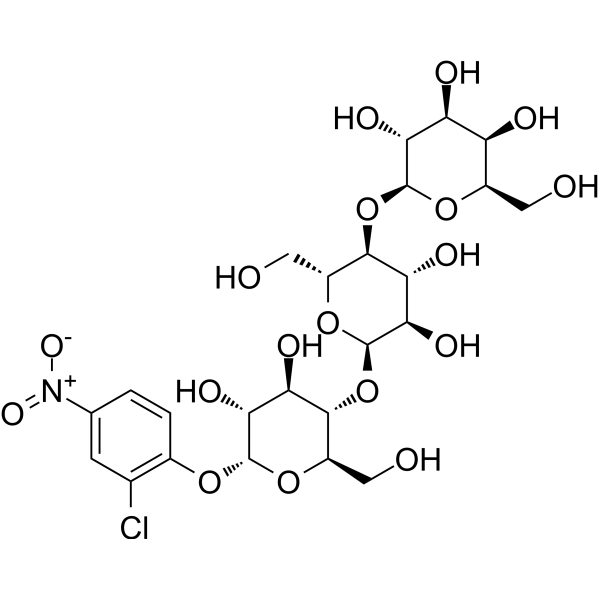
Gal-G2-CNP is a galactopyranosyl maltoside. Gal-G2-CNP is an amylase substrate specific to salivary amylase, which produces a yellow hydrolyzate upon decomposition. Gal-G2-CNP can serve as a matrix for the assays of novel amylases and pancreatic amylases .
loading...
    loading...
Cat. No.: HY-P11170
CAS No.: 3002053-77-9
Target:  

Fungal

Research Areas:  

Infection

D-Cateslytin is an antimicrobial peptide that exhibits potent inhibition activity against Candida albicans (MIC = 2.9 μM). D-Cateslytin can rapidly enter C. albicans, and shows no cytotoxicity to human gingival fibroblasts, and is stable in saliva. D-Cateslytin can be used for research on Candida albicans related diseases, such as oral candidosis .
loading...
    loading...
Cat. No.: HY-NP153
Synonyms: LTL (Biotinylated)
Lotus Tetragonolobus Lectin (LTL) (Biotinylated) is a biotinylated derivative of Lotus Tetragonolobus Lectin (HY-NP070), with both sugar-binding specificity and biotin labeling. Lotus Tetragonolobus Lectin (Biotinylated) is used to detect proteins, glycoproteins and lectins on nitrocellulose membranes .
loading...
    loading...
Cat. No.: HY-P11150
Research Areas:  

Others

Human Histatin 1 is a histidine-rich peptide. Human Histatin 1can be isolated from saliva. Human Histatin 1 promotes cell-substrate and cell-cell adhesion .
loading...
    loading...
Cat. No.: HY-P2365
CAS No.: 127637-03-0
Target:  

Fungal

Research Areas:  

Infection

Histatin-8 is a part of the Histatin-3 central sequence and is known as hemagglutination-inhibiting peptide. Histatin-8 is a potent anti-fungal peptide. Histatin-8 shows antimicrobial activity against yeast strains. Histatin-8 can be used for oral thrush research .
loading...
    loading...
Cat. No.: HY-P0063A
CAS No.: 300801-03-0
Synonyms: GHK-Cu acetate
Research Areas:  

Inflammation/Immunology

Copper tripeptide (GHK-Cu) acetate is a tripeptide. During wound healing, Copper tripeptide acetate may be freed from existing extracellular proteins via proteolysis and serves as a chemoattractant for inflammatory and endothelial cells. Copper tripeptide acetate has been shown to increase messenger RNA production for collagen, elastin, proteoglycans, and glycosaminoglycans in fibroblasts. Copper tripeptide acetate is a natural modulator of multiple cllular pathways in skin regeneration .
loading...
    loading...
Cat. No.: HY-W775325
CAS No.: 50725-17-2
Synonyms: 7-OH-CBD
Target:  

Drug Metabolite

Research Areas:  

Neurological Disease

7-Hydroxycannabidiol (7-OH-CBD) is the metabolite of cannabidiol, which could be found in human serum and saliva .
loading...
    loading...
Cat. No.: HY-W725496
CAS No.: 103213-47-4
D-Fructose 6-phosphate dipotassium is an endogenous metabolite in saliva that affects cell growth and autophagy; it can be hydrolyzed by Fructose-1,6-bisphosphatase (FBPase). D-Fructose 6-phosphate dipotassium can be converted into D-glucose 6-phosphate (HY-112537) by the action of phosphoglucose isomerase. D-Fructose 6-phosphate dipotassium is a sugar intermediate in the glycolysis pathway and the pentose phosphate pathway. D-Fructose 6-phosphate dipotassium can be used to study Lewy body dementia .
loading...
    loading...
Cat. No.: HY-171000
CAS No.: 111071-96-6
Target:  

Endogenous Metabolite

Research Areas:  

Metabolic Disease

Propiverine N-oxide is the main metabolite of hydrochloride propiverine, and it can affect bladder contractions and saliva secretion in small pigs .
loading...
    loading...
Cat. No.: HY-K1065

MCE Exosome Isolation and Purification Kit provides a simple and effective method to isolate and purify intact exosomes from cerebro-spinal fluid, amniotic fluid, milk, saliva, etc, which can be used for electron microscope analysis, NTA analysis, WB, qPCR, etc.

loading...
    loading...
Cat. No.: HY-W644305
CAS No.: 7148-51-8
Synonyms: 3β-Androstenol
Research Areas:  

Neurological Disease

Androst-16-en-3-ol is a pheromone derived from boars that triggers mating responses in estrous sows. It also exists in human urine, plasma, saliva and sweat. As an endogenous neurosteroid, Androst-16-en-3-ol acts as a positive allosteric modulator of GABAA receptors (GABAA receptor) and exerts anxiolytic, antidepressant and anticonvulsant activities in mice.
loading...
    loading...
Cat. No.: HY-N16683
CAS No.: 104594-69-6
Category:  

Flavonols Flavonoids Animals

Target:  

Others

Galangin 5-methyl ether is a potentially active compound that can be naturally extracted from propolis. Propolis is a resinous substance collected by bees from the leaf buds and bark cracks of various trees, enriched with saliva and enzyme secretions. The propolis extract containing Galangin 5-methyl ether has pharmacological activities such as antibacterial, antiviral, and anti-inflammatory effects, and can be used in research related to cold syndromes, skin diseases, and oral inflammation .
loading...
    loading...
Cat. No.: HY-N20632
CAS No.: 942503-47-1
Maltol-3-O-(4'-O-p-coumaroyl-6'-O-(3-hydroxy-3-methylglutaroyl))-β-glucopyranoside is a sortase A inhibitor of Streptococcus mutans, with an IC50 value of 94.3 μM. Maltol-3-O-(4'-O-p-coumaroyl-6'-O-(3-hydroxy-3-methylglutaroyl))-β-glucopyranoside inhibits saliva-induced aggregation of Streptococcus mutans. Maltol-3-O-(4'-O-p-coumaroyl-6'-O-(3-hydroxy-3-methylglutaroyl))-β-glucopyranoside can be used in caries-related research .
loading...
    loading...
  • 1

