12 Results for "

writhing test

" in MedChemExpress (MCE) Product Catalog:
Products (12)

12 Results for "writhing test" in MCE Product Catalog:

1
1 Cited Publications
Cat. No.: HY-N6028
CAS No.: 59219-65-7
Darutoside is an orally effective diterpene compound with significant anti-inflammatory, analgesic, wound healing promotion, and immunomodulatory activities. Darutoside reduces edema and pain responses by inhibiting the expression of COX-2 and the migration of inflammatory cells. It regulates macrophage polarization towards the M2 type by inhibiting the NF-κB pathway, alleviating inflammation and promoting wound healing. Through multi-target regulation of metabolic networks, Darutoside significantly alleviates acute gouty arthritis .
loading...
    loading...
Cat. No.: HY-N8487
CAS No.: 22395-22-8
7-Methoxyflavone is a flavonoid compound that can be isolated from Zornia brasiliensis. 7-Methoxyflavone can bind to human serum albumin and is an aromatase inhibitor. 7-Methoxyflavone has peripheral analgesic and certain antitumor activities. 7-Methoxyflavone is effective against chemical pain but has no significant effect on thermal pain .
loading...
    loading...
Cat. No.: HY-114771
CAS No.: 490-20-0
Purity:  99.93%
Target:  

Drug Intermediate

Research Areas:  

Inflammation/Immunology

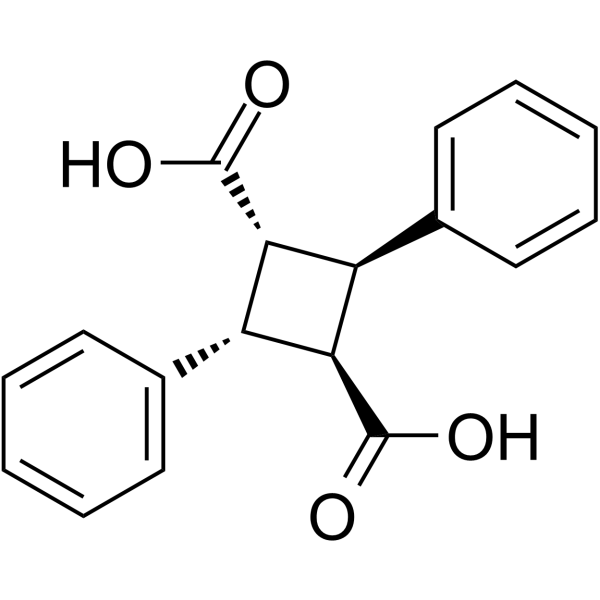
α-Truxillic acid is form by the dimerization of two molecules of α-trans-cinnamic acid, with anti-inflammatory activities. α-Truxillic acid has no analgesic activity, but its derivatives bound to camphor fragments exhibit significant activity in the peripheral analgesic model (writhing test) .
loading...
    loading...
Cat. No.: HY-W275039
CAS No.: 363-03-1
Synonyms: 2-Phenylbenzoquinone
Research Areas:  

Neurological Disease

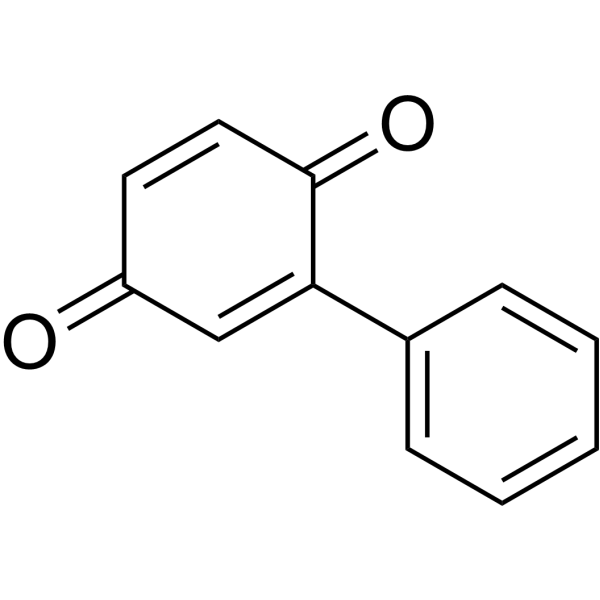
Phenylquinone (2-Phenylbenzoquinone) causes pain and induces writhing in mice, and is often used in experiments to test the effectiveness of analgesics or agent that can suppress or relieve pain .
loading...
    loading...
Cat. No.: HY-119912
CAS No.: 55300-30-6
Synonyms: Stakane dihydrochloride
Target:  

COX

Antrafenine (Stakane) dihydrochloride is a non-narcotic analgesic. Antrafenine dihydrochloride demonstrates central analgesic effects in acetic acid writhing test and mouse hot plate test experiments. Antrafenine dihydrochloride significantly alleviates osteoarthritis pain. Antrafenine dihydrochloride exhibits mild anti-inflammatory activity in a rat toe edema model. Antrafenine dihydrochloride can be used for pain and anti-inflammatory research .
loading...
    loading...
Cat. No.: HY-123452
CAS No.: 83674-78-6
Target:  

Others

Research Areas:  

Neurological Disease

SCH 30497 is a potent and orally active analgesic agent. SCH 30497 exhibits analgesic activity in the rat yeast-induced paw pain model, the mouse acetic acid-induced writhing test, and the squirrel monkey electric shock titration test. SCH 30497 can be used in pain research .
loading...
    loading...
Cat. No.: HY-149270
CAS No.: 3039955-76-2
Target:  

COX

Research Areas:  

Inflammation/Immunology

COX-2-IN-31 (compound 7b) is an orally active and dual inhibitor of COX-2 (IC50=60 nM) and 5-LOX (IC50=1.9 μM). COX-2-IN-31 also inhibits transmembrane hCA IX(Ki=48.9 nM) and hCA XII(Ki=5.8 nM) activity. COX-2-IN-31 exhibits anti-inflammatory and analgesic activity .
loading...
    loading...
Cat. No.: HY-119925
CAS No.: 6831-10-3
Amaralin is a sesquiterpene lactone with analgesic activity, which exists in the leaves and stems of Helenium amarum (Raf.) H. Rock. When administered subcutaneously, Amaralin produces analgesic effects in the mouse tail-flick test. When administered subcutaneously, Amaralin inhibits acetic acid-induced writhing syndrome in mice. Amaralin can be used for pain-related research .
loading...
    loading...
Cat. No.: HY-120938
CAS No.: 289902-71-2
Target:  

TRP Channel

Research Areas:  

Neurological Disease

JYL-273 analog-1 (Compound 28, Example 45) is a potent transient receptor potential ion channel (TRP channel) (TRPV1) agonist (Ki = 10.8 nM). JYL-273 analog-1 has analgesic activity (PBQ-induced writhing test: ED50 = 1.0 mg/kg). JYL-273 analog-1 can be used for analgesia studies .
loading...
    loading...
Cat. No.: HY-N8487R
CAS No.: 22395-22-8
7-Methoxyflavone (Standard) is the analytical standard of 7-Methoxyflavone (HY-N8487). This product is intended for research and analytical applications. 7-Methoxyflavone is a flavonoid compound that can be isolated from Zornia brasiliensis. 7-Methoxyflavone can bind to human serum albumin and is an aromatase inhibitor. 7-Methoxyflavone has peripheral analgesic and certain antitumor activities. 7-Methoxyflavone is effective against chemical pain but has no significant effect on thermal pain .
loading...
    loading...
Cat. No.: HY-N18124
CAS No.: 122688-84-0
1-O-Tigloyl-1-O-debenzoylohchinal is an orally active limonoid-type triterpenoid anti-inflammatory and peripheral analgesic agent isolated from the fruits of Melia toosendan. 1-O-Tigloyl-1-O-debenzoylohchinal significantly inhibits acetic acid (HY-Y0319)-induced increase in vascular permeability, λ-Carrageenan (HY-N9470)-induced paw edema, and acetic acid-induced writhing response in mice. 1-O-Tigloyl-1-O-debenzoylohchinal shows no significant analgesic effect in the hot-plate test, and acts mainly on the peripheral rather than the central nervous system. 1-O-Tigloyl-1-O-debenzoylohchinal can be widely used in the research of acute or chronic inflammation, stomachache and other related diseases .
loading...
    loading...
Cat. No.: HY-183773
Target:  

Opioid Receptor

Research Areas:  

Neurological Disease

KOR agonist-9 is a selective kappa opioid receptor (KOR) agonist with an EC50 of 1.41 nM. KOR agonist-9 exhibits >125-fold selectivity over μ/δ-opioid receptors. KOR agonist-9 antinociceptive and antipruritic effects in mice. KOR agonist-9 can be used for the research of pain, pruritus .
loading...
    loading...
  • 1

