



COX-2-IN-31
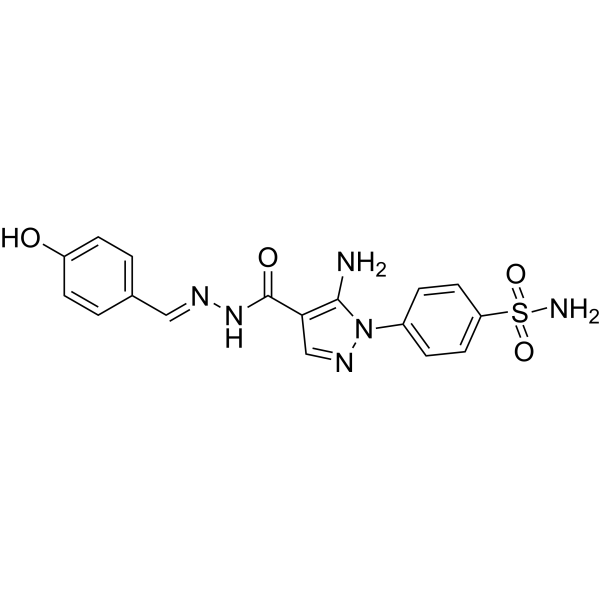
COX-2-IN-31 (compound 7b) is an orally active and dual inhibitor of COX-2 (IC50=60 nM) and 5-LOX (IC50=1.9 μM). COX-2-IN-31 also inhibits transmembrane hCA IX(Ki=48.9 nM) and hCA XII(Ki=5.8 nM) activity. COX-2-IN-31 exhibits anti-inflammatory and analgesic activity.
For research use only. We do not sell to patients.
- CAS No.: 3039955-76-2
- Formula: C17H16N6O4S
- Molecular Weight:400.41
-
Storage:
Please store the product under the recommended conditions in the Certificate of Analysis.

To place orders, for customer services and technical support, please contact: MedChemExpress USA
Tel: 609-228-6898 E-mail: [email protected] [email protected]


-
 Biological Activity
-
Chemical Information
- Protocols
- Purity & Documentation
- References
-
 Help & FAQs




Biological Activity
Description
IC50 & Target
[1]|
COX-1 12.5 μM (IC50) |
COX-2 60 nM (IC50) |
In Vitro
COX-2-IN-31 (compound 7b) potently inhibits hCA IX and XII with Ki values in the nanomolar range(48.9 nM and 5.8 nM) in the Carbonic anhydrase inhibition assay[1].
MedChemExpress (MCE) has not independently confirmed the accuracy of these methods. They are for reference only.
In Vivo
COX-2-IN-31 (10 mg/kg; oral gavage; single dose) results a significant reduction of paw height in Carrageenan (HY-125474)-induced rat paw edema assay[1].
COX-2-IN-31 (10 mg/kg; p.o; single dose) shows safety profile on the gastric tissues in male albino rats[1].
MedChemExpress (MCE) has not independently confirmed the accuracy of these methods. They are for reference only.
-
Animal Model:Acetic acid writhing test in mice[1]
-
Dosage:10 mg/kg
-
Administration:Oral gavage; single dose; 1 h.
-
Result:Decreased the number of writhing responses of mouse conpared with control group.
-
Animal Model:Carrageenan (HY-125474)-induced rat paw edema[1]
-
Dosage:10 mg/kg
-
Administration:Oral gavage:; single dose; 1-3h
-
Result:Decreased the edema volume of mouse conpared with control group.


Chemical Information
-
CAS No. 3039955-76-2
-
Molecular Weight 400.41
-
Formula C17H16N6O4S
-
SMILES
NC1=C(C=NN1C2=CC=C(C=C2)S(N)(=O)=O)C(N/N=C/C3=CC=C(C=C3)O)=O
-
Shipping
Room temperature in continental US; may vary elsewhere.
-
Storage
Please store the product under the recommended conditions in the Certificate of Analysis.


Purity & Documentation
References
[1]. Ragab MA, et al. 4-(5-Amino-pyrazol-1-yl) benzene sulfonamide derivatives as novel multi-target anti-inflammatory agents endowed with inhibitory activity against COX-2, 5-LOX and carbonic anhydrase: Design, synthesis, and biological assessments. Eur J Med Chem. 2023 Mar 15; 250:115180. [Content Brief]

Calculators
Concentration (start) × Volume (start) = Concentration (final) × Volume (final)


COX-2-IN-31 Related Classifications
HY-149270 Related Classifications
 Powered by Bioz