



Spinosad
Based on 4 publication(s) in Google Scholar
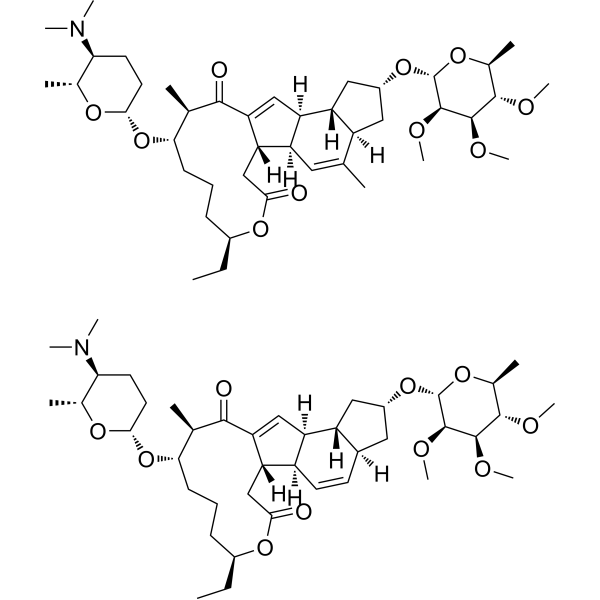
Spinosad, a mixture of spinosyns A and D known as fermentation products of a soil actinomycete (Saccharopolyspora spinosa), is a biological neurotoxic insecticide with a broader action spectrum. Spinosad targets the nicotinic acetylcholine receptor (nAChRs) of the insect nervous system. Spinosad has an excellent environmental and mammalian toxicological profile. Larvicidal activity.
연구목적의 판매만을 진행합니다. 환자를 대상으로 한 판매는 하지 않습니다.
- Purity : 98.02%
- CAS No.: 168316-95-8
- 화학식: C83H132N2O20
- 분자량:1477.94
-
보관:Powder -20°C, 3 years , 4°C, 2 years ; In solvent -80°C, 6 months , -20°C, 1 month

To place orders, for customer services and technical support, please contact: MedChemExpress USA
Tel: 609-228-6898 E-mail: [email protected] [email protected]


-
 Biological Activity
-
Chemical Information
-
용액&용해도
- Protocol
- 순도&문서
- References
-
 Help & FAQs


-
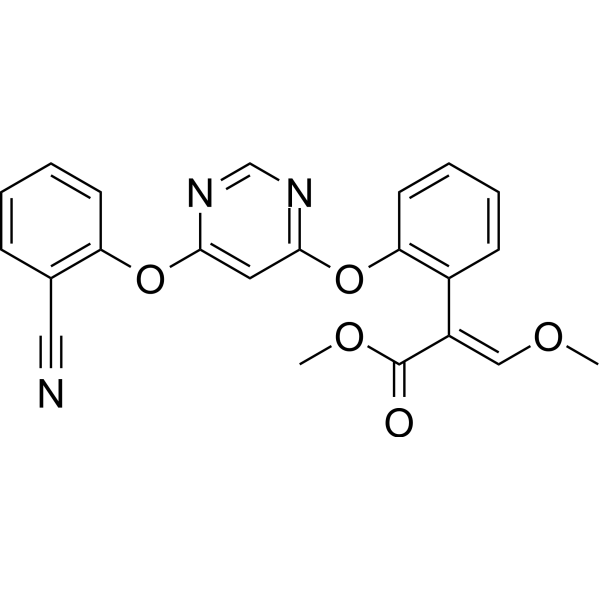
HY-B0849
AzoxystrobinFungicide -
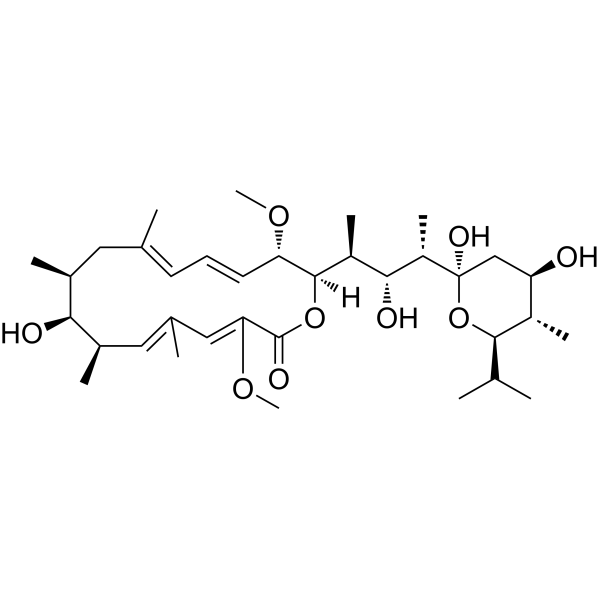
HY-100558
Bafilomycin A1V-ATPase Inhibitor -
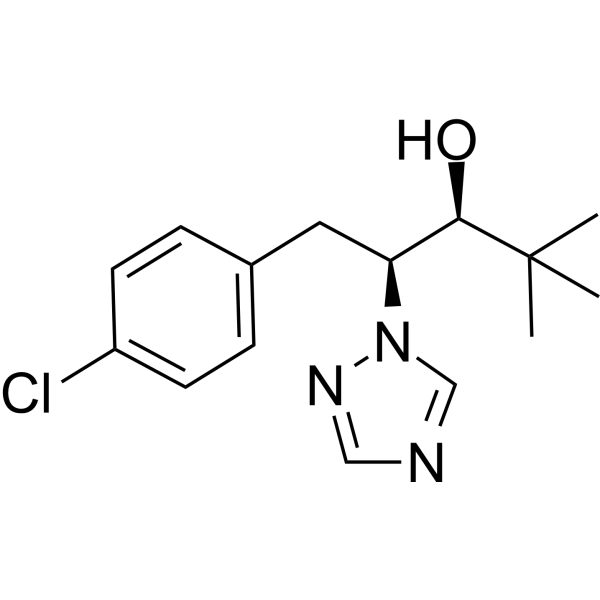
HY-B0853
PaclobutrazolFungal Inhibitor -
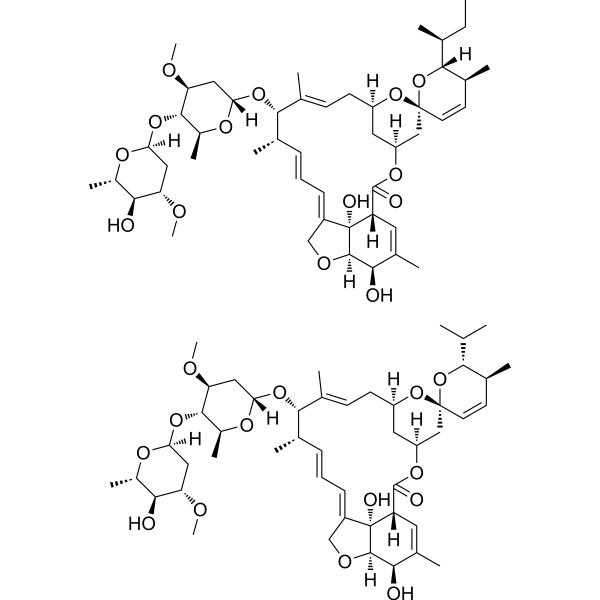
HY-15311
Avermectin B1Anti-infection Agent -
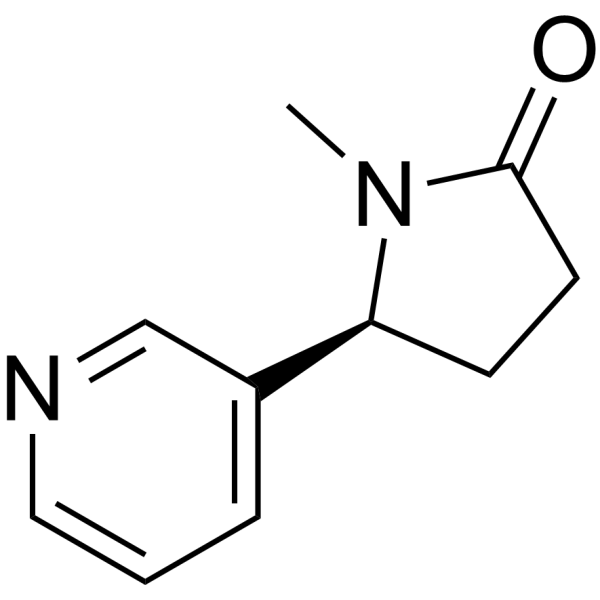
HY-B1178
CotinineEndogenous Metabolite -
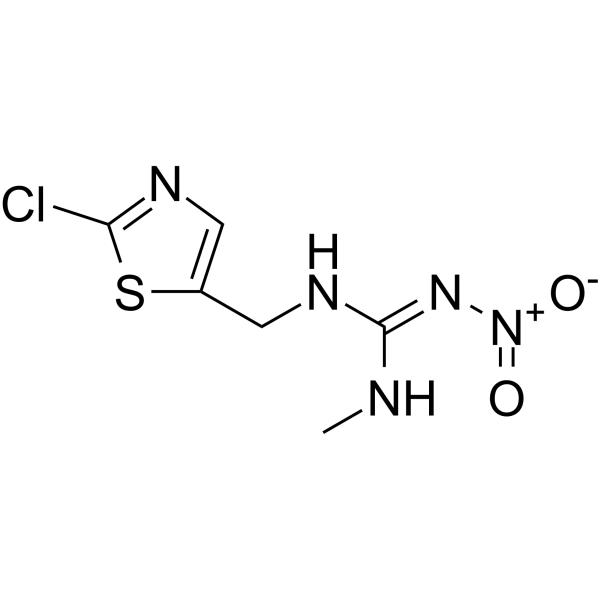
HY-133167
ClothianidinInsecticide -

HY-133167R
Clothianidin (Standard)Insecticide -
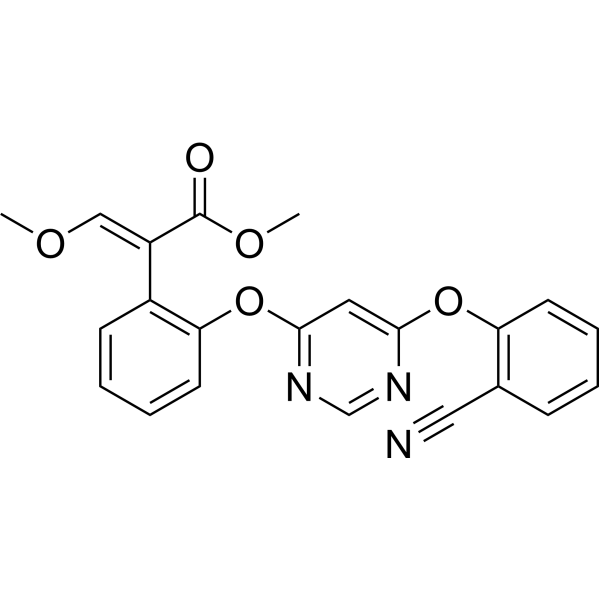
HY-B0849R
Azoxystrobin (Standard)Fungicide -
HY-B0725
Doxepin HydrochlorideAntidepressant -
HY-17583
GriseofulvinAntifungal Antibiotic -
HY-B0725R
Doxepin Hydrochloride (Standard)Reference Standard -

HY-B1178R
Cotinine (Standard)Endogenous Metabolite
Publications Citing Use of MedChemExpress (MCE) Spinosad
More

Biological Activity
제품 설명
In Vitro
Spinosad acts as an allosteric agonist of acetylcholine (Ach) by binding to nicotinicacetylcholine receptors (nAChRs), prototypicalunits that function as neurotransmitter ligand-gated ion channels[4].
MedChemExpress (MCE) has not independently confirmed the accuracy of these methods. They are for reference only.
In Vivo
Spinosad causes in vivo oxidative effects in the brain of Oreochromis niloticus. Spinosad causes elevations in the contents of tGSH, GSH, GSSG, Hsp70, and reductions in the ratio of GSH/GSSG and GPx activity and an induction in the GR (glutathione reducta) activity. Spinosad has oxidative effects in the brain tissue by altering the parameters in GSH-related antioxidant system and Hsp70[6].
MedChemExpress (MCE) has not independently confirmed the accuracy of these methods. They are for reference only.
Clinical Trial
| NCT Number | Sponsor | Condition | Start Date |
Phase

|
|---|---|---|---|---|
| NCT01329991 | 2011-05 | PHASE1 |


Chemical Information
-
CAS No. 168316-95-8
-
Appearance Solid
-
분자량 1477.94
-
화학식 C83H132N2O20
-
Color White to off-white
-
SMILES
CC1=C[C@]2([H])[C@](C=C3[C@@]2([H])CC(O[C@H](CCC[C@@H]([C@H](C3=O)C)O[C@@H]4O[C@@H]([C@H](CC4)N(C)C)C)CC)=O)([H])[C@@]5([H])[C@@]1([H])C[C@H](C5)O[C@H]6[C@@H]([C@@H]([C@H]([C@@H](O6)C)OC)OC)OC.O=C([C@@H]([C@H](CCC[C@@H](O7)CC)O[C@@H]8O[C@@H]([C@H](CC8)N(C)C)C)C)C9=C[C@@]([C@](C=C[C@]%10([H])C%11)([H])[C@]9([H])CC7=O)([H])[C@]%10([H])C[C@@H]%11O[C@H]%12[C@@H]([C@@H]([C@H]([C@@H](O%12)C)OC)OC)OC
-
Structure Classification
-
Initial Source
Saccharopolyspora spinosa
-
선적
Room temperature in continental US; may vary elsewhere.
-
보관
Powder -20°C 3 years 4°C 2 years In solvent -80°C 6 months -20°C 1 month


Publications (4)
-
Journal Impact Factor
-
Most Recent
-
Microb Cell Fact
Enhancement of spinosad production in Saccharopolyspora spinosa by overexpression of the complete 74-kb spinosyn gene cluster. [Abstract]2025 May 8;24(1):102. PMID: 40340747 -
Commun Biol
2024 Jul 3;7(1):808. PMID: 38961219 -
Viruses
Nicotinic Acetylcholine Receptor Alpha6 Contributes to Antiviral Immunity via IMD Pathway in Drosophila melanogaster. [Abstract]2024 Apr 3;16(4):562. PMID: 38675904 -
Biomed Pharmacother
Spinosad blocks CHRNA5 mediated EGFR signaling pathway activation to inhibit lung adenocarcinoma proliferation. [Abstract]2024 Aug:177:117105. PMID: 39002438


용액&용해도
In Vitro:
DMSO : 10 mg/mL (6.77 mM; ultrasonic and warming and heat to 60°C; Hygroscopic DMSO has a significant impact on the solubility of product, please use newly opened DMSO)
Please refer to the solubility information to select the appropriate solvent. Once prepared, please aliquot and store the solution to prevent product inactivation from repeated freeze-thaw cycles.
Storage method and period of stock solution: -80°C, 6 months; -20°C, 1 month. When stored at -80°C, please use it within 6 months. When stored at -20°C, please use it within 1 month.
Please refer to the solubility information to select the appropriate solvent. Once prepared, please aliquot and store the solution to prevent product inactivation from repeated freeze-thaw cycles.
Storage method and period of stock solution: -80°C, 6 months; -20°C, 1 month. When stored at -80°C, please use it within 6 months. When stored at -20°C, please use it within 1 month.
Concentration (start) × Volume (start) = Concentration (final) × Volume (final)
In Vivo:
Select the appropriate dissolution method based on your experimental animal and administration route.
- For the following dissolution methods, please ensure to first prepare a clear stock solution using an In Vitro approach and then sequentially add co-solvents:
- To ensure reliable experimental results, the clarified stock solution can be appropriately stored based on storage conditions. As for the working solution for In Vivo experiments, it is recommended to prepare freshly and use it on the same day.
- The percentages shown for the solvents indicate their volumetric ratio in the final prepared solution. If precipitation or phase separation occurs during preparation, heat and/or sonication can be used to aid dissolution.
Add each solvent one by one: 10% DMSO 40% PEG300 5% Tween-80 45% Saline
Solubility: ≥ 1 mg/mL (0.68 mM); Clear solution
This protocol yields a clear solution of ≥ 1 mg/mL (saturation unknown).
Taking 1 mL working solution as an example, add 100 μL DMSO stock solution (10.0 mg/mL) to 400 μL PEG300, and mix evenly; then add 50 μL Tween-80 and mix evenly; then add 450 μL Saline to adjust the volume to 1 mL.
Preparation of Saline: Dissolve 0.9 g sodium chloride in ddH₂O and dilute to 100 mL to obtain a clear Saline solution.
Add each solvent one by one: 10% DMSO 90% (20% SBE-β-CD in Saline)
Solubility: 1 mg/mL (0.68 mM); Clear solution; Need ultrasonic
This protocol yields a clear solution of 1 mg/mL.
Taking 1 mL working solution as an example, add 100 μL DMSO stock solution (10.0 mg/mL) to 900 μL 20% SBE-β-CD in Saline, and mix evenly.
Preparation of 20% SBE-β-CD in Saline (4°C, storage for one week): 2 g SBE-β-CD powder is dissolved in 10 mL Saline, completely dissolve until clear.
In Vivo Dissolution Calculator
Please enter the basic information of animal experiments:
-
-
-
-
Recommended: Prepare an additional quantity of animals to account for potential losses during experiments.
Please enter your animal formula composition:
-
%DMSO +
Recommended: Keep the proportion of DMSO in working solution below 2% if your animal is weak.
-
%+
-
+%Tween-80 + +
-
%Saline +
The co-solvents required include: DMSO, . All of co-solvents are available by MedChemExpress (MCE). , Tween 80. All of co-solvents are available by MedChemExpress (MCE).
Working solution concentration: 0.22 mg/mL
Method for preparing stock solution: mg drug dissolved in μL DMSO. Stock solution concentration: mg/mL.
1. Take μL DMSO stock solution;
2. Add μL .
μL , mix evenly;
3. Then add μL Tween 80, mix evenly;
4. Then add μL
Please ensure that the stock solution in the first step is dissolved to a clear state, and add co-solvents in sequence. You can use ultrasonic heating (ultrasonic cleaner, recommended frequency 20-40 kHz), vortexing, etc. to assist dissolution.


순도&문서
-
Data Sheet (286 KB)
-
SDS (458 KB)
- English - EN (458 KB)
- Français - FR (458 KB)
- Deutsch - DE (458 KB)
- Norwegian - NO (458 KB)
- Español - ES (458 KB)
- Swedish - SV (458 KB)
- Italian - IT (458 KB)
- Korean - KR (458 KB)
- Portuguese - PT (458 KB)
-
Handling Instructions (2659 KB)
References
[1]. Duchet C, et al. Effects of Bacillus thuringiensis israelensis and spinosad on adult emergence of the non-biting midges Polypedilum nubifer (Skuse) and Tanytarsus curticornis Kieffer (Diptera: Chironomidae) in coastal wetlands. Ecotoxicol Environ Saf. 2015;115:272-278. [Content Brief]
[2]. Wang J, et al. A three amino acid deletion in the transmembrane domain of the nicotinic acetylcholine receptor α6 subunit confers high-level resistance to spinosad in Plutella xylostella. Insect Biochem Mol Biol. 2016;71:29-36. [Content Brief]
[3]. Huang J, et al. High Level of Spinosad Production in the Heterologous Host Saccharopolyspora erythraea. Appl Environ Microbiol. 2016;82(18):5603-5611. Published 2016 Aug 30. [Content Brief]
[4]. McCormack PL. Spinosad: in pediculosis capitis. Am J Clin Dermatol. 2011;12(5):349-353. [Content Brief]
[5]. Santos VSV, et al. Properties, toxicity and current applications of the biolarvicide spinosad. J Toxicol Environ Health B Crit Rev. 2020;23(1):13-26. [Content Brief]
[6]. Piner P, et al. Organic insecticide spinosad causes in vivo oxidative effects in the brain of Oreochromis niloticus. Environ Toxicol. 2014;29(3):253-260. [Content Brief]


Complete Stock Solution Preparation Table
Please refer to the solubility information to select the appropriate solvent. Once prepared, please aliquot and store the solution to prevent product inactivation from repeated freeze-thaw cycles.
Storage method and period of stock solution: -80°C, 6 months; -20°C, 1 month. When stored at -80°C, please use it within 6 months. When stored at -20°C, please use it within 1 month.
| Optional Solvent | Concentration Solvent Mass | 1 mg | 5 mg | 10 mg | 25 mg |
|---|---|---|---|---|---|
| DMSO | 1 mM | 0.6766 mL | 3.3831 mL | 6.7662 mL | 16.9154 mL |
| 5 mM | 0.1353 mL | 0.6766 mL | 1.3532 mL | 3.3831 mL |


Spinosad Related Classifications
HY-138800 Related Classifications
 Powered by Bioz