



Tebipenem pivoxil

Based on 1 Customer Validation
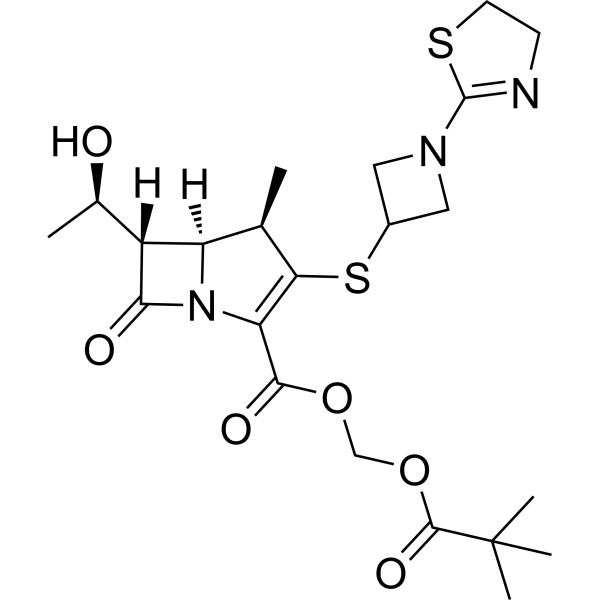
Tebipenem pivoxil (L084 hydrobromide) is an orally active carbapenem Antibiotic. Tebipenem pivoxil acts as a substrate of OATP1A2 with high affinity for this transporter (Km = 41.1 μM). Tebipenem pivoxil achieves intestinal absorption via carrier-mediated uptake and simple diffusion. Tebipenem pivoxil inhibits the growth of Gram-positive bacteria, Gram-negative bacteria, multidrug-resistant bacteria, and pathogens producing extended-spectrum β-lactamases. Tebipenem pivoxil eliminates intestinal infection pathogens and reduces mortality in septic mice. Tebipenem pivoxil can be used in research related to bacterial pneumonia, severe gastrointestinal infections, bacterial sepsis, complicated urinary tract infections, and acute pyelonephritis.
Nur für Forschungszwecke. Wir verkaufen nicht an Patienten.
- Reinheit : 99.68%
- CAS. Nr.: 161715-24-8
- Formel: C22H31N3O6S2
- Molecular Weight:497.63
-
Speicherung:Powder -20°C, 3 years , 4°C, 2 years ; In solvent -80°C, 2 years , -20°C, 1 year

To place orders, for customer services and technical support, please contact: MedChemExpress USA
Tel: 609-228-6898 E-mail: [email protected] [email protected]


-
 Biologische Aktivität
-
Chemical Information
-
Lösungsmittel & Löslichkeit
- Reinheit & Dokumentation
- Verweise
-
 Help & FAQs




Alle Antibiotic Isoform-spezifische Produkte anzeigen
More

Biologische Aktivität
Beschreibung
In Vitro
Tebipenem pivoxil (2.5-1000 μM; 60 min) is a substrate for human OATP1A2 which has high affinity (Km = 41.1 μM), while human OATP2B1 has low affinity for the compound (Km > 1 mM)[1].
Tebipenem pivoxil displays excellent in vitro antibacterial activity against Gram-positive bacterial strains including MSSA, MSSE, and Pyogenic streptococcus (MIC90 ≤0.125 µg/mL), with moderate activity against MRSA (MIC90 16 µg/mL), MRSE (MIC90 8 µg/mL), and Enterococcus faecalis (MIC90 32 µg/mL), and weaker activity against Enterococcus faecium (MIC90 128 µg/mL)[3].
Tebipenem pivoxil (18-24 h) displays strong bactericidal activity against Escherichia coli, Staphylococcus aureus, and Klebsiella pneumoniae, with MBC ranges of 0.016-2 µg/mL, 0.063-32 µg/mL, and 0.031-32 µg/mL respectively, and MBC/MIC ratios of 1-8 for Escherichia coli and 2-8 for Staphylococcus aureus and Klebsiella pneumoniae[3].
MedChemExpress (MCE) has not independently confirmed the accuracy of these methods. They are for reference only.
In Vivo
Tebipenem pivoxil (50 mg/kg; p.o.; two doses at 2 and 16 hours post-infection) delivers a 2.3-log reduction in S. flexneri CFUs in the small intestine of infected B6 mice, showing superior efficacy compared to subcutaneous Tebipenem freebase[2].
Tebipenem pivoxil (50 mg/kg; p.o.; twice daily; 5 days, starting 18 hours post-infection) clears faecal S. flexneri within 24 hours and significantly reduces diarrhoea severity and intestinal pathology in infected gnotobiotic piglets[2].
MedChemExpress (MCE) has not independently confirmed the accuracy of these methods. They are for reference only.
-
Animal Model:B6 (female, 9-10 weeks old, intraperitoneal infection with S. flexneri lux1)[2]
-
Dosage:50 mg/kg
-
Administration:p.o.; two doses at 2 and 16 hours post-infection
-
Result:Achieved a 2.3-log reduction of S. flexneri CFUs in the small intestine compared to untreated controls.
Achieved a comparable 2.3-log reduction of S. flexneri CFUs in the large intestine compared to untreated controls.
Resulted in a significantly lower bacterial load in the small intestine than in mice treated with 39 mg/kg subcutaneous Tebipenem freebase (p < 0.05).
-
Animal Model:Gnotobiotic piglets (24 hours old, oral inoculation with S. flexneri 2457T)[2]
-
Dosage:50 mg/kg
-
Administration:p.o.; twice daily; 5 days, starting 18 hours post-infection
-
Result:Significantly reduced the severity of diarrhoea compared to untreated infected controls.
Reduced faecal S. flexneri CFU/g from 1 × 10⁷ to undetectable levels within 24 hours after a single dose, while untreated animals maintained high bacterial counts.
Markedly reduced intestinal lesions, inflammation, and intracellular Shigella in treated piglets compared to controls.
Clinical Trial
| NCT Number | Sponsor | Condition | Start Date |
Phase

|
|---|---|---|---|---|
| NCT01329991 | Plexxikon| | 2011-05 | PHASE1 |


Chemical Information
-
CAS. Nr. 161715-24-8
-
Appearance Solid
-
Molecular Weight 497.63
-
Formel C22H31N3O6S2
-
Color White to off-white
-
SMILES
O=C(C(N1C2=O)=C(SC3CN(C4=NCCS4)C3)[C@H](C)[C@]1([H])[C@@]2([H])[C@H](O)C)OCOC(C(C)(C)C)=O
-
Synonyms
L084
-
Versand
Room temperature in continental US; may vary elsewhere.
-
Speicherung
Powder -20°C 3 years 4°C 2 years In solvent -80°C 2 years -20°C 1 year


Lösungsmittel & Löslichkeit
In Vitro:
DMSO : 50 mg/mL (100.48 mM; Need ultrasonic; Hygroscopic DMSO has a significant impact on the solubility of product, please use newly opened DMSO)
Please refer to the solubility information to select the appropriate solvent. Once prepared, please aliquot and store the solution to prevent product inactivation from repeated freeze-thaw cycles.
Storage method and period of stock solution: -80°C, 2 years; -20°C, 1 year. When stored at -80°C, please use it within 2 years. When stored at -20°C, please use it within 1 year.
Please refer to the solubility information to select the appropriate solvent. Once prepared, please aliquot and store the solution to prevent product inactivation from repeated freeze-thaw cycles.
Storage method and period of stock solution: -80°C, 2 years; -20°C, 1 year. When stored at -80°C, please use it within 2 years. When stored at -20°C, please use it within 1 year.
Konzentration (Stammlösung) × Volumen (Stammlösung) = Konzentration (Ziellösung) × Volumen (Ziellösung)
In Vivo:
Select the appropriate dissolution method based on your experimental animal and administration route.
- For the following dissolution methods, please ensure to first prepare a clear stock solution using an In Vitro approach and then sequentially add co-solvents:
- To ensure reliable experimental results, the clarified stock solution can be appropriately stored based on storage conditions. As for the working solution for In Vivo experiments, it is recommended to prepare freshly and use it on the same day.
- The percentages shown for the solvents indicate their volumetric ratio in the final prepared solution. If precipitation or phase separation occurs during preparation, heat and/or sonication can be used to aid dissolution.
Add each solvent one by one: 10% DMSO 40% PEG300 5% Tween-80 45% Saline
Solubility: ≥ 5 mg/mL (10.05 mM); Clear solution
This protocol yields a clear solution of ≥ 5 mg/mL (saturation unknown).
Taking 1 mL working solution as an example, add 100 μL DMSO stock solution (50.0 mg/mL) to 400 μL PEG300, and mix evenly; then add 50 μL Tween-80 and mix evenly; then add 450 μL Saline to adjust the volume to 1 mL.
Preparation of Saline: Dissolve 0.9 g sodium chloride in ddH₂O and dilute to 100 mL to obtain a clear Saline solution.
Add each solvent one by one: 10% DMSO 90% (20% SBE-β-CD in Saline)
Solubility: ≥ 5 mg/mL (10.05 mM); Clear solution
This protocol yields a clear solution of ≥ 5 mg/mL (saturation unknown).
Taking 1 mL working solution as an example, add 100 μL DMSO stock solution (50.0 mg/mL) to 900 μL 20% SBE-β-CD in Saline, and mix evenly.
Preparation of 20% SBE-β-CD in Saline (4°C, storage for one week): 2 g SBE-β-CD powder is dissolved in 10 mL Saline, completely dissolve until clear.
In Vivo Dissolution Calculator
Please enter the basic information of animal experiments:
-
-
-
-
Recommended: Prepare an additional quantity of animals to account for potential losses during experiments.
Please enter your animal formula composition:
-
%DMSO +
Recommended: Keep the proportion of DMSO in working solution below 2% if your animal is weak.
-
%+
-
+%Tween-80 + +
-
%Saline +
The co-solvents required include: DMSO, . All of co-solvents are available by MedChemExpress (MCE). , Tween 80. All of co-solvents are available by MedChemExpress (MCE).
Working solution concentration: 0.22 mg/mL
Method for preparing stock solution: mg drug dissolved in μL DMSO. Stock solution concentration: mg/mL.
1. Take μL DMSO stock solution;
2. Add μL .
μL , mix evenly;
3. Then add μL Tween 80, mix evenly;
4. Then add μL
Please ensure that the stock solution in the first step is dissolved to a clear state, and add co-solvents in sequence. You can use ultrasonic heating (ultrasonic cleaner, recommended frequency 20-40 kHz), vortexing, etc. to assist dissolution.


Reinheit & Dokumentation
-
Data Sheet (285 KB)
-
SDS (393 KB)
- English - EN (393 KB)
- Français - FR (393 KB)
- Deutsch - DE (393 KB)
- Norwegian - NO (393 KB)
- Español - ES (393 KB)
- Swedish - SV (393 KB)
- Italian - IT (393 KB)
- Korean - KR (393 KB)
- Portuguese - PT (393 KB)
-
Handling Instructions (2659 KB)
Verweise
[1]. Kato K, et al. Intestinal absorption mechanism of tebipenem pivoxil, a novel oral carbapenem: involvement of human OATP family in apical membrane transport. Molecular pharmaceutics. 2010 Oct 04;7(5):1747-56. [Content Brief]
[2]. Fernández Álvaro E, et al. The repurposing of Tebipenem pivoxil as alternative therapy for severe gastrointestinal infections caused by extensively drug-resistant spp. eLife. 2022 Mar 15;11:e69798. [Content Brief]
[3]. Yao Q, et al. Antibacterial Properties of Tebipenem Pivoxil Tablet, a New Oral Carbapenem Preparation against a Variety of Pathogenic Bacteria in Vitro and in Vivo. Molecules (Basel, Switzerland). 2016 Jan 06;21(1):62. [Content Brief]
[4]. Eckburg PB, et al. Oral Tebipenem Pivoxil Hydrobromide in Complicated Urinary Tract Infection. The New England journal of medicine. 2022 Apr 07;386(14):1327-1338. [Content Brief]


Complete Stock Solution Preparation Table
Please refer to the solubility information to select the appropriate solvent. Once prepared, please aliquot and store the solution to prevent product inactivation from repeated freeze-thaw cycles.
Storage method and period of stock solution: -80°C, 2 years; -20°C, 1 year. When stored at -80°C, please use it within 2 years. When stored at -20°C, please use it within 1 year.
| Optional Solvent | Concentration Solvent Mass | 1 mg | 5 mg | 10 mg | 25 mg |
|---|---|---|---|---|---|
| DMSO | 1 mM | 2.0095 mL | 10.0476 mL | 20.0953 mL | 50.2381 mL |
| 5 mM | 0.4019 mL | 2.0095 mL | 4.0191 mL | 10.0476 mL | |
| 10 mM | 0.2010 mL | 1.0048 mL | 2.0095 mL | 5.0238 mL | |
| 15 mM | 0.1340 mL | 0.6698 mL | 1.3397 mL | 3.3492 mL | |
| 20 mM | 0.1005 mL | 0.5024 mL | 1.0048 mL | 2.5119 mL | |
| 25 mM | 0.0804 mL | 0.4019 mL | 0.8038 mL | 2.0095 mL | |
| 30 mM | 0.0670 mL | 0.3349 mL | 0.6698 mL | 1.6746 mL | |
| 40 mM | 0.0502 mL | 0.2512 mL | 0.5024 mL | 1.2560 mL | |
| 50 mM | 0.0402 mL | 0.2010 mL | 0.4019 mL | 1.0048 mL | |
| 60 mM | 0.0335 mL | 0.1675 mL | 0.3349 mL | 0.8373 mL | |
| 80 mM | 0.0251 mL | 0.1256 mL | 0.2512 mL | 0.6280 mL | |
| 100 mM | 0.0201 mL | 0.1005 mL | 0.2010 mL | 0.5024 mL |


Tebipenem pivoxil Related Classifications
HY-B0396 Related Classifications
 Powered by Bioz