



Wilforgine (Standard)
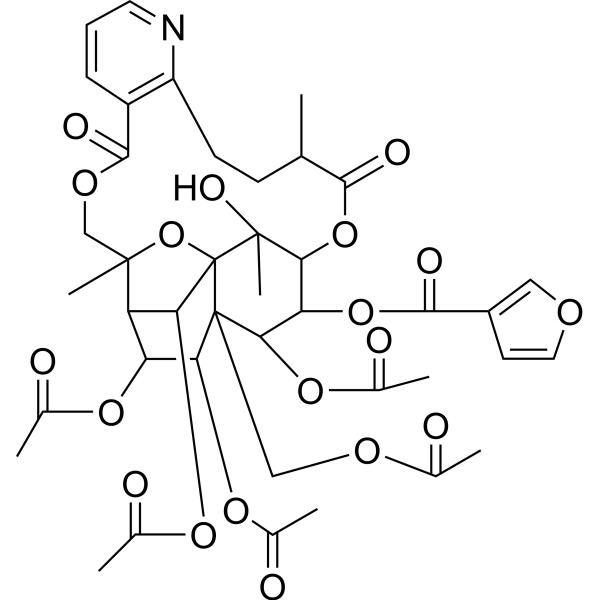
Wilforgine (Standard) is the analytical standard of Wilforgine. This product is intended for research and analytical applications. Wilforgine is a bioactive sesquiterpene alkaloid in Tripterygium wilfordii Hook. F. Wilforgine can induce microstructural and ultrastructural changes in the muscles of Mythimna separata larvae, and the sites of action are proposed to be calcium receptors or channels in the muscular system.
For research use only. We do not sell to patients.
- CAS No.: 37239-47-7
- Formula: C41H47NO19
- Molecular Weight:857.81
-
Storage:
Please store the product under the recommended conditions in the Certificate of Analysis.


To place orders, for customer services and technical support, please contact: MedChemExpress USA
Tel: 609-228-6898 E-mail: [email protected] [email protected]


-
 Product Information
-
Chemical Information
- Purity & Documentation
-
 Help & FAQs




Product Information
Information
Application
The compound is the grade of analytical standard, which is the reference standard supplied assay. It is commonly used in qualitative, quantitative and methodological research experiments in HPLC, GC and MS.


Chemical Information
-
CAS No. 37239-47-7
-
Molecular Weight 857.81
-
Formula C41H47NO19
-
SMILES
O=C(C)OCC(C1OC(C)=O)(C(C(OC(C2=COC=C2)=O)C3OC(C4C)=O)OC(C)=O)C(OC(C)(COC(C(C=CC=N5)=C5CC4)=O)C6C1OC(C)=O)(C3(O)C)C6OC(C)=O
-
Structure Classification
-
Initial Source
-
Shipping
Room temperature in continental US; may vary elsewhere.
-
Storage
Please store the product under the recommended conditions in the Certificate of Analysis.


Purity & Documentation
References
[1]. Ouyang XK, et al. Simultaneous determination of four sesquiterpene alkaloids in Tripterygium wilfordii Hook. F. extracts by high-performance liquid chromatography. Phytochem Anal. 2007 Jul-Aug;18(4):320-5. [Content Brief]
[2]. Ma S, et al. Comparative studies on muscle microstructure and ultrastructure of Mythimna separata Walker treated with wilforgine and chlorantraniliprole. Ecotoxicol Environ Saf. 2018 Jan;147:1023-1034. [Content Brief]
[3]. Gao X, et al. Wilforine, the Q-marker and PK-maker of Tripterygium glycosides tablet: Based on preparation quantitative analysis and PK-PD study. Phytomedicine. 2019 Feb 15;54:357-364. [Content Brief]

Calculators
Concentration (start) × Volume (start) = Concentration (final) × Volume (final)


Wilforgine (Standard) Related Classifications
HY-N1072R Related Classifications
 Powered by Bioz