



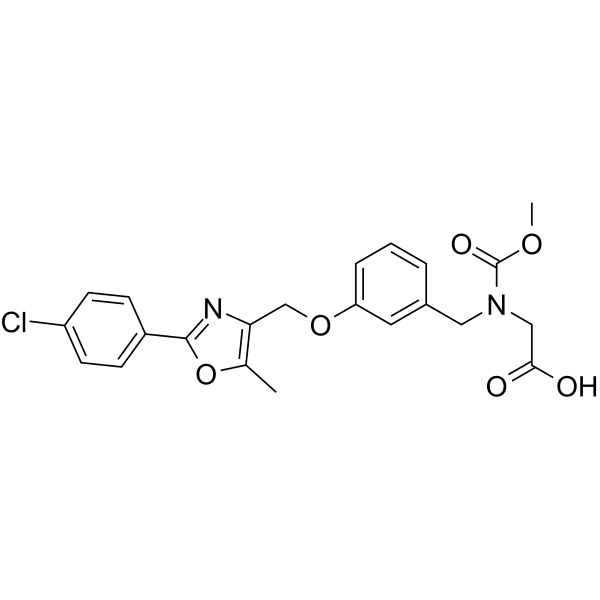
BMS-687453
Based on 3 publication(s) in Google Scholar
BMS-687453 is a potent and selective PPARα agonist, with an EC50 and IC50 of 10 nM and 260 nM for human PPARα and 4100 nM and >15000 nM for PPARγ in PPAR-GAL4 transactivation assays.
For research use only. We do not sell to patients.
- Purity : 99.31%
- CAS No.: 1000998-59-3
- Formula: C22H21ClN2O6
- Molecular Weight:444.86
-
Storage:Powder -20°C, 3 years , 4°C, 2 years ; In solvent -80°C, 2 years , -20°C, 1 year

To place orders, for customer services and technical support, please contact: MedChemExpress USA
Tel: 609-228-6898 E-mail: [email protected] [email protected]


-
 Biological Activity
-
Chemical Information
-
Solvent & Solubility
- Purity & Documentation
- References
-
 Help & FAQs


-
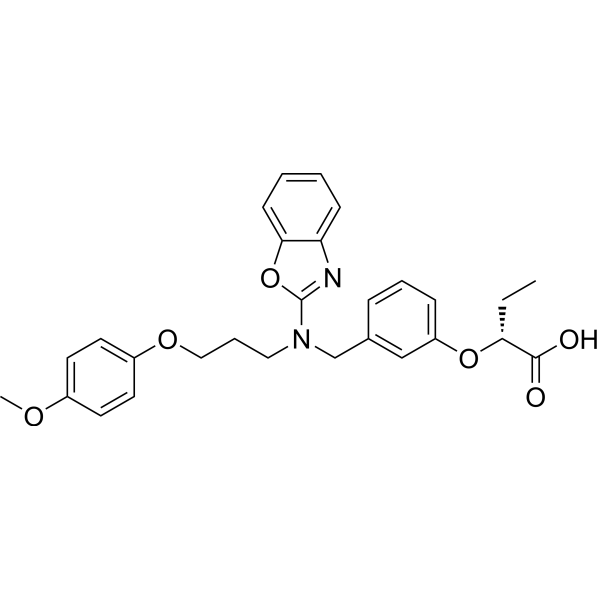
HY-17618
PemafibratePPARα Agonist -
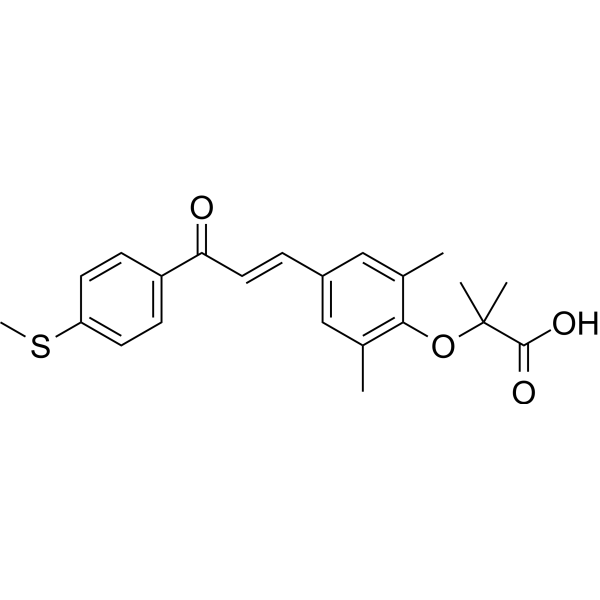
HY-16737
ElafibranorPPARα/δ Agonist -
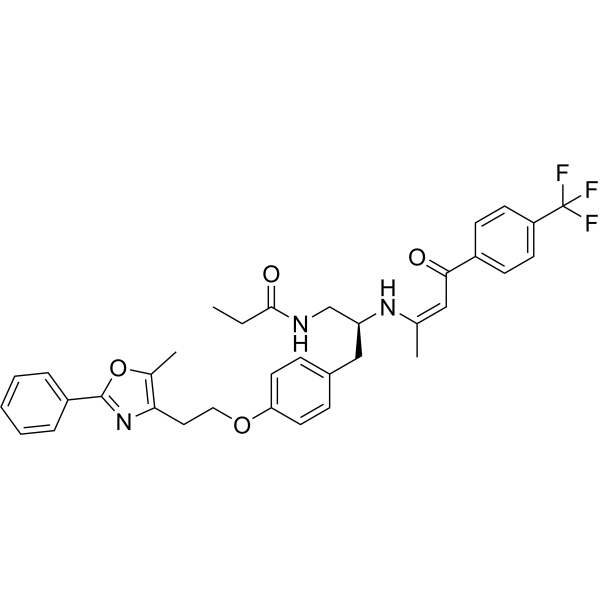
HY-15372
GW6471PPARα Antagonist -
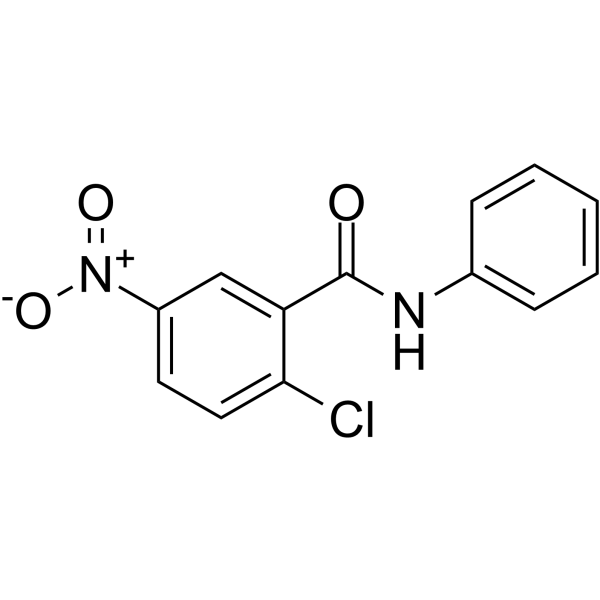
HY-16578
GW9662PPARγ Antagonist -
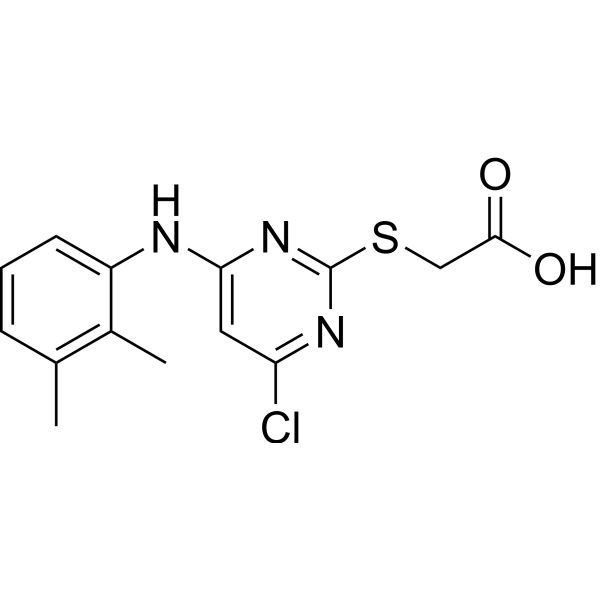
HY-16995
Pirinixic acidPPAR Agonist -
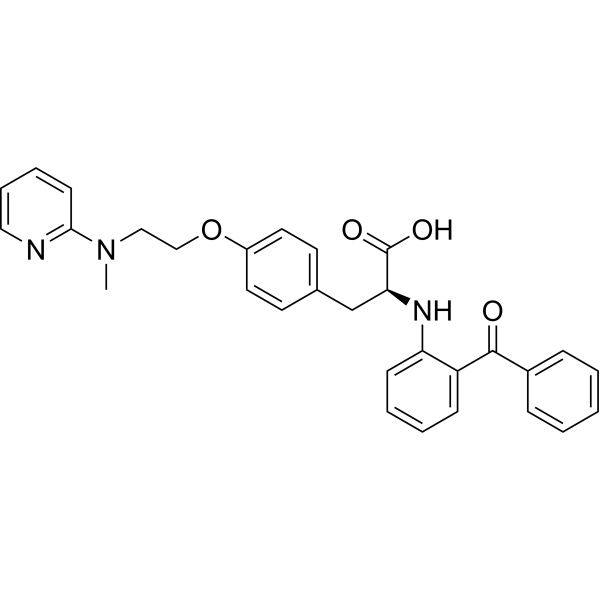
HY-15655
GW1929PPARγ Agonist -
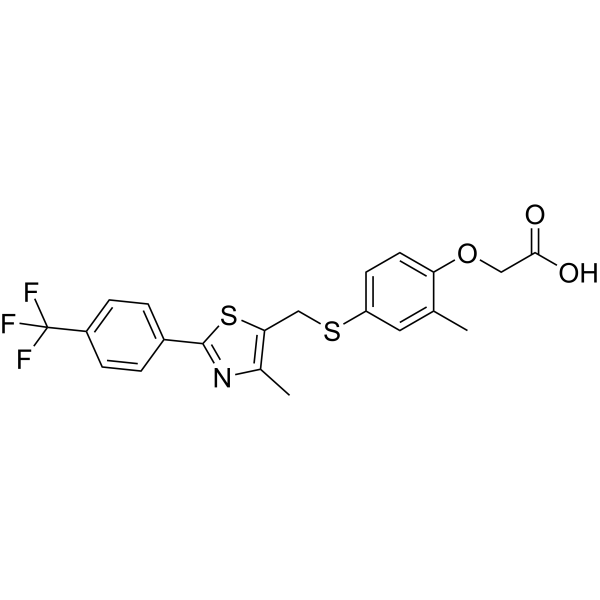
HY-10838
GW 501516PPARδ Agonist -
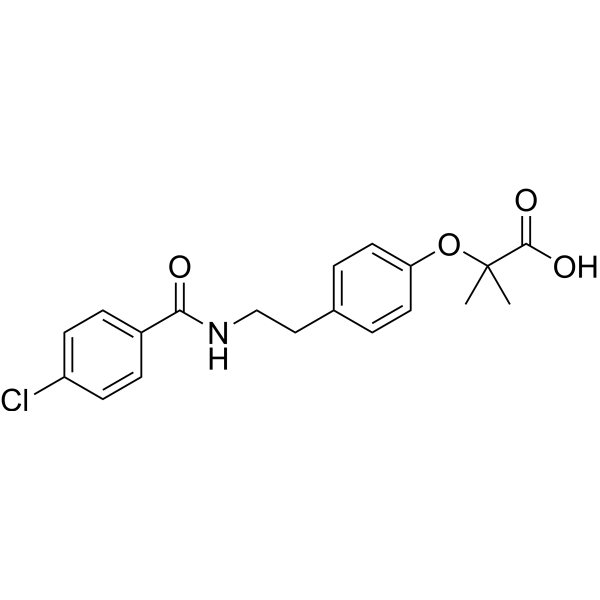
HY-B0637
BezafibratePPAR Agonist -
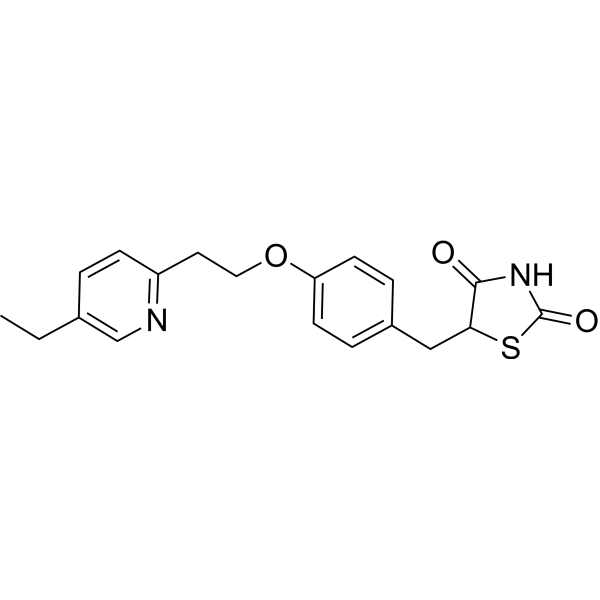
HY-13956
PioglitazonePPARγ Agonist -
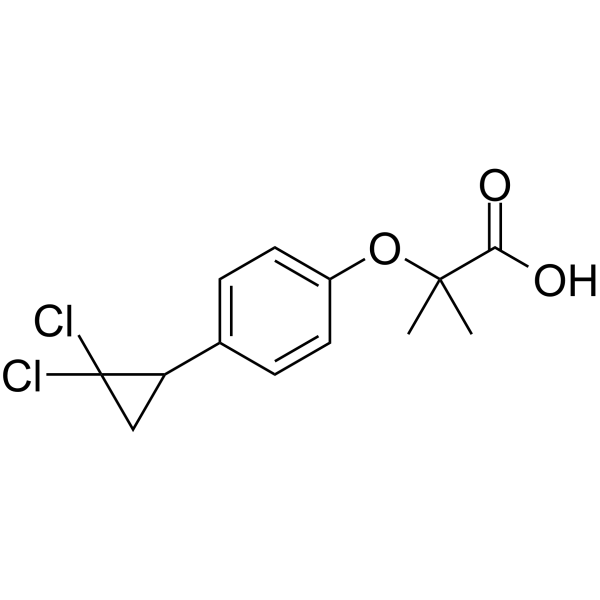
HY-B0664
CiprofibratePeroxisome Proliferator -
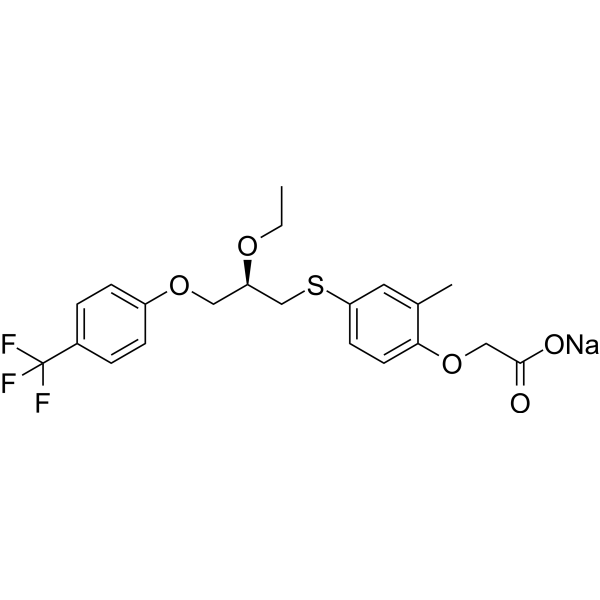
HY-19522A
Seladelpar sodiumPPARδ Agonist -
HY-13861
GW7647PPAR Agonist
Publications Citing Use of MedChemExpress (MCE) BMS-687453
More

Biological Activity
Description
IC50 & Target
|
PPARα 260 nM (IC50, Human PPARα) |
Cellular Effect
|
Cell Line

|
Type | Value | Description | References |
|---|---|---|---|---|
| HEK293 | EC50 |
10 nM
Compound: 2, BMS-687453
|
Agonist activity at human PPARalpha LBD (167-468) expressed in HEK293 cells coexpressing GAL4-DBD by transactivation assay
Agonist activity at human PPARalpha LBD (167-468) expressed in HEK293 cells coexpressing GAL4-DBD by transactivation assay
|
[PMID: 20218621] |
| HEK293 | EC50 |
4017 nM
Compound: 1
|
Agonist activity against human Gal4-fussed PPARgamma in HEK293 cells by luciferase reporter gene assay
Agonist activity against human Gal4-fussed PPARgamma in HEK293 cells by luciferase reporter gene assay
|
[PMID: 20356736] |
| HEK293 | EC50 |
4100 nM
Compound: 2, BMS-687453
|
Agonist activity at human PPARgamma LBD (176-477) expressed in HEK293 cells coexpressing GAL4-DBD by transactivation assay
Agonist activity at human PPARgamma LBD (176-477) expressed in HEK293 cells coexpressing GAL4-DBD by transactivation assay
|
[PMID: 20218621] |
| HEK293 | EC50 |
426 nM
Compound: 2, BMS-687453
|
Agonist activity at mouse PPARalpha LBD (167-469) expressed in HEK293 cells coexpressing GAL4-DBD by transactivation assay
Agonist activity at mouse PPARalpha LBD (167-469) expressed in HEK293 cells coexpressing GAL4-DBD by transactivation assay
|
[PMID: 20218621] |
| HEK293 | EC50 |
488 nM
Compound: 2, BMS-687453
|
Agonist activity at syrian golden hamster PPARalpha LBD (167-468) expressed in HEK293 cells coexpressing GAL4-DBD by transactivation assay
Agonist activity at syrian golden hamster PPARalpha LBD (167-468) expressed in HEK293 cells coexpressing GAL4-DBD by transactivation assay
|
[PMID: 20218621] |
| HEK293 | EC50 |
9.6 nM
Compound: 1
|
Agonist activity against human Gal4-fussed PPARalpha in HEK293 cells by luciferase reporter gene assay
Agonist activity against human Gal4-fussed PPARalpha in HEK293 cells by luciferase reporter gene assay
|
[PMID: 20356736] |
| HepG2 | EC50 |
2400 nM
Compound: 2, BMS-687453
|
Agonist activity at full length human PPARgamma expressed in HepG2 cells co-transfected with pBL-tk-luciferase by luciferase reporter gene assay
Agonist activity at full length human PPARgamma expressed in HepG2 cells co-transfected with pBL-tk-luciferase by luciferase reporter gene assay
|
[PMID: 20218621] |
| HepG2 | EC50 |
47 nM
Compound: 2, BMS-687453
|
Agonist activity at full length human PPARalpha expressed in HepG2 cells co-transfected with pBL-tk-luciferase by luciferase reporter gene assay
Agonist activity at full length human PPARalpha expressed in HepG2 cells co-transfected with pBL-tk-luciferase by luciferase reporter gene assay
|
[PMID: 20218621] |
In Vitro
BMS-687453 is a potent and selective PPARα agonist, with an EC50 and IC50 of 10 nM and 260 nM for human PPARα and ∼410-fold and more than 57-fold selectivity vs human PPARγ of 4100 nM and >15000 nM in PPAR-GAL4 transactivation assays. BMS-687453 exhibits high PPARα potency (EC50 = 47 nM) with ∼50-fold selectivity vs PPARγ (EC50 = 2400 nM) in HepG2 cells. However, BMS-687453 shows less potent activities in rodent PPARα functional assays, with a moderate EC50 of 426 nM for mouse and 488 nM for hamster but remains a full PPARα agonist in both species[1].
MedChemExpress (MCE) has not independently confirmed the accuracy of these methods. They are for reference only. .
In Vivo
MedChemExpress (MCE) has not independently confirmed the accuracy of these methods. They are for reference only.


Chemical Information
-
CAS No. 1000998-59-3
-
Appearance Solid
-
Molecular Weight 444.86
-
Formula C22H21ClN2O6
-
Color White to off-white
-
SMILES
ClC(C=C1)=CC=C1C2=NC(COC3=CC=CC(CN(C(OC)=O)CC(O)=O)=C3)=C(C)O2
-
Shipping
Room temperature in continental US; may vary elsewhere.
-
Storage
Powder -20°C 3 years 4°C 2 years In solvent -80°C 2 years -20°C 1 year


Publications (3)
-
Journal Impact Factor
-
Most Recent
-
Nat Commun
Modulating the PPARγ pathway upregulates NECTIN4 and enhances chimeric antigen receptor (CAR) T cell therapy in bladder cancer. [Abstract]2025 Sep 10;16(1):8215. PMID: 40931013 -
Cell Rep
Exosomal miR-27b-3p secreted by visceral adipocytes contributes to endothelial inflammation and atherogenesis. [Abstract]2023 Jan 31;42(1):111948. PMID: 36640325 -


Solvent & Solubility
In Vitro:
DMSO : ≥ 100 mg/mL (224.79 mM; Hygroscopic DMSO has a significant impact on the solubility of product, please use newly opened DMSO)
* "≥" means soluble, but saturation unknown.
Please refer to the solubility information to select the appropriate solvent. Once prepared, please aliquot and store the solution to prevent product inactivation from repeated freeze-thaw cycles.
Storage method and period of stock solution: -80°C, 2 years; -20°C, 1 year. When stored at -80°C, please use it within 2 years. When stored at -20°C, please use it within 1 year.
Please refer to the solubility information to select the appropriate solvent. Once prepared, please aliquot and store the solution to prevent product inactivation from repeated freeze-thaw cycles.
Storage method and period of stock solution: -80°C, 2 years; -20°C, 1 year. When stored at -80°C, please use it within 2 years. When stored at -20°C, please use it within 1 year.
Concentration (start) × Volume (start) = Concentration (final) × Volume (final)
In Vivo:
Select the appropriate dissolution method based on your experimental animal and administration route.
- For the following dissolution methods, please ensure to first prepare a clear stock solution using an In Vitro approach and then sequentially add co-solvents:
- To ensure reliable experimental results, the clarified stock solution can be appropriately stored based on storage conditions. As for the working solution for In Vivo experiments, it is recommended to prepare freshly and use it on the same day.
- The percentages shown for the solvents indicate their volumetric ratio in the final prepared solution. If precipitation or phase separation occurs during preparation, heat and/or sonication can be used to aid dissolution.
Add each solvent one by one: 10% DMSO 40% PEG300 5% Tween-80 45% Saline
Solubility: ≥ 2.5 mg/mL (5.62 mM); Clear solution
This protocol yields a clear solution of ≥ 2.5 mg/mL (saturation unknown).
Taking 1 mL working solution as an example, add 100 μL DMSO stock solution (25.0 mg/mL) to 400 μL PEG300, and mix evenly; then add 50 μL Tween-80 and mix evenly; then add 450 μL Saline to adjust the volume to 1 mL.
Preparation of Saline: Dissolve 0.9 g sodium chloride in ddH₂O and dilute to 100 mL to obtain a clear Saline solution.
Add each solvent one by one: 10% DMSO 90% (20% SBE-β-CD in Saline)
Solubility: 2.5 mg/mL (5.62 mM); Suspended solution; Need ultrasonic
This protocol yields a suspended solution of 2.5 mg/mL. Suspended solution can be used for oral and intraperitoneal injection.
Taking 1 mL working solution as an example, add 100 μL DMSO stock solution (25.0 mg/mL) to 900 μL 20% SBE-β-CD in Saline, and mix evenly.
Preparation of 20% SBE-β-CD in Saline (4°C, storage for one week): 2 g SBE-β-CD powder is dissolved in 10 mL Saline, completely dissolve until clear.
In Vivo Dissolution Calculator
Please enter the basic information of animal experiments:
-
-
-
-
Recommended: Prepare an additional quantity of animals to account for potential losses during experiments.
Please enter your animal formula composition:
-
%DMSO +
Recommended: Keep the proportion of DMSO in working solution below 2% if your animal is weak.
-
%+
-
+%Tween-80 + +
-
%Saline +
The co-solvents required include: DMSO, . All of co-solvents are available by MedChemExpress (MCE). , Tween 80. All of co-solvents are available by MedChemExpress (MCE).
Working solution concentration: 0.22 mg/mL
Method for preparing stock solution: mg drug dissolved in μL DMSO. Stock solution concentration: mg/mL.
1. Take μL DMSO stock solution;
2. Add μL .
μL , mix evenly;
3. Then add μL Tween 80, mix evenly;
4. Then add μL
Please ensure that the stock solution in the first step is dissolved to a clear state, and add co-solvents in sequence. You can use ultrasonic heating (ultrasonic cleaner, recommended frequency 20-40 kHz), vortexing, etc. to assist dissolution.


Purity & Documentation
-
Data Sheet (279 KB)
-
SDS (393 KB)
- English - EN (393 KB)
- Français - FR (393 KB)
- Deutsch - DE (393 KB)
- Norwegian - NO (393 KB)
- Español - ES (393 KB)
- Swedish - SV (393 KB)
- Italian - IT (393 KB)
- Korean - KR (393 KB)
- Portuguese - PT (393 KB)
-
Handling Instructions (2659 KB)
References
[1]. Li J, et al. Discovery of an oxybenzylglycine based peroxisome proliferator activated receptor alpha selective agonist 2-((3-((2-(4-chlorophenyl)-5-methyloxazol-4-yl)methoxy)benzyl)(methoxycarbonyl)amino)acetic acid (BMS-687453). J Med Chem. 2010 Apr 8;53 [Content Brief]
[2]. Mukherjee R, et al. Novel peroxisome proliferator-activated receptor alpha agonists lower low-density lipoprotein and triglycerides, raise high-density lipoprotein, and synergistically increase cholesterol excretion with a liver X receptor agonist. J Phar [Content Brief]
[3]. Vassallo JD, et al. Biomarkers of drug-induced skeletal muscle injury in the rat: troponin I and myoglobin. Toxicol Sci. 2009 Oct;111(2):402-12. [Content Brief]


Complete Stock Solution Preparation Table
Please refer to the solubility information to select the appropriate solvent. Once prepared, please aliquot and store the solution to prevent product inactivation from repeated freeze-thaw cycles.
Storage method and period of stock solution: -80°C, 2 years; -20°C, 1 year. When stored at -80°C, please use it within 2 years. When stored at -20°C, please use it within 1 year.
| Optional Solvent | Concentration Solvent Mass | 1 mg | 5 mg | 10 mg | 25 mg |
|---|---|---|---|---|---|
| DMSO | 1 mM | 2.2479 mL | 11.2395 mL | 22.4790 mL | 56.1975 mL |
| 5 mM | 0.4496 mL | 2.2479 mL | 4.4958 mL | 11.2395 mL | |
| 10 mM | 0.2248 mL | 1.1239 mL | 2.2479 mL | 5.6197 mL | |
| 15 mM | 0.1499 mL | 0.7493 mL | 1.4986 mL | 3.7465 mL | |
| 20 mM | 0.1124 mL | 0.5620 mL | 1.1239 mL | 2.8099 mL | |
| 25 mM | 0.0899 mL | 0.4496 mL | 0.8992 mL | 2.2479 mL | |
| 30 mM | 0.0749 mL | 0.3746 mL | 0.7493 mL | 1.8732 mL | |
| 40 mM | 0.0562 mL | 0.2810 mL | 0.5620 mL | 1.4049 mL | |
| 50 mM | 0.0450 mL | 0.2248 mL | 0.4496 mL | 1.1239 mL | |
| 60 mM | 0.0375 mL | 0.1873 mL | 0.3746 mL | 0.9366 mL | |
| 80 mM | 0.0281 mL | 0.1405 mL | 0.2810 mL | 0.7025 mL | |
| 100 mM | 0.0225 mL | 0.1124 mL | 0.2248 mL | 0.5620 mL |


BMS-687453 Related Classifications
HY-10678 Related Classifications
 Powered by Bioz