



Cefamandole
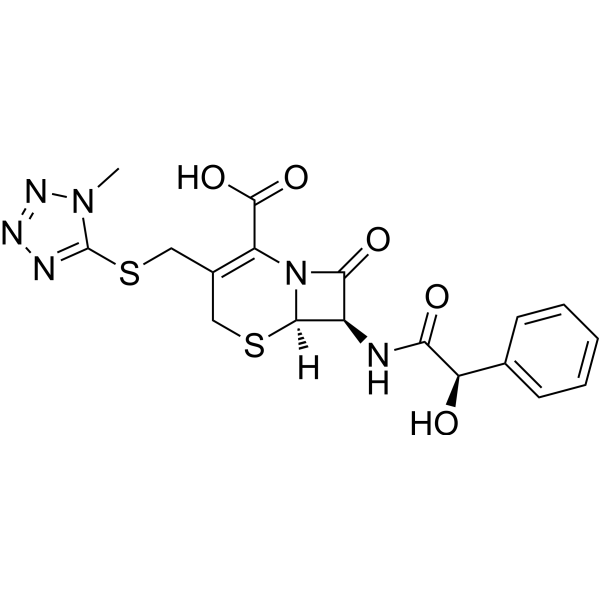
Cefamandole (Cephamandole) is a semi-synthetic second-generation cephalosporin antibiotic with broad-spectrum antimicrobial activity. Cefamandole is resistant to hydrolysis by β-lactamases produced by some Gram-negative bacteria. Cefamandole kills Gram-positive cocci and various Gram-negative bacilli mainly by inhibiting cell wall synthesis, but it is inactive against Pseudomonas, Proteus vulgaris and Providencia stuartii, and its efficacy is affected by inoculum size. The plasma elimination half-life of Cefamandole in rats is only 0.4 h, it is mainly excreted in urine in biologically active form, and it hardly penetrates the non-inflamed blood-brain barrier. Cefamandole is widely used in studies related to bacterial infections.
For research use only. We do not sell to patients.
- CAS No.: 34444-01-4
- Formula: C18H18N6O5S2
- Molecular Weight:462.50
-
Storage:
Please store the product under the recommended conditions in the Certificate of Analysis.

To place orders, for customer services and technical support, please contact: MedChemExpress USA
Tel: 609-228-6898 E-mail: [email protected] [email protected]


-
 Biological Activity
-
Chemical Information
- Protocols
- Purity & Documentation
- References
-
 Help & FAQs


All Antibiotic Isoforms
More

Biological Activity
Description
IC50 & Target
|
β-lactam |
Cellular Effect
|
Cell Line

|
Type | Value | Description | References |
|---|---|---|---|---|
| S2 | IC50 |
450 μM
Compound: Cefamandole
|
TP_TRANSPORTER: inhibition of PAH uptake in OAT1-expressing S2 cells
TP_TRANSPORTER: inhibition of PAH uptake in OAT1-expressing S2 cells
|
[PMID: 12005172] |
| S2 | IC50 |
90 μM
Compound: Cefamandole
|
TP_TRANSPORTER: inhibition of Estrone sulfate uptake in OAT3-expressing S2 cells
TP_TRANSPORTER: inhibition of Estrone sulfate uptake in OAT3-expressing S2 cells
|
[PMID: 12005172] |
In Vitro
Cefamandole (30 μg/mL; 0, 1, 3, 6, 12 h) is hydrolyzed by beta-lactamases from Enterobacter cloacae, Serratia marcescens, and Proteus morganii, allowing bacterial growth to resume after hydrolysis is complete, while Pseudomonas aeruginosa grows despite cefamandole presence prior to hydrolysis[1].
Cefamandole (sodium) (0.12-64 μg/mL; 18 h) inhibits 90-100% of methicillin-susceptible S. aureus, group A and B streptococci, S. pneumoniae, N. gonorrhoeae, H. influenzae, and S. typhosa[3].
MedChemExpress (MCE) has not independently confirmed the accuracy of these methods. They are for reference only.
-
Cell Line:Methicillin-susceptible S. aureus, group A and B streptococci, S. pneumoniae, N. gonorrhoeae, H. influenzae, and S. typhosa
-
Concentration:0.12, 0.25, 0.5, 1, 2, 4, 8, 16, 32, 16 μg/mL
-
Incubation Time:18 h
-
Result:Inhibited 90-100% of methicillin-susceptible S. aureus, group A and B streptococci, S. pneumoniae, N. gonorrhoeae, H. influenzae, and S. typhosa at concentrations of 2 μg/mL or less, with variable activity against gram-negative rods including 70% of E. coli inhibited at 4 μg/mL and 80% of B. fragilis subsp. fragilis inhibited at 32 μg/mL.
In Vivo
Cefamandole (50 mg/kg; intravenous administration; single dose) exhibits free drug pharmacokinetic characteristics consistent with a two-compartment model in male Sprague-Dawley rats, with an elimination half-life of 21.6 min[5].
MedChemExpress (MCE) has not independently confirmed the accuracy of these methods. They are for reference only.
-
Animal Model:Sprague-Dawley (male, adult, 280-350 g, specific pathogen-free)[5]
-
Dosage:50 mg/kg
-
Administration:i.v.; single dose
-
Result:Achieved an in vivo microdialysis recovery of 55.44% (n=6) at an infusion concentration of 1 μg/mL.
Fitted a two-compartment pharmacokinetic model with parameters: A = 148.4 ± 34.3 μg/mL, B = 16.9 ± 4.2 μg/mL, α = 0.11 ± 0.01 1/min, β = 0.033 ± 0.003 1/min, distribution half-life (t1/2,α) = 6.4 ± 0.5 min, elimination half-life (t1/2,β) = 21.6 ± 1.6 min, AUC = 1799.4 ± 254.7 μg min/mL, volume of distribution (Vd) = 372.2 ± 87.4 mL, clearance (Cl) = 30.5 ± 5.0 mL/min/kg, mean residence time (MRT) = 15.4 ± 1.1 min (n=5).


Chemical Information
-
CAS No. 34444-01-4
-
Molecular Weight 462.50
-
Formula C18H18N6O5S2
-
SMILES
O=C(C(N12)=C(CSC3=NN=NN3C)CS[C@]2([H])[C@H](NC([C@H](O)C4=CC=CC=C4)=O)C1=O)O
-
Synonyms
Cephamandole
-
Shipping
Room temperature in continental US; may vary elsewhere.
-
Storage
Please store the product under the recommended conditions in the Certificate of Analysis.


Purity & Documentation
References
[1]. Neu HC, et al. Cefamandole, a cephalosporin antibiotic with an unusually wide spectrum of activity. Antimicrob Agents Chemother. 1974;6(2):177-182. [Content Brief]
[2]. Eykyn S, et al. Antibacterial activity of cefamandole, a new cephalosporin antibiotic, compared with that of cephaloridine, cephalothin, and cephalexin. Antimicrob Agents Chemother. 1973;3(6):657-661. [Content Brief]
[3]. Griffith RS, et al. Cefamandole: in vitro and clinical pharmacokinetics. Antimicrob Agents Chemother. 1976;10(5):814-823. [Content Brief]
[4]. Lee FH, et al. Comparative tissue distribution of ceforanide, cefazolin, and cefamandole in rats. Antimicrob Agents Chemother. 1981;19(4):625-627. [Content Brief]
[5]. Yeh PH, et al. Determination of unbound cefamandole in rat blood by microdialysis and microbore liquid chromatography. Biomed Chromatogr. 2001;15(1):14-17. [Content Brief]

Calculators
Concentration (start) × Volume (start) = Concentration (final) × Volume (final)


Cefamandole Related Classifications
HY-B1128 Related Classifications
 Powered by Bioz