



34444-01-4
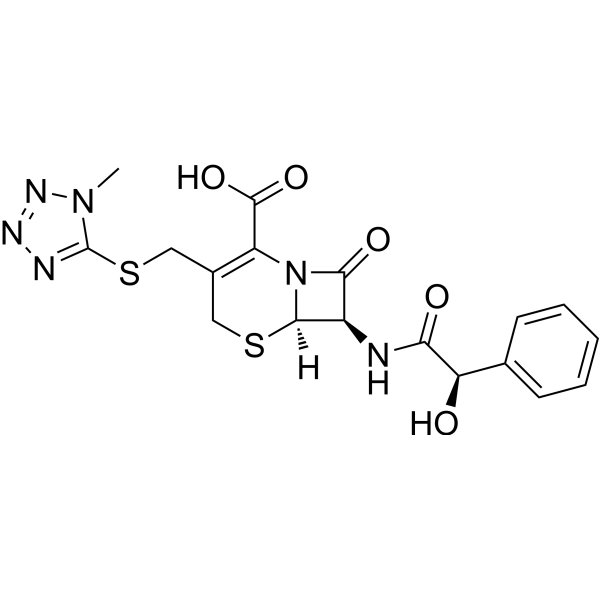
Chemical Structure
Cefamandole
Synonym(s): Cephamandole
- CAS No.: 34444-01-4
- Formula:C18H18N6O5S2
- Molecular Weight:462.50
IUPAC Name: (6R,7R)-7-((R)-2-hydroxy-2-phenylacetamido)-3-(((1-methyl-1H-tetrazol-5-yl)thio)methyl)-8-oxo-5-thia-1-azabicyclo[4.2.0]oct-2-ene-2-carboxylic acid
InChIKey: OLVCFLKTBJRLHI-AXAPSJFSSA-N
SMILES: O=C(C(N12)=C(CSC3=NN=NN3C)CS[C@]2([H])[C@H](NC([C@H](O)C4=CC=CC=C4)=O)C1=O)O
Biological Activity: Cefamandole (Cephamandole sodium) is a β-lactam antibiotic with broad-spectrum antibacterial activity. Cefamandole resists hydrolysis by β-lactamase of some Gram-negative bacteria. Cefamandole binds with high affinity to major penicillin-binding proteins (PBP) and with low affinity to PBP 2a, induces the production of low-affinity PBP associated with Methicillin (HY-121544) resistance, and blocks peptidoglycan biosynthesis through the SecA subunit of PBP. Cefamandole can be used in research related to bacterial infections[1][2][3][4][5][6][7][8][9].
| Cat. No. | Product Name | Purity | Description | Pricing | |||||||||||||||||||
|---|---|---|---|---|---|---|---|---|---|---|---|---|---|---|---|---|---|---|---|---|---|---|---|
|
|
Cefamandole | Cefamandole (Cephamandole sodium) is a β-lactam antibiotic with broad-spectrum antibacterial activity. Cefamandole resists hydrolysis by β-lactamase of some Gram-negative bacteria. Cefamandole binds with high affinity to major penicillin-binding proteins (PBP) and with low affinity to PBP 2a, induces the production of low-affinity PBP associated with Methicillin (HY-121544) resistance, and blocks peptidoglycan biosynthesis through the SecA subunit of PBP. Cefamandole can be used in research related to bacterial infections. | |||||||||||||||||||||
|
loading...
/
|
|||||||||||||||||||||||
References
- [1]. Neu HC, et al. Cefamandole, a cephalosporin antibiotic with an unusually wide spectrum of activity. Antimicrob Agents Chemother. 1974;6(2):177-182. [Content Brief]
- [2]. Eykyn S, et al. Antibacterial activity of cefamandole, a new cephalosporin antibiotic, compared with that of cephaloridine, cephalothin, and cephalexin. Antimicrob Agents Chemother. 1973;3(6):657-661. [Content Brief]
- [3]. Griffith RS, et al. Cefamandole: in vitro and clinical pharmacokinetics. Antimicrob Agents Chemother. 1976;10(5):814-823. [Content Brief]
- [4]. Lee FH, et al. Comparative tissue distribution of ceforanide, cefazolin, and cefamandole in rats. Antimicrob Agents Chemother. 1981;19(4):625-627. [Content Brief]
- [5]. Yeh PH, et al. Determination of unbound cefamandole in rat blood by microdialysis and microbore liquid chromatography. Biomed Chromatogr. 2001;15(1):14-17. [Content Brief]
- [6]. Chambers HF. Coagulase-negative staphylococci resistant to beta-lactam antibiotics in vivo produce penicillin-binding protein 2a. Antimicrob Agents Chemother. 1987 Dec;31(12):1919-24. [Content Brief]
- [7]. Yotsuji A, et al. Mechanism of action of cephalosporins and resistance caused by decreased affinity for penicillin-binding proteins in Bacteroides fragilis. Antimicrob Agents Chemother. 1988 Dec;32(12):1848-53. [Content Brief]
- [8]. Murakami K, et al. Production of low-affinity penicillin-binding protein by low- and high-resistance groups of methicillin-resistant Staphylococcus aureus. Antimicrob Agents Chemother. 1987 Sep;31(9):1307-11.
- [9]. Pothineni VR, et al. In vitro and in vivo evaluation of cephalosporins for the treatment of Lyme disease. Drug Des Devel Ther. 2018 Sep 11;12:2915-2921. [Content Brief]



