



MI-538
Based on 5 publication(s) in Google Scholar
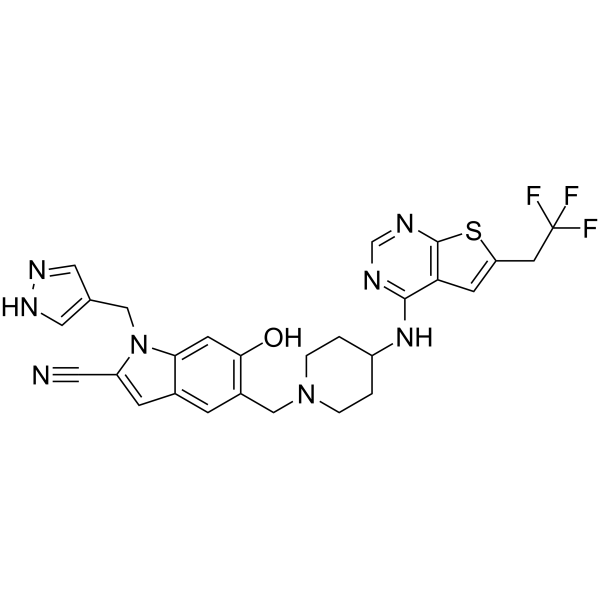
MI-538 is an inhibitor of the interaction between menin and MLL fusion proteins with an IC50 of 21 nM.
Nur für Forschungszwecke. Wir verkaufen nicht an Patienten.
- Reinheit : 98.23%
- CAS. Nr.: 1857417-10-7
- Formel: C27H25F3N8OS
- Molecular Weight:566.60
-
Speicherung:Powder -20°C, 3 years , 4°C, 2 years ; In solvent -80°C, 2 years , -20°C, 1 year

To place orders, for customer services and technical support, please contact: MedChemExpress USA
Tel: 609-228-6898 E-mail: [email protected] [email protected]


-
 Biologische Aktivität
-
Chemical Information
-
Lösungsmittel & Löslichkeit
- Reinheit & Dokumentation
- Verweise
-
 Help & FAQs


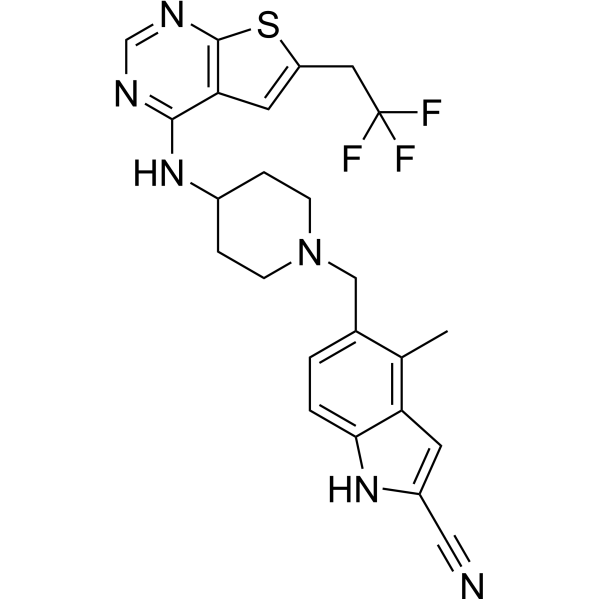
Publications Citing Use of MedChemExpress (MCE) MI-538
More

Biologische Aktivität
Beschreibung
IC50 & Target
IC50 : 21 nM (menin and MLL interaction); Kd: 6.5 nM (menin)[1]
Cellular Effect
|
Cell Line

|
Type | Value | Description | References |
|---|---|---|---|---|
| Bone marrow cell | GI50 |
0.083 μM
Compound: 27; MI-538
|
Growth inhibition of MLL-AF9 transformed mouse bone marrow cells after 7 days by MTT assay
Growth inhibition of MLL-AF9 transformed mouse bone marrow cells after 7 days by MTT assay
|
[PMID: 26744767] |
| Bone marrow cell | GI50 |
9 μM
Compound: 27; MI-538
|
Growth inhibition of Hoxa9/Meis1 transformed mouse bone marrow cells after 7 days by MTT assay
Growth inhibition of Hoxa9/Meis1 transformed mouse bone marrow cells after 7 days by MTT assay
|
[PMID: 26744767] |
| HL-60 | GI50 |
>6000 nM
Compound: 27; MI-538
|
Growth inhibition of human HL60 after 7 days by MTT assay
Growth inhibition of human HL60 after 7 days by MTT assay
|
[PMID: 26744767] |
| K562 | EC50 |
2.7 μM
Compound: MI-538
|
Cytotoxicity against human K562 cells measured after 48 hrs by MTT assay
Cytotoxicity against human K562 cells measured after 48 hrs by MTT assay
|
[PMID: 35569690] |
| MOLM-13 | GI50 |
268 nM
Compound: 27; MI-538
|
Growth inhibition of human MOLM13 after 7 days by MTT assay
Growth inhibition of human MOLM13 after 7 days by MTT assay
|
[PMID: 26744767] |
| MOLM-13 | EC50 |
0.14 μM
Compound: MI-538
|
Cytotoxicity against human MOLM-13 cells measured after 48 hrs by MTT assay
Cytotoxicity against human MOLM-13 cells measured after 48 hrs by MTT assay
|
[PMID: 35569690] |
| MV4-11 | GI50 |
175 nM
Compound: 27; MI-538
|
Growth inhibition of human MV4-11 after 7 days by MTT assay
Growth inhibition of human MV4-11 after 7 days by MTT assay
|
[PMID: 26744767] |
In Vitro
MI-538 inhibits the proliferation of MLL leukemia cells with a GI50 of 83 nM. MI-538 shows no effect (up to 6 μM) on growth of the control cell lines HL-60 and HM-2, which do not harbor MLL translocations, demonstrating good selectivity toward MLL fusion protein transformed cells. MI-538 binds to menin with low nanomolar affinity (Kd=6.5 nM). Its potent cellular activity originates from the improved binding affinity to menin and possibly increased cell membrane permeability. Treatment with MI-538 results in strong down regulation of expression of Hoxa9 and Meis1 genes. About 100 nM 27 was sufficient to reduce by ~50% Hoxa9 expression in MLL-AF9 cells, and even more pronounced effect was seen on Meis1 expression[1].
MedChemExpress (MCE) has not independently confirmed the accuracy of these methods. They are for reference only.
In Vivo
MedChemExpress (MCE) has not independently confirmed the accuracy of these methods. They are for reference only.


Chemical Information
-
CAS. Nr. 1857417-10-7
-
Appearance Solid
-
Molecular Weight 566.60
-
Formel C27H25F3N8OS
-
Color White to off-white
-
SMILES
FC(F)(F)CC(S1)=CC2=C1N=CN=C2NC3CCN(CC4=C(O)C=C(N(CC5=CNN=C5)C(C#N)=C6)C6=C4)CC3
-
Versand
Room temperature in continental US; may vary elsewhere.
-
Speicherung
Powder -20°C 3 years 4°C 2 years In solvent -80°C 2 years -20°C 1 year


Publications (5)
-
Journal Impact Factor
-
Most Recent
-
Acta Pharmacol Sin
2022 Feb;43(2):457-469. PMID: 33850273 -
Cells
Unlike Its Paralog LEDGF/p75, HRP-2 Is Dispensable for MLL-R Leukemogenesis but Important for Leukemic Cell Survival. [Abstract]2021 Jan 19;10(1):192. PMID: 33477970 -
Mol Carcinog
PRMT1 inhibition promotes ferroptosis sensitivity via ACSL1 upregulation in acute myeloid leukemia. [Abstract]2023 Aug;62(8):1119-1135. PMID: 37144835 -
-


Lösungsmittel & Löslichkeit
In Vitro:
DMSO : 100 mg/mL (176.49 mM; Need ultrasonic; Hygroscopic DMSO has a significant impact on the solubility of product, please use newly opened DMSO)
Please refer to the solubility information to select the appropriate solvent. Once prepared, please aliquot and store the solution to prevent product inactivation from repeated freeze-thaw cycles.
Storage method and period of stock solution: -80°C, 2 years; -20°C, 1 year. When stored at -80°C, please use it within 2 years. When stored at -20°C, please use it within 1 year.
Please refer to the solubility information to select the appropriate solvent. Once prepared, please aliquot and store the solution to prevent product inactivation from repeated freeze-thaw cycles.
Storage method and period of stock solution: -80°C, 2 years; -20°C, 1 year. When stored at -80°C, please use it within 2 years. When stored at -20°C, please use it within 1 year.
Konzentration (Stammlösung) × Volumen (Stammlösung) = Konzentration (Ziellösung) × Volumen (Ziellösung)
In Vivo:
Select the appropriate dissolution method based on your experimental animal and administration route.
- For the following dissolution methods, please ensure to first prepare a clear stock solution using an In Vitro approach and then sequentially add co-solvents:
- To ensure reliable experimental results, the clarified stock solution can be appropriately stored based on storage conditions. As for the working solution for In Vivo experiments, it is recommended to prepare freshly and use it on the same day.
- The percentages shown for the solvents indicate their volumetric ratio in the final prepared solution. If precipitation or phase separation occurs during preparation, heat and/or sonication can be used to aid dissolution.
Add each solvent one by one: 10% DMSO 40% PEG300 5% Tween-80 45% Saline
Solubility: ≥ 10 mg/mL (17.65 mM); Clear solution
This protocol yields a clear solution of ≥ 10 mg/mL (saturation unknown).
Taking 1 mL working solution as an example, add 100 μL DMSO stock solution (100.0 mg/mL) to 400 μL PEG300, and mix evenly; then add 50 μL Tween-80 and mix evenly; then add 450 μL Saline to adjust the volume to 1 mL.
Preparation of Saline: Dissolve 0.9 g sodium chloride in ddH₂O and dilute to 100 mL to obtain a clear Saline solution.
Add each solvent one by one: 10% DMSO 90% (20% SBE-β-CD in Saline)
Solubility: 2.08 mg/mL (3.67 mM); Suspended solution; Need ultrasonic
This protocol yields a suspended solution of 2.08 mg/mL. Suspended solution can be used for oral and intraperitoneal injection.
Taking 1 mL working solution as an example, add 100 μL DMSO stock solution (20.8 mg/mL) to 900 μL 20% SBE-β-CD in Saline, and mix evenly.
Preparation of 20% SBE-β-CD in Saline (4°C, storage for one week): 2 g SBE-β-CD powder is dissolved in 10 mL Saline, completely dissolve until clear.
In Vivo Dissolution Calculator
Please enter the basic information of animal experiments:
-
-
-
-
Recommended: Prepare an additional quantity of animals to account for potential losses during experiments.
Please enter your animal formula composition:
-
%DMSO +
Recommended: Keep the proportion of DMSO in working solution below 2% if your animal is weak.
-
%+
-
+%Tween-80 + +
-
%Saline +
The co-solvents required include: DMSO, . All of co-solvents are available by MedChemExpress (MCE). , Tween 80. All of co-solvents are available by MedChemExpress (MCE).
Working solution concentration: 0.22 mg/mL
Method for preparing stock solution: mg drug dissolved in μL DMSO. Stock solution concentration: mg/mL.
1. Take μL DMSO stock solution;
2. Add μL .
μL , mix evenly;
3. Then add μL Tween 80, mix evenly;
4. Then add μL
Please ensure that the stock solution in the first step is dissolved to a clear state, and add co-solvents in sequence. You can use ultrasonic heating (ultrasonic cleaner, recommended frequency 20-40 kHz), vortexing, etc. to assist dissolution.


Reinheit & Dokumentation
-
Data Sheet (275 KB)
-
SDS (393 KB)
- English - EN (393 KB)
- Français - FR (393 KB)
- Deutsch - DE (393 KB)
- Norwegian - NO (393 KB)
- Español - ES (393 KB)
- Swedish - SV (393 KB)
- Italian - IT (393 KB)
- Korean - KR (393 KB)
- Portuguese - PT (393 KB)
-
Handling Instructions (2659 KB)
Verweise


Complete Stock Solution Preparation Table
Please refer to the solubility information to select the appropriate solvent. Once prepared, please aliquot and store the solution to prevent product inactivation from repeated freeze-thaw cycles.
Storage method and period of stock solution: -80°C, 2 years; -20°C, 1 year. When stored at -80°C, please use it within 2 years. When stored at -20°C, please use it within 1 year.
| Optional Solvent | Concentration Solvent Mass | 1 mg | 5 mg | 10 mg | 25 mg |
|---|---|---|---|---|---|
| DMSO | 1 mM | 1.7649 mL | 8.8246 mL | 17.6491 mL | 44.1228 mL |
| 5 mM | 0.3530 mL | 1.7649 mL | 3.5298 mL | 8.8246 mL | |
| 10 mM | 0.1765 mL | 0.8825 mL | 1.7649 mL | 4.4123 mL | |
| 15 mM | 0.1177 mL | 0.5883 mL | 1.1766 mL | 2.9415 mL | |
| 20 mM | 0.0882 mL | 0.4412 mL | 0.8825 mL | 2.2061 mL | |
| 25 mM | 0.0706 mL | 0.3530 mL | 0.7060 mL | 1.7649 mL | |
| 30 mM | 0.0588 mL | 0.2942 mL | 0.5883 mL | 1.4708 mL | |
| 40 mM | 0.0441 mL | 0.2206 mL | 0.4412 mL | 1.1031 mL | |
| 50 mM | 0.0353 mL | 0.1765 mL | 0.3530 mL | 0.8825 mL | |
| 60 mM | 0.0294 mL | 0.1471 mL | 0.2942 mL | 0.7354 mL | |
| 80 mM | 0.0221 mL | 0.1103 mL | 0.2206 mL | 0.5515 mL | |
| 100 mM | 0.0176 mL | 0.0882 mL | 0.1765 mL | 0.4412 mL |


MI-538 Related Classifications
HY-19810 Related Classifications
 Powered by Bioz