



Peptide 401

Based on 1 Customer Validation
Peptide 401, a potent mast cell degranulating factor from bee venom, suppresses the increased vascular permeability due to intradermal injection of various smooth muscle spasmogens (histamine, and 5-HT).
For research use only. We do not sell to patients.
- Purity : 97.37%
- CAS No.: 32908-73-9
- Formula: C110H192N40O24S4
- Molecular Weight:2587.22
-
Storage:
Sealed storage, away from moisture.
Powder -80°C, 2 years , -20°C, 1 year* In solvent : -80°C, 6 months; -20°C, 1 month (sealed storage, away from moisture)

To place orders, for customer services and technical support, please contact: MedChemExpress USA
Tel: 609-228-6898 E-mail: [email protected] [email protected]


-
 Biological Activity
-
Chemical Information
-
Solvent & Solubility
- Protocols
- Purity & Documentation
- References
-
 Help & FAQs




Biological Activity
Description
IC50 & Target
|
Histamine Receptor |
Serotonin |
In Vivo
MedChemExpress (MCE) has not independently confirmed the accuracy of these methods. They are for reference only.


Chemical Information
-
CAS No. 32908-73-9
-
Appearance Solid
-
Molecular Weight 2587.22
-
Formula C110H192N40O24S4
-
Color White to off-white
-
Sequence
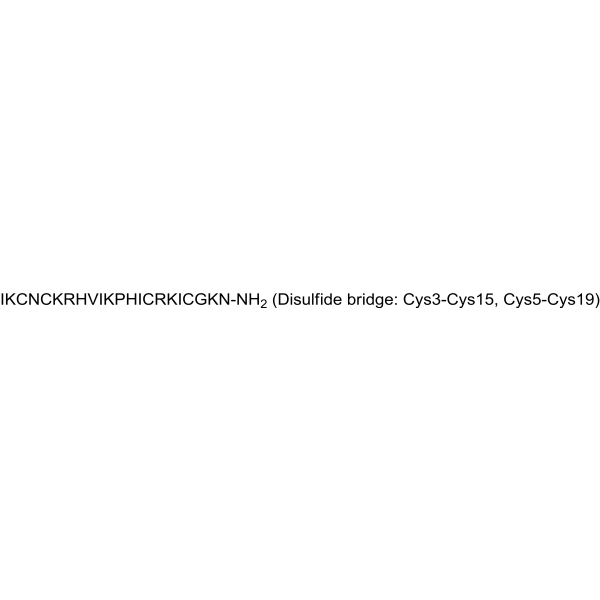
Ile-Lys-Cys-Asn-Cys-Lys-Arg-His-Val-Ile-Lys-Pro-His-Ile-Cys-Arg-Lys-Ile-Cys-Gly-Lys-Asn-NH2 (Disulfide bridge: Cys3-Cys15, Cys5-Cys19)
-
Sequence Shortening
IKCNCKRHVIKPHICRKICGKN-NH2 (Disulfide bridge: Cys3-Cys15, Cys5-Cys19)
-
Shipping
Room temperature in continental US; may vary elsewhere.
-
Storage
Sealed storage, away from moisture
Powder -80°C 2 years -20°C 1 year * In solvent : -80°C, 6 months; -20°C, 1 month (sealed storage, away from moisture)


Solvent & Solubility
In Vitro:
H2O : 2.08 mg/mL (0.80 mM; Need ultrasonic)


Purity & Documentation
-
Data Sheet (273 KB)
-
SDS (252 KB)
- English - EN (252 KB)
- Français - FR (252 KB)
- Deutsch - DE (252 KB)
- Norwegian - NO (252 KB)
- Español - ES (252 KB)
- Swedish - SV (252 KB)
- Italian - IT (252 KB)
- Korean - KR (252 KB)
- Portuguese - PT (252 KB)
-
Handling Instructions (2659 KB)
References
[1]. Hanson JM, et al. Anti-inflammatory property of 401 (MCD-peptide), a peptide from the venom of the bee Apis mellifera (L.). Br J Pharmacol. 1974 Mar;50(3):383-92. [Content Brief]
[2]. Banks BE, et al. Anti-inflammatory activity of bee venom peptide 401 (mast cell degranulating peptide) andcompound 48/80 results from mast cell degranulation in vivo. Br J Pharmacol. 1990 Feb;99(2):350-4. [Content Brief]

Calculators
Concentration (start) × Volume (start) = Concentration (final) × Volume (final)


Peptide 401 Related Classifications
HY-12537 Related Classifications
 Powered by Bioz