



Autophagy
Autophagy is a conserved cellular degradation and recycling process in the lysosome. In mammalian cells, there are three primary types of autophagy: microautophagy, macroautophagy, and chaperone-mediated autophagy (CMA). Microphagy captures cargoes by means of invaginations or protrusions of the lysosomal membrane directly, CMA uses chaperones to identify cargo proteins and then unfolds and transfers them into the lysosomal, while macroautophagy sequesters cargo by autophagosomes-de novo synthesized of double-membrane vesicles-and subsequently transport it to the lysosome.
Macroautophagy is the best studied and it occurs at a low level constitutively and can also be further induced under stress conditions, such as nutrient or energy starvation with a salient feature of autophagy protein degradation. Stress-induced macrophagy plays an important role in protein catabolism with another key protein degradation pathway, the ubiquitin–proteasome system (UPS).
As the study progressed, autophagy gains its importance under basal, nutrient-rich conditions, and is now recognized as a critical housekeeping pathway in catabolism of diverse cellular constituents, such as protein aggregates (aggrephagy), lipid droplets (lipophagy), iron complex (Ferritinophagy) and carbohydrate. Except for macromolecules, autophagy can also target several organelles and structures, such as mitochondria (mitophagy), peroxisome (pexophagy), endoplasmic reticulum (reticulophagy or ER-phagy), ribosome (ribophagy), spermatozoon-inherited organelles following fertilization (allophagy), secretory granules within pancreatic cells (zymophagy) and intracellular pathogens (xenophagy).
Autophagy and its dysfunction are associated with a variety of human pathologies, including ageing, cancer, neurodegenerative disease, heart disease and metabolic diseases, such as diabetes. Plenty of drugs and natural products are involved in autophagy modulation through multiple signaling pathways. Small molecules that can regulate autophagy seem to have great potential to intervene such diseases in animal models or clinical courses.
All Product Categories
-
Autophagy Inhibitors
(470)
View all products
-
Autophagy Agonists
(6)
View all products
-
Autophagy Activators
(119)
View all products
-
Autophagy Modulators
(59)
View all products
-
Autophagy Chemicals
(2)
View all products
-
Autophagy Inducers
(2163)
View all products
-
Autophagy Controls
(5)
View all products
-
Autophagy Ligand
(1)
View all products
-
Autophagy Related Products (3358)
Related Products (3358)

-
Antibodies (31)
-
Autophagy Signaling Pathway
-
Binimetinib (Standard)
 0 ImagesSynonyms: MEK162 (Standard); ARRY-162 (Standard); ARRY-438162 (Standard)Binimetinib (Standard) is the analytical standard of Binimetinib. This product is intended for research and analytical applications. Binimetinib (MEK162) is an oral and selective MEK1/2 inhibitor. Binimetinib (MEK162) inhibits MEK with an IC50 of 12 nM.
-
CP 53631
 0 ImagesCat. No.: HY-W020041CAS No.: 79836-56-9CP 53631 is an autophagy inhibitor (Autophagy) with anticancer activity. Additionally, CP 53631 can be used as an internal standard for Sertraline (HY-B0176A) in research related to selective serotonin reuptake inhibitors (SSRIs) in the field of antidepressants .
-
ATG5 PPI-IN-2
 0 ImagesCat. No.: HY-183732CAS No.: 2841473-85-4ATG5 PPI-IN-2 is a selective inhibitor of ATG5-TECAIR protein-protein interaction, with a IC50 of 19.16 μM. ATG5 PPI-IN-2 also acts as an Autophagy inhibitor.
-
Autophagy-IN-12
 0 ImagesCat. No.: HY-183736CAS No.: 2841473-93-4Autophagy-IN-12 is a Autophagy inhibitor. Autophagy-IN-12 exhibits an IC50 value of >33 μM against the protein-protein interactions of ATG5-ATG16L1 and ATG5-TECAIR.
-
(Rac)-Sitagliptin
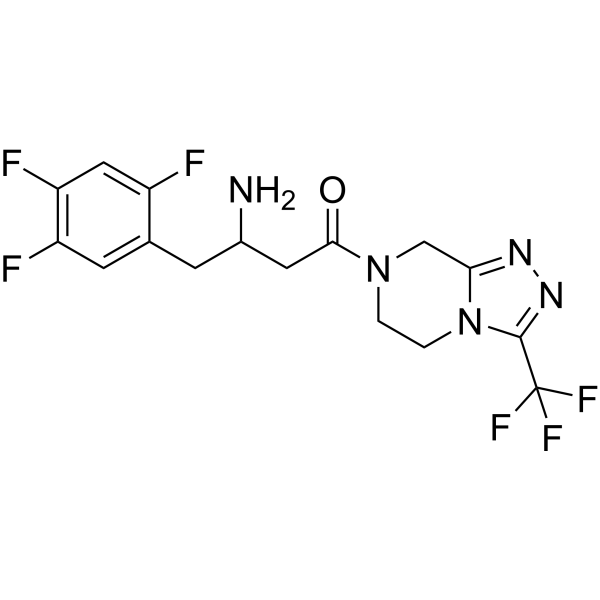 0 ImagesCat. No.: HY-13749DCAS No.: 823817-56-7Synonyms: (Rac)-MK-0431(Rac)-Sitagliptin is an isoform of Sitagliptin (HY-13749), which is a potent and orally active inhibitor of DPP4 with an IC50 of 19 nM in Caco-2 cell extracts.
-
VER-155008 (Standard)
 0 ImagesCat. No.: HY-10941RCAS No.: 1134156-31-2VER-155008 (Standard) is the analytical standard of VER-155008 (HY-10941). This product is intended for research and analytical applications. VER-155008 is an inhibitor of Hsp70, with IC50s of 0.5 μM, 2.6 μM, and 2.6 μM for Hsp70, Hsc70 and Grp7, respectively, and with a Kd of 0.3 μM for Hsp70.
-
Erythromycin Ethylsuccinate (Standard)
 0 ImagesSynonyms: Erythromycin ethyl succinate (Standard); EES (Standard)Erythromycin Ethylsuccinate (Standard) is the analytical standard of Erythromycin Ethylsuccinate. This product is intended for research and analytical applications. Erythromycin Ethylsuccinate is an antibiotic useful for the treatment of a number of bacterial infections, has an antimicrobial spectrum similar to or slightly wider than that of penicillin. Erythromycin Ethylsuccinate has antiviral activity against HIV-1.
-
Liensinine (Standard)
 0 ImagesLiensinine (Standard) is the analytical standard of Liensinine (HY-N0484). This product is intended for research and analytical applications. Liensinine is a bisbenzylisoquinoline alkaloid. By inhibiting the PI3K/AKT and JNK/p38-MAPK signaling pathways, Liensinine suppresses autophagy and apoptosis, clears Aβ, and exerts anti-inflammatory, antioxidant and neuroprotective effects. Liensinine activates AMPK and inhibits the expression of HIF-1α and VEGF, thereby suppressing angiogenesis. Liensinine exerts anti-tumor effects through ROS-mediated inhibition of the JAK2/STAT3 signaling pathway. Liensinine can be used for the research of diseases such as Alzheimer's disease, hepatocellular carcinoma, osteosarcoma, sepsis-induced organ injury and stroke.
-
ATG5/TECAIR-IN-2
 0 ImagesCat. No.: HY-183828CAS No.: 2841473-95-6ATG5/TECAIR-IN-2 is an ATG5 inhibitor with target IC50 values >33 μM.ATG5/TECAIR-IN-2 disrupts protein-protein interactions between ATG5 and ATG16L1, and between ATG5 and TECAIR.ATG5/TECAIR-IN-2 inhibits autophagy in mammalian cells.
-
Dorsomorphin dihydrochloride (Standard)
 0 ImagesSynonyms: Compound C dihydrochloride (Standard); BML-275 dihydrochloride (Standard)Dorsomorphin (dihydrochloride) (Standard) is the analytical standard of Dorsomorphin (dihydrochloride). This product is intended for research and analytical applications. Dorsomorphin (Compound C) dihydrochloride is a potent, selective and ATP-competitive AMPK inhibitor, with a Ki of 109 nM. Dorsomorphin dihydrochloride inhibits BMP pathway by targeting the type I receptors ALK2, ALK3, and ALK6. Dorsomorphin dihydrochloride can reverse autophagy activation and anti-inflammatory effect of Urolithin A (HY-100599).




