



Autophagy
Autophagy is a conserved cellular degradation and recycling process in the lysosome. In mammalian cells, there are three primary types of autophagy: microautophagy, macroautophagy, and chaperone-mediated autophagy (CMA). Microphagy captures cargoes by means of invaginations or protrusions of the lysosomal membrane directly, CMA uses chaperones to identify cargo proteins and then unfolds and transfers them into the lysosomal, while macroautophagy sequesters cargo by autophagosomes-de novo synthesized of double-membrane vesicles-and subsequently transport it to the lysosome.
Macroautophagy is the best studied and it occurs at a low level constitutively and can also be further induced under stress conditions, such as nutrient or energy starvation with a salient feature of autophagy protein degradation. Stress-induced macrophagy plays an important role in protein catabolism with another key protein degradation pathway, the ubiquitin–proteasome system (UPS).
As the study progressed, autophagy gains its importance under basal, nutrient-rich conditions, and is now recognized as a critical housekeeping pathway in catabolism of diverse cellular constituents, such as protein aggregates (aggrephagy), lipid droplets (lipophagy), iron complex (Ferritinophagy) and carbohydrate. Except for macromolecules, autophagy can also target several organelles and structures, such as mitochondria (mitophagy), peroxisome (pexophagy), endoplasmic reticulum (reticulophagy or ER-phagy), ribosome (ribophagy), spermatozoon-inherited organelles following fertilization (allophagy), secretory granules within pancreatic cells (zymophagy) and intracellular pathogens (xenophagy).
Autophagy and its dysfunction are associated with a variety of human pathologies, including ageing, cancer, neurodegenerative disease, heart disease and metabolic diseases, such as diabetes. Plenty of drugs and natural products are involved in autophagy modulation through multiple signaling pathways. Small molecules that can regulate autophagy seem to have great potential to intervene such diseases in animal models or clinical courses.
All Product Categories
-
Autophagy Inhibitors
(470)
View all products
-
Autophagy Agonists
(6)
View all products
-
Autophagy Activators
(119)
View all products
-
Autophagy Modulators
(59)
View all products
-
Autophagy Chemicals
(2)
View all products
-
Autophagy Inducers
(2163)
View all products
-
Autophagy Controls
(5)
View all products
-
Autophagy Ligand
(1)
View all products
-
Autophagy Related Products (3358)
Related Products (3358)

-
Antibodies (31)
-
Autophagy Signaling Pathway
-
Lucanthone (Standard)
 0 ImagesLucanthone (Standard) is the analytical standard of Lucanthone. This product is intended for research and analytical applications. Lucanthone is an endonuclease inhibitor of Apurinic endonuclease-1 (APE-1).
-
Daurisoline-d5
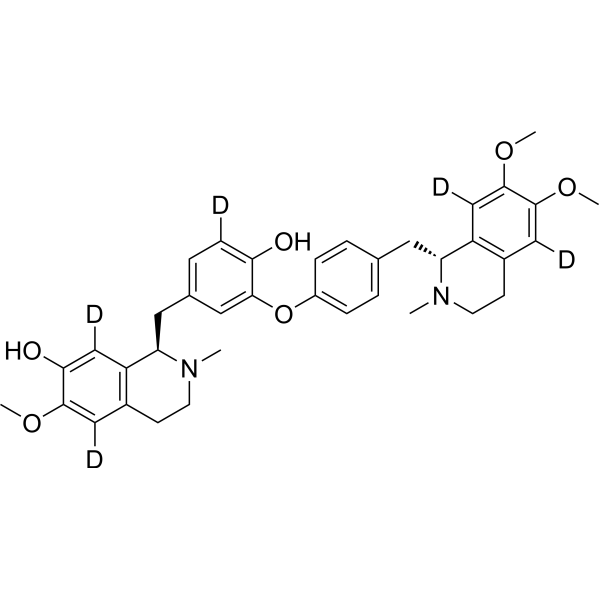 0 ImagesCat. No.: HY-N0221S1Synonyms: (R,R)-Daurisoline-d5Daurisoline-d5 is the deuterium labeled Daurisoline (HY-N0221). Daurisoline is a bis-benzylisoquinoline alkaloid that can be isolated from Menispermum dauricum and Rhizoma Menispermi. Daurisoline exerts a blocking effect on hERG and has antiarrhythmic effects. Daurisoline is a potent autophagy blocker that can be used for the research of cancer.
-
Mefloquine hydrochloride (Standard)
 0 ImagesSynonyms: Mefloquin hydrochloride (Standard)Mefloquine (hydrochloride) (Standard) is the analytical standard of Mefloquine (hydrochloride). This product is intended for research and analytical applications. Mefloquine hydrochloride (Mefloquin hydrochloride), a quinoline antimalarial agent, is an anti-SARS-CoV-2 entry inhibitor. Mefloquine hydrochloride is also a K+ channel (KvQT1/minK) antagonist with an IC50 of ~1 μM. Mefloquine hydrochloride can be used for malaria, systemic lupus erythematosus and cancer research.
-
URB-597 (Standard)
 0 ImagesSynonyms: KDS-4103 (Standard)URB-597 (Standard) is the analytical standard of URB-597. This product is intended for research and analytical applications. URB-597 (KDS-4103) is an orally bioavailable and selective FAAH inhibitor. URB-597 inhibits FAAH activity with an IC50s of approximately 5 nM in rat brain membranes, 0.5 nM in intact rat neurons, 3 nM in human liver microsomes. Antidepressant-like effects. Analgesic activity.
-
Tempol (Standard)
 0 ImagesCat. No.: HY-100561RCAS No.: 2226-96-2Synonyms: 4-Hydroxy-TEMPO (Standard)Tempol (Standard) is the analytical standard of Tempol. This product is intended for research and analytical applications. Tempol is a general superoxide dismutase (SOD)-mimetic agent that efficiently neutralizes reactive oxygen species (ROS).
-
Chloroquine dihydrochloride (Standard)
 0 ImagesChloroquine (dihydrochloride) (Standard) is the analytical standard of Chloroquine (dihydrochloride). This product is intended for research and analytical applications. Chloroquine dihydrochloride is an antimalarial and anti-inflammatory agent widely used to treat malaria and rheumatoid arthritis. Chloroquine dihydrochloride is an autophagy and toll-like receptors (TLRs) inhibitor. Chloroquine dihydrochloride is highly effective in the control of SARS-CoV-2 (COVID-19) infection in vitro (EC50=1.13 μM)[1][2][3][4].
-
Momelotinib (Standard)
 0 ImagesSynonyms: CYT387 (Standard)Momelotinib (Standard) is the analytical standard of Momelotinib. This product is intended for research and analytical applications. Momelotinib (CYT387) is an ATP-competitive inhibitor of JAK1/JAK2 with IC50a of 11 nM and 18 nM,respectively. CYT387 shows much less activity against JAK3.
-
Astragaloside II (Standard)
 0 ImagesCat. No.: HY-N0433RCAS No.: 84676-89-1Synonyms: Astrasieversianin VIII (Standard)Astragaloside II (Standard) is the analytical standard of Astragaloside II (HY-N0433). This product is intended for research and analytical applications. Astragaloside II is an orally active Cycloartane-type triterpene glycoside. Astragaloside II can be extracted from Astragalus membranaceus. Astragaloside II inhibits Autophagy, decreases pro-inflammatory cytokines (IL-6, IL-1β), HIF-α, p-p65, p-IκB and increases SOD. Astragaloside II regulates immunity and reduces inflammatory responses. Astragaloside II can be used in the research of diseases such as liver cancer, osteoporosis, immunosuppressive diseases, and ulcerative colitis.
-
Autophinib (Standard)
 0 ImagesAutophinib (Standard) is the analytical standard of Autophinib (HY-101920). This product is intended for research and analytical applications. Autophinib is a potent, selective autophagy inhibitor with IC50s of 90 nM and 40 nM for starvation- and Rapamycin-induced autophagy, respectively. Autophinib is also an ATP competitive Vacuolar Protein Sorting 34 (VPS34) inhibitor with an IC50 of 19 nM. Autophinib inhibits autophagy induced by starvation or Rapamycin by targeting VPS34.
-
PHA-665752 (Standard)
 0 ImagesCat. No.: HY-11107RCAS No.: 477575-56-7PHA-665752 (Standard) is the analytical standard of PHA-665752 (HY-11107). This product is intended for research and analytical applications. PHA-665752 is a selective, ATP-competitive, and active-site inhibitor of the catalytic activity of c-Met Kinase (Ki=4 nM; IC50=9 nM). PHA-665752 exhibits >50-fold selectivity for c-Met compared with a panel of diverse tyrosine and serine-threonine Kinases. PHA-665752 induces apoptosis and cell cycle arrest, and exhibits cytoreductive antitumor activity.
-
Desethyl chloroquine (Standard)
 0 ImagesCat. No.: HY-135811RCAS No.: 1476-52-4Desethyl chloroquine (Standard) is the analytical standard of Desethyl chloroquine. This product is intended for research and analytical applications. Desethyl chloroquine is a major desethyl metabolite of Chloroquine. Chloroquine diphosphate is an inhibitor of autophagy and toll-like receptors (TLRs). Desethyl chloroquine possesses antiplasmodic activity.
-
Momelotinib sulfate (Standard)
 0 ImagesSynonyms: CYT387 sulfate salt (Standard)Momelotinib (sulfate) (Standard) is the analytical standard of Momelotinib (sulfate). This product is intended for research and analytical applications. Momelotinib sulfate (CYT387 sulfate salt) is an ATP-competitive inhibitor of JAK1/JAK2 with IC50 of 11 nM/18 nM, 10-fold selectivity versus JAK3 (IC50=155 nM).


-
Esmolol hydrochloride (Standard)
 0 ImagesEsmolol hydrochloride (Standard) is the analytical standard of Esmolol hydrochloride (HY-B1392).This product is intended for research and analytical applications. Esmolol hydrochloride is an ultra-short-acting cardioselective β1-adrenergic blocker. Esmolol hydrochloride exerts its antiarrhythmic effect by activating Neurokinin 1 ReceptorEsmolol hydrochloride attenuates post resuscitation myocardial dysfunction. Esmolol hydrochloride improves diabetic wound healing by inhibiting aldose reductase and the production of advanced glycation end products and promoting fibroblast migration. Esmolol hydrochloride can be used to study cardiac diseases such as arrhythmias and diabetic foot ulcers.
-
Daurisoline (Standard)
 0 ImagesCat. No.: HY-N0221RCAS No.: 70553-76-3Synonyms: (R,R)-Daurisoline (Standard)Daurisoline (Standard) is the analytical standard of Daurisoline. This product is intended for research and analytical applications. Daurisoline is a bis-benzylisoquinoline alkaloid that can be isolated from Menispermum dauricum and Rhizoma Menispermi. Daurisoline exerts a blocking effect on hERG and has antiarrhythmic effects. Daurisoline is a potent autophagy blocker that can be used for the research of cancer.
-
Binimetinib-d3
 0 ImagesCat. No.: HY-15202S1CAS No.: 2890696-59-8Synonyms: MEK162-d3; ARRY-162-d3; ARRY-438162-d3Binimetinib-d3 (MEK162-d3) is deuterium labeled Binimetinib. Binimetinib (MEK162) is an oral and selective MEK1/2 inhibitor. Binimetinib (MEK162) inhibits MEK with an IC50 of 12 nM.
-
Desethyl chloroquine diphosphate (Standard)
 0 ImagesDesethyl chloroquine (diphosphate) (Standard) is the analytical standard of Desethyl chloroquine (diphosphate). This product is intended for research and analytical applications. Desethyl chloroquine diphosphate is a major desethyl metabolite of Chloroquine. Chloroquine diphosphate is an inhibitor of autophagy and toll-like receptors (TLRs). Desethyl chloroquine diphosphate possesses antiplasmodic activity.
-
Lys01
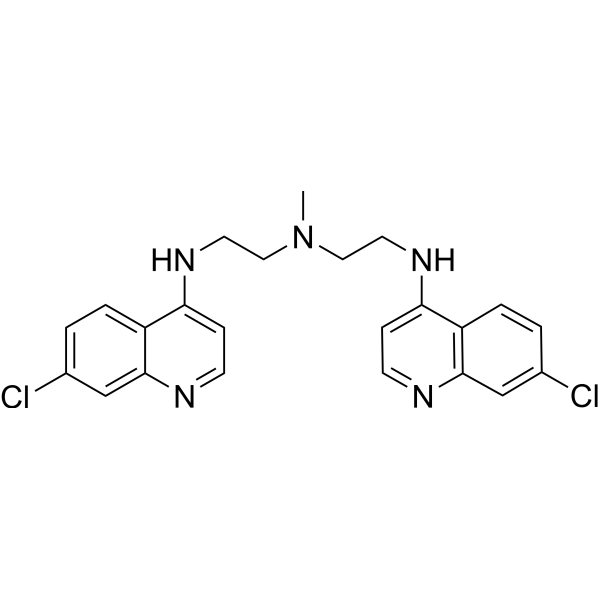 0 ImagesCat. No.: HY-12855CAS No.: 1391426-22-4Lys01, a dimeric form of Chloroquine (HY-17589A), is an autophagy inhibitor. Lys01 inhibits cell viability of 1205Lu, c8161, LN229, HT-29 cells with IC50s of 3.6, 3.8, 7.9, 6.0 μM. Lys01 can be used for anticancer research.
-
TPEN (Standard)
 0 ImagesSynonyms: TPEDA (Standard)TPEN (Standard) is the analytical standard of TPEN (HY-100202). This product is intended for research and analytical applications. TPEN (TPEDA) is a specific cell-permeable heavy metal chelator. TPEN has a higher affinity for Zn2+, but a lower affinity for Mg2+ and Ca2+. TPEN induces DNA damage and increases intracellular ROS production. TPEN also inhibits cell proliferation and induces apoptosis.




