



CAMK IV
CaMKIV (calcium/calmodulin-dependent protein kinase IV) is a calcium-responsive serine/threonine kinase that functions primarily in the nucleus to couple intracellular calcium signals with CRE-dependent transcription programs through phosphorylation of CREB.[1] Mechanistically, CaMKIV operates within the CaMKK-CaMKIV-CREB signaling axis, where upstream CaMKK activation promotes CREB phosphorylation and transcriptional responses associated with neuronal plasticity and activity-dependent gene expression.[2][3] Through this pathway, CaMKIV contributes to the regulation of c-Fos expression, late-phase long-term potentiation (L-LTP), and transcriptional processes required for long-term memory consolidation.[1] In disease-relevant and experimental models, disruption of CaMKIV signaling reduces activity-induced CREB phosphorylation and impairs hippocampus-dependent memory retention without markedly affecting basal synaptic transmission or early LTP, supporting its role in long-term neuronal adaptation.[1] Compared with the closely related CaMKII family, which participates broadly in synaptic signaling, CaMKIV shows a stronger association with nuclear transcriptional regulation and trophic CREB-dependent gene expression.[3] This distinction makes CaMKIV a useful experimental target for investigating calcium-dependent transcription, memory-associated signaling networks, and neuroprotective gene programs.[1][3] For research applications, pharmacological or genetic manipulation of the upstream CaMKK-CaMKIV pathway is commonly used to examine CREB-mediated transcriptional responses and neuronal plasticity mechanisms.[2][3]
References:
- [1]. Kang H, et al. An important role of neural activity-dependent CaMKIV signaling in the consolidation of long-term memory. Cell. 2001 Sep 21;106(6):771-83. [Content Brief]
- [2]. Peters M, et al. Loss of Ca2+/calmodulin kinase kinase beta affects the formation of some, but not all, types of hippocampus-dependent long-term memory. J Neurosci. 2003 Oct 29;23(30):9752-60. [Content Brief]
- [3]. Bell KF, et al. Calmodulin kinase IV-dependent CREB activation is required for neuroprotection via NMDA receptor-PSD95 disruption. J Neurochem. 2013 Jul;126(2):274-87. [Content Brief]
-
CAMK IV Related Products (1)
Related Products (1)

-
CaMKP inhibitor sodium
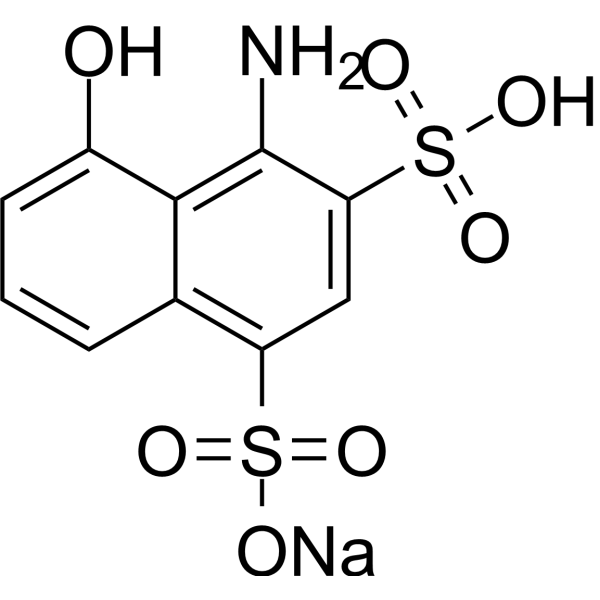 0 ImagesCaMKP inhibitor sodium (compound 5) is an inhibitor of Ca2+/neutral protein-dependent protein concentration (CaMKP) and its nuclear type (CaMKP-N) (IC50: 6.4 μM, CaMKP; 6.6 μM, CaMKP-N). CaMKP is one type of Ser/Thr protein, which can be passed through to remove the oxidized oxidized protein (CaMK). CaMKP inhibitor sodium inhibits CaMKP mediated phospho-CaMKI hydrolysis, unaffectes protein phosphoric acid 2C (PP2C) and calcineurin (CaN).



