CB2
Cannabinoid receptor CB2 (CB2R) is a cannabinoid G protein-coupled receptor originally characterized as a peripheral receptor expressed in macrophages and immune tissues[1][2]. Mechanistically, CB2R couples through Gi/o proteins, inhibits adenylyl cyclase, and activates MAPK signaling, linking cannabinoid receptor signaling to immune-cell regulation[3]. In inflammatory biology, CB2R modulates immune-cell functions in cell systems and animal models, and CB2-deficient mice show exacerbated inflammatory phenotypes[2]. In neuroinflammation, CB2R activity is especially relevant in macrophage-lineage cells and CNS microglia, connecting peripheral immune regulation with central immune responses[4]. Compared with CB1, CB2 is distinguished by immune-enriched distribution, while CB1 is found predominantly in neuronal tissues and also couples to ion-channel signaling[5]. For experimental applications, CB2-selective agonists such as HU-308 bind CB2 efficiently, inhibit forskolin-stimulated cyclic AMP production in CB2-transfected cells, and support receptor-selective studies of inflammation and peripheral analgesia[6].- CB2R links cannabinoid receptor signaling with immune modulation, inflammation models, and neuroimmune research design[2][4]. - CB2 differs from CB1 mainly by immune distribution, not by complete separation of signaling pathways[5]. - HU-308 supports CB2-selective pharmacology studies in inflammation, peripheral analgesia, and cAMP assays[6].
References:
- [1]. Munro S, et al. Molecular characterization of a peripheral receptor for cannabinoids. Nature. 1993 Sep 2;365(6441):61-5. [Content Brief]
- [2]. Turcotte C, et al. The CB2 receptor and its role as a regulator of inflammation. Cell Mol Life Sci. 2016 Dec;73(23):4449-4470. [Content Brief]
- [3]. Howlett AC. Cannabinoid receptor signaling. Handb Exp Pharmacol. 2005;(168):53-79. [Content Brief]
- [4]. Cabral GA, et al. Emerging role of the cannabinoid receptor CB2 in immune regulation: therapeutic prospects for neuroinflammation. Expert Rev Mol Med. 2009 Jan 20;11:e3. [Content Brief]
- [5]. Howlett AC, et al. International Union of Pharmacology. XXVII. Classification of cannabinoid receptors. Pharmacol Rev. 2002 Jun;54(2):161-202. [Content Brief]
- [6]. Hanus L, et al. HU-308: a specific agonist for CB(2), a peripheral cannabinoid receptor. Proc Natl Acad Sci U S A. 1999 Dec 7;96(25):14228-33. [Content Brief]
-
CB2 Related Products (82)
Related Products (82)

-
PSB-SB1202
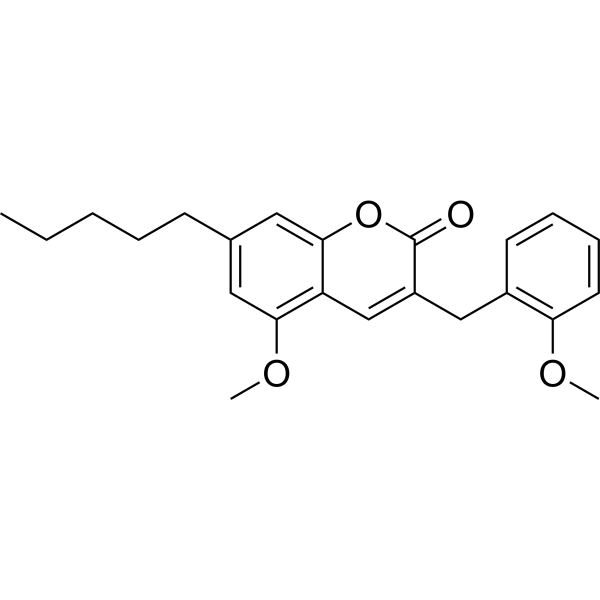 0 ImagesPSB-SB1202 (Compound 21a) is a phenyl coumarin compound. PSB-SB1202 is a CB1/CB2 agonist with EC50 values of 56 and 14 nM, and Ki values of 32 and 49 nM, respectively.