



P2Y11 Receptor
P2Y11 receptor is a human purinergic receptor coupled to phosphoinositide and cyclic AMP signaling[1]. ATP, ATPγS, BzATP, dATP, and AR-C67085 activate recombinant human P2Y11 receptor, while ADPβS, AMPαS, and A3P5PS act as partial agonists[1]. Mechanistically, ATP and UTP can both mobilize Ca2+ through human P2Y11 receptor, but they recruit distinct signaling pathways[2]. In immune biology, current evidence supports a role for P2Y11 in immune activation with cell type-specific effects[3]. In disease models, P2RY11 variants associate with narcolepsy and altered ATP-induced cell death in T lymphocytes and NK cells[4]. In rheumatoid arthritis-derived fibroblast-like synoviocytes, P2Y11R expression rises and NF340 suppresses IL-1β-induced TNF-α, IL-6, MMP expression, oxidative stress, and NFκB signaling[5]. In lung fibroblasts, extracellular ATP or oxidative stress induces premature senescence through P2Y11R-linked ER Ca2+ release and mitochondrial ROS production[6]. Compared with related isoforms, P2Y11 remains experimentally distinctive because rodents lack a murine P2ry11 orthologue and some antibodies, expression assays, agonists, and antagonists have specificity limitations[3]. Therefore, P2Y11 receptor studies require human-relevant systems and carefully validated pharmacological tools[3].
References:
- [1]. Communi D, et al. Pharmacological characterization of the human P2Y11 receptor. Br J Pharmacol. 1999 Nov;128(6):1199-206. [Content Brief]
- [2]. White PJ, et al. Characterization of a Ca2+ response to both UTP and ATP at human P2Y11 receptors: evidence for agonist-specific signaling. Mol Pharmacol. 2003 Jun;63(6):1356-63. [Content Brief]
- [3]. Dreisig K, et al. A critical look at the function of the P2Y11 receptor. Purinergic Signal. 2016 Sep;12(3):427-37. [Content Brief]
- [4]. Birgitte Kornum, et al. The P2Y11 receptor is associated with narcolepsy and with higher susceptibility to ATP induced cell death in T lymphocytes and NK cells. (47.5). The Journal of Immunology, Volume 186, Issue 1_Supplement, April 2011, Page 47.5.
- [5]. Gao F, et al. P2Y11 receptor antagonist NF340 ameliorates inflammation in human fibroblast-like synoviocytes: An implication in rheumatoid arthritis. IUBMB Life. 2019 Oct;71(10):1552-1560. [Content Brief]
- [6]. Shatat AS. P2Y11 receptor is a critical regulator of extracellular ATP-mediated premature senescence in lung fibroblasts: Implications of ER-Ca+2 release/mitochondrial ROS production signaling pathway. Purinergic Signal. 2025 Apr;21(2):271-273. doi: 10.1007/s11302-024-10036-9. Epub 2024 Jul 8. PMID: 38977636; PMCID: PMC12062467. et al. P2Y11 receptor is a critical regulator of extracellular ATP-mediated premature senescence in lung fibroblasts: Implications of ER-Ca+2 release/mitochondrial ROS production signaling pathway. Purinergic Signal. 2025 Apr;21(2):271-273. [Content Brief]
All Product Categories
-
P2Y11 Receptor Related Products (1)
Related Products (1)

-
NF340
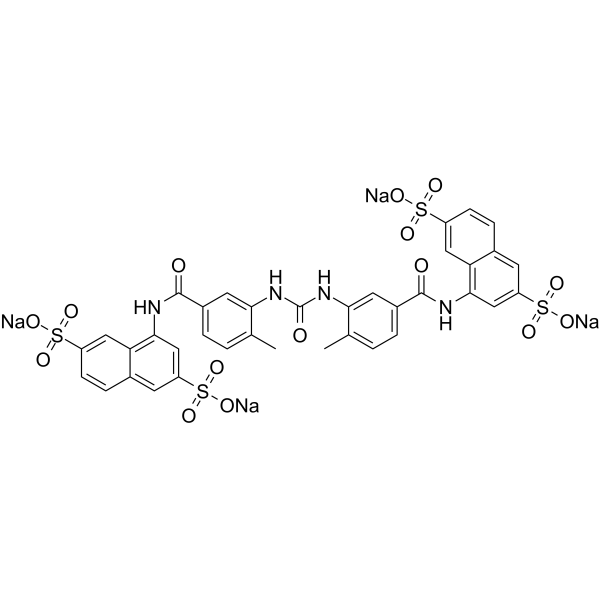 0 ImagesCat. No.: HY-108659CAS No.: 202982-98-7NF340 is a P2Y11 receptor inhibitor with a pIC50 of 7.3-7.7 against human P2Y11 receptor, and it exhibits high selectivity over other P2Y family receptors. NF340 binds to the ATP-binding amino acid residues of the P2Y11 receptor to inhibit its activity, block nociceptive activity, and reduce spinal dorsal horn P2Y11 receptor upregulation induced by spinal nerve injury. NF340 attenuates the NFκB signaling pathway activated by IL-1β by decreasing IκBα phosphorylation, nuclear p65 accumulation, and NFκB promoter activity. NF340 inhibits IL-1β-induced pro-inflammatory cytokine expression, reduces intracellular ROS and 4-HNE levels, and suppresses IL-1β-induced matrix metalloproteinase expression in primary fibroblast-like synoviocytes. NF340 inhibits ATP-induced elevation of intracellular Ca2+ concentration and cell migration in human hepatocellular carcinoma cells. NF340 can be used in the research of neuropathic pain, myocardial ischemia/reperfusion injury, inflammatory pain, rheumatoid arthritis, and hepatocellular carcinoma.



