



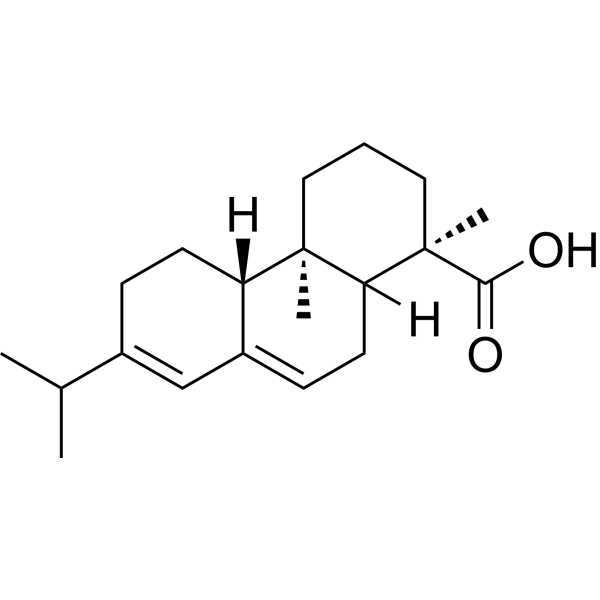
Abietic acid
Based on 3 publication(s) in Google Scholar
Abietic acid, an orally active diterpene isolated from Colophony, displays significant anti-proliferative, anti-inflammatory, anti-obesity effect, bacteriostatic, cell cycle arresting and pro-apoptotic activities. Abietic acid inhibits lipoxygenase activity for allergy. Abietic acid enhances cell migration and tube formation in HUVECs. Abietic acid induces significant angiogenic potential, which is associated with upregulation of extracellular signal-regulated kinase (ERK) and p38 expression. Abietic acid attenuates sepsis-induced lung injury by inhibiting nuclear factor kappa-light-chain-enhancer of activated B cells (NF-κB) pathway to inhibit M1 macrophage polarization. Abietic acid exhibits a positive effect against liver injury by attenuating inflammation and ferroptosis. Abietic acid shows accelerated wound closure in a mouse model of cutaneous wounds. Abietic acid significantly reduces the proliferation and growth of NSCLC cells by IKKβ inhibition.Additionally, Abietic acid ameliorates psoriasis-like inflammation and modulates gut microbiota in mice. Abietic acid is promising for research in non-small-cell lung cancer (NSCLC), liver injury-related deseases and psoriasis.
For research use only. We do not sell to patients.
- Purity: 92.70%
- CAS No.: 514-10-3
- Formula: C20H30O2
- Molecular Weight:302.45
-
Storage:Powder -20°C, 3 years , 4°C, 2 years ; In solvent -80°C, 6 months , -20°C, 1 month

To place orders, for customer services and technical support, please contact: MedChemExpress USA
Tel: 609-228-6898 E-mail: [email protected] [email protected]


-
 Biological Activity
-
Chemical Information
-
Solvent & Solubility
- Purity & Documentation
- References
-
 Help & FAQs
-

Anti-Infection Compound Library
HY-L002
-
Immunology/Inflammation Compound Library
HY-L007
-
Kinase Inhibitor Library
HY-L009
-
NF-κB Signaling Compound Library
HY-L014
-
Stem Cell Signaling Compound Library
HY-L017
-
Natural Product Library
HY-L021
-
Anti-Cancer Compound Library
HY-L025
-
Anti-Aging Compound Library
HY-L034
-
Differentiation Inducing Compound Library
HY-L038
-
Antibacterial Compound Library
HY-L049
-
Ferroptosis Compound Library
HY-L051
-
Medicine Food Homology Compound Library
HY-L055
-
Pyroptosis Compound Library
HY-L059
-
Orally Active Compound Library
HY-L061
-
Traditional Chinese Medicine Active Compound Library
HY-L065
-
Anti-Lung Cancer Compound Library
HY-L075
-
Anti-Obesity Compound Library
HY-L087
-
Anti-Liver Cancer Compound Library
HY-L101
-
Anti-Cancer Natural Product Library
HY-L107
-
Anti-inflammatory Traditional Chinese Medicine Active Compound Library
HY-L114
-
Plant-Sourced Natural Product Library
HY-L115
-
Anti-Prostate Cancer Compound Library
HY-L124
-
Cell Death Library
HY-L162
-
Serine/Threonine Kinase Inhibitor Library
HY-L164
-
Macrophage Related Compound Library
HY-L174
-
Bioactive Compound Library Max
HY-L181
-
MCE Bioactive Compound Library
HY-L001V
-
Natural Product Library Plus
HY-L021P
-
Natural Product and Natural Product-Like Compound Library
HY-L021M
-
Bioactive Compound Library
HY-L001
-
PBCRBS Traditional Chinese Medicine Compound Library
HY-L193
-
Protein Kinase Compound Library
HY-L196
-
High-Throughput Bioactive Compound Library
HY-L205
-
High-Throughput Natural Product Library
HY-L206
-
Ancient Chinese Classical Formulas Traditional Chinese Medicine Active Compound Library
HY-L209
-
Mouse Metabolite Compound Library
HY-L217
-
Diarrhea-Related Traditional Chinese Medicine Active Compound Library
HY-L224
-
Posttranslational Modification Library
HY-L226
-
Mongolian Medicine Compound Library
HY-L238
-
Natural Product Diversity Scaffold Library
HY-L245
-
Tonifying Traditional Chinese Medicine Monomer Compound Library
HY-L246
-
Lactylation Compound Library
HY-L249


Publications Citing Use of MedChemExpress (MCE) Abietic acid
More

Biological Activity
|
Cell Line

|
Type | Value | Description | References |
|---|---|---|---|---|
| A549 | IC50 |
>100 μM
Compound: 1
|
Cytotoxic activity against human A549 cells assessed as reduction in cell viability after 72 hrs by SRB assay
Cytotoxic activity against human A549 cells assessed as reduction in cell viability after 72 hrs by SRB assay
|
[PMID: 28011223] |
| HeLa | CC50 |
14.9 μg/mL
Compound: 1
|
Cytotoxicity against human HeLa cells after 48 hrs by MTT assay
Cytotoxicity against human HeLa cells after 48 hrs by MTT assay
|
[PMID: 19217699] |
| PC-3 | IC50 |
>100 μM
Compound: 1
|
Cytotoxic activity against human PC3 cells assessed as reduction in cell viability after 72 hrs by SRB assay
Cytotoxic activity against human PC3 cells assessed as reduction in cell viability after 72 hrs by SRB assay
|
[PMID: 28011223] |
| SK-OV-3 | IC50 |
90.4 μM
Compound: 1
|
Cytotoxic activity against human SKOV3 cells assessed as reduction in cell viability after 72 hrs by SRB assay
Cytotoxic activity against human SKOV3 cells assessed as reduction in cell viability after 72 hrs by SRB assay
|
[PMID: 28011223] |
| Vero | CC50 |
52.5 μg/mL
Compound: 1
|
Cytotoxicity against african green monkey Vero cells after 48 hrs by MTT assay
Cytotoxicity against african green monkey Vero cells after 48 hrs by MTT assay
|
[PMID: 19217699] |
Abietic acid (0.8 μM, 24 h) inhibits the cell proliferation in in HUVECs, NSCLC and mouse macrophages, but increases tube formation, cell migration and the expression of p-p38 and p-ERK in HUVECs[2][3][6].
Abietic acid (0-50 μM, 24h) effectively arrested the cells in the G0/G1 phase through reducing the expression of cell cycle-related proteins[3].
Abietic acid (0-100 μM, 0.5 h or 1 h) binds directly to IKKβ and suppresses the IKKβ/NF-κB signaling pathway in NSCLC cells[3].
The structure of hepatocytes in acetaminophen (APAP) (HY-66005) (300 mg/kg, i.p., 13 h) + abietic acid (10, 20, 40mg /kg, i.p., 13 h) group is similar to that in APAP group, the area of inflammatory infiltration and tissue necrosis is significantly reduced, and the nucleolus is obvious in the liver of mice[5].
Abietic acid (20, 40, 80 μM, 13 h)significantly inhibits APAP-induced TNF-α, IL-1β expression and MDA and Fe2+ production, but significantly increases the expression of Nrf2 and HO-1 in liver cells[5].
MedChemExpress (MCE) has not independently confirmed the accuracy of these methods. They are for reference only.
-
Cell Line:Human umbilical vein vascular endothelial cells (HUVECs)
-
Concentration:0.4-25 μM
-
Incubation Time:24 h
-
Result:Inhibited the proliferation of HUVECs in a dose-dependent manner.
-
Cell Line:HUVECs
-
Concentration:0.4 and 0.8 µM
-
Incubation Time:24 h
-
Result:Resulted in HUVECs migration increases of 9.23 and 25.17% at 0.4 and 0.8 µM.
-
Cell Line:NSCLC cells
-
Concentration:0-50 μM
-
Incubation Time:24 h
-
Result:Effectively arrested PC-9 and H1975 cells at the G0/G1 phase and down-regulated the expression of cyclin D1 and cdk4 in NSCLC cells.
-
Cell Line:Mouse macrophages
-
Concentration:low concentrations (20, 40 and 80 µmol/L) and high concentrations (160 and 320 µmol/L)
-
Incubation Time:26 h
-
Result:Decreased the viability of mouse macrophages at high concentrations and the concentration of IL-1β, TNF-α, IL-6 and MIP-2 which were induced by LPS in the cell culture medium of mouse macrophages.
Abietic acid (40 mg/kg, i.p., 6 or 24 h) improved survival and attenuates sepsis induced lung injury in mice[6].
Abietic acid (1.0 mg/kg, p.o., daily for 7 days) ameliorates the symptom of imiquimod (IMQ) (HY-B0180)-induced psoriasis-like inflammation and reconstructs the microbiota community composition in mice[7].
MedChemExpress (MCE) has not independently confirmed the accuracy of these methods. They are for reference only.
-
Animal Model:Male ICR mouse model of cutaneous wounds (4-5 weeks of age)[2]
-
Dosage:0.8 µM
-
Administration:treat wound daily, captured images on day 0, 2, 4, 6, 8, and 10
-
Result:Had an effect on wound closure in male ICR mouse model of cutaneous wounds.
-
Animal Model:Male C57BL/6 mice (24-30 g, 8-10 weeks old)[6]
-
Dosage:40 mg/kg
-
Administration:i.p., 6 or 24 h
-
Result:Improved survival and attenuated sepsis induced lung injury in mice.
-
Animal Model:IMQ-induced psoriasis-like inflammation mice (7 weeks old, 16-18 g)
-
Dosage:1.0 mg/kg
-
Administration:p.o., daily for 7 days
-
Result:Attenuated the imiquimod-induced psoriasis-like lesions and decreased PASI score of skin lesions in mice.


Chemical Information
-
CAS No. 514-10-3
-
Appearance Solid
-
Molecular Weight 302.45
-
Formula C20H30O2
-
Color White to off-white
-
SMILES
C[C@@]1(C2[C@@](CCC1)(C)[C@@]3([H])CCC(C(C)C)=CC3=CC2)C(O)=O
-
Structure Classification
-
Shipping
Room temperature in continental US; may vary elsewhere.
-
Storage
Powder -20°C 3 years 4°C 2 years In solvent -80°C 6 months -20°C 1 month


Publications (3)
-
Journal Impact Factor
-
Most Recent
-
Cell Rep
2025 Apr 16;44(5):115572. PMID: 40249703 -
-
Immunol Invest
NLRP12 Mediates Macrophage Polarization and Drives Host Defense Against Severe Klebsiella Pneumoniae Pneumonia. [Abstract]2025 Oct 23:1-17. PMID: 41128475


Solvent & Solubility
DMSO : 100 mg/mL (330.63 mM; Need ultrasonic; Hygroscopic DMSO has a significant impact on the solubility of product, please use newly opened DMSO)
Please refer to the solubility information to select the appropriate solvent. Once prepared, please aliquot and store the solution to prevent product inactivation from repeated freeze-thaw cycles.
Storage method and period of stock solution: -80°C, 6 months; -20°C, 1 month. When stored at -80°C, please use it within 6 months. When stored at -20°C, please use it within 1 month.
Please refer to the solubility information to select the appropriate solvent. Once prepared, please aliquot and store the solution to prevent product inactivation from repeated freeze-thaw cycles.
Storage method and period of stock solution: -80°C, 6 months; -20°C, 1 month. When stored at -80°C, please use it within 6 months. When stored at -20°C, please use it within 1 month.
Concentration (start) × Volume (start) = Concentration (final) × Volume (final)
Select the appropriate dissolution method based on your experimental animal and administration route.
- For the following dissolution methods, please ensure to first prepare a clear stock solution using an In Vitro approach and then sequentially add co-solvents:
- To ensure reliable experimental results, the clarified stock solution can be appropriately stored based on storage conditions. As for the working solution for In Vivo experiments, it is recommended to prepare freshly and use it on the same day.
- The percentages shown for the solvents indicate their volumetric ratio in the final prepared solution. If precipitation or phase separation occurs during preparation, heat and/or sonication can be used to aid dissolution.
Add each solvent one by one: 10% DMSO 40% PEG300 5% Tween-80 45% Saline
Solubility: ≥ 2.5 mg/mL (8.27 mM); Clear solution
This protocol yields a clear solution of ≥ 2.5 mg/mL (saturation unknown).
Taking 1 mL working solution as an example, add 100 μL DMSO stock solution (25.0 mg/mL) to 400 μL PEG300, and mix evenly; then add 50 μL Tween-80 and mix evenly; then add 450 μL Saline to adjust the volume to 1 mL.
Preparation of Saline: Dissolve 0.9 g sodium chloride in ddH₂O and dilute to 100 mL to obtain a clear Saline solution.
Add each solvent one by one: 10% DMSO 90% (20% SBE-β-CD in Saline)
Solubility: ≥ 2.5 mg/mL (8.27 mM); Clear solution
This protocol yields a clear solution of ≥ 2.5 mg/mL (saturation unknown).
Taking 1 mL working solution as an example, add 100 μL DMSO stock solution (25.0 mg/mL) to 900 μL 20% SBE-β-CD in Saline, and mix evenly.
Preparation of 20% SBE-β-CD in Saline (4°C, storage for one week): 2 g SBE-β-CD powder is dissolved in 10 mL Saline, completely dissolve until clear.
Please enter the basic information of animal experiments:
-
-
-
-
Recommended: Prepare an additional quantity of animals to account for potential losses during experiments.
Please enter your animal formula composition:
-
%DMSO +
Recommended: Keep the proportion of DMSO in working solution below 2% if your animal is weak.
-
%+
-
+%Tween-80 + +
-
%Saline +
The co-solvents required include: DMSO, . All of co-solvents are available by MedChemExpress (MCE). , Tween 80. All of co-solvents are available by MedChemExpress (MCE).
Working solution concentration: 0.22 mg/mL
Method for preparing stock solution: mg drug dissolved in μL DMSO. Stock solution concentration: mg/mL.
1. Take μL DMSO stock solution;
2. Add μL .
μL , mix evenly;
3. Then add μL Tween 80, mix evenly;
4. Then add μL
Please ensure that the stock solution in the first step is dissolved to a clear state, and add co-solvents in sequence. You can use ultrasonic heating (ultrasonic cleaner, recommended frequency 20-40 kHz), vortexing, etc. to assist dissolution.


Purity & Documentation
-
Data Sheet (284 KB)
-
SDS (536 KB)
- English - EN (536 KB)
- Français - FR (536 KB)
- Deutsch - DE (536 KB)
- Norwegian - NO (536 KB)
- Español - ES (536 KB)
- Swedish - SV (536 KB)
- Italian - IT (536 KB)
- Korean - KR (536 KB)
- Portuguese - PT (536 KB)
-
Handling Instructions (2659 KB)
References
[1]. Ulusu NN, et al. Abietic acid inhibits lipoxygenase activity. Phytother Res. 2002 Feb;16(1):88-90. [Content Brief]
[2]. Park JY, et al. Abietic acid isolated from pine resin (Resina Pini) enhances angiogenesis in HUVECs and accelerates cutaneous wound healing in mice[J]. J Ethnopharmacol. 2017 May 5;203:279-287. [Content Brief]
[3]. Liu X, et al. Abietic acid suppresses non-small-cell lung cancer cell growth via blocking IKKβ/NF-κB signaling[J]. Onco Targets Ther. 2019 Jun 20;12:4825-4837. [Content Brief]
[4]. Fernández MA, et al. Anti-inflammatory activity of abietic acid, a diterpene isolated from Pimenta racemosa var. grissea. J Pharm Pharmacol. 2001 Jun;53(6):867-72. [Content Brief]
[5]. An Y, et al. Abietic acid inhibits acetaminophen-induced liver injury by alleviating inflammation and ferroptosis through regulating Nrf2/HO-1 axis[J]. Int Immunopharmacol. 2023 May;118:110029. [Content Brief]
[6]. Fang H, et al. Abietic acid attenuates sepsis-induced lung injury by inhibiting nuclear factor kappa-light-chain-enhancer of activated B cells (NF-κB) pathway to inhibit M1 macrophage polarization[J]. Exp Anim. 2022 Nov 10;71(4):481-490. [Content Brief]
[7]. Li XQ, et al. Abietic acid ameliorates psoriasis-like inflammation and modulates gut microbiota in mice[J]. J Ethnopharmacol. 2021 May 23;272:113934. [Content Brief]


Complete Stock Solution Preparation Table
Please refer to the solubility information to select the appropriate solvent. Once prepared, please aliquot and store the solution to prevent product inactivation from repeated freeze-thaw cycles.
Storage method and period of stock solution: -80°C, 6 months; -20°C, 1 month. When stored at -80°C, please use it within 6 months. When stored at -20°C, please use it within 1 month.
| Optional Solvent | Concentration Solvent Mass | 1 mg | 5 mg | 10 mg | 25 mg |
|---|---|---|---|---|---|
| DMSO | 1 mM | 3.3063 mL | 16.5317 mL | 33.0633 mL | 82.6583 mL |
| 5 mM | 0.6613 mL | 3.3063 mL | 6.6127 mL | 16.5317 mL | |
| 10 mM | 0.3306 mL | 1.6532 mL | 3.3063 mL | 8.2658 mL | |
| 15 mM | 0.2204 mL | 1.1021 mL | 2.2042 mL | 5.5106 mL | |
| 20 mM | 0.1653 mL | 0.8266 mL | 1.6532 mL | 4.1329 mL | |
| 25 mM | 0.1323 mL | 0.6613 mL | 1.3225 mL | 3.3063 mL | |
| 30 mM | 0.1102 mL | 0.5511 mL | 1.1021 mL | 2.7553 mL | |
| 40 mM | 0.0827 mL | 0.4133 mL | 0.8266 mL | 2.0665 mL | |
| 50 mM | 0.0661 mL | 0.3306 mL | 0.6613 mL | 1.6532 mL | |
| 60 mM | 0.0551 mL | 0.2755 mL | 0.5511 mL | 1.3776 mL | |
| 80 mM | 0.0413 mL | 0.2066 mL | 0.4133 mL | 1.0332 mL | |
| 100 mM | 0.0331 mL | 0.1653 mL | 0.3306 mL | 0.8266 mL |


Abietic acid Related Classifications
HY-N6871 Related Classifications
 Powered by Bioz