



D-Glucan

Based on 1 Customer Validation
D-Glucan is an orally effective Dectin-1 receptor immune activator with antioxidant properties (reducing TNF-α). D-Glucan activates macrophages and neutrophils to scavenge free radicals, inhibit oxidative stress and inflammatory responses, and improve insulin sensitivity. D-Glucan promotes glycolysis by enhancing the activity of the antioxidant enzyme glutathione, inhibiting gluconeogenesis and activating GK. D-Glucan can be used in the research of liver damage protection (antagonizing Acetaminophen (HY-66005) toxicity), radiation protection (synergistic with vitamin E) and diabetes (improving glucose metabolism).
For research use only. We do not sell to patients.
- Purity: 96.0%
- CAS No.: 9012-72-0
-
Storage:Powder -20°C, 3 years , 4°C, 2 years ; In solvent -80°C, 6 months , -20°C, 1 month

To place orders, for customer services and technical support, please contact: MedChemExpress USA
Tel: 609-228-6898 E-mail: [email protected] [email protected]


-
 Biological Activity
-
Chemical Information
-
Solvent & Solubility
- Purity & Documentation
- References
-
 Help & FAQs




Biological Activity
|
Dectin-1 |
D-Glucan (20, 100, 500 μg/mL; 24 h) significantly induces iNOS mRNA expression and NO release in rat alveolar macrophages (AMs) and RAW 264.7 cells, and upregulates the mRNA expression of IL-1β, IL-6, TNF-α, and COX-2. The effect of D-Glucan is comparable to that of LPS (1 μg/mL)[1].
D-Glucan (20, 100, 500 μg/mL; 24 h) upregulates IL-6 mRNA in RAW 264.7 cells was significantly higher than that of the low concentration group (20 μg/mL)[1].
MedChemExpress (MCE) has not independently confirmed the accuracy of these methods. They are for reference only.
-
Cell Line:Rat alveolar macrophages (AMs) and RAW 264.7 cells
-
Concentration:20, 100, 500 μg/mL, with or without 1 μg/mL (LPS)
-
Incubation Time:24 h
-
Result:Unaffected cell viability of AMs and RAW 264.7 cells at all tested concentrations.
β-D-glucan (250 mg/kg, 1 month) combined with vitamin E improves the survival rate of irradiated mice (LD50/30 and LD50/60), showing a synergistic radioprotective effect[3].
β-D-glucan (500, 1000, 2000 mg/kg, oral administration; 28 days) significantly improves hepatic glycogen synthesis, glucokinase (GK) activity and insulin sensitivity (HOMA-IR and QUICKI index) in diabetic mice[4].
MedChemExpress (MCE) has not independently confirmed the accuracy of these methods. They are for reference only.
-
Animal Model:Acetaminophen-Induced Hepatic Injury Model BALB/c mice (25–30 g, mixed gender) with acetaminophen hepatotoxicity
-
Dosage:50 mg/kg β-D-glucan (suspended in saline)
-
Administration:Oral gavage daily for 10 days, followed by a single acetaminophen injection (900 mg/kg, i.p.)
-
Result:Significantly reduced serum AST (639.2±84.3 vs. 975.2±202.3 U/L), ALT (598.5±189.0 vs. 138.7±7.6 U/L), and LDH (4300±326.1 vs. 5999±198.5 U/L) levels.
Suppressed hepatic MDA (66.2±6.6 vs. 87.5±4.5 nmol/g) and MPO activity (24.2±2.2 vs. 34.0±1.5 U/g), and restored GSH content (2.0±0.08 vs. 1.5±0.03 μmol/g) compared to the acetaminophen group.
Reduced inflammation and necrosis in Histopathology assay.
-
Animal Model:Female mice (strain unspecified) exposed to 60Co γ-rays
-
Dosage:250 mg/kg β-D-glucan (vehicle unspecified) + 1 mg/kg vitamin E (vehicle unspecified)
-
Administration:Oral gavage daily for 1 month before irradiation
-
Result:Combined β-D-glucan and vitamin E treatment increased LD50/30 from 8 Gy (control) to 11 Gy and LD50/60 from 6 Gy to 8 Gy. The dose reduction factor (DRF) was 1.375 for LD50/30 and 1.33 for LD50/60, indicating synergistic radioprotection.
-
Animal Model:ICR male mice (4 weeks old) with streptozotocin-nicotinamide-induced diabetes
-
Dosage:500-2000 mg/kg oat β-D-glucan (suspended in saline)
-
Administration:Oral gavage daily for 28 days
-
Result:Significantly reduced fasting blood glucose (1000–2000 mg/kg) (FBG: 9.8–11.2 mmol/L vs. 17.1 mmol/L in control), improved glucose tolerance (peak glucose at 60 min: 10–15 mmol/L vs. 25 mmol/L), increased hepatic glycogen (0.7–0.8 mg/g vs. 0.5 mg/g), and enhanced glucokinase (GK) activity (0.3–0.4 IU/mg vs. 0.2 IU/mg) while reducing glucose-6-phosphatase (G-6-Pase) activity (14–16 mU/mg vs. 18 mU/mg).
Restored pancreatic islet structure and reduced lymphocyte infiltration in Histopathology assay.


Chemical Information
-
CAS No. 9012-72-0
-
Appearance Solid
-
Color White to off-white
-
SMILES
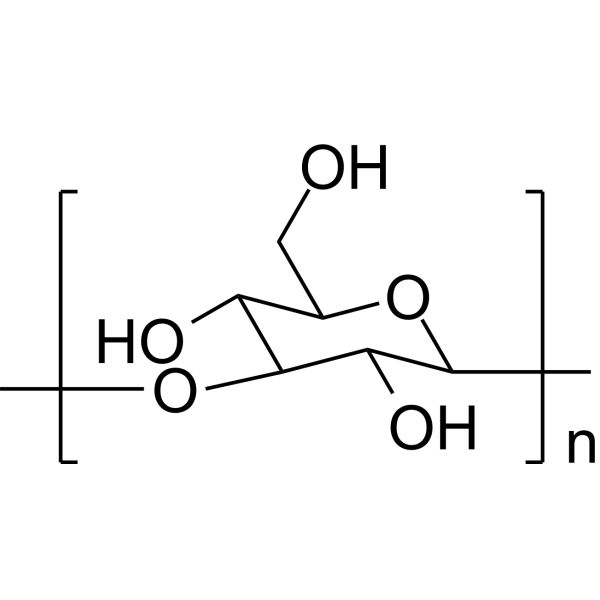
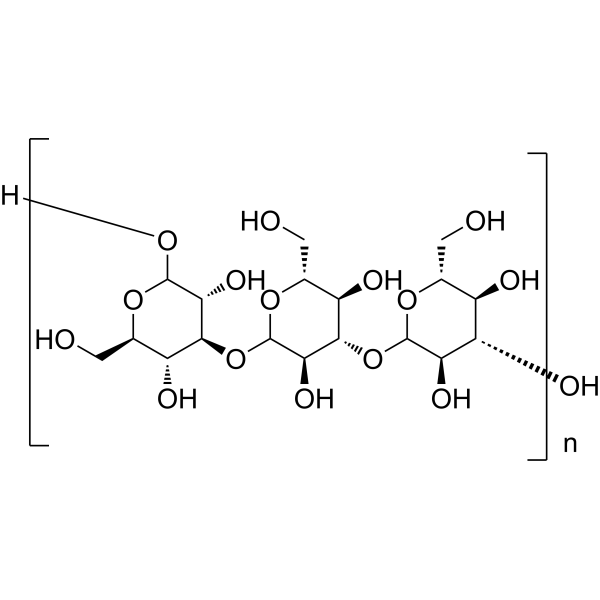
[D-Glucan]
-
Shipping
Room temperature in continental US; may vary elsewhere.
-
Storage
Powder -20°C 3 years 4°C 2 years In solvent -80°C 6 months -20°C 1 month


Solvent & Solubility
DMSO : 100 mg/mL (Need ultrasonic; Hygroscopic DMSO has a significant impact on the solubility of product, please use newly opened DMSO)
Select the appropriate dissolution method based on your experimental animal and administration route.
- For the following dissolution methods, please ensure to first prepare a clear stock solution using an In Vitro approach and then sequentially add co-solvents:
- To ensure reliable experimental results, the clarified stock solution can be appropriately stored based on storage conditions. As for the working solution for In Vivo experiments, it is recommended to prepare freshly and use it on the same day.
- The percentages shown for the solvents indicate their volumetric ratio in the final prepared solution. If precipitation or phase separation occurs during preparation, heat and/or sonication can be used to aid dissolution.
Add each solvent one by one: 10% DMSO 40% PEG300 5% Tween-80 45% Saline
Solubility: ≥ 2.5 mg/mL; Clear solution
This protocol yields a clear solution of ≥ 2.5 mg/mL (saturation unknown).
Taking 1 mL working solution as an example, add 100 μL DMSO stock solution (25.0 mg/mL) to 400 μL PEG300, and mix evenly; then add 50 μL Tween-80 and mix evenly; then add 450 μL Saline to adjust the volume to 1 mL.
Preparation of Saline: Dissolve 0.9 g sodium chloride in ddH₂O and dilute to 100 mL to obtain a clear Saline solution.
Add each solvent one by one: 10% DMSO 90% (20% SBE-β-CD in Saline)
Solubility: ≥ 2.5 mg/mL; Clear solution
This protocol yields a clear solution of ≥ 2.5 mg/mL (saturation unknown).
Taking 1 mL working solution as an example, add 100 μL DMSO stock solution (25.0 mg/mL) to 900 μL 20% SBE-β-CD in Saline, and mix evenly.
Preparation of 20% SBE-β-CD in Saline (4°C, storage for one week): 2 g SBE-β-CD powder is dissolved in 10 mL Saline, completely dissolve until clear.
Please enter the basic information of animal experiments:
-
-
-
-
Recommended: Prepare an additional quantity of animals to account for potential losses during experiments.
Please enter your animal formula composition:
-
%DMSO +
Recommended: Keep the proportion of DMSO in working solution below 2% if your animal is weak.
-
%+
-
+%Tween-80 + +
-
%Saline +
The co-solvents required include: DMSO, . All of co-solvents are available by MedChemExpress (MCE). , Tween 80. All of co-solvents are available by MedChemExpress (MCE).
Working solution concentration: 0.22 mg/mL
Method for preparing stock solution: mg drug dissolved in μL DMSO. Stock solution concentration: mg/mL.
1. Take μL DMSO stock solution;
2. Add μL .
μL , mix evenly;
3. Then add μL Tween 80, mix evenly;
4. Then add μL
Please ensure that the stock solution in the first step is dissolved to a clear state, and add co-solvents in sequence. You can use ultrasonic heating (ultrasonic cleaner, recommended frequency 20-40 kHz), vortexing, etc. to assist dissolution.


Purity & Documentation
-
Data Sheet (276 KB)
-
SDS (393 KB)
- English - EN (393 KB)
- Français - FR (393 KB)
- Deutsch - DE (393 KB)
- Norwegian - NO (393 KB)
- Español - ES (393 KB)
- Swedish - SV (393 KB)
- Italian - IT (393 KB)
- Korean - KR (393 KB)
- Portuguese - PT (393 KB)
-
Handling Instructions (2659 KB)
References
[1]. Ljungman AG, et al. (1→3) -β-d-Glucan stimulates nitric oxide generation and cytokine mRNA expression in macrophages. Environ Toxicol Pharmacol. 1998 Jun 2;5 (4) :273-81. [Content Brief]
[2]. Toklu HZ, et al. Acetaminophen-induced toxicity is prevented by beta-D-glucan treatment in mice. Eur J Pharmacol. 2006 Aug 14;543 (1-3) :133-40. [Content Brief]
[3]. Tabeie F, et al. Radioprotective Effect of Beta D-Glucan and Vitamin E on Gamma Irradiated Mouse. J Clin Diagn Res. 2017 Feb;11 (2) :TC08-TC11. [Content Brief]
[4]. Liu M, et al. The anti-diabetic activity of oat β-d-glucan in streptozotocin-nicotinamide induced diabetic mice. Int J Biol Macromol. 2016 Oct;91:1170-6. [Content Brief]

Calculators
Concentration (start) × Volume (start) = Concentration (final) × Volume (final)


D-Glucan Related Classifications
HY-134816 Related Classifications
 Powered by Bioz