



Protegrin-1
Based on 2 publication(s) in Google Scholar
Protegrin-1 is an orally active antibacterial peptide. Protegrin-1 activates ERK, COX2, NFκB, inhibits Apoptosis, and NO production. Protegrin-1 has antibacterial activity against S. aureus, E. faecium, E. coli, P. aeruginosa and K. Pneumoniae, with MBC values between 10 and 20 µM. Protegrin-1 has antiviral activity against dengue NS2B-NS3. Protegrin-1 has anti-inflammatory activity. Protegrin-1 is used in the study of inflammatory diseases and infections.
For research use only. We do not sell to patients.
- Purity: 99.96%
- CAS No.: 168831-77-4
- Formula: C88H147N37O19S4
- Molecular Weight:2155.61
-
Storage:
Sealed storage, away from moisture.
Powder -80°C, 2 years , -20°C, 1 year* In solvent : -80°C, 6 months; -20°C, 1 month (sealed storage, away from moisture)

To place orders, for customer services and technical support, please contact: MedChemExpress USA
Tel: 609-228-6898 E-mail: [email protected] [email protected]


-
 Biological Activity
-
Chemical Information
-
Solvent & Solubility
- Purity & Documentation
- References
-
 Help & FAQs


Publications Citing Use of MedChemExpress (MCE) Protegrin-1
More

Biological Activity
Protegrin-1 (2.5-12.5 μM; 24-72 h) inhibits dengue NS2B-NS3 serine protease and viral replication in MK2 cells[1].
Protegrin-1 (1-9 μM; 16 h) promotes the migration of IPEC-J2 cells[2].
Protegrin-1 (>100 μM; 24 h) reduces the viability of 661W and PMN cells[3].
Protegrin-1 (0.1-10 μg/mL; 24 h) inhibits porcine ovarian granulosa cell apoptosis from Hydrogen peroxide-induced oxidative stress via the PERK/eIF2a/CHOP signaling pathway[5].
Protegrin-1 shows antimicrobial activity against S. aureus, E. faecium, E. coli, P. aeruginosa and K. Pneumoniae, with MBC values between 10 and 20 µM[6].
Protegrin-1 (1.25-20 μM) inhibits LPS-induced activation of RAW macrophages, inhibiting the NO production[6].
MedChemExpress (MCE) has not independently confirmed the accuracy of these methods. They are for reference only.
-
Cell Line:IPEC-J2
-
Concentration:9 μM
-
Incubation Time:3 h
-
Result:Increased CCL2, COX2, IRF7, NFκB, EGFR, and MCL-1.
Protegrin-1 (5 mg/kg; i.v.; single) reduces the mortality of mice inoculated intravenously with Staphylococcus aureus[7].
Protegrin-1 (10 mg/kg; p.o.) reduces Citrobacter rodentium intestinal infection in mice as evidenced by reduced histopathologic change in the colon, prevention of body weight loss, milder clinical signs of disease[8].
MedChemExpress (MCE) has not independently confirmed the accuracy of these methods. They are for reference only.
-
Animal Model:Immunocompetent mice inoculated with Pseudomonas aeruginosa or Staphylococcus aureus by intraperitoneal injection; mice inoculated with Staphylococcus aureus by intravenous injection; leukopenic mice[7]
-
Dosage:0.5 mg/kg (mice inoculated with Pseudomonas aeruginosa or Staphylococcus aureus by intraperitoneal injection); 5 mg/kg (mice inoculated with Staphylococcus aureus by intravenous injection); 2.5 mg/kg (leukopenic mice)
-
Administration:Intraperitoneal injection (i.p.) (0.5 mg/kg); Intravenous injection (i.v.) (2.5, 5 mg/kg); single
-
Result:Caused 0% to 27% mortality (0.5 mg/kg).
Caused 7% to 33% mortality (5 mg/kg).
Caused 33% mortality (2.5 mg/kg).
| NCT Number | Sponsor | Condition | Start Date |
Phase

|
|---|---|---|---|---|
| NCT01329991 | Plexxikon| | 2011-05 | PHASE1 |


Chemical Information
-
CAS No. 168831-77-4
-
Appearance Solid
-
Molecular Weight 2155.61
-
Formula C88H147N37O19S4
-
Color White to off-white
-
Synonyms
PG1
-
Sequence
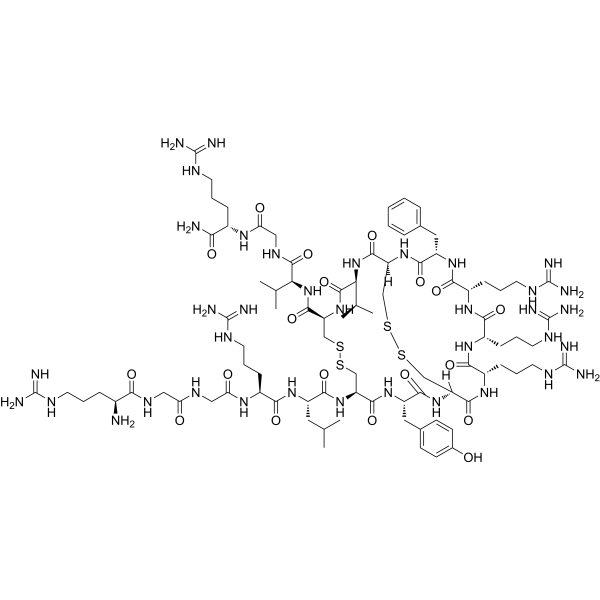
Arg-Gly-Gly-Arg-Leu-Cys-Tyr-Cys-Arg-Arg-Arg-Phe-Cys-Val-Cys-Val-Gly-Arg-NH2 (Disulfide bridge:Cys6-Cys15;Cys8-Cys13)
-
Sequence Shortening
RGGRLCYCRRRFCVCVGR-NH2 (Disulfide bridge:Cys6-Cys15;Cys8-Cys13)
-
Shipping
Room temperature in continental US; may vary elsewhere.
-
Storage
Sealed storage, away from moisture
Powder -80°C 2 years -20°C 1 year * In solvent : -80°C, 6 months; -20°C, 1 month (sealed storage, away from moisture)


Publications (2)
-
Journal Impact Factor
-
Most Recent
-
Int J Pharm
Combined antimicrobial and pro-healing effects of cathelicidins in a polysaccharide-based hydrogel scaffold: treatment of carbapenemase-resistant Pseudomonas aeruginosa wound infections in a porcine model. [Abstract]2026 Jun 25:699:126992. PMID: 42150643 -
Folia Microbiol (Praha)
EDTA enhances antimicrobial activity of PR-39 and Protegrin-1 antimicrobial peptides against carbapenem-resistant Pseudomonas aeruginosa in serum. [Abstract]2026 May 28. PMID: 42207438


Solvent & Solubility
DMSO : 20 mg/mL (9.28 mM; Need ultrasonic; Hygroscopic DMSO has a significant impact on the solubility of product, please use newly opened DMSO)
Please refer to the solubility information to select the appropriate solvent. Once prepared, please aliquot and store the solution to prevent product inactivation from repeated freeze-thaw cycles.
Storage method and period of stock solution: -80°C, 6 months; -20°C, 1 month (sealed storage, away from moisture). When stored at -80°C, please use it within 6 months. When stored at -20°C, please use it within 1 month.
Please refer to the solubility information to select the appropriate solvent. Once prepared, please aliquot and store the solution to prevent product inactivation from repeated freeze-thaw cycles.
Storage method and period of stock solution: -80°C, 6 months; -20°C, 1 month (sealed storage, away from moisture). When stored at -80°C, please use it within 6 months. When stored at -20°C, please use it within 1 month.
Concentration (start) × Volume (start) = Concentration (final) × Volume (final)


Purity & Documentation
-
Data Sheet (287 KB)
-
SDS (254 KB)
- English - EN (254 KB)
- Français - FR (254 KB)
- Deutsch - DE (254 KB)
- Norwegian - NO (254 KB)
- Español - ES (254 KB)
- Swedish - SV (254 KB)
- Italian - IT (254 KB)
- Korean - KR (254 KB)
- Portuguese - PT (254 KB)
-
Handling Instructions (2659 KB)
References
[1]. Rothan HA, et al. Protegrin-1 inhibits dengue NS2B-NS3 serine protease and viral replication in MK2 cells. J Biomed Biotechnol. 2012;2012:251482. [Content Brief]
[2]. Penney J, et al. Protegrin 1 Enhances Innate Cellular Defense via the Insulin-Like Growth Factor 1 Receptor Pathway. Front Cell Infect Microbiol. 2018 Sep 28;8:331. [Content Brief]
[3]. Soundrarajan N, et al. Protegrin-1 cytotoxicity towards mammalian cells positively correlates with the magnitude of conformational changes of the unfolded form upon cell interaction. Sci Rep. 2019 Aug 9;9(1):11569. [Content Brief]
[5]. Li X, et al. Protegrin-1 inhibits porcine ovarian granulosa cell apoptosis from H2O2-induced oxidative stress via the PERK/eIF2α/CHOP signaling pathway in vitro. Theriogenology. 2022 Feb;179:117-127. [Content Brief]
[6]. Javed A, et al. Antimicrobial and immunomodulatory activities of porcine cathelicidin Protegrin-1. Mol Immunol. 2024 Sep;173:100-109. [Content Brief]
[7]. Steinberg DA, et al. Protegrin-1: a broad-spectrum, rapidly microbicidal peptide with in vivo activity. Antimicrob Agents Chemother. 1997 Aug;41(8):1738-42. [Content Brief]
[8]. Osakowicz C, et al. Protective and Anti-Inflammatory Effects of Protegrin-1 on Citrobacter rodentium Intestinal Infection in Mice. Int J Mol Sci. 2021 Aug 31;22(17):9494. [Content Brief]


Complete Stock Solution Preparation Table
Please refer to the solubility information to select the appropriate solvent. Once prepared, please aliquot and store the solution to prevent product inactivation from repeated freeze-thaw cycles.
Storage method and period of stock solution: -80°C, 6 months; -20°C, 1 month (sealed storage, away from moisture). When stored at -80°C, please use it within 6 months. When stored at -20°C, please use it within 1 month.
| Optional Solvent | Concentration Solvent Mass | 1 mg | 5 mg | 10 mg | 25 mg |
|---|---|---|---|---|---|
| DMSO | 1 mM | 0.4639 mL | 2.3195 mL | 4.6391 mL | 11.5976 mL |
| 5 mM | 0.0928 mL | 0.4639 mL | 0.9278 mL | 2.3195 mL |


Protegrin-1 Related Classifications
HY-P1633 Related Classifications
 Powered by Bioz