



1330267-50-9

Chemical Structure
Mexiletine-d6
Synonym(s): KOE-1173-d6
- CAS No.: 1330267-50-9
- Formula:C11H11D6NO
- Molecular Weight:185.30
InChIKey: VLPIATFUUWWMKC-DZMJLSHMSA-N
SMILES: CC1=C(C(C)=CC=C1)OC([2H])(C([2H])(C([2H])([2H])[2H])N)[2H]
Biological Activity: Mexiletine-d6 (KOE-1173-d6) is deuterium labeled Mexiletine. Mexiletine is an orally effective antiarrhythmic agent which has also been found to be effective for myotonia and neuropathic pain. Mexiletine exerts its efficacy through blocking sodium channels (IC50 : 75±8 μM for tonic block, 23.6±2.8 μM for use-dependent block), therefore can be used for cardiovascular and neurological research[1][2][3][4][5].
| Cat. No. | Product Name | Purity | Description | Pricing | |||||||||||||||||||
|---|---|---|---|---|---|---|---|---|---|---|---|---|---|---|---|---|---|---|---|---|---|---|---|
|
|
Mexiletine-d6 | Mexiletine-d6 (KOE-1173-d6) is deuterium labeled Mexiletine. Mexiletine is an orally effective antiarrhythmic agent which has also been found to be effective for myotonia and neuropathic pain. Mexiletine exerts its efficacy through blocking sodium channels (IC50 : 75±8 μM for tonic block, 23.6±2.8 μM for use-dependent block), therefore can be used for cardiovascular and neurological research. | |||||||||||||||||||||
|
loading...
/
|
|||||||||||||||||||||||
|
|
Mexiletine-d3 | Mexiletine-d3 (KOE-1173-d3) is deuterium labeled Mexiletine. Mexiletine is an orally effective antiarrhythmic agent which has also been found to be effective for myotonia and neuropathic pain. Mexiletine exerts its efficacy through blocking sodium channels (IC50 : 75±8 μM for tonic block, 23.6±2.8 μM for use-dependent block), therefore can be used for cardiovascular and neurological research. | |||||||||||||||||||||
|
loading...
/
|
|||||||||||||||||||||||
|
|
Mexiletine | 99.92% | Mexiletine is an orally effective antiarrhythmic agent which has also been found to be effective for myotonia and neuropathic pain. Mexiletine exerts its efficacy through blocking sodium channels (IC50 : 75±8 μM for tonic block, 23.6±2.8 μM for use-dependent block), therefore can be used for cardiovascular and neurological research. | ||||||||||||||||||||
|
loading...
/
|
|||||||||||||||||||||||
-
Similarity Score 0.97
 HY-A0093RMexiletine hydrochloride (Standard)
-
Similarity Score 0.78
 HY-124331H77-77
-
Similarity Score 0.76
 HY-N61492-Isobutoxyaniline
-
Similarity Score 0.76
 HY-W7133122,6-DMA hydrochloride
-
Similarity Score 0.74
 HY-I0882R2-Isopropoxy-5-methylaniline (Standard)
-
Similarity Score 0.74
 HY-1390452,4-DMA hydrochloride
-
Similarity Score 0.74
 HY-B1283RMephenesin (Standard)
-
Similarity Score 0.74
 HY-1164414-Hydroxy-3-methoxyamphetamine hydrochloride
-
Similarity Score 0.73
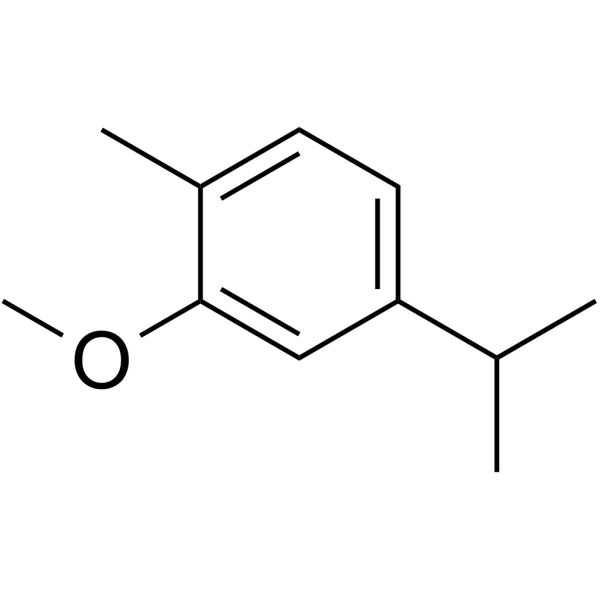 HY-W049970Carvacrol methyl ether
-

Explore the MedChemAI to find more analogs


References
- [1]. Russak EM, et al. Impact of Deuterium Substitution on the Pharmacokinetics of Pharmaceuticals. Ann Pharmacother. 2019;53(2):211-216. [Content Brief]
- [2]. Campbell RW, et al. Mexiletine. N Engl J Med. 1987,316(1):29-34. [Content Brief]
- [3]. De Bellis M, et al. Combined modifications of mexiletine pharmacophores for new lead blockers of Na(v)1.4 channels. Biophys J. 2013,104(2):344-54. [Content Brief]
- [4]. Nasilli G, et al. Mexiletine reverses oxaliplatin-induced neuropathic pain in rats. J Pharmacol Sci. 2010;112(4):473-6. [Content Brief]
- [5]. Egashira N, et al. Mexiletine reverses oxaliplatin-induced neuropathic pain in rats. J Pharmacol Sci. 2010,112(4):473-6. [Content Brief]



