



ZJ43

Based on 1 Customer Validation
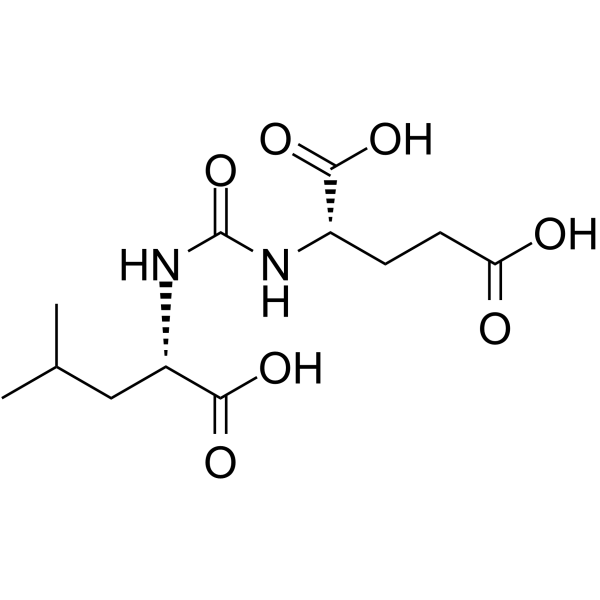
ZJ43 is a NAAG peptidase inhibitor and glutamate carboxypeptidase II/III (GCP II/III) inhibitor with human GCP II IC50 of 2.4 nM and Ki of 0.8 nM. ZJ43 blocks N-acetylaspartylglutamate hydrolysis, elevates extracellular N-acetylaspartylglutamate levels, and activates group II metabotropic glutamate receptors (mGluR). ZJ43 can be used for the research of schizophrenia, inflammatory pain, neuropathic pain, and traumatic brain injury.
Nur für Forschungszwecke. Wir verkaufen nicht an Patienten.
- Reinheit : 99.6%
- CAS. Nr.: 723331-20-2
- Formel: C12H20N2O7
- Molecular Weight:304.30
-
Speicherung:Powder -20°C, 3 years , 4°C, 2 years ; In solvent -80°C, 6 months , -20°C, 1 month

To place orders, for customer services and technical support, please contact: MedChemExpress USA
Tel: 609-228-6898 E-mail: [email protected] [email protected]


-
 Biologische Aktivität
-
Chemical Information
- Protokoll
- Reinheit & Dokumentation
- Verweise
-
 Help & FAQs




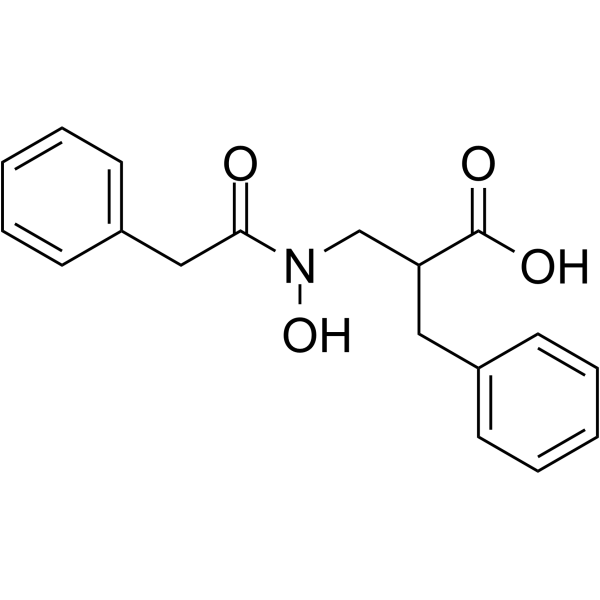
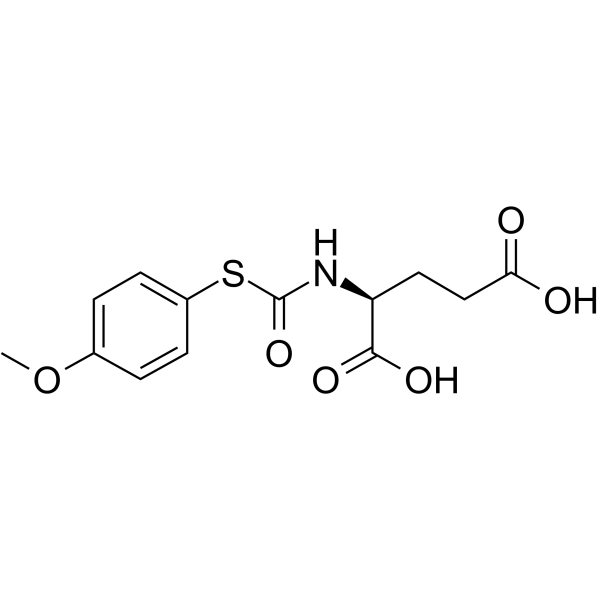


Biologische Aktivität
Beschreibung
IC50 & Target
[1]|
group II mGlu receptors |
In Vitro
ZJ43 (range sufficient to generate dose-response curves; 2 h) potently inhibits cloned human GCP II with a Ki of 0.8 nM[1].
ZJ43 (range sufficient to generate dose-response curves) inhibits cloned mouse GCP III with a Ki of 23 nM[1].
ZJ43 (2 h) inhibits cloned rat GCPII with a Ki of 3 nM[3].
MedChemExpress (MCE) has not independently confirmed the accuracy of these methods. They are for reference only.
In Vivo
ZJ43 (10-100 mg/kg; i.v.; single dose) produces dose-dependent analgesia in the rat Formalin inflammatory pain model[3].
ZJ43 (10-100 mg/kg; i.v.; single dose) produces dose-dependent antiallodynic effects in the rat partial sciatic nerve ligation neuropathic pain model[3].
ZJ43 (100 mg/kg; i.v.; single dose) does not alter acute nociceptive responses to noxious mechanical or thermal stimulation in healthy rats[3].
ZJ43 (50-150 mg/kg; i.p.; every 8 h; 3 total doses) significantly reduces ipsilateral neuronal degeneration in rat lateral fluid percussion TBI[4].
MedChemExpress (MCE) has not independently confirmed the accuracy of these methods. They are for reference only.
-
Animal Model:Sprague-Dawley (male, 280-330 g, PCP-induced schizophrenia-like symptoms)[1]
-
Dosage:150 mg/kg
-
Administration:i.p.; single dose
-
Result:Significantly reduced PCP-induced motor activity, with a statistically significant difference in total distance traveled between 80-180 min compared to PCP-only treated rats (p = 0.021).
Significantly increased the frequency of rats being "still" (p = 0.015).
Significantly reduced PCP-induced stereotypic falling (p = 0.02), circling movements (p ≤ 0.001), total head movements (p = 0.005), and head bobbing (p = 0.004) compared to PCP-only treated rats.
Produced a non-statistically significant trend toward reduced PCP-induced mouth movements, tremors, and sideways head movements.
Failed to reduce PCP-induced sniffing and showed a non-significant tendency to increase this behavior (p = 0.17).
-
Animal Model:Rats (Formalin-induced inflammatory pain model)[3]
-
Dosage:10 mg/kg; 100 mg/kg
-
Administration:i.v.; single dose
-
Result:Decreased cumulative formalin-evoked flinches in both phase 1 (0-6 minutes) and phase 2 (10-60 minutes) in a dose-dependent manner (phase 1 P < 0.005, phase 2 P < 0.001).
Reduced flinching to ~50% of vehicle response in phase 1 and ~30% of vehicle response in phase 2 at 100 mg/kg.
-
Animal Model:Rats (partial sciatic nerve ligation neuropathic pain model)[3]
-
Dosage:10 mg/kg; 100 mg/kg
-
Administration:i.v.; single dose
-
Result:Significantly increased the maximum 50% probability mechanical withdrawal threshold in a dose-dependent manner (P < 0.001).
Elevated the threshold to ~13 g at 100 mg/kg (compared to ~2 g in saline-treated rats).
-
Animal Model:Rats[3]
-
Dosage:100 mg/kg
-
Administration:i.v.; single dose
-
Result:Had no significant effect on the number of paw withdrawal responses to noxious mechanical stimulation, with maximum responses (18.8) and minimum responses (15.6) not differing significantly from saline-treated rats (P > 0.3).
Had no significant effect on hotplate response latency, with % maximum possible effect (-9.9) not differing significantly from saline-treated rats (P > 0.8).
-
Animal Model:Sprague-Dawley (male, 340 g, lateral fluid percussion TBI moel)[4]
-
Dosage:50 mg/kg; 100 mg/kg; 150 mg/kg
-
Administration:i.p.; every 8 h; 3 total doses
-
Result:Significantly reduced the number of ipsilateral degenerating neurons in the hippocampal CA2/3 regions compared to vehicle (p < 0.01).
Reduced ipsilateral astrocyte loss to 14.0% versus 30.6% in the vehicle group at 50 mg/kg dose (p = 0.05; p = 0.007).


Chemical Information
-
CAS. Nr. 723331-20-2
-
Appearance Solid
-
Molecular Weight 304.30
-
Formel C12H20N2O7
-
Color Colorless to off-white
-
SMILES
O=C(N[C@H](C(O)=O)CCC(O)=O)N[C@H](C(O)=O)CC(C)C
-
Versand
Room temperature in continental US; may vary elsewhere.
-
Speicherung
Powder -20°C 3 years 4°C 2 years In solvent -80°C 6 months -20°C 1 month


Reinheit & Dokumentation
-
Data Sheet (278 KB)
-
SDS (393 KB)
- English - EN (393 KB)
- Français - FR (393 KB)
- Deutsch - DE (393 KB)
- Norwegian - NO (393 KB)
- Español - ES (393 KB)
- Swedish - SV (393 KB)
- Italian - IT (393 KB)
- Korean - KR (393 KB)
- Portuguese - PT (393 KB)
-
Handling Instructions (2659 KB)
Verweise
[1]. Olszewski RT, et al. NAAG peptidase inhibition reduces locomotor activity and some stereotypes in the PCP model of schizophrenia via group II mGluR. J Neurochem. 2004 May;89(4):876-85. [Content Brief]
[2]. Nonaka T, et al. A role for the locus coeruleus in the analgesic efficacy of N-acetylaspartylglutamate peptidase (GCPII) inhibitors ZJ43 and 2-PMPA. Mol Pain. 2017;13:1744806917697008. [Content Brief]
[3]. Yamamoto T, et al. Antinociceptive effects of N-acetylaspartylglutamate (NAAG) peptidase inhibitors ZJ-11, ZJ-17 and ZJ-43 in the rat formalin test and in the rat neuropathic pain model. Eur J Neurosci. 2004;20(2):483-494. [Content Brief]
[4]. Zhong C, et al. NAAG peptidase inhibitor reduces acute neuronal degeneration and astrocyte damage following lateral fluid percussion TBI in rats. J Neurotrauma. 2005;22(2):266-276. [Content Brief]

Calculators
Konzentration (Stammlösung) × Volumen (Stammlösung) = Konzentration (Ziellösung) × Volumen (Ziellösung)


ZJ43 Related Classifications
HY-103344 Related Classifications
 Powered by Bioz
Keywords
- ZJ43
- 723331-20-2
- ZJ 43
- ZJ-43
- Aminopeptidase
- Carboxypeptidase
- mGluR
- N-acetylaspartylglutamate
- male Sprague-Dawley rats
- group II metabotropic glutamate receptors
- inflammatory pain
- NMDA receptor
- glutamate carboxypeptidase III
- rat cerebellar granule cells
- glutamate carboxypeptidase II
- traumatic brain injury
- neuropathic pain
- Inhibitor
- inhibitor
- inhibit