



Fluphenazine
Based on 3 publication(s) in Google Scholar
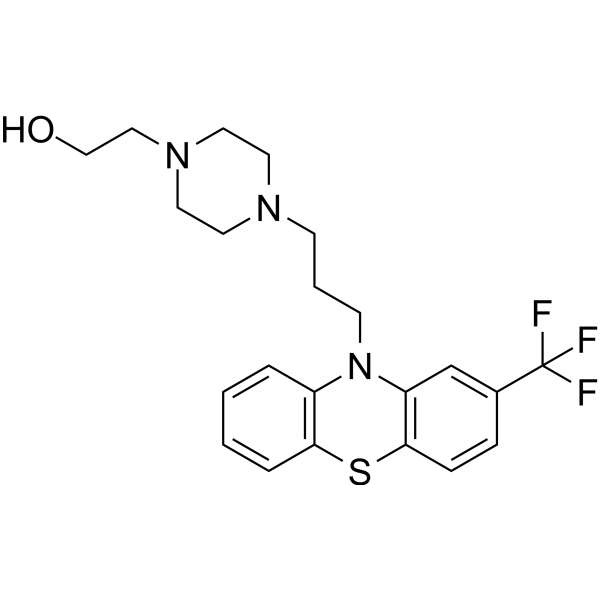
Fluphenazine is a potent, orally active phenothiazine-based dopamine receptor antagonist. Fluphenazine blocks neuronal voltage-gated sodium channels. Fluphenazine acts primarily through antagonism of postsynaptic dopamine-2 receptors in mesolimbic, nigrostriatal, and tuberoinfundibular neural pathways. Fluphenazine can antagonize Methylphenidate-induced stereotyped gnawing and inhibit climbing behaviour in mice. Fluphenazine can be used for researching psychosis and painful peripheral neuropathy associated with diabetes and has potential to inhibit SARS-CoV-2.
Nos produits utilisent uniquement pour la recherche. Nous ne vendons pas aux patients.
- Pureté: 98.70%
- CAS No.: 69-23-8
- Formule: C22H26F3N3OS
- Masse moléculaire:437.52
-
Stockage:Pure form -20°C, 3 years , 4°C, 2 years ; In solvent -80°C, 6 months , -20°C, 1 month

To place orders, for customer services and technical support, please contact: MedChemExpress USA
Tel: 609-228-6898 E-mail: [email protected] [email protected]


-
 Activité biologique
-
Chemical Information
-
Solvant et solubilité
- Pureté et documentation
- Références
-
 Help & FAQs
-


Anti-diabetic Compound Library
HY-L040
-
Orally Active Compound Library
HY-L061
-
Neurotransmitter Receptor Compound Library
HY-L062
-
FDA Approved & Pharmacopeial Drug Library
HY-L066
-
Neuroprotective Compound Library
HY-L070
-
Neurodegenerative Disease-related Compound Library
HY-L086
-
Mechanoreceptors Compound Library
HY-L095
-
Sodium Channel Blocker Library
HY-L118
-
FDA-Approved Anticancer Drug Library
HY-L122
-
Human Metabolite Library
HY-L123
-
Off-patent Drug Library
HY-L141
-
Membrane Protein-targeted Compound Library
HY-L149
-
Membrane Receptor-targeted Compound Library
HY-L150
-
Mitochondrial Toxicity Compound Library
HY-L155
-
Dopamine Receptor Compound Library
HY-L165
-
Ion Channel Compound Library
HY-L166
-
Multi-Target Compound Library
HY-L176
-
Bioactive Compound Library Max
HY-L181
-
MCE Bioactive Compound Library
HY-L001V
-
Drug Repurposing Compound Library Plus
HY-L035P
-
FDA-Approved Drug Library Plus
HY-L022P
-
FDA-Approved Drug Library Mini
HY-L022M
-
Bioactive Compound Library
HY-L001
-
High-Throughput Bioactive Compound Library
HY-L205
-
Mass Spectrometry Human Metabolite Library
HY-L215
-
Lactylation Compound Library
HY-L249
-
Anti-Infection Compound Library
HY-L002
-
GPCR/G Protein Compound Library
HY-L006
-
Immunology/Inflammation Compound Library
HY-L007
-
Membrane Transporter/Ion Channel Compound Library
HY-L011
-
Neuronal Signaling Compound Library
HY-L013
-
FDA-Approved Drug Library
HY-L022
-
Anti-Cancer Compound Library
HY-L025
-
Antiviral Compound Library
HY-L027
-
Drug Repurposing Compound Library
HY-L035


Publications Citing Use of MedChemExpress (MCE) Fluphenazine
MoreVoir tous les produits spécifiques à Isoform Dopamine Receptor
More

Activité biologique
|
Cell Line

|
Type | Value | Description | References |
|---|---|---|---|---|
| HEK293 | IC50 |
110 μM
Compound: fluphenazine
|
Inhibition of 4-(4-(dimethylamino)styryl)-N-methylpyridinium uptake at human OCT1 expressed in HEK293 cells by confocal microscopy
Inhibition of 4-(4-(dimethylamino)styryl)-N-methylpyridinium uptake at human OCT1 expressed in HEK293 cells by confocal microscopy
|
[PMID: 18788725] |
| HepG2 | IC50 |
4.4 μM
Compound: SYSU-20913S
|
Cytotoxicity against human HepG2 cells assessed as reduction in cell viability after 48 hrs by CCK8 assay
Cytotoxicity against human HepG2 cells assessed as reduction in cell viability after 48 hrs by CCK8 assay
|
10.1039/C3MD00397C |
| HUVEC | IC50 |
38.01 μM
Compound: Fluphenazine
|
Antiproliferative activity against human HUVEC cells assessed as inhibition of cell growth in measured after 72 hrs by MTT assay
Antiproliferative activity against human HUVEC cells assessed as inhibition of cell growth in measured after 72 hrs by MTT assay
|
[PMID: 34435487] |
| L02 | IC50 |
>160 μM
Compound: SYSU-20913S
|
Cytotoxicity against human LO2 cells assessed as reduction in cell viability after 48 hrs by CCK8 assay
Cytotoxicity against human LO2 cells assessed as reduction in cell viability after 48 hrs by CCK8 assay
|
10.1039/C3MD00397C |
| LoVo | IC50 |
80 μM
Compound: Fluphenazine
|
Antiproliferative activity against human LoVo cells assessed as reduction in cell viability incubated for 48 hrs by MTT assay
Antiproliferative activity against human LoVo cells assessed as reduction in cell viability incubated for 48 hrs by MTT assay
|
[PMID: 37060756] |
| MCF7 | IC50 |
24.57 μM
Compound: Fluphenazine
|
Antiproliferative activity against human MCF7 cells assessed as inhibition of cell growth measured after 72 hrs by MTT assay
Antiproliferative activity against human MCF7 cells assessed as inhibition of cell growth measured after 72 hrs by MTT assay
|
[PMID: 34435487] |
| MDA-MB-231 | IC50 |
16.73 μM
Compound: Fluphenazine
|
Antiproliferative activity against human MDA-MB-231 cells assessed as inhibition of cell growth measured after 72 hrs by MTT assay
Antiproliferative activity against human MDA-MB-231 cells assessed as inhibition of cell growth measured after 72 hrs by MTT assay
|
[PMID: 34435487] |
| MDA-MB-231 | IC50 |
18.56 μM
Compound: Fluphenazine
|
Antiproliferative activity against human drug tolerant MDA-MB-231/lapatinib cells assessed as inhibition of cell growth in measured after 72 hrs by MTT assay
Antiproliferative activity against human drug tolerant MDA-MB-231/lapatinib cells assessed as inhibition of cell growth in measured after 72 hrs by MTT assay
|
[PMID: 34435487] |
| NIH-3T3-G185 | IC50 |
10.4 μM
Compound: Fluphenazine
|
TP_TRANSPORTER: inhibition of Rhodamine 123 efflux in NIH-3T3-G185 cells
TP_TRANSPORTER: inhibition of Rhodamine 123 efflux in NIH-3T3-G185 cells
|
[PMID: 11716514] |
| NIH-3T3-G185 | IC50 |
5.7 μM
Compound: Fluphenazine
|
TP_TRANSPORTER: inhibition of LDS-751 efflux in NIH-3T3-G185 cells
TP_TRANSPORTER: inhibition of LDS-751 efflux in NIH-3T3-G185 cells
|
[PMID: 11716514] |
| NIH-3T3-G185 | IC50 |
6.5 μM
Compound: Fluphenazine
|
TP_TRANSPORTER: inhibition of Daunorubicin efflux in NIH-3T3-G185 cells
TP_TRANSPORTER: inhibition of Daunorubicin efflux in NIH-3T3-G185 cells
|
[PMID: 11716514] |
Fluphenazine (0.125-1 mg/kg; IP, single dosage) antagonizes Methylphenidate-induced stereotyped gnawing; inhibits significantly climbing behaviour[6].
MedChemExpress (MCE) has not independently confirmed the accuracy of these methods. They are for reference only.
-
Animal Model:Mice (injected with 60 mg/kg Methylphenidate)[6]
-
Dosage:0.125, 0.25, 0.5, and 1 mg/kg
-
Administration:IP, single dosage
-
Result:Antagonized Methylphenidate-induced stereotyped gnawing; inhibited significantly climbing behaviour in mice at 0.0625-0.5 mg/kg, and at the dose of 1 mg/kg abolished this effect completely.
-
Animal Model:Mature female Swiss-Webster mice[5]
-
Dosage:1 mg/kg
-
Administration:IG, treated from day 6 to day 15 of gestation
-
Result:Significantly reduced fetal weight and length, increased the incidence of incomplete ossification of sternebrae and skull bones.
| NCT Number | Sponsor | Condition | Start Date |
Phase
|
|---|---|---|---|---|
| NCT01329991 | Plexxikon| | 2011-05 | PHASE1 |


Chemical Information
-
CAS No. 69-23-8
-
Appearance Oil
-
Masse moléculaire 437.52
-
Formule C22H26F3N3OS
-
Color Colorless to off-white
-
SMILES
OCCN1CCN(CC1)CCCN2C3=C(SC4=C2C=C(C=C4)C(F)(F)F)C=CC=C3
-
Livraison
Room temperature in continental US; may vary elsewhere.
-
Stockage
Pure form -20°C 3 years 4°C 2 years In solvent -80°C 6 months -20°C 1 month


Publications (3)
-
Journal Impact Factor
-
Most Recent
-
Nat Commun
2025 Dec 18;16(1):11196. PMID: 41413037 -
Dev Cell
2024 Aug 19;59(16):2035-2052.e10. PMID: 39094564 -
Insect Biochem Mol Biol
Molecular and pharmacological characterization of the dopamine receptors in the oriental fruit fly, Bactrocera dorsalis. [Abstract]2025 May:180:104312. PMID: 40245998


Solvant et solubilité
DMSO : 100 mg/mL (228.56 mM; Need ultrasonic; Hygroscopic DMSO has a significant impact on the solubility of product, please use newly opened DMSO)
Please refer to the solubility information to select the appropriate solvent. Once prepared, please aliquot and store the solution to prevent product inactivation from repeated freeze-thaw cycles.
Storage method and period of stock solution: -80°C, 6 months; -20°C, 1 month. When stored at -80°C, please use it within 6 months. When stored at -20°C, please use it within 1 month.
Please refer to the solubility information to select the appropriate solvent. Once prepared, please aliquot and store the solution to prevent product inactivation from repeated freeze-thaw cycles.
Storage method and period of stock solution: -80°C, 6 months; -20°C, 1 month. When stored at -80°C, please use it within 6 months. When stored at -20°C, please use it within 1 month.
Concentration (start) × Volume (start) = Concentration (final) × Volume (final)
Select the appropriate dissolution method based on your experimental animal and administration route.
- For the following dissolution methods, please ensure to first prepare a clear stock solution using an In Vitro approach and then sequentially add co-solvents:
- To ensure reliable experimental results, the clarified stock solution can be appropriately stored based on storage conditions. As for the working solution for In Vivo experiments, it is recommended to prepare freshly and use it on the same day.
- The percentages shown for the solvents indicate their volumetric ratio in the final prepared solution. If precipitation or phase separation occurs during preparation, heat and/or sonication can be used to aid dissolution.
Add each solvent one by one: 10% DMSO 40% PEG300 5% Tween-80 45% Saline
Solubility: ≥ 5 mg/mL (11.43 mM); Clear solution
This protocol yields a clear solution of ≥ 5 mg/mL (saturation unknown).
Taking 1 mL working solution as an example, add 100 μL DMSO stock solution (50.0 mg/mL) to 400 μL PEG300, and mix evenly; then add 50 μL Tween-80 and mix evenly; then add 450 μL Saline to adjust the volume to 1 mL.
Preparation of Saline: Dissolve 0.9 g sodium chloride in ddH₂O and dilute to 100 mL to obtain a clear Saline solution.
Add each solvent one by one: 10% DMSO 90% (20% SBE-β-CD in Saline)
Solubility: ≥ 5 mg/mL (11.43 mM); Clear solution
This protocol yields a clear solution of ≥ 5 mg/mL (saturation unknown).
Taking 1 mL working solution as an example, add 100 μL DMSO stock solution (50.0 mg/mL) to 900 μL 20% SBE-β-CD in Saline, and mix evenly.
Preparation of 20% SBE-β-CD in Saline (4°C, storage for one week): 2 g SBE-β-CD powder is dissolved in 10 mL Saline, completely dissolve until clear.
Please enter the basic information of animal experiments:
-
-
-
-
Recommended: Prepare an additional quantity of animals to account for potential losses during experiments.
Please enter your animal formula composition:
-
%DMSO +
Recommended: Keep the proportion of DMSO in working solution below 2% if your animal is weak.
-
%+
-
+%Tween-80 + +
-
%Saline +
The co-solvents required include: DMSO, . All of co-solvents are available by MedChemExpress (MCE). , Tween 80. All of co-solvents are available by MedChemExpress (MCE).
Working solution concentration: 0.22 mg/mL
Method for preparing stock solution: mg drug dissolved in μL DMSO. Stock solution concentration: mg/mL.
1. Take μL DMSO stock solution;
2. Add μL .
μL , mix evenly;
3. Then add μL Tween 80, mix evenly;
4. Then add μL
Please ensure that the stock solution in the first step is dissolved to a clear state, and add co-solvents in sequence. You can use ultrasonic heating (ultrasonic cleaner, recommended frequency 20-40 kHz), vortexing, etc. to assist dissolution.


Pureté et documentation
-
Fiche technique (275 KB)
-
SDS (796 KB)
- English - EN (796 KB)
- Français - FR (796 KB)
- Deutsch - DE (796 KB)
- Norwegian - NO (796 KB)
- Español - ES (796 KB)
- Swedish - SV (796 KB)
- Italian - IT (796 KB)
- Korean - KR (796 KB)
- Portuguese - PT (796 KB)
-
Instruction de manipulation (2659 KB)
Références
[1]. Zhou X, et al. The neuroleptic drug, fluphenazine, blocks neuronal voltage-gated sodium channels. Brain Res. 2006;1106(1):72-81. [Content Brief]
[2]. Nazeam J, et al. Based on Principles and Insights of COVID-19 Epidemiology, Genome Sequencing, and Pathogenesis: Retrospective Analysis of Sinigrin and ProlixinRX (Fluphenazine) Provides Off-Label Drug Candidates. SLAS Discov. 2020 Dec;25(10):1123-1140. [Content Brief]
[3]. Siragusa S, Bistas KG, Saadabadi A. Fluphenazine. 2022 May 8. In: StatPearls [Internet]. Treasure Island (FL): StatPearls Publishing; 2022 Jan. [Content Brief]
[4]. Davis JL, et al. Peripheral diabetic neuropathy treated with amitriptyline and fluphenazine. JAMA. 1977 Nov 21;238(21):2291-2. [Content Brief]
[5]. Abdel-Hamid HA, et al. Teratogenic effect of diphenylhydantoin and/or fluphenazine in mice. J Appl Toxicol. 1996 May-Jun;16(3):221-5. [Content Brief]
[6]. Langwiński R, Niedzielski J. Narcotic analgesics and stereotyped behaviour in mice. Naunyn Schmiedebergs Arch Pharmacol. 1980 Jul;312(3):225-7. [Content Brief]


Complete Stock Solution Preparation Table
Please refer to the solubility information to select the appropriate solvent. Once prepared, please aliquot and store the solution to prevent product inactivation from repeated freeze-thaw cycles.
Storage method and period of stock solution: -80°C, 6 months; -20°C, 1 month. When stored at -80°C, please use it within 6 months. When stored at -20°C, please use it within 1 month.
| Optional Solvent | Concentration Solvent Mass | 1 mg | 5 mg | 10 mg | 25 mg |
|---|---|---|---|---|---|
| DMSO | 1 mM | 2.2856 mL | 11.4280 mL | 22.8561 mL | 57.1402 mL |
| 5 mM | 0.4571 mL | 2.2856 mL | 4.5712 mL | 11.4280 mL | |
| 10 mM | 0.2286 mL | 1.1428 mL | 2.2856 mL | 5.7140 mL | |
| 15 mM | 0.1524 mL | 0.7619 mL | 1.5237 mL | 3.8093 mL | |
| 20 mM | 0.1143 mL | 0.5714 mL | 1.1428 mL | 2.8570 mL | |
| 25 mM | 0.0914 mL | 0.4571 mL | 0.9142 mL | 2.2856 mL | |
| 30 mM | 0.0762 mL | 0.3809 mL | 0.7619 mL | 1.9047 mL | |
| 40 mM | 0.0571 mL | 0.2857 mL | 0.5714 mL | 1.4285 mL | |
| 50 mM | 0.0457 mL | 0.2286 mL | 0.4571 mL | 1.1428 mL | |
| 60 mM | 0.0381 mL | 0.1905 mL | 0.3809 mL | 0.9523 mL | |
| 80 mM | 0.0286 mL | 0.1429 mL | 0.2857 mL | 0.7143 mL | |
| 100 mM | 0.0229 mL | 0.1143 mL | 0.2286 mL | 0.5714 mL |


Fluphenazine Related Classifications
HY-119980 Related Classifications
 Powered by Bioz