



Emodinanthrone
Based on 1 publication(s) in Google Scholar
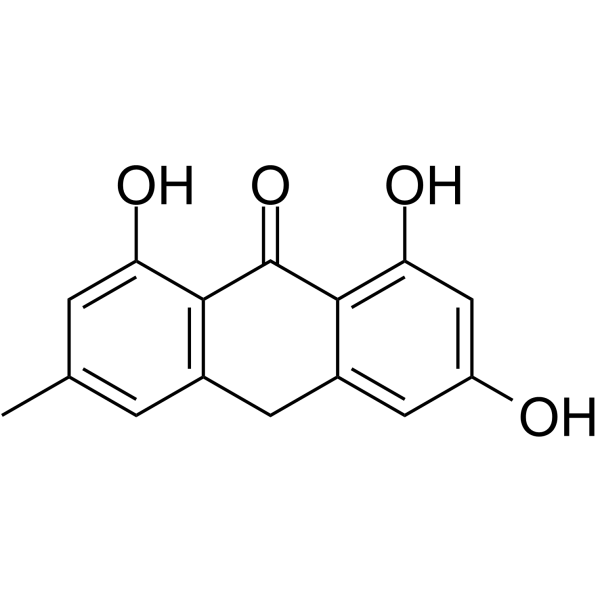
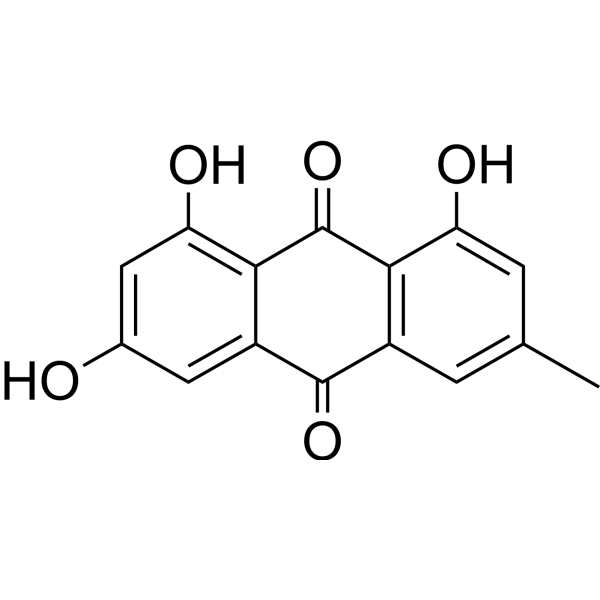
Emodinanthrone (EmodAn) is a MARCH7 stabilizer that inhibits ferroptosis (EC50=70 nM). Emodinanthrone is also a precursor to Emodin (HY-14393) and possesses antibiotic activity. Emodinanthrone directly binds to MARCH7 and blocks its ubiquitination-mediated degradation at the K608 site; this action enhances MARCH7-mediated K48 ubiquitination and degradation of NCOA4, as well as its regulation of the intracellular localization of TFR1 via K63 ubiquitination, thereby reducing the intracellular labile iron pool and blocking ferroptosis. Emodinanthrone demonstrates in vivo cardioprotective effects and exhibits a favorable safety profile. Emodinanthrone is applicable to research on ferroptosis-related cardiovascular diseases, including Doxorubicin (HY-15142A)-induced cardiomyopathy and myocardial ischemia-reperfusion injury.
商品は「研究用試薬」です。人や動物の医療用・臨床診断用・食品用の製品ではありません。
研究用途以外に使用した場合、当社は一切の責任を負いかねます。
- 純度 : 98.66%
- CAS 番号: 491-60-1
- 分子式: C15H12O4
- 分子量:256.25
-
保管条件:
4°C, protect from light
* In solvent : -80°C, 6 months; -20°C, 1 month (protect from light)

To place orders, for customer services and technical support, please contact: MedChemExpress USA
Tel: 609-228-6898 E-mail: [email protected] [email protected]


-
 生物活性
生物活性
-
化学情報
-
溶剤 & 溶解度
- プロトコル
- 純度とドキュメンテーション
- 参考文献
-
 Help & FAQs


MedChemExpress(MCE)の使用を引用している文献 Emodinanthrone
MoreAntibiotic アイソフォーム固有の製品をすべて表示
More

生物活性
製品説明
Cellular Effect
|
Cell Line

|
Type | Value | Description | References |
|---|---|---|---|---|
| HaCaT | IC50 |
>5 μM
Compound: 5k
|
Antiproliferative (inhibition of cell growth) activity against HaCaT cells (human keratinocyte line)
Antiproliferative (inhibition of cell growth) activity against HaCaT cells (human keratinocyte line)
|
[PMID: 9371243] |
| KB | IC50 |
3.9 μM
Compound: emodin anthrone
|
Cytotoxicity against human KB cells
Cytotoxicity against human KB cells
|
[PMID: 11575949] |
体外実験
Emodinanthrone (5 μM; 12 h) inhibits RSL3 (0.20 μM)-induced ferroptosis in HT-1080 cells, enhances cell viability, and reduces intracellular Fe2+ and lipid ROS levels[1].
Emodinanthrone (0.3125-5 μM; 12 h) dose-dependently enhances the viability of RSL3 (0.20 μM)-treated HT-1080 cells, exhibiting an anti-ferroptotic EC50 of 70 nM; it also demonstrates cytotoxicity against HT-1080 and HeLa cells, with IC50 values ??of 35.58 μM and 19.40 μM, respectively[1].
Emodinanthrone (5 μM; 12 h) fails to inhibit RSL3-induced ferroptosis in MARCHF7-knockdown/knockout HT-1080 cells, nor does it reduce lipid ROS levels in these cells[1].
Emodinanthrone (5 μM; 24 h) inhibits the RSL3-induced ubiquitination-mediated degradation of MARCH7 in HT-1080 cells, thereby stabilizing the MARCH7 protein, while having no effect on the ubiquitination and degradation of the MARCH7-K608R mutant[1].
Emodinanthrone (5 μM; 24 h) stabilizes the MARCH7 protein in HeLa cells and downregulates NCOA4 while upregulating the protein levels of FTH1 and GPX4[1].
Emodinanthrone (5 μM; 24 h) enhances the GFP-MARCH7 fluorescence signal in HeLa-GFP-MARCH7 cells, thereby stabilizing the MARCH7 protein[1].
MedChemExpress (MCE) has not independently confirmed the accuracy of these methods. They are for reference only.
-
Cell Line:HT-1080
-
Concentration:0.3125 μM, 0.625 μM, 1.25 μM, 2.5 μM, 5 μM
-
Incubation Time:24 h
-
Result:Showed no obvious cytotoxicity in normal HT-1080 cells, with an IC50 of 35.58 μM.
Dose-dependently increased cell viability in RSL3 (0.20 μM)-treated HT-1080 cells, with an anti-ferroptosis EC50 of 70 nM.
Significantly reversed RSL3-induced ferroptosis and cell viability reduction.
体内実験
Emodinanthrone (1 mg/kg; i.p.; 72 h prior to DOX modeling and continued for 3 days; and an additional 14 days) in Doxorubicin (DOX)-induced cardiomyopathy model in C57BL/6J male mice, induces serum levels of CK-MB, AST, and LDH; alleviates myocardial inflammation and fibrosis; reduces myocardial iron overload and lipid ROS; restores myocardial expression of MARCH7, GPX4, and FTH1 while downregulating NCOA4; and improves mouse survival rate[1].
Emodinanthrone (1 mg/kg; i.p.; once as a pretreatment prior to I/R modeling) in Myocardial Ischemia-Reperfusion (I/R) injury model in C57BL/6J male mice, reduces serum levels of AST, CK-MB, BUN, CK, and LDH; alleviates myocardial inflammation and fibrosis; reduces myocardial iron overload and lipid ROS; and restores myocardial expression of MARCH7, GPX4, and FTH1 while downregulating NCOA4[1].
MedChemExpress (MCE) has not independently confirmed the accuracy of these methods. They are for reference only.


化学情報
-
CAS 番号 491-60-1
-
性状 Solid
-
分子量 256.25
-
分子式 C15H12O4
-
Color Light yellow to yellow
-
SMILES
O=C1C2=C(C=C(C)C=C2O)CC3=CC(O)=CC(O)=C13
-
別名
EmodAN
-
Structure Classification
-
Initial Source
-
輸送条件
Room temperature in continental US; may vary elsewhere.
-
保管条件
4°C, protect from light
* In solvent : -80°C, 6 months; -20°C, 1 month (protect from light)


Publications (1)
-
Journal Impact Factor
-
Most Recent
-
Cell
2026 Jun 11;189(12):3553-3570.e30. PMID: 42049018


溶剤 & 溶解度
体外:
DMSO : 16.67 mg/mL (65.05 mM; ultrasonic and warming and heat to 80°C; Hygroscopic DMSO has a significant impact on the solubility of product, please use newly opened DMSO)
Please refer to the solubility information to select the appropriate solvent. Once prepared, please aliquot and store the solution to prevent product inactivation from repeated freeze-thaw cycles.
Storage method and period of stock solution: -80°C, 6 months; -20°C, 1 month (protect from light). When stored at -80°C, please use it within 6 months. When stored at -20°C, please use it within 1 month.
Please refer to the solubility information to select the appropriate solvent. Once prepared, please aliquot and store the solution to prevent product inactivation from repeated freeze-thaw cycles.
Storage method and period of stock solution: -80°C, 6 months; -20°C, 1 month (protect from light). When stored at -80°C, please use it within 6 months. When stored at -20°C, please use it within 1 month.
濃度 (開始) × 体積 (開始) = 濃度 (終了) × 体積 (終了)


純度とドキュメンテーション
-
データシート (277 KB)
-
SDS (251 KB)
- English - EN (251 KB)
- Français - FR (251 KB)
- Deutsch - DE (251 KB)
- Norwegian - NO (251 KB)
- Español - ES (251 KB)
- Swedish - SV (251 KB)
- Italian - IT (251 KB)
- Korean - KR (251 KB)
- Portuguese - PT (251 KB)
-
取扱説明書 (2659 KB)
参考文献
[1]. Huang W, et al. Stabilizing MARCH7 as a ferro-guardian against ferroptosis. Cell. 2026 Apr 27:S0092-8674(26)00388-0. [Content Brief]
[2]. Jin-Young Chung, et al. Expression, purification, and characterization of AknX anthrone oxygenase, which is involved in aklavinone biosynthesis in Streptomyces galilaeus. J Bacteriol. 2002 Nov;184(22):6115-22. [Content Brief]
[3]. T Ubbink-Kok, et al. Inhibition of electron transfer and uncoupling effects by emodin and emodinanthrone in Escherichia coli. Antimicrob Agents Chemother. 1986 Jul;30(1):147-51. [Content Brief]
[4]. M K Wang, et al. Triterpenoid saponins from Berneuxia thebetica. Phytochemistry. 1998 Aug;48(8):1411-4. [Content Brief]


Complete Stock Solution Preparation Table
Please refer to the solubility information to select the appropriate solvent. Once prepared, please aliquot and store the solution to prevent product inactivation from repeated freeze-thaw cycles.
Storage method and period of stock solution: -80°C, 6 months; -20°C, 1 month (protect from light). When stored at -80°C, please use it within 6 months. When stored at -20°C, please use it within 1 month.
| Optional Solvent | Concentration Solvent Mass | 1 mg | 5 mg | 10 mg | 25 mg |
|---|---|---|---|---|---|
| DMSO | 1 mM | 3.9024 mL | 19.5122 mL | 39.0244 mL | 97.5610 mL |
| 5 mM | 0.7805 mL | 3.9024 mL | 7.8049 mL | 19.5122 mL | |
| 10 mM | 0.3902 mL | 1.9512 mL | 3.9024 mL | 9.7561 mL | |
| 15 mM | 0.2602 mL | 1.3008 mL | 2.6016 mL | 6.5041 mL | |
| 20 mM | 0.1951 mL | 0.9756 mL | 1.9512 mL | 4.8780 mL | |
| 25 mM | 0.1561 mL | 0.7805 mL | 1.5610 mL | 3.9024 mL | |
| 30 mM | 0.1301 mL | 0.6504 mL | 1.3008 mL | 3.2520 mL | |
| 40 mM | 0.0976 mL | 0.4878 mL | 0.9756 mL | 2.4390 mL | |
| 50 mM | 0.0780 mL | 0.3902 mL | 0.7805 mL | 1.9512 mL | |
| 60 mM | 0.0650 mL | 0.3252 mL | 0.6504 mL | 1.6260 mL |


Emodinanthrone 関連分類
HY-N9362 関連分類
 Powered by Bioz