



Demethyleneberberine
Based on 3 publication(s) in Google Scholar
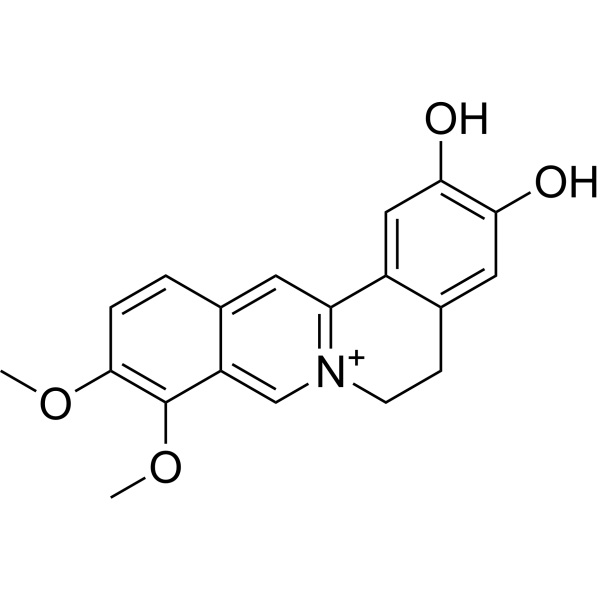
Demethyleneberberine is a blood-brain barrier-permeable antioxidant. Demethyleneberberine exerts antioxidant effects by targeting mitochondria, activates the AMPK signaling pathway to regulate lipid metabolism, and inhibits inflammation-related pathways such as NF-κB and MAPK. Demethyleneberberine can be used in the research of inflammatory and other diseases.
商品は「研究用試薬」です。人や動物の医療用・臨床診断用・食品用の製品ではありません。
研究用途以外に使用した場合、当社は一切の責任を負いかねます。
- CAS 番号: 25459-91-0
- 分子式: C19H18NO4+
- 分子量:324.35
-
保管条件:
4°C, protect from light
* In solvent : -80°C, 6 months; -20°C, 1 month (protect from light)

To place orders, for customer services and technical support, please contact: MedChemExpress USA
Tel: 609-228-6898 E-mail: [email protected] [email protected]


-
 生物活性
生物活性
-
化学情報
-
溶剤 & 溶解度
- 純度とドキュメンテーション
- 参考文献
-
 Help & FAQs



MedChemExpress(MCE)の使用を引用している文献 Demethyleneberberine
MoreAMPK アイソフォーム固有の製品をすべて表示
More

生物活性
Demethyleneberberine (50 μM; 2 h) neutralizes 55% of H2O2-induced ROS in HepG2 cells[1].
Demethyleneberberine (50 μM; 1 week) reverses ethanol-induced mitochondrial membrane potential depolarization in ethanol-exposed HepG2 cells[1].
Demethyleneberberine (0-50 μM; 0-24 h) shows no toxicity to HepG2 cells at concentrations up to 50 μM, reduces cellular lipid accumulation by 25% at 10 μM, and activates the AMPK pathway in a dose- and time-dependent manner[2].
MedChemExpress (MCE) has not independently confirmed the accuracy of these methods. They are for reference only.
| Species | Dose | Route | AUC0-t | AUC0-∞ | Cmax | Tmax | T1/2 | MRT0-∞ | Bioavailability |
|---|---|---|---|---|---|---|---|---|---|
| Rat[3] | 2 mg/kg | i.v. | 111.13 ng·h/mL | 158.75 ng·h/mL | 128.24 ng/mL | 0.08 h | 5.57 h | 5.13 h | / |
| Rat[3] | 20 mg/kg | i.v. | 27.14 ng·h/mL | 29.83 ng·h/mL | 60.22 ng/mL | 0.08 h | 4.26 h | 4.13 h | 2.44 % |
| Rat[3] | 40 mg/kg | i.g. | 131.60 ng·h/mL | 133.36 ng·h/mL | 308.25 ng/mL | 0.08 h | 3.14 h | 1.13 h | 5.92 % |
| Mice[3] | 2 mg/kg | i.v. | 226.16 ng·h/mL | 343.51 ng·h/mL | 94.50 ng/mL | 0.08 h | 6.80 h | 10.54 h | / |
| Mice[3] | 40 mg/kg | i.g. | 202.26 ng·h/mL | 264.61 ng·h/mL | 177.15 ng/mL | 0.08 h | 4.10 h | 5.29 h | 4.47 % |
Demethyleneberberine (40 mg/kg per day; i.p.; daily; 5 weeks) prevents chronic alcohol intake-induced liver injury and steatosis in ICR mice by inhibiting oxidative stress pathways and restoring fatty acid oxidation[1].
Demethyleneberberine (20-40 mg/kg; i.p.; daily administration; for 4 consecutive weeks) alleviates MCD-induced non-alcoholic fatty liver disease (NAFLD) in ICR mice and spontaneous NAFLD in db/db mice[2].
MedChemExpress (MCE) has not independently confirmed the accuracy of these methods. They are for reference only.
-
Animal Model:ICR mice (male, 8 weeks old, 24-26 g, acute alcoholic liver injury model)[1]
-
Dosage:40 mg/kg
-
Administration:i.p.; 1 hour after each ethanol exposure; 3 exposures total
-
Result:Attenuated ethanol-induced microsteatosis, swelling, and apoptosis in liver cells.
Blunted elevated serum ALT levels.
Blocked ethanol-induced 33% decline in mitochondrial GSH and GPx activity and 250% elevation in mitochondrial TBARS formation.
Alleviated ethanol-mediated mitochondrial swelling.
Significantly recovered ethanol-reduced mitochondrial AST activity by 50%.
Ameliorated ethanol-induced mitochondrial ultrastructural damages and reduced lipid droplet accumulation.
-
Animal Model:C57BLKS/J-Leprdb/Leprdb (db/db) mice (8-week-old male; spontaneous NAFLD model due to leptin deficiency)[2]
-
Dosage:20 mg/kg
-
Administration:i.p.; daily; 4 weeks
-
Result:Reduced liver/body index.
Decreased hepatic TG and TC levels and improved liver function (reduced serum ALT).
Decreased hepatic MDA.
Reduced lipid droplet accumulation.
Activated AMPK phosphorylation and increased phosphorylation of ACC.
Reduced expression of lipogenic genes and inflammatory genes (IL-1β, TNFα).
Increased expression of fatty acid β-oxidation genes (ACO, MCAD, CPT1A) and lipid transport genes (MTTP, ApoB).


化学情報
-
CAS 番号 25459-91-0
-
性状 Solid
-
分子量 324.35
-
分子式 C19H18NO4+
-
Color Light yellow to yellow
-
SMILES
COC1=C(OC)C2=C[N+]3=C(C4=CC(O)=C(O)C=C4CC3)C=C2C=C1
-
別名
デメチレンベルベリン
-
Structure Classification
-
Initial Source
-
輸送条件
Room temperature in continental US; may vary elsewhere.
-
保管条件
4°C, protect from light
* In solvent : -80°C, 6 months; -20°C, 1 month (protect from light)


Publications (3)
-
Journal Impact Factor
-
Most Recent
-
Phytomedicine
Huaier-derived arnicolide D induces ferroptosis in gastric cancer via SRC/TNF-mediated GPX4 inactivation. [Abstract]2026 May:154:158029. PMID: 41818944 -
Molecules
Discovery of Nine Dipeptidyl Peptidase-4 Inhibitors from Coptis chinensis Using Virtual Screening, Bioactivity Evaluation, and Binding Studies. [Abstract]2024 May 14;29(10):2304. PMID: 38792165 -
Chem Biol Drug Des
CD163 and TYROBP Are Two Therapeutic Targets for Hyperglycemia-Induced Mesangial Cell Stress. [Abstract]2025 Dec;106(6):e70213. PMID: 41329505


溶剤 & 溶解度
DMSO : 10 mg/mL (30.83 mM; ultrasonic and adjust pH to 8 with HCl; Hygroscopic DMSO has a significant impact on the solubility of product, please use newly opened DMSO)
Please refer to the solubility information to select the appropriate solvent. Once prepared, please aliquot and store the solution to prevent product inactivation from repeated freeze-thaw cycles.
Storage method and period of stock solution: -80°C, 6 months; -20°C, 1 month (protect from light). When stored at -80°C, please use it within 6 months. When stored at -20°C, please use it within 1 month.
Please refer to the solubility information to select the appropriate solvent. Once prepared, please aliquot and store the solution to prevent product inactivation from repeated freeze-thaw cycles.
Storage method and period of stock solution: -80°C, 6 months; -20°C, 1 month (protect from light). When stored at -80°C, please use it within 6 months. When stored at -20°C, please use it within 1 month.
濃度 (開始) × 体積 (開始) = 濃度 (終了) × 体積 (終了)
Select the appropriate dissolution method based on your experimental animal and administration route.
- For the following dissolution methods, please ensure to first prepare a clear stock solution using an In Vitro approach and then sequentially add co-solvents:
- To ensure reliable experimental results, the clarified stock solution can be appropriately stored based on storage conditions. As for the working solution for In Vivo experiments, it is recommended to prepare freshly and use it on the same day.
- The percentages shown for the solvents indicate their volumetric ratio in the final prepared solution. If precipitation or phase separation occurs during preparation, heat and/or sonication can be used to aid dissolution.
Add each solvent one by one: 10% DMSO 90% (20% SBE-β-CD in Saline)
Solubility: ≥ 2.5 mg/mL (7.71 mM); Clear solution
This protocol yields a clear solution of ≥ 2.5 mg/mL (saturation unknown).
Taking 1 mL working solution as an example, add 100 μL DMSO stock solution (25.0 mg/mL) to 900 μL 20% SBE-β-CD in Saline, and mix evenly.
Preparation of 20% SBE-β-CD in Saline (4°C, storage for one week): 2 g SBE-β-CD powder is dissolved in 10 mL Saline, completely dissolve until clear.
Please enter the basic information of animal experiments:
-
-
-
-
Recommended: Prepare an additional quantity of animals to account for potential losses during experiments.
Please enter your animal formula composition:
-
%DMSO +
Recommended: Keep the proportion of DMSO in working solution below 2% if your animal is weak.
-
%+
-
+%Tween-80 + +
-
%Saline +
The co-solvents required include: DMSO, . All of co-solvents are available by MedChemExpress (MCE). , Tween 80. All of co-solvents are available by MedChemExpress (MCE).
Working solution concentration: 0.22 mg/mL
Method for preparing stock solution: mg drug dissolved in μL DMSO. Stock solution concentration: mg/mL. * In solvent : -80°C, 6 months; -20°C, 1 month (protect from light)
1. Take μL DMSO stock solution;
2. Add μL .
μL , mix evenly;
3. Then add μL Tween 80, mix evenly;
4. Then add μL
Please ensure that the stock solution in the first step is dissolved to a clear state, and add co-solvents in sequence. You can use ultrasonic heating (ultrasonic cleaner, recommended frequency 20-40 kHz), vortexing, etc. to assist dissolution.


純度とドキュメンテーション
-
データシート (280 KB)
-
SDS (251 KB)
- English - EN (251 KB)
- Français - FR (251 KB)
- Deutsch - DE (251 KB)
- Norwegian - NO (251 KB)
- Español - ES (251 KB)
- Swedish - SV (251 KB)
- Italian - IT (251 KB)
- Korean - KR (251 KB)
- Portuguese - PT (251 KB)
-
取扱説明書 (2659 KB)
参考文献
[1]. Zhang P, et al. Demethyleneberberine, a natural mitochondria-targeted antioxidant, inhibits mitochondrial dysfunction, oxidative stress, and steatosis in alcoholic liver disease mouse model. J Pharmacol Exp Ther. 2015;352(1):139-147. [Content Brief]
[2]. Qiang X, et al. Demethyleneberberine attenuates non-alcoholic fatty liver disease with activation of AMPK and inhibition of oxidative stress. Biochem Biophys Res Commun. 2016 Apr 15;472(4):603-9. [Content Brief]
[3]. Li J, et al. Pharmacokinetics, Tissue Distribution and Excretion of Demethyleneberberine, a Metabolite of Berberine, in Rats and Mice. Molecules. 2023;28(23):7725. Published 2023 Nov 23. [Content Brief]
[4]. Saklani P, et al. Demethyleneberberine, a potential therapeutic agent in neurodegenerative disorders: a proposed mechanistic insight. Mol Biol Rep. 2022;49(10):10101-10113. [Content Brief]


Complete Stock Solution Preparation Table
Please refer to the solubility information to select the appropriate solvent. Once prepared, please aliquot and store the solution to prevent product inactivation from repeated freeze-thaw cycles.
Storage method and period of stock solution: -80°C, 6 months; -20°C, 1 month (protect from light). When stored at -80°C, please use it within 6 months. When stored at -20°C, please use it within 1 month.
| Optional Solvent | Concentration Solvent Mass | 1 mg | 5 mg | 10 mg | 25 mg |
|---|---|---|---|---|---|
| DMSO | 1 mM | 3.0831 mL | 15.4154 mL | 30.8309 mL | 77.0772 mL |
| 5 mM | 0.6166 mL | 3.0831 mL | 6.1662 mL | 15.4154 mL | |
| 10 mM | 0.3083 mL | 1.5415 mL | 3.0831 mL | 7.7077 mL | |
| 15 mM | 0.2055 mL | 1.0277 mL | 2.0554 mL | 5.1385 mL | |
| 20 mM | 0.1542 mL | 0.7708 mL | 1.5415 mL | 3.8539 mL | |
| 25 mM | 0.1233 mL | 0.6166 mL | 1.2332 mL | 3.0831 mL | |
| 30 mM | 0.1028 mL | 0.5138 mL | 1.0277 mL | 2.5692 mL |


Demethyleneberberine 関連分類
HY-N0592 関連分類
 Powered by Bioz