



ZJ43

Based on 1 Customer Validation
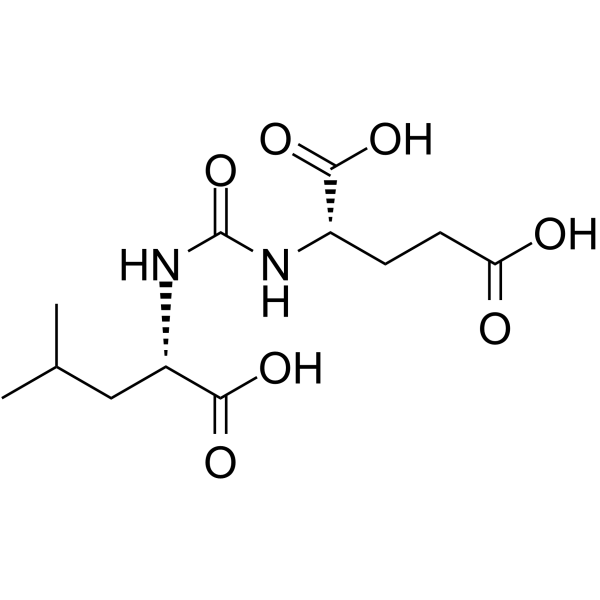
ZJ43 is a NAAG peptidase inhibitor and glutamate carboxypeptidase II/III (GCP II/III) inhibitor with human GCP II IC50 of 2.4 nM and Ki of 0.8 nM. ZJ43 blocks N-acetylaspartylglutamate hydrolysis, elevates extracellular N-acetylaspartylglutamate levels, and activates group II metabotropic glutamate receptors (mGluR). ZJ43 can be used for the research of schizophrenia, inflammatory pain, neuropathic pain, and traumatic brain injury.
商品は「研究用試薬」です。人や動物の医療用・臨床診断用・食品用の製品ではありません。
研究用途以外に使用した場合、当社は一切の責任を負いかねます。
- 純度 : 99.6%
- CAS 番号: 723331-20-2
- 分子式: C12H20N2O7
- 分子量:304.30
-
保管条件:Powder -20°C, 3 years , 4°C, 2 years ; In solvent -80°C, 6 months , -20°C, 1 month

To place orders, for customer services and technical support, please contact: MedChemExpress USA
Tel: 609-228-6898 E-mail: [email protected] [email protected]


-
 生物活性
生物活性
-
化学情報
- プロトコル
- 純度とドキュメンテーション
- 参考文献
-
 Help & FAQs






生物活性
製品説明
IC50 & Target
[1]|
group II mGlu receptors |
体外実験
ZJ43 (range sufficient to generate dose-response curves; 2 h) potently inhibits cloned human GCP II with a Ki of 0.8 nM[1].
ZJ43 (range sufficient to generate dose-response curves) inhibits cloned mouse GCP III with a Ki of 23 nM[1].
ZJ43 (2 h) inhibits cloned rat GCPII with a Ki of 3 nM[3].
MedChemExpress (MCE) has not independently confirmed the accuracy of these methods. They are for reference only.
体内実験
ZJ43 (10-100 mg/kg; i.v.; single dose) produces dose-dependent analgesia in the rat Formalin inflammatory pain model[3].
ZJ43 (10-100 mg/kg; i.v.; single dose) produces dose-dependent antiallodynic effects in the rat partial sciatic nerve ligation neuropathic pain model[3].
ZJ43 (100 mg/kg; i.v.; single dose) does not alter acute nociceptive responses to noxious mechanical or thermal stimulation in healthy rats[3].
ZJ43 (50-150 mg/kg; i.p.; every 8 h; 3 total doses) significantly reduces ipsilateral neuronal degeneration in rat lateral fluid percussion TBI[4].
MedChemExpress (MCE) has not independently confirmed the accuracy of these methods. They are for reference only.
-
Animal Model:Sprague-Dawley (male, 280-330 g, PCP-induced schizophrenia-like symptoms)[1]
-
Dosage:150 mg/kg
-
Administration:i.p.; single dose
-
Result:Significantly reduced PCP-induced motor activity, with a statistically significant difference in total distance traveled between 80-180 min compared to PCP-only treated rats (p = 0.021).
Significantly increased the frequency of rats being "still" (p = 0.015).
Significantly reduced PCP-induced stereotypic falling (p = 0.02), circling movements (p ≤ 0.001), total head movements (p = 0.005), and head bobbing (p = 0.004) compared to PCP-only treated rats.
Produced a non-statistically significant trend toward reduced PCP-induced mouth movements, tremors, and sideways head movements.
Failed to reduce PCP-induced sniffing and showed a non-significant tendency to increase this behavior (p = 0.17).
-
Animal Model:Rats (Formalin-induced inflammatory pain model)[3]
-
Dosage:10 mg/kg; 100 mg/kg
-
Administration:i.v.; single dose
-
Result:Decreased cumulative formalin-evoked flinches in both phase 1 (0-6 minutes) and phase 2 (10-60 minutes) in a dose-dependent manner (phase 1 P < 0.005, phase 2 P < 0.001).
Reduced flinching to ~50% of vehicle response in phase 1 and ~30% of vehicle response in phase 2 at 100 mg/kg.
-
Animal Model:Rats (partial sciatic nerve ligation neuropathic pain model)[3]
-
Dosage:10 mg/kg; 100 mg/kg
-
Administration:i.v.; single dose
-
Result:Significantly increased the maximum 50% probability mechanical withdrawal threshold in a dose-dependent manner (P < 0.001).
Elevated the threshold to ~13 g at 100 mg/kg (compared to ~2 g in saline-treated rats).
-
Animal Model:Rats[3]
-
Dosage:100 mg/kg
-
Administration:i.v.; single dose
-
Result:Had no significant effect on the number of paw withdrawal responses to noxious mechanical stimulation, with maximum responses (18.8) and minimum responses (15.6) not differing significantly from saline-treated rats (P > 0.3).
Had no significant effect on hotplate response latency, with % maximum possible effect (-9.9) not differing significantly from saline-treated rats (P > 0.8).
-
Animal Model:Sprague-Dawley (male, 340 g, lateral fluid percussion TBI moel)[4]
-
Dosage:50 mg/kg; 100 mg/kg; 150 mg/kg
-
Administration:i.p.; every 8 h; 3 total doses
-
Result:Significantly reduced the number of ipsilateral degenerating neurons in the hippocampal CA2/3 regions compared to vehicle (p < 0.01).
Reduced ipsilateral astrocyte loss to 14.0% versus 30.6% in the vehicle group at 50 mg/kg dose (p = 0.05; p = 0.007).


化学情報
-
CAS 番号 723331-20-2
-
性状 Solid
-
分子量 304.30
-
分子式 C12H20N2O7
-
Color Colorless to off-white
-
SMILES
O=C(N[C@H](C(O)=O)CCC(O)=O)N[C@H](C(O)=O)CC(C)C
-
輸送条件
Room temperature in continental US; may vary elsewhere.
-
保管条件
Powder -20°C 3 years 4°C 2 years In solvent -80°C 6 months -20°C 1 month


純度とドキュメンテーション
-
データシート (278 KB)
-
SDS (393 KB)
- English - EN (393 KB)
- Français - FR (393 KB)
- Deutsch - DE (393 KB)
- Norwegian - NO (393 KB)
- Español - ES (393 KB)
- Swedish - SV (393 KB)
- Italian - IT (393 KB)
- Korean - KR (393 KB)
- Portuguese - PT (393 KB)
-
取扱説明書 (2659 KB)
参考文献
[1]. Olszewski RT, et al. NAAG peptidase inhibition reduces locomotor activity and some stereotypes in the PCP model of schizophrenia via group II mGluR. J Neurochem. 2004 May;89(4):876-85. [Content Brief]
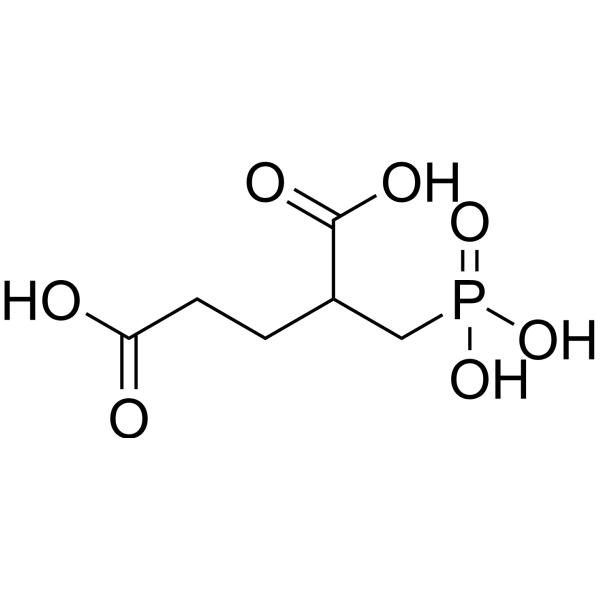
[2]. Nonaka T, et al. A role for the locus coeruleus in the analgesic efficacy of N-acetylaspartylglutamate peptidase (GCPII) inhibitors ZJ43 and 2-PMPA. Mol Pain. 2017;13:1744806917697008. [Content Brief]
[3]. Yamamoto T, et al. Antinociceptive effects of N-acetylaspartylglutamate (NAAG) peptidase inhibitors ZJ-11, ZJ-17 and ZJ-43 in the rat formalin test and in the rat neuropathic pain model. Eur J Neurosci. 2004;20(2):483-494. [Content Brief]
[4]. Zhong C, et al. NAAG peptidase inhibitor reduces acute neuronal degeneration and astrocyte damage following lateral fluid percussion TBI in rats. J Neurotrauma. 2005;22(2):266-276. [Content Brief]

Calculators
濃度 (開始) × 体積 (開始) = 濃度 (終了) × 体積 (終了)


ZJ43 関連分類
HY-103344 関連分類
 Powered by Bioz
Keywords
- ZJ43
- 723331-20-2
- ZJ 43
- ZJ-43
- Aminopeptidase
- Carboxypeptidase
- mGluR
- N-acetylaspartylglutamate
- male Sprague-Dawley rats
- group II metabotropic glutamate receptors
- inflammatory pain
- NMDA receptor
- glutamate carboxypeptidase III
- rat cerebellar granule cells
- glutamate carboxypeptidase II
- traumatic brain injury
- neuropathic pain
- Inhibitor
- inhibitor
- inhibit