



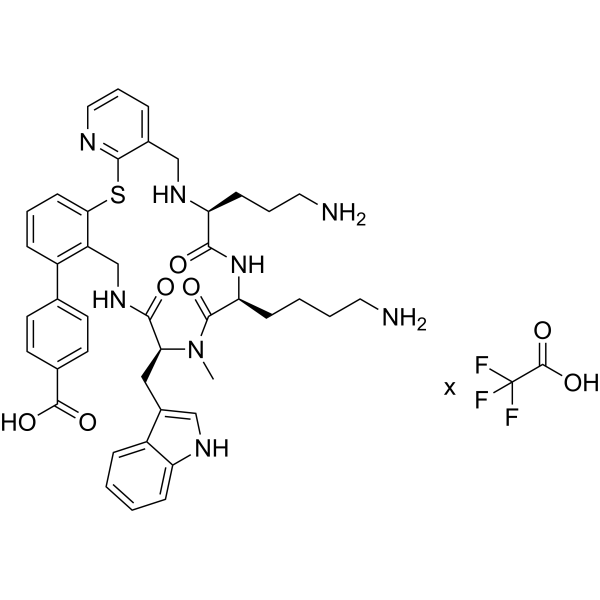
Zosurabalpin TFA
Zosurabalpin (Abx MCP; RG6006) TFA is a lipopolysaccharide (LPS) transport inhibitor that targets the LptB2FGC complex. Zosurabalpin TFA blocks the transport of LPS from the inner membrane to the outer membrane, leading to intracellular toxic accumulation of LPS and bacterial death. Zosurabalpin TFA exhibits potent antibacterial activity against carbapenem-resistant Acinetobacter baumannii (CRAB) and shows in vivo efficacy in mouse infection models. Zosurabalpin TFA can be used for research on CRAB infections, including pneumonia and sepsis.
商品は「研究用試薬」です。人や動物の医療用・臨床診断用・食品用の製品ではありません。
研究用途以外に使用した場合、当社は一切の責任を負いかねます。
- 分子式: C43H50N8O5S.xC2HF3O2
- 分子量:790.97 (free base)
-
保管条件:
Please store the product under the recommended conditions in the Certificate of Analysis.

To place orders, for customer services and technical support, please contact: MedChemExpress USA
Tel: 609-228-6898 E-mail: [email protected] [email protected]


-
 生物活性
生物活性
-
化学情報
- 純度とドキュメンテーション
- 参考文献
-
 Help & FAQs




生物活性
製品説明
体外実験
Zosurabalpin (Abx MCP; RG6006) TFA potently inhibits multidrug-resistant Acinetobacter baumannii isolates in vitro by targeting the LptB2FGC LPS transport complex, with MIC values ranging from 0.12 to 1.00 μg/mL[2].
Zosurabalpin (0.01-10 μM; 10 min) TFA inhibits LPS transport by targeting the LptB2FGC complex of Acinetobacter baylyi, with detectable inhibitory effects observed at concentrations as low as 0.01 μM[3].
Zosurabalpin (24 h) TFA exerts bactericidal activity against pan-drug-resistant Acinetobacter baumannii ACC01073 at concentrations of 4× MIC and above[3].
Zosurabalpin (0.01-10 μM; 60 min) TFA inhibits the transport of lipopolysaccharide (LPS) from wild-type A. baylyi LptB2FGC to LptA[4].
Zosurabalpin (0.0001-10 μM) TFA binds to LPS-loaded A. baylyi LptB2FG with high affinity (but does not bind to LptB2FGC)[4].
Zosurabalpin TFA sequesters LPS in the intermediate transport state of A. baylyi LptB2FG by binding to the composite site formed by the transporter and its LPS substrate, and its binding conformation competes with the transmembrane helix of LptC for access to the transporter gate[4].
MedChemExpress (MCE) has not independently confirmed the accuracy of these methods. They are for reference only.
Parmacokinetics
| Species | Dose | Route | CL | Vss | T1/2 (Elimination) |
|---|---|---|---|---|---|
| Mice[3] | 1 mg/kg | i.v. | 51 mL/min/kg | 0.7 L/kg | 0.3 h |
体内実験
Zosurabalpin (24-48 h) TFA achieves a net reduction in bacteria within 24 hours and sustains suppression of bacterial loads over 48 hours at different administration doses in neutropenic mouse thigh and lung models of Acinetobacter baumannii infection[1].
Zosurabalpin (0.3-30 mg/kg; subcutaneous injection; administered twice at 1 h and 5 h post-infection) TFA confers 100% survival rate to immunocompetent mice with Acinetobacter baumannii-induced sepsis at doses of 1 mg/kg and above[3].
Zosurabalpin (6-360 mg/kg; subcutaneous injection; once every 6 hours; for 24 hours) TFA reduces lung bacterial load by > 5 log10 in neutropenic mice infected with extensively drug-resistant A. baumannii pneumonia at a total daily subcutaneous dose of 360 mg/kg[3].
Zosurabalpin (6-360 mg/kg; subcutaneous injection; once every 6 hours; for 24 hours) TFA reduces the thigh bacterial load of neutropenic mice with thigh infections induced by multidrug-resistant A. baumannii below the limit of detection at total daily subcutaneous doses of 160 mg/kg and above[3].
Zosurabalpin (30 mg/kg; subcutaneous injection; 2 administrations) TFA confers complete or partial survival benefits to immunocompetent mice infected with a specific Zosurabalpin-resistant A. baumannii mutant strain[3].
MedChemExpress (MCE) has not independently confirmed the accuracy of these methods. They are for reference only.
-
Animal Model:CD-1 (male, 6 weeks old at arrival, immunocompetent, inoculated intraperitoneally with carbapenem-resistant Acinetobacter baumannii ACC00445)[3]
-
Dosage:0.3, 1, 3, 10, 30 mg/kg
-
Administration:s.c.; 2 doses at 1 and 5 h post-infection
-
Result:Achieved 100% mouse survival over 7 days at 1 mg/kg, 3 mg/kg, 10 mg/kg, and 30 mg/kg.
Achieved 10% mouse survival over 7 days at 0.3 mg/kg.
-
Animal Model:CD-1 (male, 6 weeks old at arrival, neutropenic via two intraperitoneal injections of cyclophosphamide monohydrate on day -4 and day -1, inoculated intratracheally with pan-drug-resistant Acinetobacter baumannii ACC01073)[3]
-
Dosage:6, 20, 60, 160, 240, 360 mg/kg
-
Administration:s.c.; every 6 hours; 24 hours
-
Result:Caused a dose-dependent decrease in lung bacterial burden.
Achieved a > 5 log10 reduction in CFUs at the 360 mg/kg per day dose.
-
Animal Model:CD-1 (male, 6 weeks old at arrival, neutropenic via two intraperitoneal injections of cyclophosphamide monohydrate on day -4 and day -1, inoculated intramuscularly with multidrug-resistant Acinetobacter baumannii ACC01085)[3]
-
Dosage:6, 20, 60, 160, 240, 360 mg/kg
-
Administration:s.c.; every 6 hours; 24 hours
-
Result:Caused a dose-dependent decrease in thigh bacterial burden.
Achieved reductions below the limit of detection (2 log10 CFUs per thigh) at doses of 160 mg/kg per day and above.
-
Animal Model:CD-1 (male, 6 weeks old at arrival, immunocompetent, inoculated intraperitoneally with zosurabalpin-resistant Acinetobacter baumannii mutants)[3]
-
Dosage:30 mg/kg
-
Administration:s.c.; 2 doses
-
Result:Achieved 100% survival for mice infected with adeS R152K, adeS G318S, adeS R108S, and adeS ISAba1 mutants.
Achieved 87.5% survival for mice infected with the lptG G40D mutant.
Achieved 75% survival for mice infected with the adeS ISAba1 (ROB23370) mutant.
Achieved 50% survival for mice infected with the lptF R322C mutant.
Achieved 37.5% survival for mice infected with the lptF W271S mutant.
Achieved 0% survival for mice infected with the lptF I323K, lptF I317L, and lptF R322L mutants.


化学情報
-
分子量 790.97 (free base)
-
分子式 C43H50N8O5S.xC2HF3O2
-
SMILES
O=C1NCC2=C(C3=CC=C(C=C3)C(O)=O)C=CC=C2SC4=NC=CC=C4CN[C@H](C(N[C@H](C(N([C@H]1CC5=CNC6=CC=CC=C56)C)=O)CCCCN)=O)CCCN.OC(C(F)(F)F)=O.[x]
-
別名
Abx MCP TFA; RG6006 TFA
-
輸送条件
Room temperature in continental US; may vary elsewhere.
-
保管条件
Please store the product under the recommended conditions in the Certificate of Analysis.


純度とドキュメンテーション
参考文献
[3]. Zampaloni C, et al. A novel antibiotic class targeting the lipopolysaccharide transporter. Nature. 2024 Jan;625(7995):566-571. [Content Brief]
[4]. Pahil KS, et al. A new antibiotic traps lipopolysaccharide in its intermembrane transporter. Nature. 2024 Jan;625(7995):572-577. [Content Brief]

Calculators
濃度 (開始) × 体積 (開始) = 濃度 (終了) × 体積 (終了)


Zosurabalpin TFA 関連分類
HY-147429A 関連分類
 Powered by Bioz