



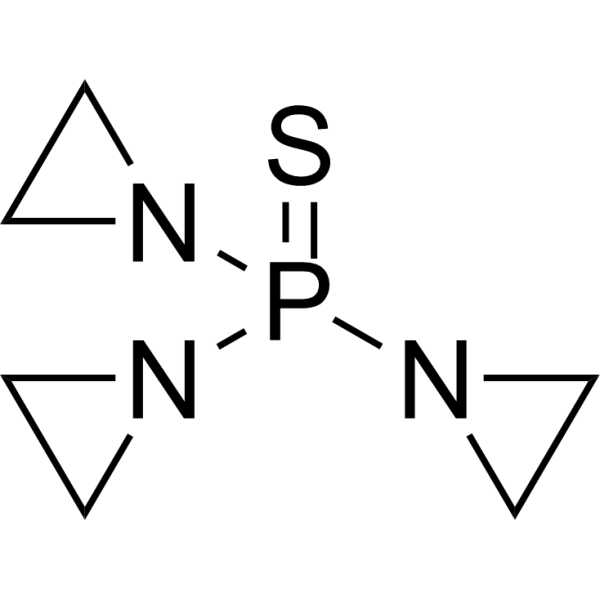
Thio-TEPA
Based on 3 publication(s) in Google Scholar
Thio-TEPA is a DNA alkylating agent, with antitumor activity.
연구목적의 판매만을 진행합니다. 환자를 대상으로 한 판매는 하지 않습니다.
- Purity: 99.98%
- CAS No.: 52-24-4
- 화학식: C6H12N3PS
- 분자량:189.22
-
보관:
4°C, protect from light
* In solvent : -80°C, 6 months; -20°C, 1 month (protect from light)

To place orders, for customer services and technical support, please contact: MedChemExpress USA
Tel: 609-228-6898 E-mail: [email protected] [email protected]


-
 Biological Activity
-
Chemical Information
-
용액&용해도
- Protocol
- 순도&문서
- References
-
 Help & FAQs
-


Antibacterial Compound Library
HY-L049
-
NMPA-Approved Drug Library
HY-L053
-
FDA Approved & Pharmacopeial Drug Library
HY-L066
-
Antibiotics Library
HY-L067
-
Anti-Lung Cancer Compound Library
HY-L075
-
Drug-Induced Liver Injury (DILI) Compound Library
HY-L076
-
Tumorigenesis-Related Compound Library
HY-L100
-
EMA-Approved Drug Library
HY-L116
-
FDA-Approved Anticancer Drug Library
HY-L122
-
Human Metabolite Library
HY-L123
-
Off-patent Drug Library
HY-L141
-
Bioactive Compound Library Max
HY-L181
-
MCE Bioactive Compound Library
HY-L001V
-
Drug Repurposing Compound Library Plus
HY-L035P
-
FDA-Approved Drug Library Plus
HY-L022P
-
FDA-Approved Drug Library Mini
HY-L022M
-
Bioactive Compound Library
HY-L001
-
High-Throughput Bioactive Compound Library
HY-L205
-
Anti-Cancer Approved Drug Library
HY-L213
-
Mass Spectrometry Human Metabolite Library
HY-L215
-
RNA Binding Bioactive Compound Library
HY-L248
-
Anti-Infection Compound Library
HY-L002
-
Cell Cycle/DNA Damage Compound Library
HY-L004
-
FDA-Approved Drug Library
HY-L022
-
Anti-Cancer Compound Library
HY-L025
-
Anti-Aging Compound Library
HY-L034
-
Drug Repurposing Compound Library
HY-L035


Publications Citing Use of MedChemExpress (MCE) Thio-TEPA
MoreAll Antibiotic Isoforms
More

Biological Activity
DNA Alkylator[1]
|
Cell Line

|
Type | Value | Description | References |
|---|---|---|---|---|
| 5637 | IC50 |
2 μM
Compound: Thtp
|
Cytotoxicity against human 5637 cells after 96 hrs by microtiter assay
Cytotoxicity against human 5637 cells after 96 hrs by microtiter assay
|
[PMID: 18187237] |
| A-427 | IC50 |
1.58 μM
Compound: Thtp
|
Cytotoxicity against human A427 cells after 96 hrs by microtiter assay
Cytotoxicity against human A427 cells after 96 hrs by microtiter assay
|
[PMID: 18187237] |
| DAN-G | IC50 |
1.66 μM
Compound: Thtp
|
Cytotoxicity against human DAN-G cells after 96 hrs by microtiter assay
Cytotoxicity against human DAN-G cells after 96 hrs by microtiter assay
|
[PMID: 18187237] |
| KYSE-510 | IC50 |
4.31 μM
Compound: Thtp
|
Cytotoxicity against human KYSE510 cells after 96 hrs by microtiter assay
Cytotoxicity against human KYSE510 cells after 96 hrs by microtiter assay
|
[PMID: 18187237] |
| KYSE-520 cell line | IC50 |
6.44 μM
Compound: Thtp
|
Cytotoxicity against human KYSE520 cells after 96 hrs by microtiter assay
Cytotoxicity against human KYSE520 cells after 96 hrs by microtiter assay
|
[PMID: 18187237] |
| KYSE-70 cell line | IC50 |
5.4 μM
Compound: Thtp
|
Cytotoxicity against human KYSE70 cells after 96 hrs by microtiter assay
Cytotoxicity against human KYSE70 cells after 96 hrs by microtiter assay
|
[PMID: 18187237] |
| LCLC-103H cell line | IC50 |
6.97 μM
Compound: Thtp
|
Cytotoxicity against human LCLC-103H cells after 96 hrs by microtiter assay
Cytotoxicity against human LCLC-103H cells after 96 hrs by microtiter assay
|
[PMID: 18187237] |
| MCF7 | IC50 |
3.23 μM
Compound: Thtp
|
Cytotoxicity against human MCF7 cells after 96 hrs by microtiter assay
Cytotoxicity against human MCF7 cells after 96 hrs by microtiter assay
|
[PMID: 18187237] |
| RT-112 | IC50 |
3.4 μM
Compound: Thtp
|
Cytotoxicity against human RT112 cells after 96 hrs by microtiter assay
Cytotoxicity against human RT112 cells after 96 hrs by microtiter assay
|
[PMID: 18187237] |
| RT-4 | IC50 |
18.27 μM
Compound: Thtp
|
Cytotoxicity against human RT4 cells after 96 hrs by microtiter assay
Cytotoxicity against human RT4 cells after 96 hrs by microtiter assay
|
[PMID: 18187237] |
| SISO | IC50 |
1.4 μM
Compound: Thtp
|
Cytotoxicity against human SISO cells after 96 hrs by microtiter assay
Cytotoxicity against human SISO cells after 96 hrs by microtiter assay
|
[PMID: 18187237] |
| YAPC | IC50 |
2.66 μM
Compound: Thtp
|
Cytotoxicity against human YAPC cells after 96 hrs by microtiter assay
Cytotoxicity against human YAPC cells after 96 hrs by microtiter assay
|
[PMID: 18187237] |
Thio-TEPA exhibits alkylating activity in rat liver slice incubation. Thio-TEPA does not affect the viability of rat liver slices, and is not accumulated in the slices at all doses of 2, 5, 10 mM[1].
MedChemExpress (MCE) has not independently confirmed the accuracy of these methods. They are for reference only.
MedChemExpress (MCE) has not independently confirmed the accuracy of these methods. They are for reference only.
| NCT Number | Sponsor | Condition | Start Date |
Phase
|
|---|---|---|---|---|
| NCT01329991 | Plexxikon| | 2011-05 | PHASE1 |


Chemical Information
-
CAS No. 52-24-4
-
Appearance Solid
-
분자량 189.22
-
화학식 C6H12N3PS
-
Color White to off-white
-
SMILES
S=P(N1CC1)(N2CC2)N3CC3
-
선적
Room temperature in continental US; may vary elsewhere.
-
보관
4°C, protect from light
* In solvent : -80°C, 6 months; -20°C, 1 month (protect from light)


Publications (3)
-
Journal Impact Factor
-
Most Recent
-
Cell Rep Med
CAN-Scan: A multi-omic phenotype-driven precision oncology platform identifies prognostic biomarkers of therapy response for colorectal cancer. [Abstract]2025 Apr 15;6(4):102053. PMID: 40187357 -
Med
Olgotrelvir, a dual inhibitor of SARS-CoV-2 Mpro and cathepsin L, as a standalone antiviral oral intervention candidate for COVID-19. [Abstract]2024 Jan 12;5(1):42-61.e23. PMID: 38181791 -
Anal Chem
A Computational Integration Strategy Driven by Chemical Similarity Uncovers Comprehensive Metabolic Profiles of Small Bioactive Peptides via UHPLC-HRMS for Doping Control. [Abstract]2025 Nov 18;97(45):25158-25167. PMID: 41202118


용액&용해도
DMSO : 100 mg/mL (528.49 mM; Need ultrasonic; Hygroscopic DMSO has a significant impact on the solubility of product, please use newly opened DMSO)
H2O : < 0.1 mg/mL (insoluble)
Please refer to the solubility information to select the appropriate solvent. Once prepared, please aliquot and store the solution to prevent product inactivation from repeated freeze-thaw cycles.
Storage method and period of stock solution: -80°C, 6 months; -20°C, 1 month (protect from light). When stored at -80°C, please use it within 6 months. When stored at -20°C, please use it within 1 month.
Please refer to the solubility information to select the appropriate solvent. Once prepared, please aliquot and store the solution to prevent product inactivation from repeated freeze-thaw cycles.
Storage method and period of stock solution: -80°C, 6 months; -20°C, 1 month (protect from light). When stored at -80°C, please use it within 6 months. When stored at -20°C, please use it within 1 month.
Concentration (start) × Volume (start) = Concentration (final) × Volume (final)
Select the appropriate dissolution method based on your experimental animal and administration route.
- For the following dissolution methods, please ensure to first prepare a clear stock solution using an In Vitro approach and then sequentially add co-solvents:
- To ensure reliable experimental results, the clarified stock solution can be appropriately stored based on storage conditions. As for the working solution for In Vivo experiments, it is recommended to prepare freshly and use it on the same day.
- The percentages shown for the solvents indicate their volumetric ratio in the final prepared solution. If precipitation or phase separation occurs during preparation, heat and/or sonication can be used to aid dissolution.
Add each solvent one by one: 10% DMSO 40% PEG300 5% Tween-80 45% Saline
Solubility: 2.5 mg/mL (13.21 mM); Suspended solution; Need ultrasonic
This protocol yields a suspended solution of 2.5 mg/mL. Suspended solution can be used for oral and intraperitoneal injection.
Taking 1 mL working solution as an example, add 100 μL DMSO stock solution (25.0 mg/mL) to 400 μL PEG300, and mix evenly; then add 50 μL Tween-80 and mix evenly; then add 450 μL Saline to adjust the volume to 1 mL.
Preparation of Saline: Dissolve 0.9 g sodium chloride in ddH₂O and dilute to 100 mL to obtain a clear Saline solution.
Add each solvent one by one: 10% DMSO 90% (20% SBE-β-CD in Saline)
Solubility: 2.5 mg/mL (13.21 mM); Suspended solution; Need ultrasonic
This protocol yields a suspended solution of 2.5 mg/mL. Suspended solution can be used for oral and intraperitoneal injection.
Taking 1 mL working solution as an example, add 100 μL DMSO stock solution (25.0 mg/mL) to 900 μL 20% SBE-β-CD in Saline, and mix evenly.
Preparation of 20% SBE-β-CD in Saline (4°C, storage for one week): 2 g SBE-β-CD powder is dissolved in 10 mL Saline, completely dissolve until clear.
Please enter the basic information of animal experiments:
-
-
-
-
Recommended: Prepare an additional quantity of animals to account for potential losses during experiments.
Please enter your animal formula composition:
-
%DMSO +
Recommended: Keep the proportion of DMSO in working solution below 2% if your animal is weak.
-
%+
-
+%Tween-80 + +
-
%Saline +
The co-solvents required include: DMSO, . All of co-solvents are available by MedChemExpress (MCE). , Tween 80. All of co-solvents are available by MedChemExpress (MCE).
Working solution concentration: 0.22 mg/mL
Method for preparing stock solution: mg drug dissolved in μL DMSO. Stock solution concentration: mg/mL. * In solvent : -80°C, 6 months; -20°C, 1 month (protect from light)
1. Take μL DMSO stock solution;
2. Add μL .
μL , mix evenly;
3. Then add μL Tween 80, mix evenly;
4. Then add μL
Please ensure that the stock solution in the first step is dissolved to a clear state, and add co-solvents in sequence. You can use ultrasonic heating (ultrasonic cleaner, recommended frequency 20-40 kHz), vortexing, etc. to assist dissolution.

Protocol
The effect of Thio-TEPA on slice viability is studied by the determination of intracellular potassium (K+) leakage. Intracellular K+ is measured by flame photometry and is expressed in relation to the DNA content as measured using fluorometry. Thio-TEPA is added at concentrations of 1, 2, 5, and 10 mM and slices are incubated for 6, 12, and 24 h. The results are compared with the values found for drug-free controls. Thio-TEPA in medium and slices is measured following 3, 6, and 9 h incubation at the three highest concentrations. Krebs-HEPES buffer is used as the slicing buffer and Waymouth's MB 752/1 medium supplemented with 10 μg gentamycin is used as the incubation medium[1].
MedChemExpress (MCE) has not independently confirmed the accuracy of these methods. They are for reference only.
Mice[2]
Male C57BL/6JIco mice, 19 weeks old, 25 to 30 g, are used as recipients. Congenic C57BL/6J-Gpi-1a/Gpi-1a (B6-Gpi-1a) and BALB.B10LiLa (Gpi-1a) mice are used as a source of syngeneic and allogeneic donor bone marrow, respectively. The latter combination is H-2-compatible (both H-2b), but mismatched on a number of minor histocompatibility loci. Thio-TEPA is dissolved in PBS and injected i.p. at a single bolus of 20 mg/kg. Preliminary pilot experiments have established that this approximated to the maximal tolerated dose when higher doses result in lethal gastrointestinal toxicity. Cyclophosphamide (CY) is dissolved in PBS and administered i.p. at a single dose of 200 mg/kg. Total body irradiation is delivered using a 137Cs γ-irradiation unit at a dose rate of 87 cGy/min to a dose of 5 Gy. After Thio-TEPA treatment the mice are maintained on neomycin (3.5 g/L sterile drinking water) for 2 weeks to minimize the possible problems of endotoxemia via gut toxicity[2].
MedChemExpress (MCE) has not independently confirmed the accuracy of these methods. They are for reference only.


순도&문서
-
Data Sheet (279 KB)
-
SDS (643 KB)
- English - EN (643 KB)
- Français - FR (643 KB)
- Deutsch - DE (643 KB)
- Norwegian - NO (643 KB)
- Español - ES (643 KB)
- Swedish - SV (643 KB)
- Italian - IT (643 KB)
- Korean - KR (643 KB)
- Portuguese - PT (643 KB)
-
Handling Instructions (2659 KB)
References
[1]. Hagen B, et al. Metabolism and alkylating activity of thio-TEPA in rat liver slice incubation. Cancer Chemother Pharmacol. 1991;28(6):441-7. [Content Brief]
[2]. Down JD, et al. Thiotepa improves allogeneic bone marrow engraftment without enhancing stem cell depletion in irradiated mice. Bone Marrow Transplant. 1998 Feb;21(4):327-30. [Content Brief]


Complete Stock Solution Preparation Table
Please refer to the solubility information to select the appropriate solvent. Once prepared, please aliquot and store the solution to prevent product inactivation from repeated freeze-thaw cycles.
Storage method and period of stock solution: -80°C, 6 months; -20°C, 1 month (protect from light). When stored at -80°C, please use it within 6 months. When stored at -20°C, please use it within 1 month.
| Optional Solvent | Concentration Solvent Mass | 1 mg | 5 mg | 10 mg | 25 mg |
|---|---|---|---|---|---|
| DMSO | 1 mM | 5.2849 mL | 26.4243 mL | 52.8485 mL | 132.1213 mL |
| 5 mM | 1.0570 mL | 5.2849 mL | 10.5697 mL | 26.4243 mL | |
| 10 mM | 0.5285 mL | 2.6424 mL | 5.2849 mL | 13.2121 mL | |
| 15 mM | 0.3523 mL | 1.7616 mL | 3.5232 mL | 8.8081 mL | |
| 20 mM | 0.2642 mL | 1.3212 mL | 2.6424 mL | 6.6061 mL | |
| 25 mM | 0.2114 mL | 1.0570 mL | 2.1139 mL | 5.2849 mL | |
| 30 mM | 0.1762 mL | 0.8808 mL | 1.7616 mL | 4.4040 mL | |
| 40 mM | 0.1321 mL | 0.6606 mL | 1.3212 mL | 3.3030 mL | |
| 50 mM | 0.1057 mL | 0.5285 mL | 1.0570 mL | 2.6424 mL | |
| 60 mM | 0.0881 mL | 0.4404 mL | 0.8808 mL | 2.2020 mL | |
| 80 mM | 0.0661 mL | 0.3303 mL | 0.6606 mL | 1.6515 mL | |
| 100 mM | 0.0528 mL | 0.2642 mL | 0.5285 mL | 1.3212 mL |


Thio-TEPA Related Classifications
HY-17574 Related Classifications
 Powered by Bioz