



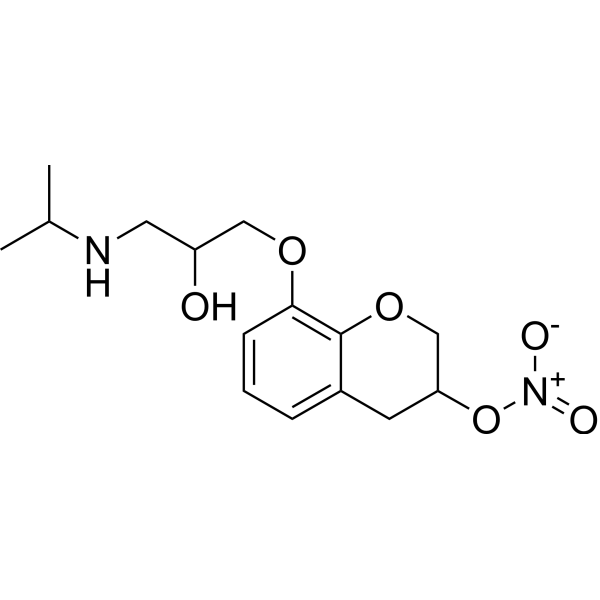
Nipradolol
Nipradolol (KT-210; K-351) is a potent blocker of alpha-1-adrenergic receptors. Nipradolol inhibits the increase of intraocular pressure (IOP) in an albino rabbit model induced by Phenylephrine (HY-B0769). Nipradolo suppresses the noradrenaline (NA)-induced muscles contraction, also exhibits vasodilator activity on the dog coronary artery.
商品は「研究用試薬」です。人や動物の医療用・臨床診断用・食品用の製品ではありません。
研究用途以外に使用した場合、当社は一切の責任を負いかねます。
- CAS 番号: 81486-22-8
- 分子式: C15H22N2O6
- 分子量:326.34
-
保管条件:
Please store the product under the recommended conditions in the Certificate of Analysis.

To place orders, for customer services and technical support, please contact: MedChemExpress USA
Tel: 609-228-6898 E-mail: [email protected] [email protected]


-
 生物活性
生物活性
-
化学情報
- プロトコル
- 純度とドキュメンテーション
- 参考文献
-
 Help & FAQs


Adrenergic Receptor アイソフォーム固有の製品をすべて表示
More

生物活性
製品説明
IC50 & Target
[2]|
α1-adrenergic receptor |
体外実験
Nipradolol (1 μM; 10 min) inhibits K-induced contraction in dog muscles with an ID50 value of 0.8 μM[1].
Nipradolol (1 μM; 10 min) reduces the resting tone and to suppress the NA-induced contraction in proximal region[1].
MedChemExpress (MCE) has not independently confirmed the accuracy of these methods. They are for reference only.
体内実験
MedChemExpress (MCE) has not independently confirmed the accuracy of these methods. They are for reference only.


化学情報
-
CAS 番号 81486-22-8
-
分子量 326.34
-
分子式 C15H22N2O6
-
SMILES
CC(C)NCC(O)COC1=C2C(CC(O[N+]([O-])=O)CO2)=CC=C1
-
別名
KT 210; K 351; Hypadil
-
輸送条件
Room temperature in continental US; may vary elsewhere.
-
保管条件
Please store the product under the recommended conditions in the Certificate of Analysis.


純度とドキュメンテーション
参考文献

Calculators
濃度 (開始) × 体積 (開始) = 濃度 (終了) × 体積 (終了)


Nipradolol 関連分類
HY-106523 関連分類
 Powered by Bioz