



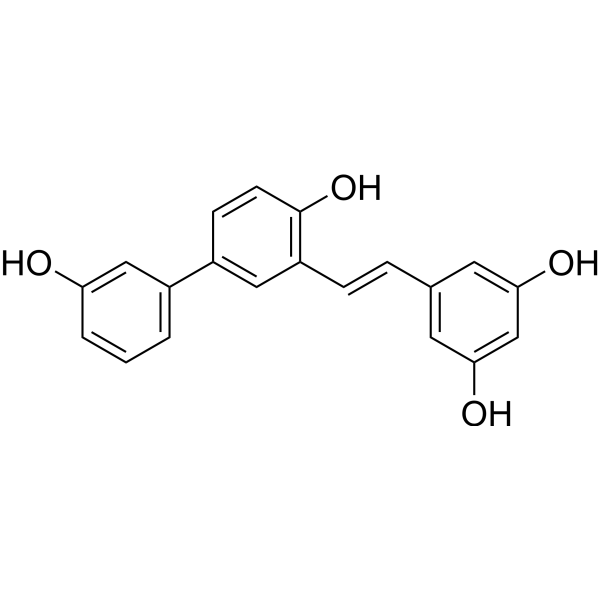
PELI1-IN-1

Based on 1 Customer Validation
PELI1-IN-1 (compound 3d) is a potent inhibitor of PELI1, E3 ubiquitin ligase. PELI1-IN-1 has anti-tumPELI1-IN-1, a Resveratrol (HY-16561) derivative, is an orally active PELI1 Inhibitor (Kd = 8.2 μM). PELI1-IN-1 markedly interrupts the interaction of PELI1 and SNAIL/SLUG, and inhibits the K63-polyubiquitization of SNAIL/SLUG by PELI1, subsequently downregulating the protein levels of epithelial-mesenchymal transition (EMT) effectors SNAIL/SLUG. PELI1-IN-1 significantly reduces the level of SNAIL, SLUG and Vimentin without affecting the PELI1 expression. PELI1-IN-1 targets the FHA domain of PELI1 and disrupts the interaction, leading to the anti-metastasis of TNBC cells in vitro and in vivo. PELI1-IN-1 shows no evident toxicity in vivo.
For research use only. We do not sell to patients.
- Purity : 98.02%
- CAS No.: 3034889-94-3
- Formula: C20H16O4
- Molecular Weight:320.34
-
Storage:Powder -20°C, 3 years , 4°C, 2 years ; In solvent -80°C, 6 months , -20°C, 1 month

To place orders, for customer services and technical support, please contact: MedChemExpress USA
Tel: 609-228-6898 E-mail: [email protected] [email protected]


-
 Biological Activity
-
Chemical Information
-
Solvent & Solubility
- Protocols
- Purity & Documentation
- References
-
 Help & FAQs




Biological Activity
Description
Cellular Effect
|
Cell Line

|
Type | Value | Description | References |
|---|---|---|---|---|
| HepG2 | IC50 |
29.1 μM
Compound: A4
|
Antiproliferative activity against human HepG2 cells incubated for 72 hrs by CCK8 assay
Antiproliferative activity against human HepG2 cells incubated for 72 hrs by CCK8 assay
|
[PMID: 36063665] |
| MDA-MB-231 | IC50 |
31.2 μM
Compound: A4
|
Antiproliferative activity against human MDA-MB-231 cells incubated for 72 hrs by CCK8 assay
Antiproliferative activity against human MDA-MB-231 cells incubated for 72 hrs by CCK8 assay
|
[PMID: 36063665] |
In Vitro
PELI1-IN-1 (0-20 μM, 24-72 h) exhibits strong anti-migration activities without compromising the cell viability in MDA-MB-231[1].
PELI1-IN-1 (0-20 μM, 24 h) significantly reduces the level of SNAIL, SLUG and Vimentin without affecting the PELI1 expression in MDA-MB-231 cells[1].
PELI1-IN-1 (48 h) markedly interrupts the interaction of PELI1 and SNAIL/SLUG, and inhibits the K63-polyubiquitization of SNAIL/SLUG by PELI1, subsequently downregulating the protein levels of EMT effectors SNAIL/SLUG in MDA-MB-231 cells[1].
MedChemExpress (MCE) has not independently confirmed the accuracy of these methods. They are for reference only. Further protocols information, click here.
-
Cell Line:MDA-MB-231
-
Concentration:0, 10 μM, 20 μM
-
Incubation Time:24 h, 48 h
-
Result:Inhibited the migration of MDA-MB-231 cells, with a relative migration rate of only 29.8 %.
-
Cell Line:MDA-MB-231
-
Concentration:0, 10 μM, 20 μM
-
Incubation Time:0 h, 24 h, 48 h,72 h
-
Result:Did not affect TNBC cell proliferation at concentrations that effectively inhibited cell migration.
-
Cell Line:MDA-MB-231
-
Concentration:0, 10 μM, 20 μM
-
Incubation Time:24 h
-
Result:Significantly reduced the level of SNAIL, SLUG and Vimentin without affecting the PELI1 expression.
In Vivo
MedChemExpress (MCE) has not independently confirmed the accuracy of these methods. They are for reference only.
-
Animal Model:MDA-MB-231 cells stably expressed luciferase were injected into NXG mice (Cavens) via tail[1].
-
Dosage:50 mg/kg
-
Administration:Oral gavage, once daily for 4 weeks
-
Result:Suppressed MDA-MB231 cell metastasis as evidenced by lower luciferase intensity in the lung.
Showed no behavioral abnormality (lethargy, clonic convulsion, anorexia, or ruffled fur) and significant body weight loss.


Chemical Information
-
CAS No. 3034889-94-3
-
Appearance Solid
-
Molecular Weight 320.34
-
Formula C20H16O4
-
Color Off-white to light yellow
-
SMILES
OC1=CC(O)=CC(/C=C/C2=C(C=CC(C3=CC=CC(O)=C3)=C2)O)=C1
-
Shipping
Room temperature in continental US; may vary elsewhere.
-
Storage
Powder -20°C 3 years 4°C 2 years In solvent -80°C 6 months -20°C 1 month


Solvent & Solubility
In Vitro:
DMSO : 100 mg/mL (312.17 mM; Need ultrasonic; Hygroscopic DMSO has a significant impact on the solubility of product, please use newly opened DMSO)
Please refer to the solubility information to select the appropriate solvent. Once prepared, please aliquot and store the solution to prevent product inactivation from repeated freeze-thaw cycles.
Storage method and period of stock solution: -80°C, 6 months; -20°C, 1 month. When stored at -80°C, please use it within 6 months. When stored at -20°C, please use it within 1 month.
Please refer to the solubility information to select the appropriate solvent. Once prepared, please aliquot and store the solution to prevent product inactivation from repeated freeze-thaw cycles.
Storage method and period of stock solution: -80°C, 6 months; -20°C, 1 month. When stored at -80°C, please use it within 6 months. When stored at -20°C, please use it within 1 month.
Concentration (start) × Volume (start) = Concentration (final) × Volume (final)
In Vivo:
Select the appropriate dissolution method based on your experimental animal and administration route.
- For the following dissolution methods, please ensure to first prepare a clear stock solution using an In Vitro approach and then sequentially add co-solvents:
- To ensure reliable experimental results, the clarified stock solution can be appropriately stored based on storage conditions. As for the working solution for In Vivo experiments, it is recommended to prepare freshly and use it on the same day.
- The percentages shown for the solvents indicate their volumetric ratio in the final prepared solution. If precipitation or phase separation occurs during preparation, heat and/or sonication can be used to aid dissolution.
Add each solvent one by one: 10% DMSO 40% PEG300 5% Tween-80 45% Saline
Solubility: ≥ 2.5 mg/mL (7.80 mM); Clear solution
This protocol yields a clear solution of ≥ 2.5 mg/mL (saturation unknown).
Taking 1 mL working solution as an example, add 100 μL DMSO stock solution (25.0 mg/mL) to 400 μL PEG300, and mix evenly; then add 50 μL Tween-80 and mix evenly; then add 450 μL Saline to adjust the volume to 1 mL.
Preparation of Saline: Dissolve 0.9 g sodium chloride in ddH₂O and dilute to 100 mL to obtain a clear Saline solution.
Add each solvent one by one: 10% DMSO 90% (20% SBE-β-CD in Saline)
Solubility: ≥ 2.5 mg/mL (7.80 mM); Clear solution
This protocol yields a clear solution of ≥ 2.5 mg/mL (saturation unknown).
Taking 1 mL working solution as an example, add 100 μL DMSO stock solution (25.0 mg/mL) to 900 μL 20% SBE-β-CD in Saline, and mix evenly.
Preparation of 20% SBE-β-CD in Saline (4°C, storage for one week): 2 g SBE-β-CD powder is dissolved in 10 mL Saline, completely dissolve until clear.
In Vivo Dissolution Calculator
Please enter the basic information of animal experiments:
-
-
-
-
Recommended: Prepare an additional quantity of animals to account for potential losses during experiments.
Please enter your animal formula composition:
-
%DMSO +
Recommended: Keep the proportion of DMSO in working solution below 2% if your animal is weak.
-
%+
-
+%Tween-80 + +
-
%Saline +
The co-solvents required include: DMSO, . All of co-solvents are available by MedChemExpress (MCE). , Tween 80. All of co-solvents are available by MedChemExpress (MCE).
Working solution concentration: 0.22 mg/mL
Method for preparing stock solution: mg drug dissolved in μL DMSO. Stock solution concentration: mg/mL.
1. Take μL DMSO stock solution;
2. Add μL .
μL , mix evenly;
3. Then add μL Tween 80, mix evenly;
4. Then add μL
Please ensure that the stock solution in the first step is dissolved to a clear state, and add co-solvents in sequence. You can use ultrasonic heating (ultrasonic cleaner, recommended frequency 20-40 kHz), vortexing, etc. to assist dissolution.

Protocols
-
RNA extraction experimental
By lysing cells, releasing RNA, and removing impurities such as proteins and DNA, high-purity RNA products are finally obtained. The commonly used traditional method is the guanidine isothiocyanate/phenol/chloroform method (Trizol), which is suitable for a variety of animal materials including animal tissues, microorganisms, cultured cells, etc., and most plant materials.
-
Breast Cancer Modeling
Breast cancer is a heterogeneous cancer, and it has been distinguished into four subtypes: luminal A, luminal B, HER2-positive and basal-like. Molecular mutations, epigenetic alterations, hormone exposure and immune microenvironment are related to the progression of breast cancer.
-
Orthotopic Cell-Line Xenograft
Orthotopic cell-line xenograft models involve implantation of human cancer cell lines into the anatomically corresponding organ of immunodeficient mice to reproduce tumor growth within a native microenvironment, enabling more clinically relevant tumor behavior compared with subcutaneous models. These models are widely used because orthotopic placement better recapitulates tumor progression, including invasion and metastatic spread, which are often underrepresented in heterotopic implantation systems. Compared with conventional xenografts, orthotopic implantation is described as more technically complex but provides improved simulation of tumor-microenvironment interactions and metastatic behavior, making it particularly valuable for translational oncology research. Surgical orthotopic implantation approaches have been emphasized as enabling faithful reproduction of clinical cancer features, including metastasis and disease progression patterns that align with the tumor’s organ of origi


Purity & Documentation
-
Data Sheet (275 KB)
-
SDS (251 KB)
- English - EN (251 KB)
- Français - FR (251 KB)
- Deutsch - DE (251 KB)
- Norwegian - NO (251 KB)
- Español - ES (251 KB)
- Swedish - SV (251 KB)
- Italian - IT (251 KB)
- Korean - KR (251 KB)
- Portuguese - PT (251 KB)
-
Handling Instructions (2659 KB)
References


Complete Stock Solution Preparation Table
Please refer to the solubility information to select the appropriate solvent. Once prepared, please aliquot and store the solution to prevent product inactivation from repeated freeze-thaw cycles.
Storage method and period of stock solution: -80°C, 6 months; -20°C, 1 month. When stored at -80°C, please use it within 6 months. When stored at -20°C, please use it within 1 month.
| Optional Solvent | Concentration Solvent Mass | 1 mg | 5 mg | 10 mg | 25 mg |
|---|---|---|---|---|---|
| DMSO | 1 mM | 3.1217 mL | 15.6084 mL | 31.2168 mL | 78.0421 mL |
| 5 mM | 0.6243 mL | 3.1217 mL | 6.2434 mL | 15.6084 mL | |
| 10 mM | 0.3122 mL | 1.5608 mL | 3.1217 mL | 7.8042 mL | |
| 15 mM | 0.2081 mL | 1.0406 mL | 2.0811 mL | 5.2028 mL | |
| 20 mM | 0.1561 mL | 0.7804 mL | 1.5608 mL | 3.9021 mL | |
| 25 mM | 0.1249 mL | 0.6243 mL | 1.2487 mL | 3.1217 mL | |
| 30 mM | 0.1041 mL | 0.5203 mL | 1.0406 mL | 2.6014 mL | |
| 40 mM | 0.0780 mL | 0.3902 mL | 0.7804 mL | 1.9511 mL | |
| 50 mM | 0.0624 mL | 0.3122 mL | 0.6243 mL | 1.5608 mL | |
| 60 mM | 0.0520 mL | 0.2601 mL | 0.5203 mL | 1.3007 mL | |
| 80 mM | 0.0390 mL | 0.1951 mL | 0.3902 mL | 0.9755 mL | |
| 100 mM | 0.0312 mL | 0.1561 mL | 0.3122 mL | 0.7804 mL |


PELI1-IN-1 Related Classifications
HY-157435 Related Classifications
 Powered by Bioz