



Reverse transcriptase-IN-4
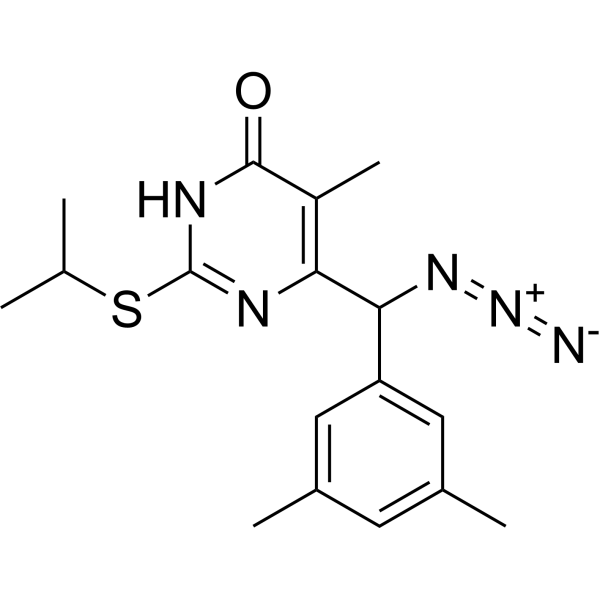
Reverse transcriptase-IN-4 (compound F10) is a potent and selective non-nucleoside reverse transcriptase (NNRT) inhibitor with an EC50 value of 0.053 μM for wild-type HIV-1 and an EC50 value of 0.26 μM for HIV-1 mutant E138K. Reverse transcriptase-IN-4 is a click chemistry reagent, it contains an Azide group and can undergo copper-catalyzed azide-alkyne cycloaddition reaction (CuAAc) with molecules containing Alkyne groups. It can also undergo strain-promoted alkyne-azide cycloaddition (SPAAC) reactions with molecules containing DBCO or BCN groups.
Nur für Forschungszwecke. Wir verkaufen nicht an Patienten.
- CAS. Nr.: 3038793-35-7
- Formel: C17H21N5OS
- Molecular Weight:343.45
-
Speicherung:
Please store the product under the recommended conditions in the Certificate of Analysis.

To place orders, for customer services and technical support, please contact: MedChemExpress USA
Tel: 609-228-6898 E-mail: [email protected] [email protected]


-
 Biologische Aktivität
-
Chemical Information
- Protokoll
- Reinheit & Dokumentation
- Verweise
-
 Help & FAQs




Biologische Aktivität
Beschreibung
Cellular Effect
|
Cell Line

|
Type | Value | Description | References |
|---|---|---|---|---|
| MT4 | CC50 |
>363.9 μM
Compound: F10
|
Cytotoxicity against human MT4 cells assessed as reduction in cell viability by MTT assay
Cytotoxicity against human MT4 cells assessed as reduction in cell viability by MTT assay
|
[PMID: 36577220] |
In Vitro
Reverse transcriptase-IN-4 (compound F10) (0-10 μM) shows very weak inhibitory effects on all CYP enzymes, and the inhibitory activities of CYP1A2, CYP2D6, CYP3A4T and CYP3A4M exceeds 50 μM. No significant inhibition is observed for CYP2C9 and CYP2C19, with IC50 values of 35.8 μM and 27.1 μM, respectively[1].
MedChemExpress (MCE) has not independently confirmed the accuracy of these methods. They are for reference only.
In Vivo
MedChemExpress (MCE) has not independently confirmed the accuracy of these methods. They are for reference only.


Chemical Information
-
CAS. Nr. 3038793-35-7
-
Molecular Weight 343.45
-
Formel C17H21N5OS
-
SMILES
CC1=CC(C)=CC(C(C2=C(C(NC(SC(C)C)=N2)=O)C)N=[N+]=[N-])=C1
-
Versand
Room temperature in continental US; may vary elsewhere.
-
Speicherung
Please store the product under the recommended conditions in the Certificate of Analysis.


Reinheit & Dokumentation
Verweise

Calculators
Konzentration (Stammlösung) × Volumen (Stammlösung) = Konzentration (Ziellösung) × Volumen (Ziellösung)


Reverse transcriptase-IN-4 Related Classifications
HY-152233 Related Classifications
 Powered by Bioz