1. Search Result
Search Result
Results for "

B0399

" in MedChemExpress (MCE) Product Catalog:

9

Inhibitors & Agonists

1

Fluorescent Dye

1

Biochemical Assay Reagents

3

Natural
Products

2

Isotope-Labeled Compounds

1

Oligonucleotides

1

GMP Molecules

Cat. No. Product Name Target Research Areas Chemical Structure
  • HY-B0399
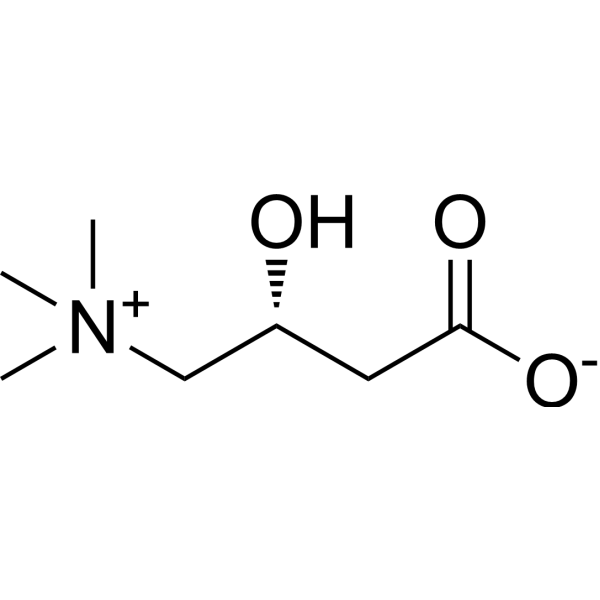
    L-Carnitine
    15+ Cited Publications

    (R)-Carnitine; Levocarnitine

    Endogenous Metabolite Neurological Disease Cancer
    L-Carnitine ((R)-Carnitine), a highly polar, small zwitterion, is an essential co-factor for the mitochondrial β-oxidation pathway. L-Carnitine functions to transport long chain fatty acyl-CoAs into the mitochondria for degradation by β-oxidation. L-Carnitine is an antioxidant. L-Carnitine can ameliorate metabolic imbalances in many inborn errors of metabolism .
    L-Carnitine
  • HY-B0399S
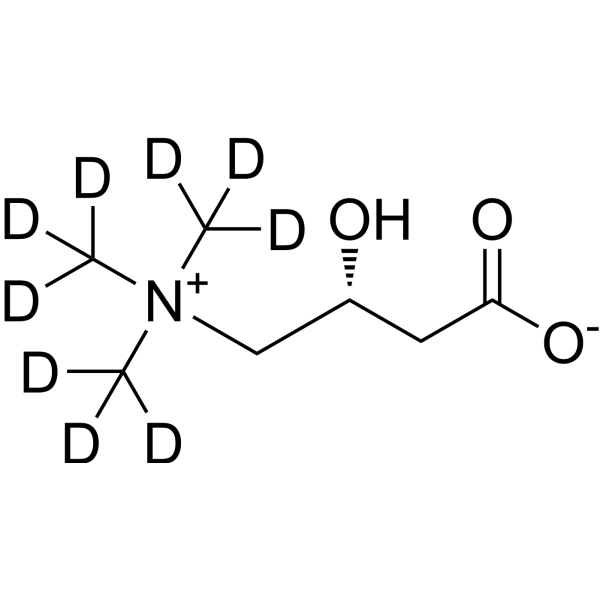
    L-Carnitine-d9
    1 Publications Verification

    (R)-Carnitine-d9; Levocarnitine-d9

    Isotope-Labeled Compounds Endogenous Metabolite Neurological Disease Metabolic Disease
    L-Carnitine-d9 is the deuterium labeled L-Carnitine. L-Carnitine (Levocarnitine) is an endogenous molecule involved in fatty acid metabolism, biosynthesized within the human body using amino acids: L-lysine and L-methionine, as substrates. L-Carnitine functions to transport long chain fatty acyl-CoAs into the mitochondria for degradation by β-oxidation. L-carnitine can ameliorate metabolic imbalances in many inborn errors of metabolism .
    L-Carnitine-d9
  • HY-B0399R

    (R)-Carnitine (Standard); Levocarnitine (Standard)

    Reference Standards Endogenous Metabolite Neurological Disease Cancer
    L-Carnitine (Standard) is the analytical standard of L-Carnitine. This product is intended for research and analytical applications. L-Carnitine ((R)-Carnitine), a highly polar, small zwitterion, is an essential co-factor for the mitochondrial β-oxidation pathway. L-Carnitine functions to transport long chain fatty acyl-CoAs into the mitochondria for degradation by β-oxidation. L-Carnitine is an antioxidant. L-Carnitine can ameliorate metabolic imbalances in many inborn errors of metabolism .
    L-Carnitine (Standard)
  • HY-B0399A

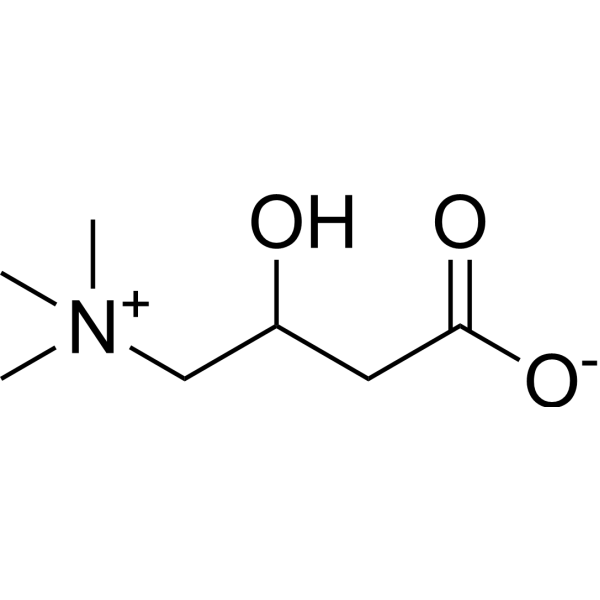
    DL-Carnitine; DL-Levocarnitine

    Mitochondrial Metabolism Metabolic Disease
    (±)-Carnitine (DL-Carnitine) is an orally effective racemic mixture of L-Carnitine (HY-B0399) and D-Carnitine. (±)-Carnitine elevates the mitochondrial NAD +/NADH ratio in the presence of 1,3-butanediol (HY-77490A). (±)-Carnitine does not increase glucose and urea production from L-glutamine, but stimulates propionate gluconeogenesis in rat renal cortical slices, and significantly reduces hepatic ketone body levels in rats fed a diet containing 30% high fat plus 20% 1,3-butanediol .
    (±)-Carnitine
  • HY-B0399S2

    (R)-Carnitine-13C3; Levocarnitine-13C3

    Isotope-Labeled Compounds Endogenous Metabolite Neurological Disease Cancer
    L-Carnitine- 13C3 ((R)-Carnitine- 13C3) is the 13C--labeled L-Carnitine (HY-B0399). L-Carnitine ((R)-Carnitine), a highly polar, small zwitterion, is an essential co-factor for the mitochondrial β-oxidation pathway. L-Carnitine functions to transport long chain fatty acyl-CoAs into the mitochondria for degradation by β-oxidation. L-Carnitine is an antioxidant. L-Carnitine can ameliorate metabolic imbalances in many inborn errors of metabolism .
    L-Carnitine-13C3
  • HY-B0399G

    (R)-Carnitine; Levocarnitine

    Endogenous Metabolite Neurological Disease Cancer
    L-Carnitine (GMP) is L-Carnitine (HY-B0399) produced by using GMP guidelines. GMP small molecules work appropriately as an auxiliary reagent for cell therapy manufacture. L-Carnitine, a highly polar, small zwitterion, is an essential co-factor for the mitochondrial β-oxidation pathway. L-Carnitine functions to transport long chain fatty acyl-CoAs into the mitochondria for degradation by β-oxidation. L-Carnitine is an antioxidant. L-Carnitine can ameliorate metabolic imbalances in many inborn errors of metabolism .
    L-Carnitine
  • HY-172548

    Carnitine Palmitoyltransferase (CPT) Endogenous Metabolite Metabolic Disease
    Docosahexaenoyl-L-carnitine chloride is a long-chain acylcarnitine composed of Docosahexaenoic acid (HY-B2167) and L-carnitine (HY-B0399). Docosahexaenoyl-L-carnitine chloride is transported into mitochondria for β -oxidation and decomposition under the action of carnitine palmitoyltransferase I (CPT I) and others. Docosahexaenoyl-L-carnitine chloride is promising for research of diseases related to fatty acid metabolism .
    Docosahexaenoyl-L-carnitine chloride
  • HY-158812

    Drug Derivative Metabolic Disease
    Eicosapentaenoyl-L-carnitine chloride is a long-chain acylcarnitine composed of Eicosapentaenoic Acid (HY-B0660) and L-Carnitine (HY-B0399). The levels of Eicosapentaenoyl-L-carnitine chloride are increased in the eyes of mice fed a diet high in n-3/n-6 polyunsaturated fatty acids (PUFAs) in a mouse model of myopia induced by out-of-focus lenses .
    Eicosapentaenoyl-L-carnitine chloride
  • HY-176830

    C19:0 Carnitine chloride; L-Carnitine nonadecanoyl ester chloride; L-Carnitine pristanoyl ester chloride

    Endogenous Metabolite Others
    Nonadecanoyl-L-carnitine (C19:0 Carnitine) chloride is a long-chain acylcarnitine composed of Nonadecanoic acid (HY-W004261) and L-carnitine (HY-B0399).
    Nonadecanoyl-L-carnitine chloride

Inquiry Online

Your information is safe with us. * Required Fields.

Salutation


Country or Region *

Applicant Name *


Organization Name *

Department *


Email Address *


Product Name *

Cat. No.


Requested quantity *

Phone Number *


Remarks

Inquiry Online

Inquiry Information

Product Name:
Cat. No.:
Quantity:
MCE Japan Authorized Agent:

