



(±)-Carnitine
Based on 2 publication(s) in Google Scholar
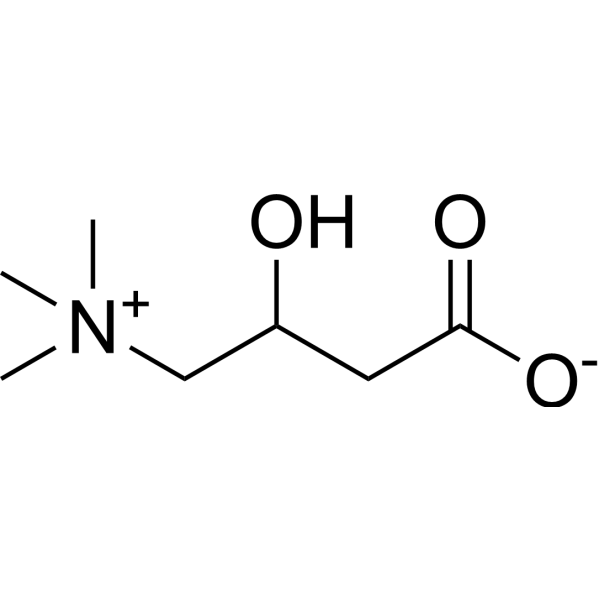
(±)-Carnitine (DL-Carnitine) is an orally effective racemic mixture of L-Carnitine (HY-B0399) and D-Carnitine. (±)-Carnitine elevates the mitochondrial NAD+/NADH ratio in the presence of 1,3-butanediol (HY-77490A). (±)-Carnitine does not increase glucose and urea production from L-glutamine, but stimulates propionate gluconeogenesis in rat renal cortical slices, and significantly reduces hepatic ketone body levels in rats fed a diet containing 30% high fat plus 20% 1,3-butanediol.
Nur für Forschungszwecke. Wir verkaufen nicht an Patienten.
- CAS. Nr.: 406-76-8
- Formel: C7H15NO3
- Molecular Weight:161.20
-
Speicherung:Powder -20°C, 3 years ; In solvent -80°C, 6 months , -20°C, 1 month

To place orders, for customer services and technical support, please contact: MedChemExpress USA
Tel: 609-228-6898 E-mail: [email protected] [email protected]


-
 Biologische Aktivität
-
Chemical Information
- Reinheit & Dokumentation
- Verweise
-
 Help & FAQs


Publications Citing Use of MedChemExpress (MCE) (±)-Carnitine
More

Biologische Aktivität
Beschreibung
In Vitro
(±)-Carnitine (1 mM) stimulates the rate of propionate gluconeogenesis in rat renal cortical slices by 3- to 5-fold[1].
MedChemExpress (MCE) has not independently confirmed the accuracy of these methods. They are for reference only.
In Vivo
MedChemExpress (MCE) has not independently confirmed the accuracy of these methods. They are for reference only.
-
Animal Model:Sprague-Dawley albino (male, initial weight ~120 g)[3]
-
Dosage:0.2% (incorporated into diet)
-
Administration:oral (ad libitum); 43 days
-
Result:Showed no significant effect on liver metabolite concentrations, adenine nucleotide levels, cytoplasmic and mitochondrial redox ratios, or phosphorylation states in rats fed a 30% fat diet alone.
Significantly decreased liver acetoacetate levels from 0.325 ± 0.028 to 0.214 ± 0.037 μmoles/g wet weight in rats fed a 30% fat plus 20% 1,3-butanediol diet.
Significantly decreased liver β-hydroxybutyrate levels from 0.694 ± 0.083 to 0.383 ± 0.087 μmoles/g wet weight in rats fed a 30% fat plus 20% 1,3-butanediol diet.
Caused a slight, non-significant decrease in acetyl CoA levels in rats fed a 30% fat plus 20% 1,3-butanediol diet.
Increased α-oxoglutarate levels from 0.098 ± 0.016 to 0.160 ± 0.014 μmoles/g wet weight in rats fed a 30% fat plus 20% 1,3-butanediol diet.
Increased the cytoplasmic NADP+/NADPH ratio from 0.0049 ± 0.0005 to 0.0070 ± 0.0003 in rats fed a 30% fat plus 20% 1,3-butanediol diet.
Increased the mitochondrial NAD+/NADH ratio from 3.26 ± 0.69 to 5.66 ± 0.43 in rats fed a 30% fat plus 20% 1,3-butanediol diet.
Showed no significant effect on lactate, pyruvate, malate, phosphoenolpyruvate, 3-phosphoglycerate, dihydroxyacetone phosphate, α-glycerophosphate, glucose-6-phosphate, citrate, isocitrate, NH4+, L-glutamate, CoA, adenine nucleotide levels, cytoplasmic NAD+/NADH ratio, or cytoplasmic and mitochondrial phosphorylation states in rats fed a 30% fat plus 20% 1,3-butanediol diet.


Chemical Information
-
CAS. Nr. 406-76-8
-
Appearance Solid
-
Molecular Weight 161.20
-
Formel C7H15NO3
-
Color Off-white to light yellow
-
SMILES
C[N+](C)(C)CC(O)CC([O-])=O
-
Synonyms
DL-Carnitine; DL-Levocarnitine
-
Structure Classification
-
Initial Source
-
Versand
Room temperature in continental US; may vary elsewhere.
-
Speicherung
Powder -20°C 3 years In solvent -80°C 6 months -20°C 1 month


Publications (2)
-
Journal Impact Factor
-
Most Recent
-
Mol Med Rep
Causal association between metabolites and upper gastrointestinal tumors: A Mendelian randomization study. [Abstract]2024 Dec;30(6):212. PMID: 39370813 -
Toxicol Appl Pharmacol
The inhibitory effect of antiretroviral drugs on the L-carnitine uptake in human placenta. [Abstract]2019 Apr 1:368:18-25. PMID: 30735677


Reinheit & Dokumentation
-
Data Sheet (272 KB)
-
SDS (393 KB)
- English - EN (393 KB)
- Français - FR (393 KB)
- Deutsch - DE (393 KB)
- Norwegian - NO (393 KB)
- Español - ES (393 KB)
- Swedish - SV (393 KB)
- Italian - IT (393 KB)
- Korean - KR (393 KB)
- Portuguese - PT (393 KB)
-
Handling Instructions (2659 KB)
Verweise
[1]. Weidemann MJ, et al. Acceleration of gluconeogenesis from propionate by Dl-carnitine in the rat kidney cortex. Biochem J. 1969;111(1):69-81. [Content Brief]
[2]. Lopes G, et al. Comparative acute effects of l-carnitine and dl-carnitine on hepatic catabolism of l-alanine and l-glutamine in rats. Acta Pharmacol Sin. 2004 Oct;25(10):1257-61. [Content Brief]
[3]. Mehlman MA, et al. Redox and phosphorylation states and metabolite concentrations in frozen clamped livers of rats fed diets containing 1,3-butanediol and DL-carnitine. J Nutr. 1972 Jan;102(1):45-51. [Content Brief]

Calculators
Konzentration (Stammlösung) × Volumen (Stammlösung) = Konzentration (Ziellösung) × Volumen (Ziellösung)


(±)-Carnitine Related Classifications
HY-B0399A Related Classifications
 Powered by Bioz