6 Results for "

Beta SARS-CoV-2 variants

" in MedChemExpress (MCE) Product Catalog:
Products (6)

6 Results for "Beta SARS-CoV-2 variants" in MCE Product Catalog:

6
6 Cited Publications
Cat. No.: HY-138794
CAS No.: 2417089-74-6
Purity:  99.60%
Research Areas:  

Cancer

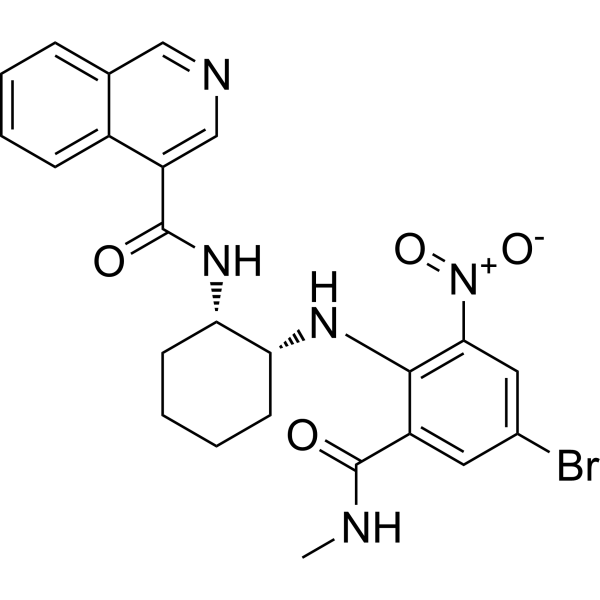
XL177A is a covalent USP7 inhibitor that blocks the deubiquitinase activity of USP7. XL177A destabilizes non-canonical PRC1 complexes or KDM6A and reduces chromatin deposition of H2AK119Ub, thereby relieving the repression of neuronal differentiation programs. Meanwhile, XL177A also regulates the ELOF1-UVSSA-USP7-nuclear β-catenin axis, decreasing the transcription levels of related proteins and the accumulation of nuclear β-catenin. XL177A exerts antiviral effects by reducing the expression levels of coronavirus receptors, and exhibits inhibitory activity against APC-mutated colorectal cancer cells, neuroblastoma, and coronaviruses including SARS-CoV-2 variants. XL177A is mainly used in studies related to colorectal cancer, neuroblastoma, and coronavirus infections .
loading...
    loading...
Cat. No.: HY-149535
CAS No.: 2921711-74-0
Purity:  99.84%
Synonyms: WU-04
Target:  

SARS-CoV

Research Areas:  

Infection

Iscartrelvir (WU-04) is a non-covalent inhibitor of SARS-CoV-2, targeting the 3CLpro protein. Iscartrelvir has high inhibitory effect on the 3CLpro protein of 6 SARS-CoV-2 variants (Alpha, Beta, Gamma, Delta, Lambda and Omicron) and 2 coronaviruses (SARS-CoV and MERS-CoV) .
loading...
    loading...
Cat. No.: HY-138794A
CAS No.: 2417089-73-5
Target:  

Deubiquitinase

Research Areas:  

Cancer

(Rac)-XL177A is the racemic isomer of XL177A (HY-138794). XL177A is a covalent USP7 inhibitor that blocks the deubiquitinase activity of USP7. XL177A destabilizes non-canonical PRC1 complexes or KDM6A and reduces chromatin deposition of H2AK119Ub, thereby relieving the repression of neuronal differentiation programs. Meanwhile, XL177A also regulates the ELOF1-UVSSA-USP7-nuclear β-catenin axis, decreasing the transcription levels of related proteins and the accumulation of nuclear β-catenin. XL177A exerts antiviral effects by reducing the expression levels of coronavirus receptors, and exhibits inhibitory activity against APC-mutated colorectal cancer cells, neuroblastoma, and coronaviruses including SARS-CoV-2 variants. XL177A is mainly used in studies related to colorectal cancer, neuroblastoma, and coronavirus infections .
loading...
    loading...
Cat. No.: HY-175029
CAS No.: 2892287-29-3
Target:  

SARS-CoV Virus Protease

Research Areas:  

Infection

ALG-097558 is an orally active 3CLpro inhibitor. ALG-097558 demonstrates pan-coronavirus activity against various SARS-CoV-2 variants as well as other human coronaviruses (HCoVs) such as SARS-CoV-1, α-HCoV 229E, and β-HCoV OC43. ALG-097558 demonstrates potent inhibition with IC50s of 2 nM (SARS-CoV-2 3CLpro) and 6 nM (229E 3CLpro). ALG-097558 demonstrates antiviral activity in the SARS-CoV-2 hamster infection model. ALG-097558 can be used for the study of viral infections[1].
loading...
    loading...
Cat. No.: HY-151265
CAS No.: 2719679-31-7
Target:  

SARS-CoV

Research Areas:  

Infection

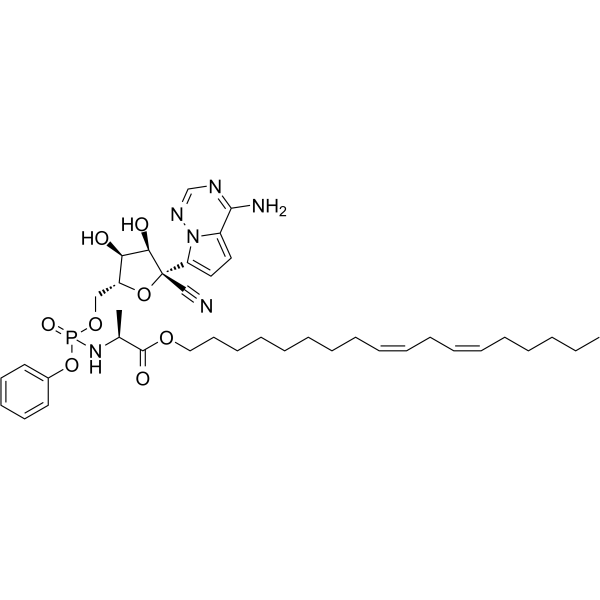
MMT5-14 is a remdesivir analogue with a higher antiviral activity in four variants of SARS-CoV-2 than Remdesivir (HY-104077). MMT5-14 inhibits SARS-CoV-2, α, β, γ and δ variants with EC50s of 0.4, 2.5, 15.9, 1.7 and 5.6 μM, respectively. MMT5-14 can be used for the research of COVID-19 .
loading...
    loading...
Cat. No.: HY-138794G
CAS No.: 2417089-74-6
XL177A GMP is XL177A (HY-138794) produced by using GMP guidelines. GMP small molecules works appropriately as an auxiliary reagent for cell therapy manufacture. XL177A is a covalent USP7 inhibitor that blocks the deubiquitinase activity of USP7. XL177A destabilizes non-canonical PRC1 complexes or KDM6A and reduces chromatin deposition of H2AK119Ub, thereby relieving the repression of neuronal differentiation programs. Meanwhile, XL177A also regulates the ELOF1-UVSSA-USP7-nuclear β-catenin axis, decreasing the transcription levels of related proteins and the accumulation of nuclear β-catenin. XL177A exerts antiviral effects by reducing the expression levels of coronavirus receptors, and exhibits inhibitory activity against APC-mutated colorectal cancer cells, neuroblastoma, and coronaviruses including SARS-CoV-2 variants. XL177A is mainly used in studies related to colorectal cancer, neuroblastoma, and coronavirus infections .
loading...
    loading...

