9 Results for "

GBM models

" in MedChemExpress (MCE) Product Catalog:
Products (9)

9 Results for "GBM models" in MCE Product Catalog:

Cat. No.: HY-115630
CAS No.: 2361988-77-2
Purity:  99.82%
Research Areas:  

Cancer

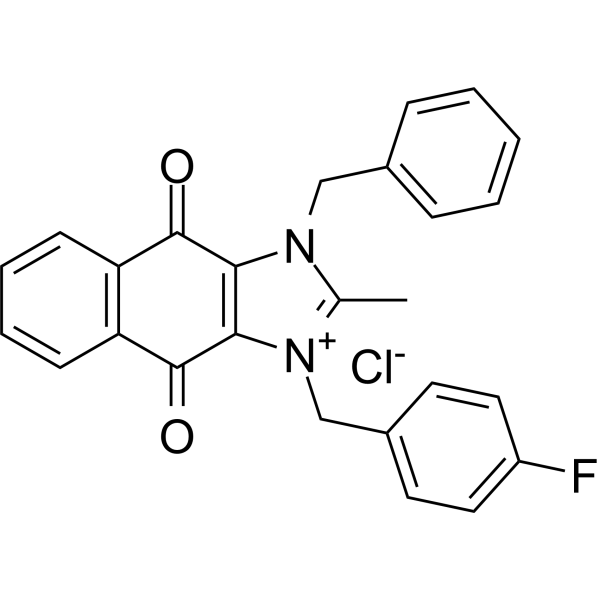
cRIPGBM chloride, an orally active, proapoptotic derivative. cRIPGBM can be generated from glioblastoma multiforme (GBM) cancer stem cells (CSCs). cRIPGBM(chloride) targets to receptor-interacting protein kinase 2 (RIPK2) to induce caspase 1-dependent apoptosis. cRIPGBM(chloride) suppresses the formation of RIPK2/TAK1 (prosurvival complex), and increases the formation of RIPK2/caspase 1 (proapoptotic complex). cRIPGBM(chloride) exerts potent anti-tumor activity in vivo in animal models .
loading...
    loading...
Cat. No.: HY-175207
CAS No.: 3109469-27-1
Target:  

Glycosidase

Research Areas:  

Cancer

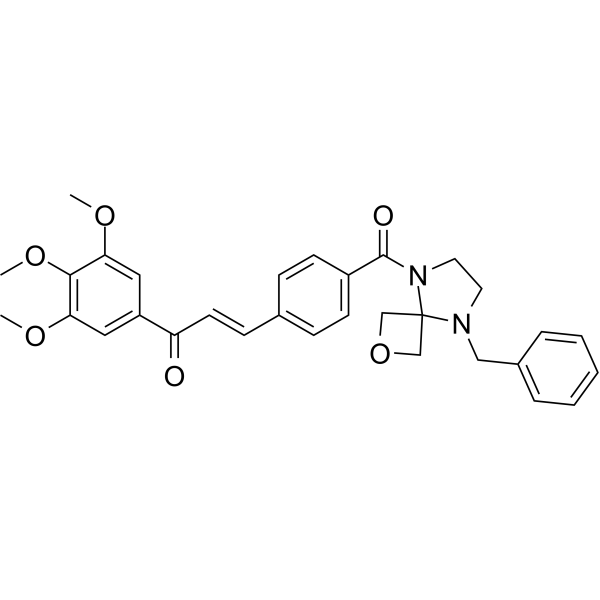
CHI3L1-IN-3 is a CHI3L1 inhibitor. CHI3L1-IN-3 binds to CHI3L1 with Kds of 13.76 μM and 13.5 μM in MST and SPR assays, respectively. CHI3L1-IN-3 demonstrates extended plasma half-lives and microsomal stability, along with reduced intrinsic clearance. CHI3L1-IN-3 induces dose-dependent cytotoxicity, reduces spheroid mass and inhibits migration in a 3D multicellular glioblastoma (GBM) spheroid model. CHI3L1-IN-3 can be used for the study of GBM .
loading...
    loading...
Cat. No.: HY-174212
CAS No.: 3037024-97-5
Target:  

Apoptosis

Research Areas:  

Cancer

MXC-017 is a blood-brain barrier (BBB)-penetrant apoptosis inducer that directly targets Vimentin (VIM). MXC-017 prevents radiation-induced glioma stem cell (GSC) formation, while promoting G0/G1 cell cycle arrest and apoptosis. MXC-017 exhibits minimal off-target effects and shows no significant cytotoxicity. MXC-017 significantly prolongs median survival when used in combination with radiation therapy in glioblastoma (GBM) mouse models.
loading...
    loading...
Cat. No.: HY-P11029
Target:  

Peptides

Research Areas:  

Cancer

CES (CESPLLSEC) is a homing peptide targeting Synaptosomal associated protein 25 (SNAP25). CES specifically homes in intracranial U87MG and the WT-glioblastoma (GBM) model. CES can be used as a targeting peptide for drug delivery for cancers research .
loading...
    loading...
Cat. No.: HY-155532
CAS No.: 3008988-49-3
Target:  

Apoptosis

Research Areas:  

Cancer

10m/ZS44 is a blood-brain barrier-permeable Glioblastoma (GBM) inhibitor. 10m/ZS44 significantly inhibits GBM tumor growth in a mouse xenograft model. 10m/ZS44 also activates the SIRT1/p53-mediated apoptosis pathway, thereby inhibiting the proliferation of U251 cells .
loading...
    loading...
Cat. No.: HY-119035
CAS No.: 115406-25-2
R-75317 is a specific platelet-activating factor (PAF) antagonist. R-75317 can prevent the decline in creatinine clearance (Ccr) in a rat model of glomerulonephritis induced by the injection of antibodies extracted from rabbits against rat glomerular basement membrane (GBM) antigens, delay the onset of proteinuria, and improve glomerular hypertrophy, mesangial matrix proliferation, and interstitial fibrosis. R-75317 may be useful in the study of glomerulonephritis .
loading...
    loading...
Cat. No.: HY-172586
CAS No.: 1574354-24-7
Target:  

GSK-3 PKA

Research Areas:  

Neurological Disease Cancer

GSK-3α/β-IN-1 is GSK-3α/β inhibitor with IC50 s of 0.265 μM and 0.255 μM for GSK-3α and GSK-3β, respectively. GSK-3α/β-IN-1 also inhibits PKA with an IC50 of 0.188 μM. GSK-3α/β-IN-1 potently inhibits cell viability of three Glioblastoma (GBM) cell lines (IC50 : 3-6 μM, 72 h) with no toxicity to human astrocytes and good metabolic stability. GSK-3α/β-IN-1 has potential CNS activity in all-human blood-brain barrier (BBB) model of GBM .
loading...
    loading...
Cat. No.: HY-186085
CAS No.: 3033961-38-2
Research Areas:  

Neurological Disease Cancer

BEN-28010 is a selective, orally active, blood-brain barrier permeable CHK1 inhibitor with an IC50 of 4.0 nM. BEN-28010 functions as a radiosensitizer, exhibits antitumor efficacy in GBM models. BEN-28010 can be used for the research of glioblastoma .
loading...
    loading...
Cat. No.: HY-181491
Research Areas:  

Cancer

Tubulin-IN-64 is a sulfonated styrylquinazoline derivative with high selectivity antitumor activity. Tubulin-IN-64 targets tubulin, inhibits the EGFR/Akt/mTOR and EGFR/Ras signaling pathways, induces cell cycle arrest, apoptosis and autophagy. Tubulin-IN-64 exhibits significant antitumor efficacy in the zebrafish GBM xenograft model. Tubulin-IN-64 can be used for the research on glioblastoma and leukemia .
loading...
    loading...

