

1. Search Result
Search Result
Results for "

HPD

" in MedChemExpress (MCE) Product Catalog:

19

Inhibitors & Agonists

4

Peptides

2

Natural
Products

19

Recombinant Proteins

9

Antibodies

3

Oligonucleotides

Cat. No. Compare Product Name Species Source Image
  • HY-P70024

    rHu4-hydroxyphenylpyruvate dioxygenase /HPD, His; 4-Hydroxyphenylpyruvate Dioxygenase; 4-Hydroxyphenylpyruvic Acid Oxidase; 4HPPD; HPD; HPPDase; HPD; PPD

    Human E. coli
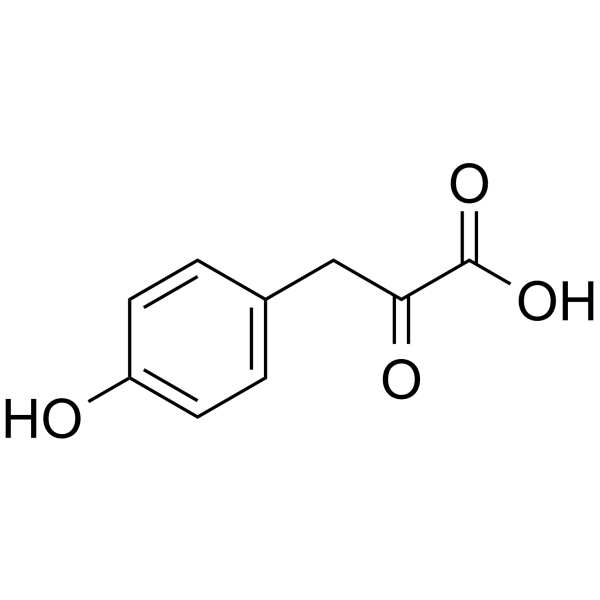
    HPD is a key enzyme in tyrosine catabolism and plays a key role in catalyzing the conversion of 4-hydroxyphenylpyruvate into homogentisate. This enzymatic process represents a key step in the tyrosine metabolic pathway and contributes to the breakdown of this amino acid. HPD/HPPDase Protein, Human (His) is the recombinant human-derived HPD/HPPDase protein, expressed by E. coli , with N-6*His labeled tag.
  • HY-P70525

    Programmed cell death protein 1; HPD-1; PDCD1; CD279

    Human HEK293
    PD-1 protein is an inhibitory receptor on T cells that maintains immune tolerance by binding to CD274/PDCD1L1 and CD273/PDCD1LG2. It blocks T cell activation by binding to CD3-TCR and recruiting PTPN11/SHP-2 to dephosphorylate key signaling molecules. PD-1 Protein, Human (HEK293, mFc) is the recombinant human-derived PD-1 protein, expressed by HEK293 , with C-mFc labeled tag.
  • HY-P73347

    CD279; HPD-1; PDCD1; Programmed cell death 1; SLEB2

    Rat HEK293
    Programmed cell death protein 1 (Pdcd1) is an immune-inhibitory receptor which delivers inhibitory signals upon binding to ligands CD274/PDCD1L1 and CD273/PDCD1LG2, playing a critical role in induction and maintenance of immune tolerance to self. Pdcd1plays a role in anti-tumor immunity and is involved in safeguarding against autoimmunity, but Pdcd1-mediated inhibitory pathway is also exploited by tumors to attenuate anti-tumor immunity. PD-1 Protein, Rat (HEK293, His) is the recombinant rat-derived PD-1 protein, expressed by HEK293 , with C-His labeled tag.
  • HY-P77509

    Programmed cell death protein 1; HPD-1; PDCD1; CD279

    Human HEK293
    PD-1 protein is an inhibitory receptor on T cells that maintains immune tolerance by binding to CD274/PDCD1L1 and CD273/PDCD1LG2. It blocks T cell activation by binding to CD3-TCR and recruiting PTPN11/SHP-2 to dephosphorylate key signaling molecules. PD-1 Protein, Human (Biotinylated, HEK293, His) is the recombinant human-derived PD-1 protein, expressed by HEK293 , with C-His labeled tag.
  • HY-P73348

    CD279; HPD-1; PDCD1; Programmed cell death 1; SLEB2

    Rat HEK293
    Programmed cell death protein 1 (Pdcd1) is an immune-inhibitory receptor which delivers inhibitory signals upon binding to ligands CD274/PDCD1L1 and CD273/PDCD1LG2, playing a critical role in induction and maintenance of immune tolerance to self. Pdcd1plays a role in anti-tumor immunity and is involved in safeguarding against autoimmunity, but Pdcd1-mediated inhibitory pathway is also exploited by tumors to attenuate anti-tumor immunity. PD-1 Protein, Rat (HEK293, Fc) is the recombinant rat-derived PD-1 protein, expressed by HEK293 , with C-hFc labeled tag.
  • HY-P73344
    PD-1 Protein, Human (HEK293, Fc, solution)
    3 Publications Verification

    CD279; HPD-1; PDCD1; Programmed cell death 1; SLEB2

    Human HEK293
    PD-1 protein is an inhibitory receptor on T cells that maintains immune tolerance by binding to CD274/PDCD1L1 and CD273/PDCD1LG2. It blocks T cell activation by binding to CD3-TCR and recruiting PTPN11/SHP-2 to dephosphorylate key signaling molecules. PD-1 Protein, Human (HEK293, Fc) is the recombinant human-derived PD-1 protein, expressed by HEK293 , with C-hFc labeled tag.
  • HY-P72406

    Programmed cell death protein 1; HPD-1; PDCD1; CD279

    Human HEK293
    PD-1 protein is an inhibitory receptor on T cells that maintains immune tolerance by binding to CD274/PDCD1L1 and CD273/PDCD1LG2. It blocks T cell activation by binding to CD3-TCR and recruiting PTPN11/SHP-2 to dephosphorylate key signaling molecules. PD-1 Protein, Human (Biotinylated, HEK293, His-Avi) is the recombinant human-derived PD-1 protein, expressed by HEK293 , with C-Avi, C-6*His labeled tag.
  • HY-P73342

    CD279; HPD-1; PDCD1; Programmed cell death 1; SLEB2

    Canine HEK293
    Programmed cell death protein 1 (Pdcd1) is an immune-inhibitory receptor which delivers inhibitory signals upon binding to ligands CD274/PDCD1L1 and CD273/PDCD1LG2, playing a critical role in induction and maintenance of immune tolerance to self. Pdcd1plays a role in anti-tumor immunity and is involved in safeguarding against autoimmunity, but Pdcd1-mediated inhibitory pathway is also exploited by tumors to attenuate anti-tumor immunity. PD-1 Protein, Canine (HEK293, His, solution) is the recombinant canine-derived PD-1 protein, expressed by HEK293 , with C-His labeled tag.
  • HY-P73345

    CD279; HPD-1; PDCD1; Programmed cell death 1; SLEB2

    Human HEK293
    PD-1 protein is an inhibitory receptor on T cells that maintains immune tolerance by binding to CD274/PDCD1L1 and CD273/PDCD1LG2. It blocks T cell activation by binding to CD3-TCR and recruiting PTPN11/SHP-2 to dephosphorylate key signaling molecules. PD-1 Protein, Human (HEK293, His-Fc) is the recombinant human-derived PD-1 protein, expressed by HEK293 , with C-hFc, C-His labeled tag.
  • HY-P73350

    CD279; HPD-1; PDCD1; Programmed cell death 1; SLEB2

    Rhesus Macaque HEK293
    Programmed cell death protein 1 (PDCD1) is an immune-inhibitory receptor which delivers inhibitory signals upon binding to ligands CD274/PDCD1L1 and CD273/PDCD1LG2, playing a critical role in induction and maintenance of immune tolerance to self. PDCD1 plays a role in anti-tumor immunity and is involved in safeguarding against autoimmunity, but PDCD1-mediated inhibitory pathway is also exploited by tumors to attenuate anti-tumor immunity. PD-1 Protein, Rhesus Macaque (HEK293, His) is the recombinant Rhesus Macaque-derived PD-1 protein, expressed by HEK293 , with C-His labeled tag.
  • HY-P73342A

    CD279; HPD-1; PDCD1; Programmed cell death 1; SLEB2

    Canine HEK293
    Programmed cell death protein 1 (Pdcd1) is an immune-inhibitory receptor which delivers inhibitory signals upon binding to ligands CD274/PDCD1L1 and CD273/PDCD1LG2, playing a critical role in induction and maintenance of immune tolerance to self. Pdcd1plays a role in anti-tumor immunity and is involved in safeguarding against autoimmunity, but Pdcd1-mediated inhibitory pathway is also exploited by tumors to attenuate anti-tumor immunity. PD-1 Protein, Canine (HEK293, C-His) is the recombinant canine-derived PD-1, expressed by HEK293, with C-6*His labeled tag.
  • HY-P73349

    CD279; HPD-1; PDCD1; Programmed cell death 1; SLEB2

    Rhesus Macaque HEK293
    Programmed cell death protein 1 (PDCD1) is an immune-inhibitory receptor which delivers inhibitory signals upon binding to ligands CD274/PDCD1L1 and CD273/PDCD1LG2, playing a critical role in induction and maintenance of immune tolerance to self. PDCD1 plays a role in anti-tumor immunity and is involved in safeguarding against autoimmunity, but PDCD1-mediated inhibitory pathway is also exploited by tumors to attenuate anti-tumor immunity. PD-1 Protein, Rhesus Macaque (HEK293, Fc) is the recombinant Rhesus Macaque-derived PD-1 protein, expressed by HEK293 , with C-hFc labeled tag.
  • HY-P705070

    Programmed cell death protein 1; HPD-1; PDCD1; CD279

    Human HEK293
  • HY-P70766

    Programmed cell death protein 1; HPD-1; PDCD1; CD279

    Human HEK293
    PD-1 protein is an inhibitory receptor on T cells that maintains immune tolerance by binding to CD274/PDCD1L1 and CD273/PDCD1LG2. It blocks T cell activation by binding to CD3-TCR and recruiting PTPN11/SHP-2 to dephosphorylate key signaling molecules. PD-1 Protein, Human (147a.a, HEK293, His) is the recombinant human-derived PD-1 protein, expressed by HEK293 , with C-6*His labeled tag.
  • HY-P73725

    CD279; HPD-1; PDCD1; Programmed cell death 1; SLEB2

    Cynomolgus HEK293
    PD-1 is a cell surface receptor on T and B cells that binds to PD-L1 and PD-L2. PD-1 is an immune checkpoint that protects autoimmunity by promoting apoptosis of antigen-specific T cells in lymph nodes (programmed cell death) and reducing apoptosis of regulatory T cells (anti-inflammatory, inhibitory T cells). The expression of PD-L1 on tumor cells inhibits anti-tumor activity through the binding of PD-1 to effector T cells. PD-1 Protein, Cynomolgus (Biotinylated, HEK293, Fc-Avi) is the recombinant cynomolgus-derived PD-1 protein, expressed by HEK293 , with C-Avi, C-hFc labeled tag.
  • HY-P704281

    Programmed cell death protein 1; PDCD1; PD-1; HPD-1; CD279

    Human HEK293
    PD-1 protein is an inhibitory receptor on T cells that maintains immune tolerance by binding to CD274/PDCD1L1 and CD273/PDCD1LG2. It blocks T cell activation by binding to CD3-TCR and recruiting PTPN11/SHP-2 to dephosphorylate key signaling molecules. PD-1 Protein, Human (HEK293, Llama Fc) is the recombinant human-derived PD-1 protein, expressed by HEK293, with C-Llama Fc labeled tag.
  • HY-P704840

    Programmed cell death protein 1; PDCD1; PD-1; HPD-1; CD279

    Human HEK293
  • HY-P70799

    Programmed cell death protein 1; PDCD1; PD-1; HPD-1; CD279

    Human HEK293
    PD-1 protein is an inhibitory receptor on T cells that maintains immune tolerance by binding to CD274/PDCD1L1 and CD273/PDCD1LG2. It blocks T cell activation by binding to CD3-TCR and recruiting PTPN11/SHP-2 to dephosphorylate key signaling molecules. PD-1 Protein, Human (C93S, HEK293, His) is the recombinant human-derived PD-1 protein, expressed by HEK293 , with C-6*His labeled tag and C93S mutation.
  • HY-P704839

    Programmed cell death protein 1; PDCD1; PD-1; HPD-1; CD279

    Human HEK293

Inquiry Online

Your information is safe with us. * Required Fields.

Salutation


Country or Region *

Applicant Name *


Organization Name *

Department *


Email Address *


Product Name *

Cat. No.


Requested quantity *

Phone Number *


Remarks

Inquiry Online

Inquiry Information

Product Name:
Cat. No.:
Quantity:
MCE Japan Authorized Agent:

