



PD-L1 Protein, Human (HEK293)
Based on 10 publication(s) in Google Scholar
The PD-L1 protein critically regulates immune tolerance by acting as a ligand for PDCD1/PD-1, regulating T cell activation threshold, and limiting effector responses. It may act as a costimulatory molecule for IL10-producing T cell subsets. PD-L1 Protein, Human (HEK293) is the recombinant human-derived PD-L1 protein, expressed by HEK293 , with tag free.
- Species: Human
- Source: HEK293
-
Storage:Stored at -20°C for 2 years from date of receipt. After reconstitution, it is stable at 4°C for 1 week or -20°C for longer (with carrier protein). It is recommended to freeze aliquots at -20°C or -80°C for extended storage.


To place orders, for customer services and technical support, please contact: MedChemExpress USA
Tel: 609-228-6898 E-mail: [email protected] [email protected]


-
 Biological Activity
-
Technical Parameters
-
Product Properties
- Documentation
- Help & FAQs


-

HY-P7396
PD-1 Protein, Human (HEK293, His) -
HY-P70632
PD-L1 Protein, Mouse (HEK293, His) -

HY-P9904
AtezolizumabAnti-PD-L1 Antibody -
HY-P7110A
VEGF165 Protein, Human (HEK293) -
HY-P70535
Galectin-9/LGALS9 Protein, Human (HEK293, His) -
HY-P70676
PD-1 Protein, Cynomolgus (HEK293, His) -
HY-P7395
PD-1 Protein, Human (CHO, Fc) -
HY-P70564
PD-L1 Protein, Cynomolgus (HEK293, His)


Biological Activity
Description
The PD-L1 protein critically regulates immune tolerance by acting as a ligand for PDCD1/PD-1, regulating T cell activation threshold, and limiting effector responses. It may act as a costimulatory molecule for IL10-producing T cell subsets. PD-L1 Protein, Human (HEK293) is the recombinant human-derived PD-L1 protein, expressed by HEK293 , with tag free.
Background
PD-L1 Protein assumes a critical role in both the induction and maintenance of immune tolerance to self, acting as a ligand for the inhibitory receptor PDCD1/PD-1 and thereby modulating the activation threshold of T-cells, ultimately limiting their effector response. Additionally, PD-L1 may function as a costimulatory molecule for T-cell subsets that predominantly produce interleukin-10 (IL10) through an as yet unidentified activating receptor. Beyond its role as an immune checkpoint, PD-L1 also acts as a transcription coactivator, translocating into the nucleus in response to hypoxia and interacting with phosphorylated STAT3 to promote the transcription of GSDMC, leading to pyroptosis. Exploited by tumors to attenuate anti-tumor immunity and escape immune system destruction, the PDCD1-mediated inhibitory pathway facilitated by PD-L1 interaction with PDCD1/PD-1 inhibits cytotoxic T lymphocytes (CTLs) effector function. Blocking the PDCD1-mediated pathway has shown promise in reversing exhausted T-cell phenotypes and normalizing anti-tumor responses, providing a rationale for cancer immunotherapy.
Verified Bioactivity
1.Measured by its ability to inhibit anti-CD3-induced proliferation of stimulated CTLL-2 mouse cytotoxic T cells. The ED50 for this effect is ≤0.2111 μg/ml in the presence of 10 μg/mL anti-CD3.
2.Measured by its binding ability in a functional ELISA. Immobilized Human PD-L1 at 1 μg/mL (100 μL/well) can bind Human PD-1. The ED50 for this effect is ≤0.8996 μg/mL.
3.Immobilized Recombinant Human PD-L1 / B7-H1 / CD274 Protein at 2 μg/mL (100 μL/well) can bind Anti-PD-L1 Antibody, Human IgG1 (Atezolizumab), the EC50 is 1-10 ng/mL.
MCE Validation Data
-
Purity - SDS-PAGE
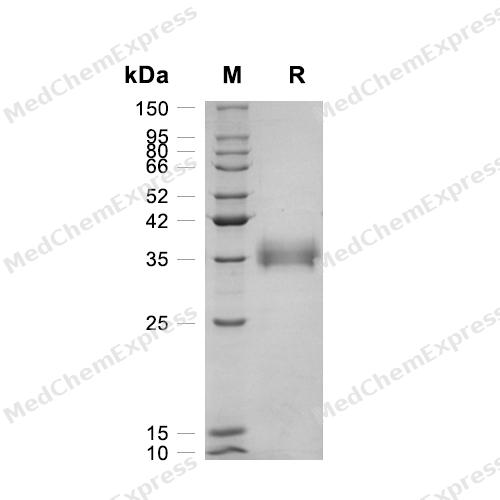
Purity - SDS-PAGE
-
Bioactivity - Cell-Based Assay
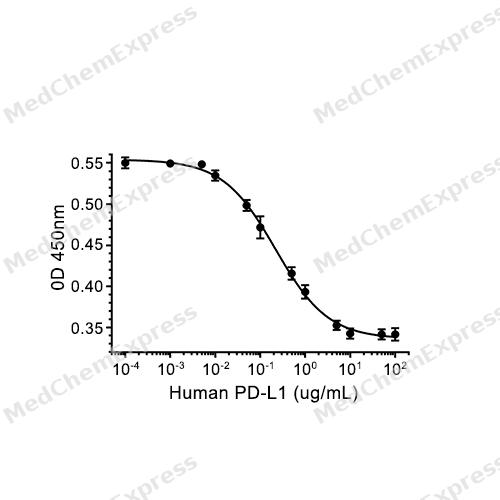
Bioactivity - Cell-Based Assay


Publications (10)
-
Journal Impact Factor
-
Most Recent
-
ACS Nano
Electric Field-Resistant Bubble-Enhanced Wash-Free Profiling of Extracellular Vesicle Surface Markers. [Abstract]2025 Mar 4;19(8):8093-8107. PMID: 39985473 -
-
Biosens Bioelectron
A facile liquid biopsy assay for highly efficient CTCs capture and reagent-less monitoring of immune checkpoint PD-L1 expression on CTCs with non-small cell lung cancer patients. [Abstract]2025 May 1:275:117236. PMID: 39929085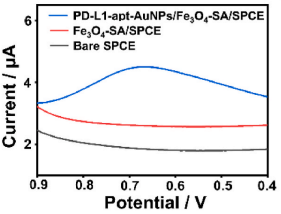
PD-L1 Protein, Human (HEK293) purchased from MedChemExpress. Usage Cited in: Biosens Bioelectron. 2025 May 1:275:117236. [Abstract]
SWV curves obtained on bare SPCE, Fe3O4-SA/SPCE, and PD-L1-apt-AuNPs/Fe3O4-SA/SPCE toward 10 ng/mL PD-L1 (PD-L1 Protein, Human (HEK293), HY-P73361) (30 min).
-
J Immunother Cancer
Fluorination augments tumor engagement and antitumor immunity of a D-peptide-based radiotheranostic agent for combinatorial immune checkpoint blockade therapy. [Abstract]2026 Mar 9;14(3):e013732. PMID: 41802811 -
-
ACS Appl Mater Interfaces
Programmable DNA Circuit-Facilitated Determination of Circulating Extracellular Vesicle PD-L1 for Lung Cancer Diagnosis and Immunotherapy Response Prediction. [Abstract]2023 Apr 12;15(14):17696-17704. PMID: 36978260 -
J Med Chem
Discovery of Novel PD-L1 Inhibitors That Induce the Dimerization, Internalization, and Degradation of PD-L1 Based on the Fragment Coupling Strategy. [Abstract]2023 Dec 28;66(24):16807-16827. PMID: 38109261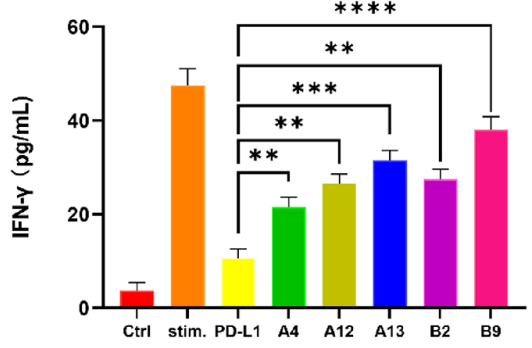
PD-L1 Protein, Human (HEK293) purchased from MedChemExpress. Usage Cited in: J Med Chem. 2023 Dec 28;66(24):16807-16827. [Abstract]
T-cell recovery activity assay in Jurkat cells. Stim. group, Jurkat cells activated by the CD3/CD28 T-cell activator; PD-L1 (PD-L1 Protein, Human (HEK293), HY-P73361) (24 h) group, adding PD-L1 to Jurkat cells followed by the T-cell activator.
-
Eur J Med Chem
Design, synthesis, and evaluation of PD-1/PD-L1 small-molecule inhibitors bearing a rigid indane scaffold. [Abstract]2023 Aug 5:256:115468. PMID: 37207535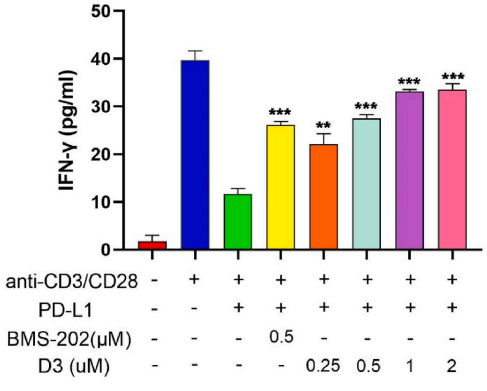
PD-L1 Protein, Human (HEK293) purchased from MedChemExpress. Usage Cited in: Eur J Med Chem. 2023 Aug 5:256:115468. [Abstract]
Effect of compound D3 on T cells recovery activity in Jurkat cells. T cell recovery activity was determined by IFN-γ release level detected by ELISA kit. The results showed that, compared with the control group, the anti-CD3/CD28 greatly increased the expression of IFN-γ, which was markedly reduced by addition of human PD-L1 protein (PD-L1 Protein, Human (HEK293), HY-P7336) (24 h).
-
OncoImmunology
Enhancing T cell anti-tumor efficacy with a PD1-TIGIT chimeric immune-checkpoint switch receptor. [Abstract]2023 Oct 5;12(1):2265703. PMID: 37808405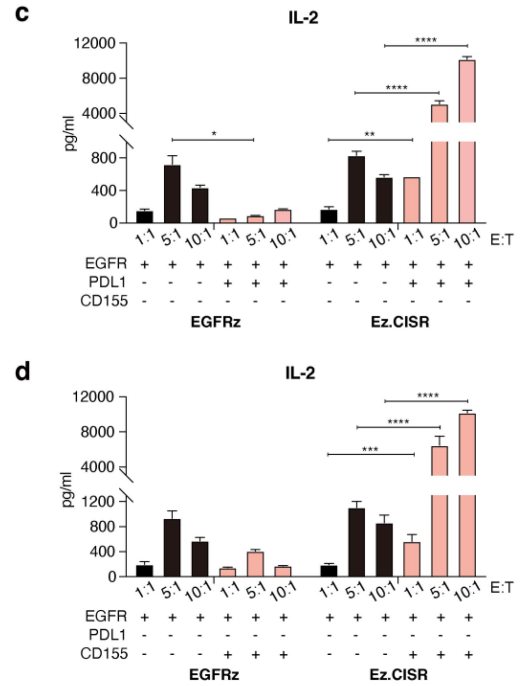
PD-L1 Protein, Human (HEK293) purchased from MedChemExpress. Usage Cited in: OncoImmunology. 2023 Oct 5;12(1):2265703. [Abstract]
PDL1 (PD-L1 Protein, Human (HEK293) (24 h)).Coculture of EGFRz-CAR T cells or Ez.CISR T cells with target cells (c, Daudi-E and Daudi-E.P cells; d, Daudi-E cells and Daudi-E.155 cells) at E:T ratios of 1:1, 5:1, and 10:1. After 24 hours, culture supernatants were collected, and levels of IL-2 were measured by enzyme-linked immunosorbent assays (means ± SDs, n = 3).
-
Bioorg Chem
A novel PET tracer for noninvasive imaging the checkpoints expression of innate and adaptive immunity in tumors by simultaneously targeting CD24 and PD-L1. [Abstract]2025 Apr:157:108260. PMID: 39952064


Technical Parameters
-
Species Human
-
Source HEK293
-
Tag Tag Free
-
Accession
Q9NZQ7-1/NP_054862.1 (F19-R238)
-
Molecular Construction
-
N-term
-
PD-L1 (F19-R238)
Accession # Q9NZQ7-1/NP_054862.1 -
C-term
-
-
Protein Length
Extracellular Domain
-
Synonyms
CD274; B7 Homolog 1; Prev. PDCD1LG1; B7-H; PD-L1; PDCD1 Ligand 1; B7H1; PDCD1L1; PDL1; HPD-L1; Programmed Cell Death 1 Ligand 1; Programmed Death Ligand 1; CD274 Antigen; ADMIO5; CD274 Molecule; B7-H1
-
AA Sequence
FTVTVPKDLYVVEYGSNMTIECKFPVEKQLDLAALIVYWEMEDKNIIQFVHGEEDLKVQHSSYRQRARLLKDQLSLGNAALQITDVKLQDAGVYRCMISYGGADYKRITVKVNAPYNKINQRILVVDPVTSEHELTCQAEGYPKAEVIWTSSDHQVLSGKTTTTNSKREEKLFNVTSTLRINTTTNEIFYCTFRRLDPEENHTAELVIPELPLAHPPNER
-
Predicted Molecular Mass
25.2 kDa
-
Molecular Weight
Approximately 31-40 kDa, based on SDS-PAGE under reducing conditions, due to the glycosylation.
-
Glycosylation
Yes
-
Purity
≥ 95%, as determined by reducing SDS-PAGE.


Product Properties
Lyophilized powder
1.Lyophilized from a 0.2 μm filtered solution of PBS, pH 7.4.
2. Lyophilized from a 0.2 μm filtered solution of PBS, pH 7.4, 8% trehalose.
3. Lyophilized from a 0.2 μm filtered solution of PBS, pH 7.4, 5% trehalose, 5% mannitol, 0.01% Tween 80.
Please refer to the lot-specific COA for specific buffer information.
<1 EU/μg, determined by LAL method.
It is not recommended to reconstitute to a concentration less than 100 μg/mL in ddH2O.
Stored at -20°C for 2 years from date of receipt. After reconstitution, it is stable at 4°C for 1 week or -20°C for longer (with carrier protein). It is recommended to freeze aliquots at -20°C or -80°C for extended storage.
Room temperature in continental US; may vary elsewhere.


Documentation
-
Data Sheet (237 KB)
-
SDS (252 KB)
- English - EN (252 KB)
- Français - FR (252 KB)
- Deutsch - DE (252 KB)
- Norwegian - NO (252 KB)
- Español - ES (252 KB)
- Swedish - SV (252 KB)
- Italian - IT (252 KB)
- Korean - KR (252 KB)
- Portuguese - PT (252 KB)
-
Handling Instructions (2659 KB)

Calculators
Concentration (start) × Volume (start) = Concentration (final) × Volume (final)


 Powered by Bioz

