12 Results for "

HSC-T6 cells

" in MedChemExpress (MCE) Product Catalog:
Products (12)

12 Results for "HSC-T6 cells" in MCE Product Catalog:

1
1 Cited Publications
Cat. No.: HY-N0909
CAS No.: 80418-25-3
Synonyms: 20(S)-Notoginsenoside R2; Ginsenoside Ng-R2
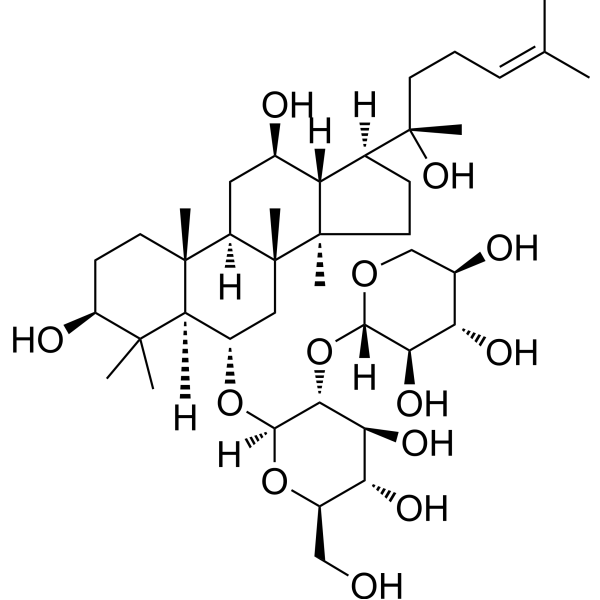
Notoginsenoside R2 (20(S)-Notoginsenoside R2; Ginsenoside Ng-R2) is an orally active notoginsenoside . Notoginsenoside R2 activates P90RSK and Nrf2 via the MEK1/2-ERK1/2 pathway to inhibit 6-OHDA-induced apoptotic damage in nerve cells. Notoginsenoside R2 upregulates SOX8/β-catenin by reducing miR-27a, thereby suppressing Aβ25-35-induced neuronal apoptosis and inflammatory responses . Notoginsenoside R2 alleviates lipid accumulation and mitochondrial dysfunction in diabetic nephropathy by inhibiting c-Src. Notoginsenoside R2 alleviates hepatic fibrosis by inducing hepatic stellate cell senescence and inhibiting the inflammatory microenvironment via JAK/STAT3 suppression . Notoginsenoside R2 can be used in research related to Parkinson's disease, Alzheimer's disease, diabetic nephropathy and hepatic fibrosis .
loading...
    loading...
Cat. No.: HY-107830
CAS No.: 1448-36-8
Purity:  99.81%
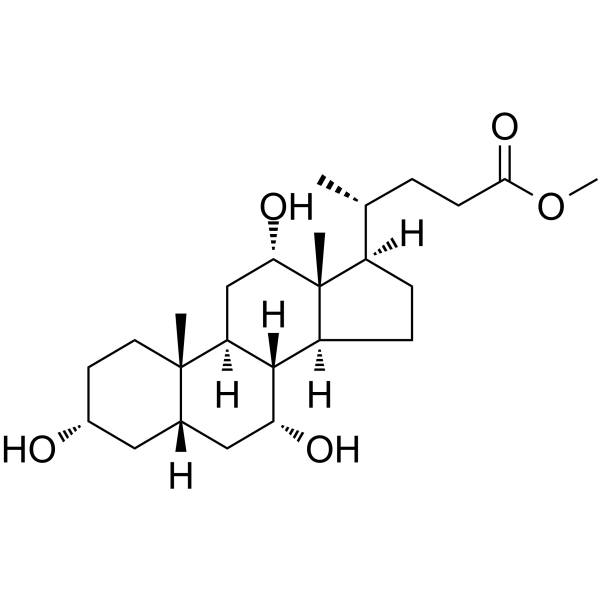
Methyl cholate is a bile acid analog and a specific inhibitor of TcdB toxin from Clostridioides difficile. Methyl cholate exerts a stronger selective inhibitory effect on TcdB than on TcdA. Methyl cholate induces conformational stabilization by binding to a unique site of TcdB, thereby blocking the binding of the toxin to host receptors and its self-processing process. Methyl cholate effectively protects human fibroblasts from TcdB-induced cytopathic effects. Methyl cholate exhibits dose-dependent anti-hepatic fibrosis activity in both cellular and zebrafish models, and significantly reduces the expression levels of α-SMA and COL-I. Methyl cholate is suitable for in-depth research in the fields of Clostridioides difficile infection and hepatic fibrosis .
loading...
    loading...
Cat. No.: HY-N6857
CAS No.: 524-20-9
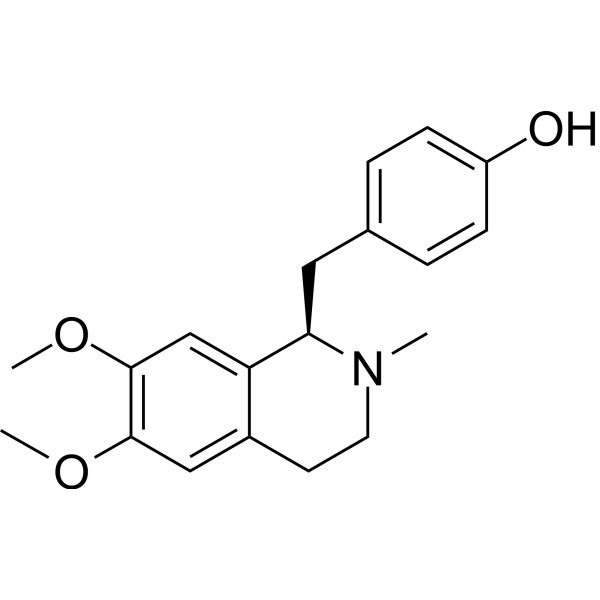
Armepavine, found in Nelumbo nucifera, is an orally active NF-κB inhibitor. Armepavine attenuates expression of p-p65, α-SMA, p-JNK1/2, p-ERK1/2, p-p38α stimulated by TNF-α and LPS. Armepavine suppresses NF-κB nuclear translocation, IκBα phosphorylation, and collagen deposition. Armepavine can be used for the research of hepatic fibrosis and leukemia .
loading...
    loading...
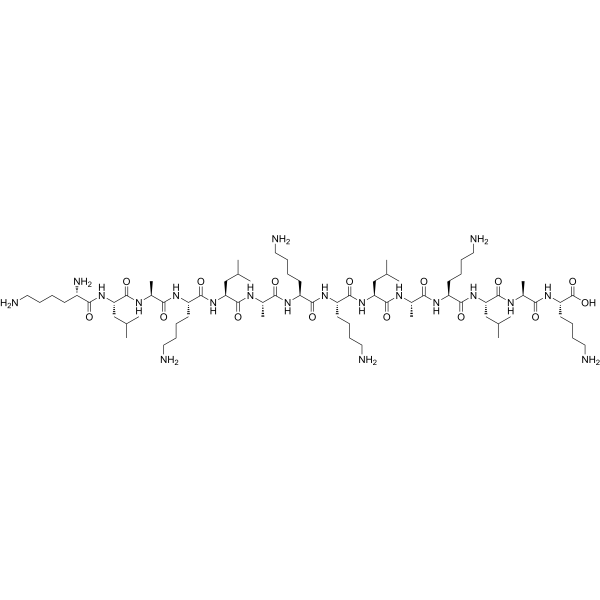
Cat. No.: HY-P5345
CAS No.: 184240-26-4
KLA peptide is a naturally occurring Antibiotic peptide that is nontoxic outside of cells but is toxic when it enters into the interior of targeted cells. KLA peptide can induce cell Apoptosis by disrupting mitochondrial membranes and activating Caspase. MG1-KLA, formed by the coupling of KLA peptide with MG1, can selectively induce apoptosis in pro-inflammatory microglia. KLA peptide can be used for the research of liver fibrosis. KLA peptide can be used for the research of neonatal hypoxic-ischemic encephalopathy.
loading...
    loading...
Cat. No.: HY-W654334
9-cis-Retinol-d5 is the deuterated-labeled 9-cis Retinol (HY-W587806). 9-cis Retinol is an upstream precursor of 9-cis-Retinal (HY-W009310) and 9-cis-Retinoic acid (HY-15128). 9-cis Retinol serves as a reaction substrate for cRDH, ARAT and LRAT, participates in cellular uptake and isomerization processes, and can be oxidized to form 9-cis-Retinal in the biosynthetic pathway. 9-cis Retinol inhibits the activity of 9-cis retinaldehyde dehydrogenase, thereby blocking the biosynthesis of 9-cis-Retinoic acid. 9-cis Retinol is applicable for metabolism-related research .
loading...
    loading...
Cat. No.: HY-W587806
CAS No.: 22737-97-9
Target:  

Endogenous Metabolite

Research Areas:  

Inflammation/Immunology

9-cis Retinol is an upstream precursor of 9-cis-Retinal (HY-W009310) and 9-cis-Retinoic acid (HY-15128). 9-cis Retinol serves as a reaction substrate for cRDH, ARAT and LRAT, participates in cellular uptake and isomerization processes, and can be oxidized to form 9-cis-Retinal in the biosynthetic pathway. 9-cis Retinol inhibits the activity of 9-cis retinaldehyde dehydrogenase, thereby blocking the biosynthesis of 9-cis-Retinoic acid. 9-cis Retinol is applicable for metabolism-related research .
loading...
    loading...
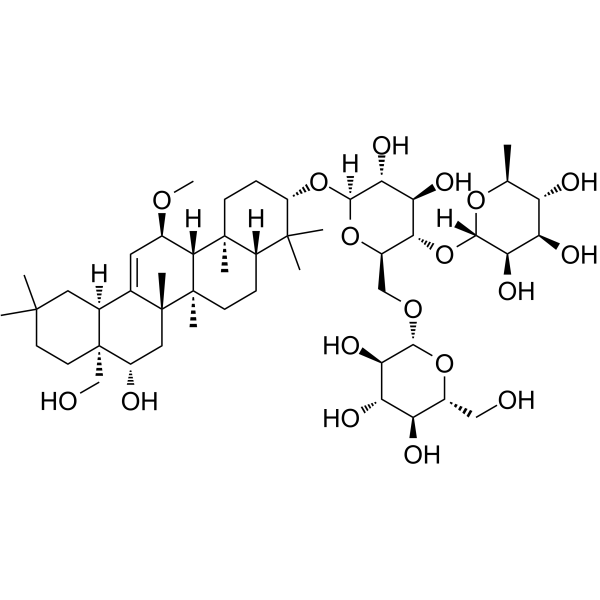
Cat. No.: HY-N4215
CAS No.: 104109-37-7
11(α)-Methoxysaikosaponin F is a triterpenoid saponin isolated from Bupleurum marginatum Wall.ex DC(ZYCH) which is a promising therapeutic for liver fibrosis. 11(α)-Methoxysaikosaponin F has an IC50 of 387.7 nM with viability of hepatic stellate cells-T6 (HSCs-T6). Triterpenoid saponins have numerous targets, important network positions, and strong inhibitory activity .
loading...
    loading...
Cat. No.: HY-N13117
CAS No.: 205370-58-7
Pinocembrin 7-O-[4′′,6′′-(S)-HHDP]-β-D-glucoside (compound 3) is a polyphenol that has weak antiproliferative activity in PDGF-induced HSC-T6 cells (IC50: 200 μM) .
loading...
    loading...
Cat. No.: HY-N3523
CAS No.: 38337-25-6
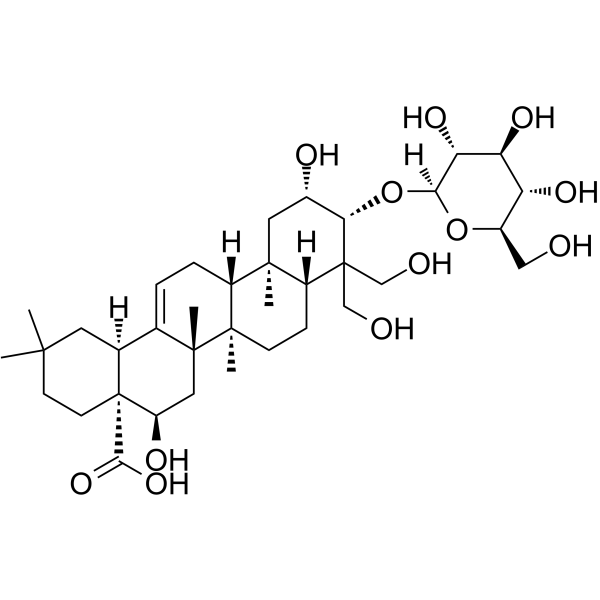
3-O-Beta-D-Glucopyranosylplatycodigenin is an oleanane-type triterpenoid isolated from roots of Platycodon grandiflorum. 3-O-Beta-D-Glucopyranosylplatycodigenin exhibits anti-proliferative activities against HSC-T6 cell line with an IC50 of 13.36 μM .
loading...
    loading...
Cat. No.: HY-N16980
CAS No.: 2292113-33-6
(7'E,8S)-2',4,8-Trihydroxy-3-methoxy-2,4'-epoxy-8,5'-neolign-7'-en-7-one (compound 4) is a novel neolignan anti-inflammatory agent. (7'E,8S)-2',4,8-Trihydroxy-3-methoxy-2,4'-epoxy-8,5'-neolign-7'-en-7-one has an IC50 of 25.2 μM against TGF-β-induced hepatic stellate cells (HSC-T6). (7'E,8S)-2',4,8-Trihydroxy-3-methoxy-2,4'-epoxy-8,5'-neolign-7'-en-7-one may be related to blocking excessive cell proliferation in the process of liver fibrosis and can be used in the study of liver fibrosis-related diseases. (7'E,8S)-2',4,8-Trihydroxy-3-methoxy-2,4'-epoxy-8,5'-neolign-7'-en-7-one can be naturally extracted from the dried aerial parts of Penthorum chinense Pursh .
loading...
    loading...
Cat. No.: HY-N8032
CAS No.: 1781226-44-5
2,6-Dihydroxyacetophenone-4-O-[4,6-(S)-hexahydroxydiphenoyl]-β-D-glucose is a novel polyphenol/ellagitannin-type glucoside. 2,6-Dihydroxyacetophenone-4-O-[4,6-(S)-hexahydroxydiphenoyl]-β-D-glucose mediates antiproliferative effects via platelet-derived growth factor (PDGF)-induced hepatic stellate cells. 2,6-Dihydroxyacetophenone-4-O-[4,6-(S)-hexahydroxydiphenoyl]-β-D-glucose can be used for the research of hepatic fibrosis .
loading...
    loading...
Cat. No.: HY-184378
CAS No.: 2922221-22-3
Research Areas:  

Metabolic Disease Cancer

MDB5 is a Hedgehog pathway and Smoothened inhibitor that binds to the 7-TM domain of Smo . MDB5 reduces hepatic stellate cell activation, extracellular matrix-related gene expression, collagen deposition, hydroxyproline content and epithelial-mesenchymal transition, and prevents sinusoidal endothelial cell capillarization . MDB5 induces G1 and S phase cell cycle arrest, triggers apoptosis by upregulating Bax and downregulating Bcl-2, and also decreases oxygen consumption rate, glucose uptake, transglutaminase activity and fibronectin matrix assembly . MDB5 reduces the levels of liver injury markers, hepatic triglyceride deposition and hepatic steatosis, restores the tissue structure of the kidney and spleen, and inhibits pancreatic tumor growth without causing body weight loss . MDB5 can be loaded into PEG-PCC-g-DC micelles, achieving high drug loading, sustained release, improved water solubility, enhanced cellular uptake and optimized hepatic distribution, with good tolerance in mice . MDB5 is applicable to research related to alcohol-associated liver disease, liver fibrosis and pancreatic cancer .
loading...
    loading...
  • 1