


1. Search Result
Search Result
Results for "

Luciferase, firefly

" in MedChemExpress (MCE) Product Catalog:

29

Inhibitors & Agonists

8

Fluorescent Dyes

2

Biochemical Assay Reagents

3

Peptides

1

MCE Kits

1

Natural
Products

1

Antibodies

7

Oligonucleotides

Cat. No. Product Name Target Research Areas Chemical Structure
  • HY-12591B
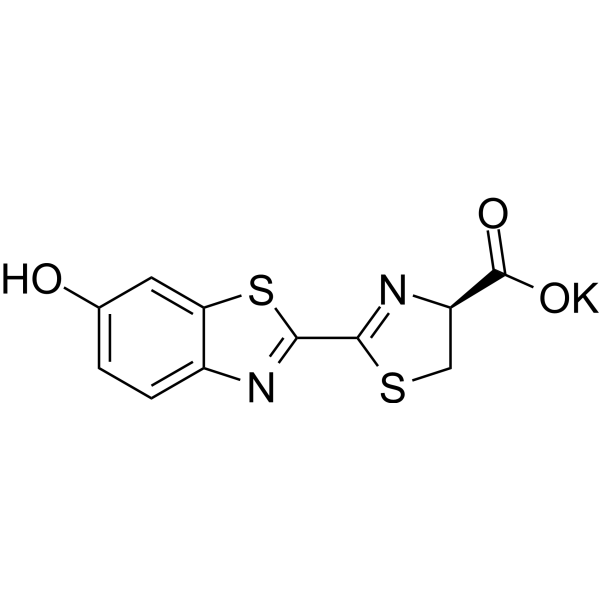
    D-Luciferin potassium
    Maximum Cited Publications
    110 Publications Verification

    D-(-)-Luciferin potassium; firefly luciferin potassium; Beetle Luciferin potassium

    Fluorescent Dye Others
    D-luciferin potassium is the natural substrate of the enzyme luciferase (Luc) that catalyzes the production of the typical yellowgreen light of fireflies. The 560 nm chemiluminescence from this reaction peaks within seconds, with light output that is proportional to luciferase concentration when the substrate luciferin is present in excess. The luciferase (luc) gene is a popular reporter gene for research and agent screening. Chemiluminescent techniques are virtually background-free, making the luc reporter gene ideal for detecting low-level gene expression. As little as 0.02 pg of luciferase can be reliably measured in a standard scintillation counter. In addition to its role as a reporter of gene expression, luciferase is commonly used in an extremely sensitive assay for ATP . We offer the firefly luciferase (HY-P1004A), luciferin free acid (HY-12591A), as well as its water-soluble sodium salts (HY-12591) and potassium salts (HY-12591B) .
    D-Luciferin potassium
  • HY-12591
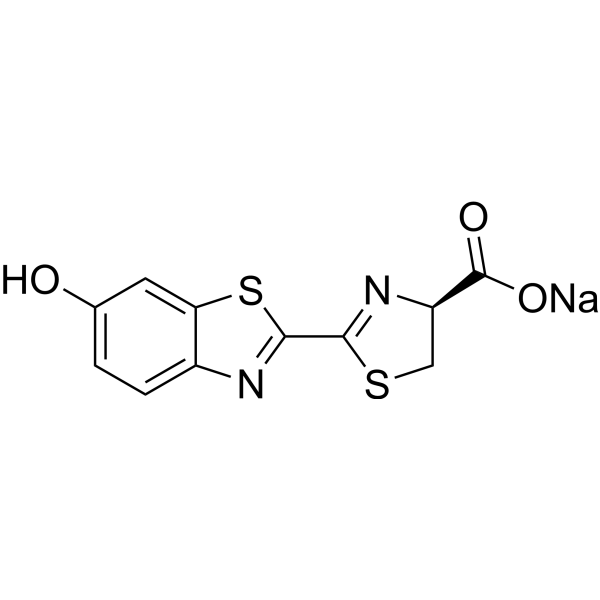
    D-Luciferin sodium
    Maximum Cited Publications
    110 Publications Verification

    D-(-)-Luciferin sodium; firefly luciferin sodium; Beetle Luciferin sodium

    Fluorescent Dye Others
    D-luciferin sodium is the natural substrate of the enzyme luciferase (Luc) that catalyzes the production of the typical yellowgreen light of fireflies. The 560 nm chemiluminescence from this reaction peaks within seconds, with light output that is proportional to luciferase concentration when the substrate luciferin is present in excess. The luciferase (luc) gene is a popular reporter gene for research and agent screening. Chemiluminescent techniques are virtually background-free, making the luc reporter gene ideal for detecting low-level gene expression. As little as 0.02 pg of luciferase can be reliably measured in a standard scintillation counter. In addition to its role as a reporter of gene expression, luciferase is commonly used in an extremely sensitive assay for ATP . We of er the firefly luciferase (HY-P1004A), luciferin free acid (HY-12591A), as well as its water-soluble sodium salts (HY-12591) and potassium salts (HY-12591B) .
    D-Luciferin sodium
  • HY-12591A
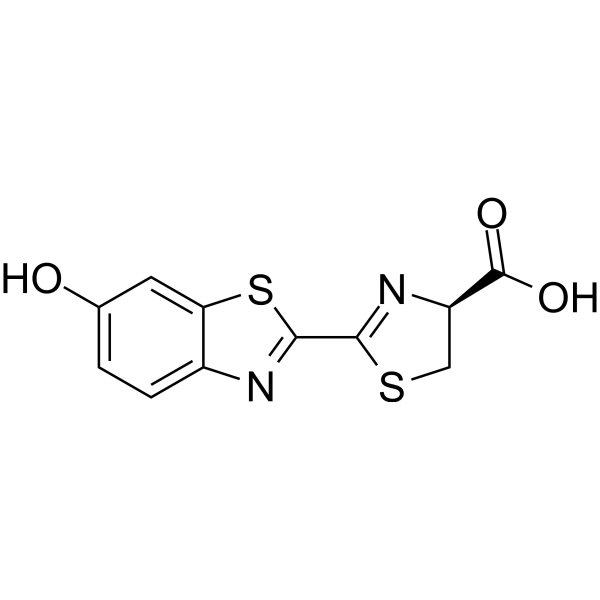
    D-Luciferin
    Maximum Cited Publications
    110 Publications Verification

    D-(-)-Luciferin; firefly luciferin; Beetle Luciferin

    Fluorescent Dye Others
    D-luciferin is the natural substrate of the enzyme luciferase (Luc) that catalyzes the production of the typical yellowgreen light of fireflies. The 560 nm chemiluminescence from this reaction peaks within seconds, with light output that is proportional to luciferase concentration when the substrate luciferin is present in excess. The luciferase (luc) gene is a popular reporter gene for research and agent screening. Chemiluminescent techniques are virtually background-free, making the luc reporter gene ideal for detecting low-level gene expression. As little as 0.02 pg of luciferase can be reliably measured in a standard scintillation counter. In addition to its role as a reporter of gene expression, luciferase is commonly used in an extremely sensitive assay for ATP . We of er the firefly luciferase (HY-P1004A), luciferin free acid (HY-12591A), as well as its water-soluble sodium salts (HY-12591) and potassium salts (HY-12591B) .
    D-Luciferin
  • HY-112641A
    AkaLumine hydrochloride
    5 Publications Verification

    Fluorescent Dye Cancer
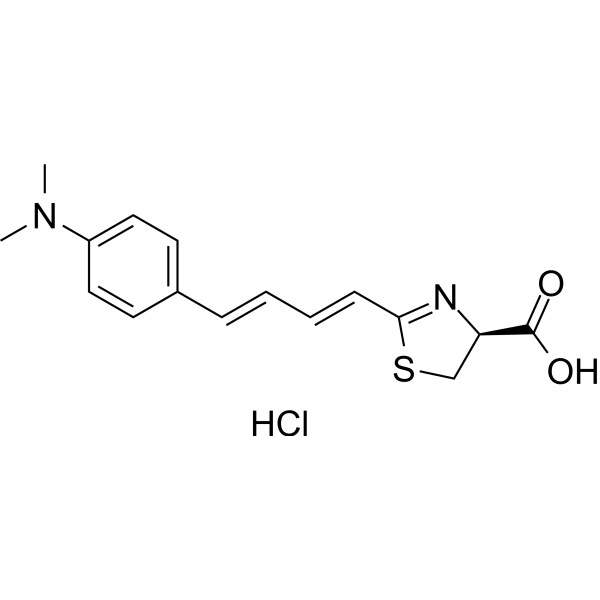
    AkaLumine hydrochloride is a D-luciferin (HY-12591A) analogue with a Km of 2.06 μM for recombinant firefly luciferase (Fluc) protein. AkaLumine hydrochloride emits near-infrared (NIR) light (λmax=677 nm) in reactions with native Fluc. AkaLumine hydrochloride has high tissue-penetration and increases detection sensitivity from deep-tissue targets .
    AkaLumine hydrochloride
  • HY-P1004A

    Fluorescent Dye Others
    Luciferase, firefly is the light-emitting enzyme responsible for the bioluminescence of fireflies and click beetles. Luciferase, firefly catalytic substrate is D-luciferin (HY-12591B) .
    Luciferase, firefly
  • HY-153229
    Firefly luciferase mRNA-LNP
    1 Publications Verification

    mRNA Biochemical Assay Reagents Others
    Firefly luciferase mRNA-LNP is a lipid nanoparticle (LNP) containing firefly luciferase mRNA. Firefly luciferase mRNA-LNP exhibits a stable nanostructure, in which LNP plays a key role in effectively protecting and transporting mRNA to cells. Luciferase is a bioluminescent reporter gene for gene regulation and functional studies. Firefly Luciferase mRNA-LNP expresses firefly luciferase protein after entering the cells, which is often used for promoter activity detection or dual fluorescent molecular complementation experiments. Firefly luciferase mRNA-LNP is studied in research for RNA delivery, cell viability, and translation efficiency .
    Firefly luciferase mRNA-LNP
  • HY-153080

    Fluorescent Dye mRNA Others
    Firefly Luciferase mRNA (N1-Me-Pseudo UTP) is a modified form of firefly luciferase mRNA, which is N1-methylated pseudo uridine (N1-Me-Pseudo UTP). Firefly Luciferase mRNA (N1-Me-Pseudo UTP) is a commonly used reporter molecule in biomedical and mRNA research and its core function is to rapidly and quantitatively monitor the expression and delivery efficiency of mRNA through the emission of light signals .
    Firefly Luciferase mRNA(N1-Me-Pseudo UTP)
  • HY-111429
    YAP/TAZ inhibitor-1
    5+ Cited Publications

    YAP Cancer
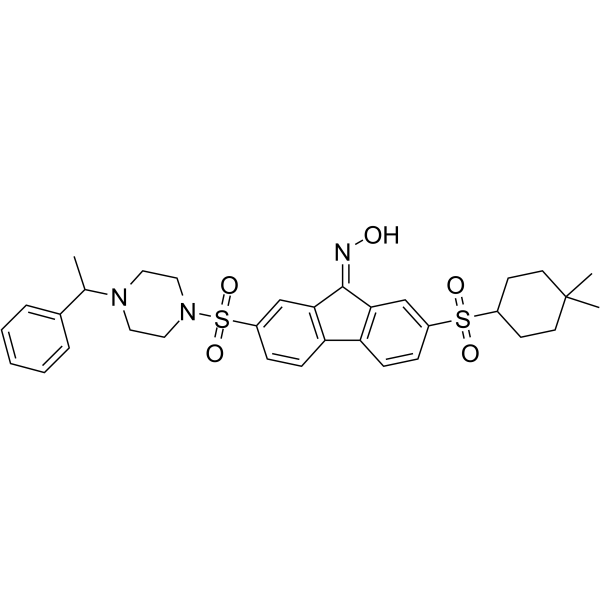
    YAP/TAZ inhibitor-1 is a YAP/TAZ inhibitor extracted from patent WO2017058716A1, Compound 1, has an IC50 of <0.100 μΜ in firefly luciferase assay .
    YAP/TAZ inhibitor-1
  • HY-155945

    Reactive Oxygen Species (ROS) Others
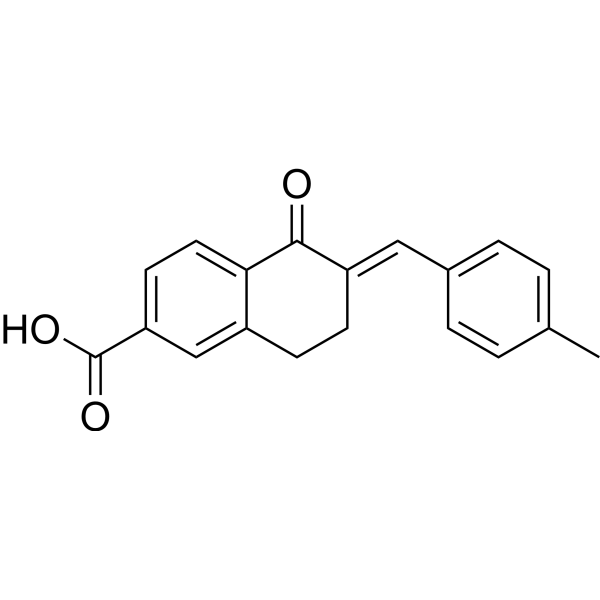
    Firefly luciferase-IN-1 (compound 48) is a highly potent and reversible inhibitor of firefly luciferase with an IC50 value of 0.25 nM .
    Firefly luciferase-IN-1
  • HY-174493

    mRNA Others
    Firefly luciferase (FLuc) mRNA (5moU) expresses a luciferase protein, originally isolated from the firefly, Photinus pyralis. FLuc is commonly used in mammalian cell culture to measure both gene expression and cell viability. It emits bioluminescence in the presence of the substrate, luciferin.
    Firefly luciferase mRNA (5moU)
  • HY-153082

    Fluorescent Dye Others
    Firefly Luciferase circRNA will express a luciferase protein, originally isolated from the Photinus pyralis (Firefly). Firefly Luciferase circRNA is ideal for monitoring and optimizing transfection efficiency and is recommended as a positive control for circular RNA transfections.
    Firefly Luciferase circRNA
  • HY-174790

    mRNA Cancer
    Firefly Luciferase mRNA is a reporter mRNA that can be transfected into cells to express firefly luciferase protein. Firefly Luciferase mRNA induces cytotoxicity in cancer cells at low concentrations. In cancer cells, the expression level of luciferase shows a non-linear relationship with the dose of Firefly Luciferase mRNA. When combined with the H2S-responsive bioluminescent probe (H-Luc), Firefly Luciferase mRNA enables bioluminescence-based detection of endogenous hydrogen sulfide in non-transgenic NAFLD cell models and NAFLD mouse models. Firefly Luciferase mRNA can be used in studies related to non-alcoholic fatty liver disease .
    Firefly Luciferase mRNA
  • HY-160869

    Fluorescent Dye Others
    Firefly luciferase-IN-2 (compound 5j) is an inhibitor of ATP-dependent luciferase (Firefly luciferase), the major light-emitting enzyme in fireflies and kowtow bugs. Firefly luciferase-IN-2 inhibits P. pyralis luciferase with an IC50 of 0.15 μM, while the inhibitory potency against R. reniformis is not significant .
    Firefly luciferase-IN-2
  • HY-160870

    Fluorescent Dye Others
    Firefly luciferase-IN-3 (CID: 17087944) is an inhibitor of ATP-dependent luciferase (Firefly luciferase) and has nM-level inhibitory activity against NanoLuc (pIC50=7.5) .
    Firefly luciferase-IN-3
  • HY-160873

    Fluorescent Dye Others
    Firefly luciferase-IN-5 (CID: 16031203) is an inhibitor of ATP-dependent luciferase (Firefly luciferase). It has nM-level inhibitory activity against GRLuc, RLuc8, and RLuc respectively (pIC50=8.5,7.5,5.5) .
    Firefly luciferase-IN-5
  • HY-158257

    Fluorescent Dye Others
    Firefly luciferase-IN-4 (CID: 3987260) is an inhibitor of ATP-dependent luciferase (Firefly luciferase). It has nM-level inhibitory activity (pIC< sub>50=6.5) .
    Firefly luciferase-IN-4
  • HY-170496

    Wnt Cancer
    Fluc-IN-1 (Compound 3) is an inhibitor for firefly luciferase with an IC50 of 25 nM. Fluc-IN-1 inhibits WNT/β-catenin signaling pathway with an IC50 of 33 nM (measuring by TOPFlash assay) .
    Fluc-IN-1
  • HY-115749

    6′-Methoxyluciferin

    Fluorescent Dye Others
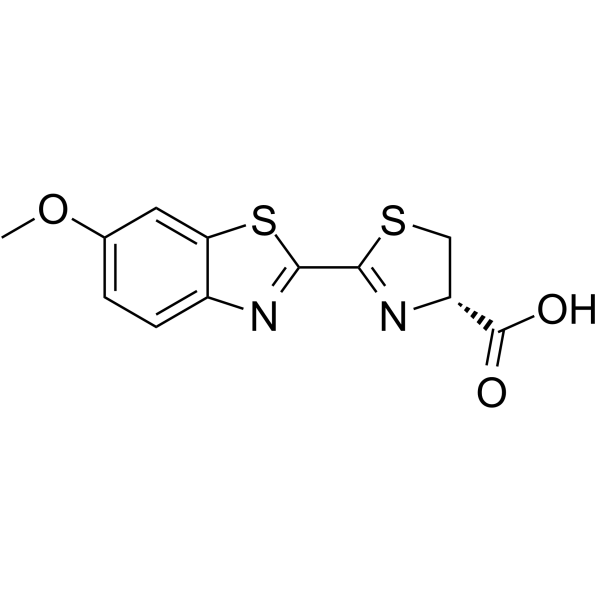
    D-Luciferin 6′-methyl ether (6′-Methoxyluciferin; compound 19a) is a potent luciferase from the North American firefly Photinus pyralis (PpyLuc) inhibitor with an IC50 of 0.1 µM. D-Luciferin 6′-methyl ether, a D-luciferin analog, shows non-specific interactions at ATP- and luciferin-binding sites of the PpyLuc active site .
    D-Luciferin 6′-methyl ether
  • HY-158256

    Fluorescent Dye Others
    Luciferase-IN-3 (compound 5h) is an inhibitor of ATP-dependent luciferase (Firefly luciferase), the major light-emitting enzyme in fireflies and kowtow bugs. Firefly luciferase-IN-2 inhibits P. pyralis luciferase with an IC50 of 3.2 μM, while the inhibitory potency against R. reniformis is not significant .
    Luciferase-IN-3
  • HY-153230

    Liposome Biochemical Assay Reagents Others
    Firefly luciferase circRNA-LNP is a lipid nanoparticle (LNP) containing Firefly luciferase circRNA, suitable for assays of RNA delivery, translation efficiency, cell viability, etc. Luciferase is commonly used as a bioluminescent reporter gene for gene regulation and function studies. Firefly Luciferase circRNA will express firefly luciferase protein after entering the cells, which is often used for promoter activity detection or dual fluorescent molecular complementation experiments. Common luciferase are firefly luciferase and sea kidney luciferase .
    Firefly luciferase circRNA-LNP
  • HY-148843

    Fluorescent Dye Others
    D-Luciferin phosphate trisodium is a synthetic and bioluminescent substrate for firefly luciferase. D-Luciferin phosphate trisodium is dephosphorylated in the presence of alkaline phosphatase, releasing the free D-fluorescein. D-Luciferin phosphate trisodium is mainly used for highly sensitive detection of phosphatase .
    D-Luciferin phosphate trisodium
  • HY-P5968A

    β(25-35)KA TFA

    Amyloid-β Neurological Disease
    [Ala28]-β Amyloid(25-35) (β(25-35)KA) TFA is an electrically neutral mutant peptide of Aβ(25-35) that accelerates the aggregation of Firefly Luciferase .
    [Ala28]-β Amyloid(25-35) TFA
  • HY-160690

    FLT3 c-Kit Others
    GW632046X is a Fluc (Firefly luciferase) inhibitor with an IC50 value of 0.58 µM .
    GW632046X
  • HY-D1904

    Fluorescent Dye Others
    D-Luciferin 6'-methyl ether sodium salt is a firefly luciferase inhibitor. D-Luciferin 6'-methyl ether sodium salt is a cofactor in Luc-catalyzed synthesis of dinucleoside polyphosphates .
    D-Luciferin 6'-methyl ether
  • HY-134956B

    YAP Cancer
    (R)-VT104 is the R-enantiomer of VT104. (R)-VT104 shows an IC50 value of 0.1-1 μΜ for firefly luciferase. VT104 is an orally active and pan-TEAD auto-palmitoylation inhibitor .
    (R)-VT104
  • HY-P5968

    β(25-35)KA

    Amyloid-β Neurological Disease
    [Ala28]-β Amyloid(25-35) (β(25-35)KA) is an electrically neutral mutant peptide of Aβ(25-35) that accelerates the aggregation of Firefly Luciferase .
    [Ala28]-β Amyloid(25-35)
  • HY-112641

    Fluorescent Dye Cancer
    AkaLumine is a D-luciferin (HY-12591A) analogue with a Km of 2.06 μM for recombinant firefly luciferase (Fluc) protein. AkaLumine emits near-infrared (NIR) light (λmax=677 nm) in reactions with native Fluc. AkaLumine has high tissue-penetration and increases detection sensitivity from deep-tissue targets .
    AkaLumine
  • HY-115749A

    (Rac)-6′-Methoxyluciferin sodium

    Drug Derivative Others
    D-Luciferin 6′-methyl ether (6′-Methoxyluciferin; compound 19a) sodium is a potent luciferase from the North American firefly Photinus pyralis (PpyLuc) inhibitor with an IC50 of 0.1 μM. D-Luciferin 6′-methyl ether, a D-luciferin analog, shows non-specific interactions at ATP- and luciferin-binding sites of the PpyLuc active site .
    (Rac)-Luciferin 6′-methyl ether sodium
  • HY-172329

    Liposome Others
    Q1-ALC-0315 iodide is a cationic quaternary ammonium lipid derivative of the ionizable cationic lipid ALC-0315 (HY-138170). Q1-ALC-0315-based LNPs can be used for lung-targeted mRNA delivery, which demonstrates high-performing firefly luciferase protein expression in the lungs .
    Q1-ALC-0315 iodide

Inquiry Online

Your information is safe with us. * Required Fields.

Salutation


Country or Region *

Applicant Name *


Organization Name *

Department *


Email Address *


Product Name *

Cat. No.


Requested quantity *

Phone Number *


Remarks

Inquiry Online

Inquiry Information

Product Name:
Cat. No.:
Quantity:
MCE Japan Authorized Agent:

