6 Results for "

Plastoquinone

" in MedChemExpress (MCE) Product Catalog:
Products (6)

6 Results for "Plastoquinone" in MCE Product Catalog:

Cat. No.: HY-N11882
CAS No.: 4299-57-4
Synonyms: PQ-9
Plastoquinone (PQ-9) is a photosynthetic electron carrier as well as a redox sensor capable of regulating state transitions and gene expression. Plastoquinone transfers electrons to the cytochrome b6/f complex via the Q cycle, and participates in the establishment of the thylakoid transmembrane pH gradient. Plastoquinone can react with ROS. Plastoquinone is used in plant photosynthesis research .
loading...
    loading...
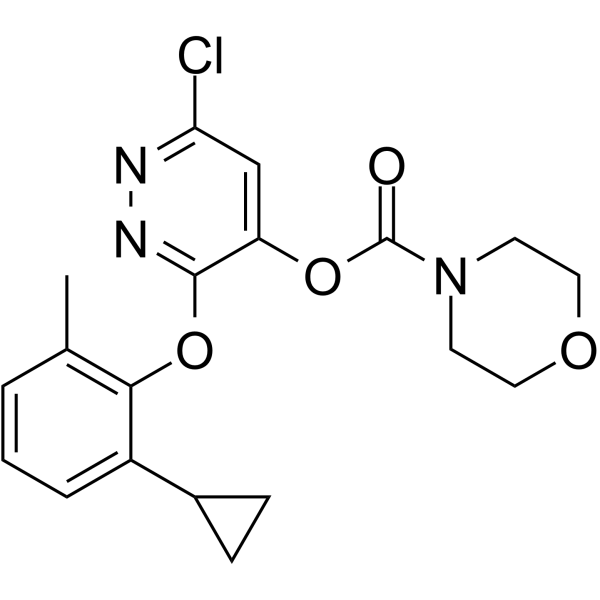
Cat. No.: HY-119989
CAS No.: 499231-24-2
Purity:  98.90%
Target:  

Herbicide

Research Areas:  

Infection

Cyclopyrimorate, a highly effective bleaching herbicide for weed control in rice fields, targets homogentisate solanesyltransferase (HST). HST is a downstream enzyme of 4-hydroxyphenylpyruvate dioxygenase in the plastoquinone (PQ) biosynthesis pathway .
loading...
    loading...
Cat. No.: HY-17659
CAS No.: 112055-76-2
Target:  

Drug Derivative

Research Areas:  

Others

Decylplastoquinone is lipid-soluble derivative of plastoquinone (HY-N11882). Plastoquinone (PQ-9), a potent electron carrier, is an essential component of photosynthesis. Plastoquinone is also a redox sensor that regulates state transitions and gene expression .
loading...
    loading...
Cat. No.: HY-W778649
CAS No.: 1795136-21-8
Sarmentine-d8 is the deuterium labeled Sarmentine. Sarmentine is a broad-spectrum contact herbicide and PSII inhibitor, with an IC50 of 3.0 μM and a Ki of 1.5 μM against spinach, an IC50 of 1.72 μM against wild-type Amaranthus retroflexus, and an IC50 of 0.97 μM against triazine-resistant Amaranthus retroflexus. Sarmentine competitively binds to the QB binding site of plastoquinone on PSII, thereby blocking photosynthetic electron transport. Sarmentine inhibits enoyl-ACP reductase in Arabidopsis thaliana by targeting the early fatty acid synthesis process, with an IC50 of 18.3 μM. Sarmentine induces light-independent loss of plasma membrane integrity and electrolyte leakage. Sarmentine also exhibits antiplasmodial, antimycobacterial, antituberculous, and antiplatelet aggregation activities .
loading...
    loading...
Cat. No.: HY-184988
CAS No.: 3123222-14-7
Target:  

Herbicide HPPD

Research Areas:  

Metabolic Disease

HPPD-IN-10 is an inhibitor of Arabidopsis thaliana 4-hydroxyphenylpyruvate dioxygenase (HPPD), with an IC50 of 0.06 μM and a Kd of 0.265 μM. HPPD-IN-10 blocks the HPPD-mediated catalytic conversion of 4-hydroxyphenylpyruvate, downregulates the biosynthesis of plastoquinone and tocopherol, induces weed bleaching, and inhibits root and shoot growth. HPPD-IN-10 can be used in herbicide-related research on gramineous and broadleaf weeds in farmlands, such as barnyard grass and purslane .
loading...
    loading...
Cat. No.: HY-W099725
CAS No.: 78910-33-5
Sarmentine is a broad-spectrum contact herbicide and PSII inhibitor, with an IC50 of 3.0 μM and a Ki of 1.5 μM against spinach, an IC50 of 1.72 μM against wild-type Amaranthus retroflexus, and an IC50 of 0.97 μM against triazine-resistant Amaranthus retroflexus. Sarmentine competitively binds to the QB binding site of plastoquinone on PSII, thereby blocking photosynthetic electron transport. Sarmentine inhibits enoyl-ACP reductase in Arabidopsis thaliana by targeting the early fatty acid synthesis process, with an IC50 of 18.3 μM. Sarmentine induces light-independent loss of plasma membrane integrity and electrolyte leakage. Sarmentine also exhibits antiplasmodial, antimycobacterial, antituberculous, and antiplatelet aggregation activities .
loading...
    loading...

