



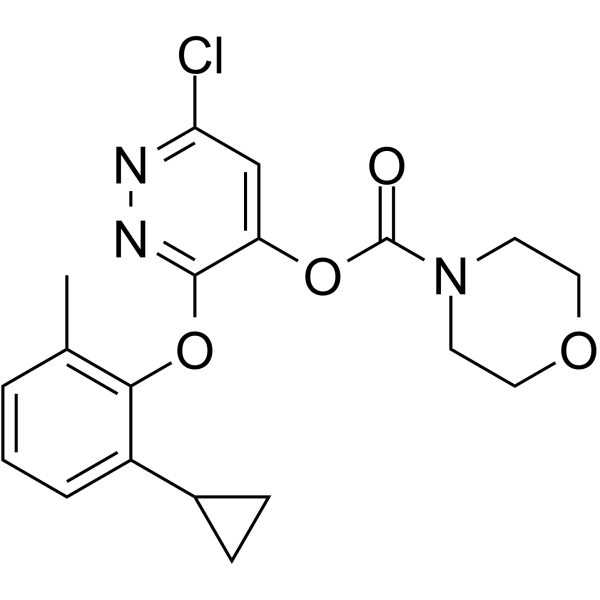
Cyclopyrimorate

Based on 1 Customer Validation
Cyclopyrimorate, a highly effective bleaching herbicide for weed control in rice fields, targets homogentisate solanesyltransferase (HST). HST is a downstream enzyme of 4-hydroxyphenylpyruvate dioxygenase in the plastoquinone (PQ) biosynthesis pathway.
Para uso exclusivo en investigación. No vendemos a pacientes.
- Pureza : 99.44%
- No. CAS: 499231-24-2
- Fòrmula: C19H20ClN3O4
- Peso molecular:389.83
-
Almacenamiento:Powder -20°C, 3 years , 4°C, 2 years ; In solvent -80°C, 2 years , -20°C, 1 year

To place orders, for customer services and technical support, please contact: MedChemExpress USA
Tel: 609-228-6898 E-mail: [email protected] [email protected]


-
 Actividad biológica
-
Chemical Information
-
Solvente y solubilidad
- Pureza y Documentación
- Referencias
-
 Help & FAQs




Actividad biológica
Descripciòn
In Vitro
Cyclopyrimorate-dependent bleaching effect on Arabidopsis thaliana is reversed by decyl PQ, suggesting that this symptom is attributable to the inhibition of PQ biosynthesis[1].
MedChemExpress (MCE) has not independently confirmed the accuracy of these methods. They are for reference only.


Chemical Information
-
No. CAS 499231-24-2
-
Appearance Solid
-
Peso molecular 389.83
-
Fòrmula C19H20ClN3O4
-
Color Off-white to light yellow
-
SMILES
O=C(OC1=CC(Cl)=NN=C1OC2=C(C=CC=C2C3CC3)C)N4CCOCC4
-
Envío
Room temperature in continental US; may vary elsewhere.
-
Almacenamiento
Powder -20°C 3 years 4°C 2 years In solvent -80°C 2 years -20°C 1 year


Solvente y solubilidad
In Vitro:
DMSO : 250 mg/mL (641.31 mM; Need ultrasonic; Hygroscopic DMSO has a significant impact on the solubility of product, please use newly opened DMSO)
Please refer to the solubility information to select the appropriate solvent. Once prepared, please aliquot and store the solution to prevent product inactivation from repeated freeze-thaw cycles.
Storage method and period of stock solution: -80°C, 2 years; -20°C, 1 year. When stored at -80°C, please use it within 2 years. When stored at -20°C, please use it within 1 year.
Please refer to the solubility information to select the appropriate solvent. Once prepared, please aliquot and store the solution to prevent product inactivation from repeated freeze-thaw cycles.
Storage method and period of stock solution: -80°C, 2 years; -20°C, 1 year. When stored at -80°C, please use it within 2 years. When stored at -20°C, please use it within 1 year.
Concentration (start) × Volume (start) = Concentration (final) × Volume (final)
In Vivo:
Select the appropriate dissolution method based on your experimental animal and administration route.
- For the following dissolution methods, please ensure to first prepare a clear stock solution using an In Vitro approach and then sequentially add co-solvents:
- To ensure reliable experimental results, the clarified stock solution can be appropriately stored based on storage conditions. As for the working solution for In Vivo experiments, it is recommended to prepare freshly and use it on the same day.
- The percentages shown for the solvents indicate their volumetric ratio in the final prepared solution. If precipitation or phase separation occurs during preparation, heat and/or sonication can be used to aid dissolution.
Add each solvent one by one: 10% DMSO 40% PEG300 5% Tween-80 45% Saline
Solubility: ≥ 6.25 mg/mL (16.03 mM); Clear solution
This protocol yields a clear solution of ≥ 6.25 mg/mL (saturation unknown).
Taking 1 mL working solution as an example, add 100 μL DMSO stock solution (62.5 mg/mL) to 400 μL PEG300, and mix evenly; then add 50 μL Tween-80 and mix evenly; then add 450 μL Saline to adjust the volume to 1 mL.
Preparation of Saline: Dissolve 0.9 g sodium chloride in ddH₂O and dilute to 100 mL to obtain a clear Saline solution.
In Vivo Dissolution Calculator
Please enter the basic information of animal experiments:
-
-
-
-
Recommended: Prepare an additional quantity of animals to account for potential losses during experiments.
Please enter your animal formula composition:
-
%DMSO +
Recommended: Keep the proportion of DMSO in working solution below 2% if your animal is weak.
-
%+
-
+%Tween-80 + +
-
%Saline +
The co-solvents required include: DMSO, . All of co-solvents are available by MedChemExpress (MCE). , Tween 80. All of co-solvents are available by MedChemExpress (MCE).
Working solution concentration: 0.22 mg/mL
Method for preparing stock solution: mg drug dissolved in μL DMSO. Stock solution concentration: mg/mL.
1. Take μL DMSO stock solution;
2. Add μL .
μL , mix evenly;
3. Then add μL Tween 80, mix evenly;
4. Then add μL
Please ensure that the stock solution in the first step is dissolved to a clear state, and add co-solvents in sequence. You can use ultrasonic heating (ultrasonic cleaner, recommended frequency 20-40 kHz), vortexing, etc. to assist dissolution.


Pureza y Documentación
-
Ficha de datos (274 KB)
-
SDS (254 KB)
- English - EN (254 KB)
- Français - FR (254 KB)
- Deutsch - DE (254 KB)
- Norwegian - NO (254 KB)
- Español - ES (254 KB)
- Swedish - SV (254 KB)
- Italian - IT (254 KB)
- Korean - KR (254 KB)
- Portuguese - PT (254 KB)
-
Instrucciones de manejo (2659 KB)
Referencias
[1]. Shino M, et al. In vivo and in vitro evidence for the inhibition of homogentisate solanesyltransferase by cyclopyrimorate. Pest Manag Sci. 2019 Nov 27. [Content Brief]
[2]. Shino M, et al. Action mechanism of bleaching herbicide cyclopyrimorate, a novel homogentisate solanesyltransferase inhibitor. J Pestic Sci. 2018 Nov 20;43(4):233-239. [Content Brief]


Complete Stock Solution Preparation Table
Please refer to the solubility information to select the appropriate solvent. Once prepared, please aliquot and store the solution to prevent product inactivation from repeated freeze-thaw cycles.
Storage method and period of stock solution: -80°C, 2 years; -20°C, 1 year. When stored at -80°C, please use it within 2 years. When stored at -20°C, please use it within 1 year.
| Optional Solvent | Concentration Solvent Mass | 1 mg | 5 mg | 10 mg | 25 mg |
|---|---|---|---|---|---|
| DMSO | 1 mM | 2.5652 mL | 12.8261 mL | 25.6522 mL | 64.1305 mL |
| 5 mM | 0.5130 mL | 2.5652 mL | 5.1304 mL | 12.8261 mL | |
| 10 mM | 0.2565 mL | 1.2826 mL | 2.5652 mL | 6.4131 mL | |
| 15 mM | 0.1710 mL | 0.8551 mL | 1.7101 mL | 4.2754 mL | |
| 20 mM | 0.1283 mL | 0.6413 mL | 1.2826 mL | 3.2065 mL | |
| 25 mM | 0.1026 mL | 0.5130 mL | 1.0261 mL | 2.5652 mL | |
| 30 mM | 0.0855 mL | 0.4275 mL | 0.8551 mL | 2.1377 mL | |
| 40 mM | 0.0641 mL | 0.3207 mL | 0.6413 mL | 1.6033 mL | |
| 50 mM | 0.0513 mL | 0.2565 mL | 0.5130 mL | 1.2826 mL | |
| 60 mM | 0.0428 mL | 0.2138 mL | 0.4275 mL | 1.0688 mL | |
| 80 mM | 0.0321 mL | 0.1603 mL | 0.3207 mL | 0.8016 mL | |
| 100 mM | 0.0257 mL | 0.1283 mL | 0.2565 mL | 0.6413 mL |


Cyclopyrimorate Related Classifications
HY-119989 Related Classifications
 Powered by Bioz