9 Results for "

Viral mRNA capping

" in MedChemExpress (MCE) Product Catalog:
Products (9)

9 Results for "Viral mRNA capping" in MCE Product Catalog:

  • Targets Recommended:
8
8 Cited Publications
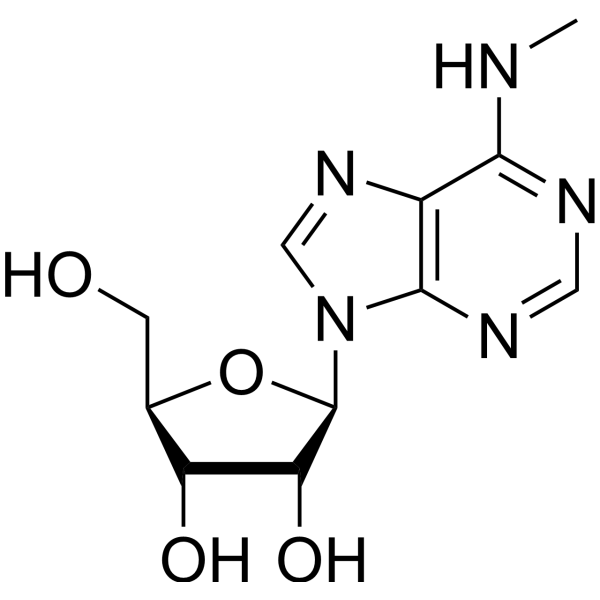
Art. -Nr.: HY-N0086
CAS. Nr.: 1867-73-8
Synonyms: 6-Methyladenosine; N-Methyladenosine
N6-Methyladenosine is the most prevalent internal (non-cap) modification present in the messenger RNA (mRNA) of all higher eukaryotes. N6-Methyladenosine can modifies viral RNAs and has antiviral activities.
loading...
    loading...
2
2 Cited Publications
Art. -Nr.: HY-N0086R
CAS. Nr.: 1867-73-8
Synonyms: 6-Methyladenosine (Standard); N-Methyladenosine (Standard)
N6-Methyladenosine (Standard) is the analytical standard of N6-Methyladenosine. This product is intended for research and analytical applications. N6-Methyladenosine is the most prevalent internal (non-cap) modification present in the messenger RNA (mRNA) of all higher eukaryotes. N6-Methyladenosine can modifies viral RNAs and has antiviral activities. In Vitro: N6-methyladenosine (m6A) is selectively recognized by the human YTH domain family 2 (YTHDF2) protein to regulate mRNA degradation. N6-methyladenosine (m6A), a prevalent internal modification in the messenger RNA of all eukaryotes, is post-transcriptionally installed by m6A methyltransferase (e.g., MT-A70) within the consensus sequence of G(m6A)C (70%) or A(m6A)C (30%). N6-methyladenosine (m6A)-containing RNAs are greatly enriched in the YTHDF-bound portion and diminished in the flow-through portion . N6-methyladenosine (m6A), the most abundant internal RNA modification, functions in diverse biological processes, including regulation of embryonic stem cell self-renewal and differentiation. N6-methyladenosine (m6A) is a large protein complex, consisting in part of methyltransferase-like 3 (METTL3) and methyltransferase-like 14 (METTL14) catalytic subunits .
loading...
    loading...
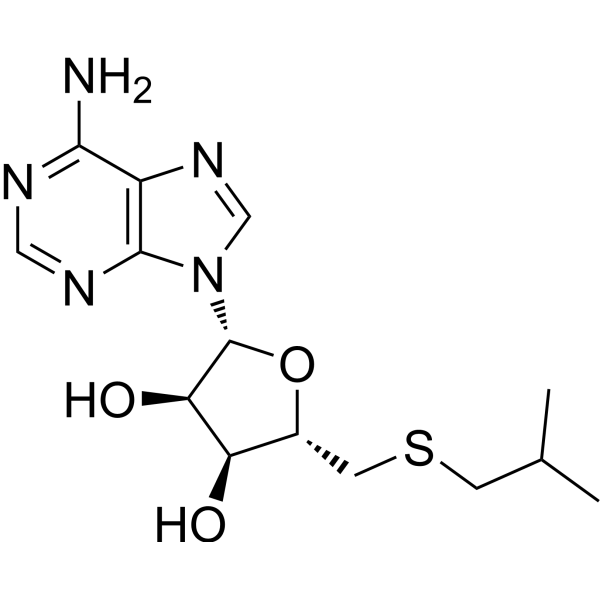
Art. -Nr.: HY-18684
CAS. Nr.: 35899-54-8
Synonyms: 5'-Isobutylthioadenosine; 5'-Deoxy-5'-isobutylthioadenosine
SIBA (5'-Isobutylthioadenosine) is a transmethylation inhibitor (SAH (HY-19528) analogue), with potent anti-proliferative activity. SIBA reversibly inhibits the production of HSV-1 by blocking methylation, specifically by blocking the 5' end-capping of viral mRNA. SIBA also inhibits the growth of tumour cells in vitro and metastatic spread in vivo. SIBA can be used in cancer, HSV-1 infection and anti-malaria studies .
loading...
    loading...
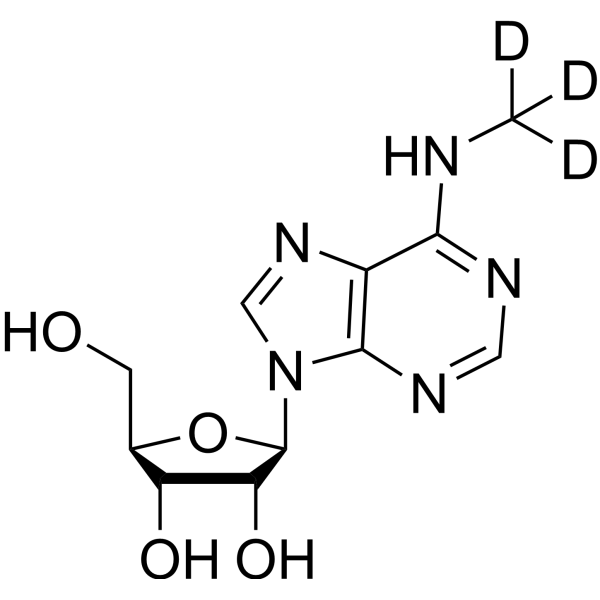
Art. -Nr.: HY-N0086S
CAS. Nr.: 139896-43-8
Synonyms: 6-Methyladenosine-d3; N-Methyladenosine-d3
N6-Methyladenosine-d3 (6-Methyladenosine-d3; N-Methyladenosine-d3) is a deuterium labeled N6-Methyladenosine (HY-N0086). N6-Methyladenosine is the most prevalent internal (non-cap) modification present in the messenger RNA (mRNA) of all higher eukaryotes. N6-Methyladenosine can modifies viral RNAs and has antiviral activities.
loading...
    loading...
Art. -Nr.: HY-N0086S2
Synonyms: 6-Methyladenosine-13C4; N-Methyladenosine-13C4
N6-Methyladenosine- 13C4 (6-Methyladenosine- 13C4; N-Methyladenosine- 13C4) is 13C-labeled N6-Methyladenosine (HY-N0086). N6-Methyladenosine is the most prevalent internal (non-cap) modification present in the messenger RNA (mRNA) of all higher eukaryotes. N6-Methyladenosine can modifies viral RNAs and has antiviral activities.
loading...
    loading...
Art. -Nr.: HY-170524
CAS. Nr.: 3052313-73-9
Forschungsgebiete:  

Infection

TDI-015051 is a highly selective, orally active antiviral agent that targets the coronavirus NSP14 guanine-N7 methyltransferase. TDI-015051 binds to substrates in a non-competitive manner and forms a stable ternary complex, precisely blocking the capping and methylation processes of viral mRNA. TDI-015051 potently inhibits a variety of coronaviruses (including SARS-CoV-2 and MERS). By impairing viral replication and translation and inducing a moderate type I interferon-mediated immune response, it significantly reduces pulmonary viral load and exhibits a synergistic effect with Nirmatrelvir (HY-138687). In addition, TDI-015051 does not inhibit non-coronavirus methyltransferases, and the drug-resistant mutations it induces impair viral fitness, demonstrating excellent antiviral properties and safety. TDI-015051 can be used for research on COVID-19 and the replication mechanism of coronaviruses .The IC50 values of TDI-015051 against SARS-CoV-2, α-hCoV-NL63, α-hCoV-229E, β-hCoV-MERS are 0.15 nM, 1.7 nM, 2.6 nM and 3.6 nM, respectively, and the Ka value against SARS-CoV-2 is 0.061 nM .
loading...
    loading...
Art. -Nr.: HY-143750
CAS. Nr.: 2485715-97-5
Target:  

Influenza Virus

Forschungsgebiete:  

Infection

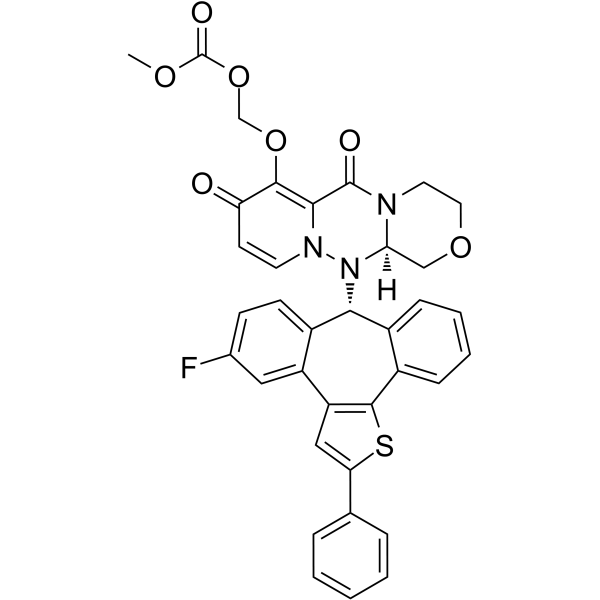
Cap-dependent endonuclease-IN-7 is a potent inhibitor of cap-dependent endonuclease (CEN). Cap-dependent endonuclease-IN-7 Inhibits the synthesis of viral mRNA and eventually inhibits virus proliferation. Cap-dependent endonuclease-IN-7 has the potential for the research of viral infections (including influenza A, influenza B and influenza C) (extracted from patent WO2020177715A1, compound 5)
loading...
    loading...
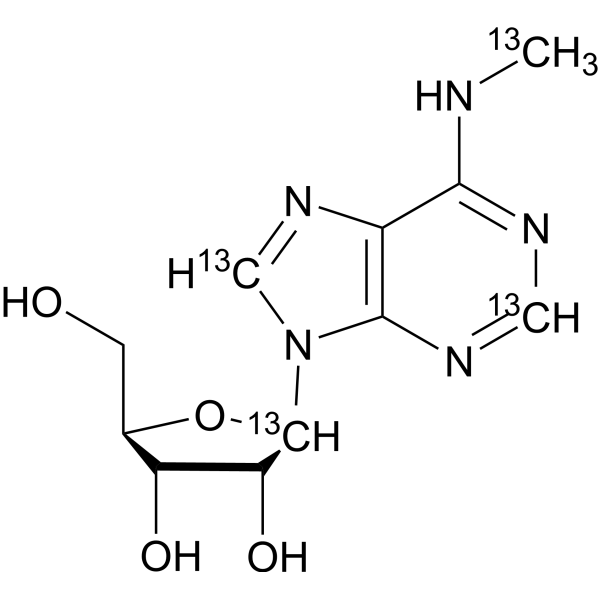
Art. -Nr.: HY-N0086S3
Synonyms: 6-Methyladenosine-13C3; N-Methyladenosine-13C3
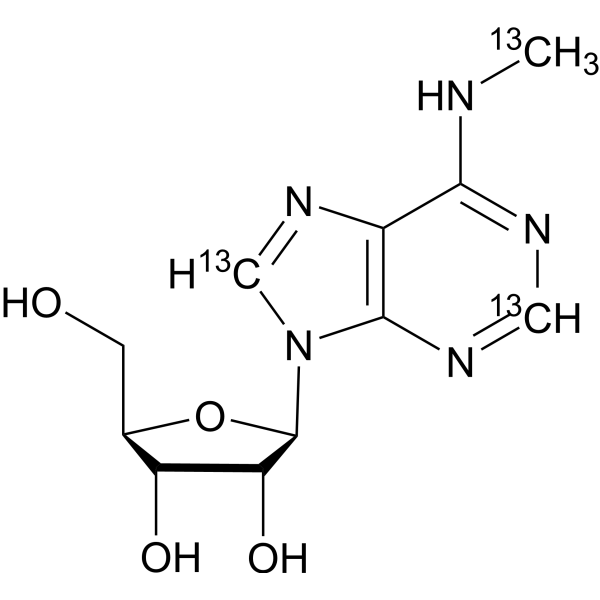
N6-Methyladenosine- 13C3 (6-Methyladenosine- 13C3) is 13C-labeled N6-Methyladenosine (HY-N0086). N6-Methyladenosine is the most prevalent internal (non-cap) modification present in the messenger RNA (mRNA) of all higher eukaryotes. N6-Methyladenosine can modifies viral RNAs and has antiviral activities .
loading...
    loading...
Art. -Nr.: HY-179556
Target:  

SARS-CoV

Forschungsgebiete:  

Infection

SARS-CoV-2 nsp14-IN-10 is a highly potent and selective NSP14 (IC50 = 0.34 µM) S-adenosylmethionine (SAM) binding pocket inhibitor. SARS-CoV-2 nsp14-IN-10 demonstrates robust antiviral activity against SARS-CoV-2. SARS-CoV-2 nsp14-IN-10 exhibits broad-spectrum activity against other betacoronaviruses and inhibits SARS-CoV-2 at the replication stage. SARS-CoV-2 nsp14-IN-10 suppresses viral translation and exhibits immunostimulatory effects. SARS-CoV-2 nsp14-IN-10 specifically reverses NSP14-mediated alterations inhost transcriptome. SARS-CoV-2 nsp14-IN-10 can be used for the study of SARS-CoV-2 .
loading...
    loading...

