Search Result
Results for "
amide groups
" in MedChemExpress (MCE) Product Catalog:
107
Biochemical Assay Reagents
2
Isotope-Labeled Compounds
| Cat. No. |
Product Name |
Target |
Research Areas |
Chemical Structure |
-
- HY-100138
-
|
|
Radionuclide-Drug Conjugates (RDCs)
ADC Linker
|
Cancer
|
|
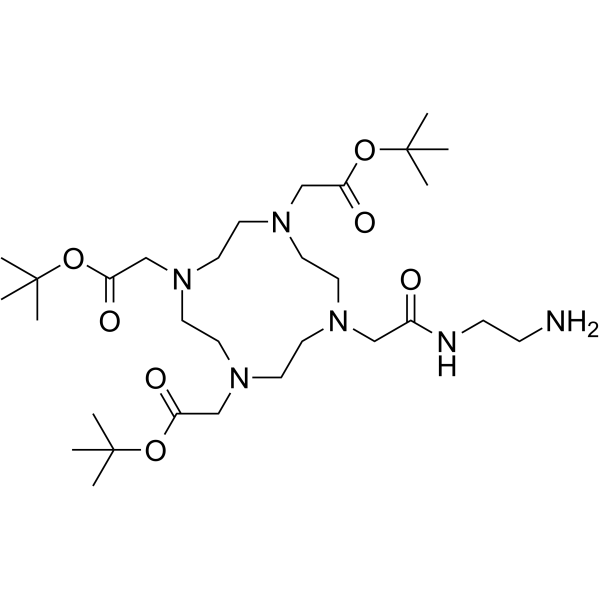
2-Aminoethyl-mono-amide-DOTA-tris(tBu ester) is a metal chelator precursor containing a DOTA macrocyclic structure. DOTA can form highly stable complexes with metal ions (such as 68Ga, 177Lu) through four nitrogen atoms and four carboxylic acid groups to mediate targeted delivery of radionuclides. The tert-butyl ester group (tBu ester) of 2-Aminoethyl-mono-amide-DOTA-tris(tBu ester) also protects the carboxylic acid group during synthesis, and forms a free carboxyl group after deprotection reaction for coupling with targeting molecules (such as antibodies, peptides). 2-Aminoethyl-mono-amide-DOTA-tris(tBu ester) may be combined with tumor pre-targeting systems through bioorthogonal reactions (such as reverse electron demand Diels-Alder reaction) to study radioactive imaging or therapy of tumor tissues, and is mainly used in tumor pre-targeting research in the field of nuclear medicine .
|
-
-
- HY-130086
-
|
|
ADC Linker
|
Cancer
|
|
Bis-PEG4-NHS ester is a crosslinking reagent and amine-reactive modulator .Bis-PEG4-NHS ester reacts with primary amine groups on liposome surfaces via amide bond formation to covalently attach dibenzylcyclooctyne groups, with a hydrophilic PEG4 spacer reducing steric hindrance for subsequent click chemistry .Bis-PEG4-NHS ester enables site-specific antibody coupling to liposome surfaces via copper-free strain-promoted alkyne-azide cycloaddition click chemistry without disrupting liposome structure in minimal organic solvent volumes .Bis-PEG4-NHS ester undergoes hydrolysis during annealing to form -COOH groups that interact with PbI and FAI to enhance perovskite structural integrity, passivate defects, and modulate nucleation kinetics to regulate crystal growth .Bis-PEG4-NHS ester enhances device efficiency and long-term stability when used as an antisolvent additive for p-i-n perovskite solar cells .
|
-
-
- HY-20128
-
|
|
Drug Intermediate
|
Others
|
|
Piperazin-2-one is a piperazine ring derivative containing amide and ester carbonyl groups. As an important intermediate, Piperazin-2-one can be used for the synthesis of various active compounds .
|
-
-
- HY-126672
-
|
|
ADC Linker
|
Cancer
|
|
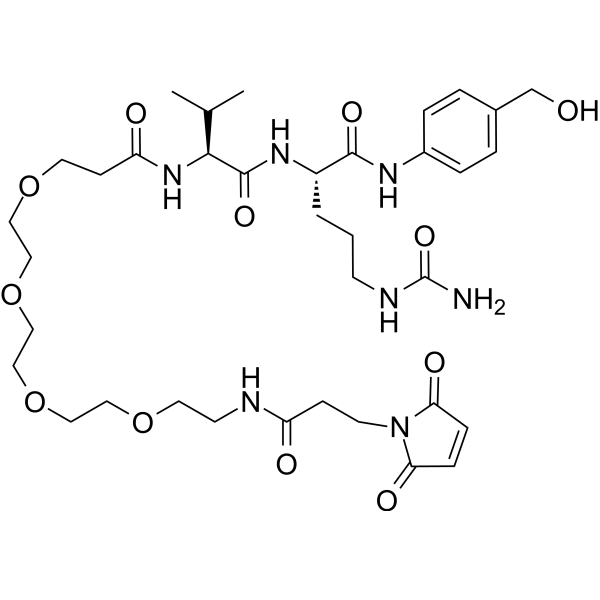
Mal-amide-PEG4-Val-Cit-PAB-OH is a cleavable ADC linker containing a Maleimide group. Mal-amide-PEG4-Val-Cit-PAB-OH is used in the synthesis of antibody-drug conjugates (ADCs) .
|
-
-
- HY-118562
-
|
|
Fluorescent Dye
|
Others
|
|
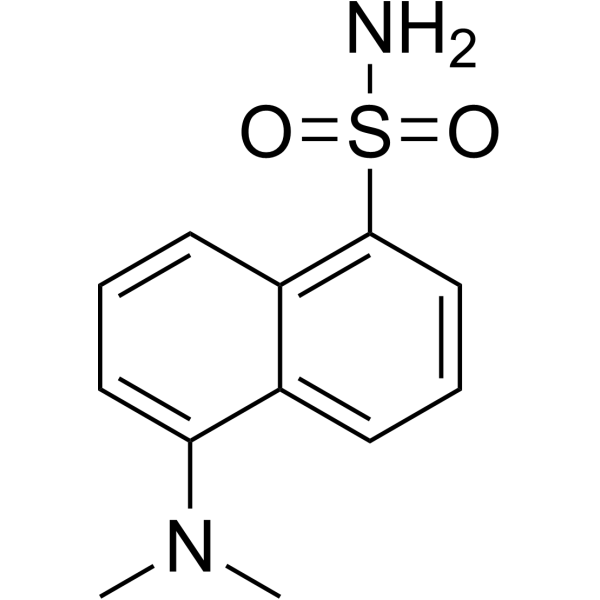
Dansyl amide is a fluorescent dye that is used in biochemistry and chemistry to label substances with the fluorescent dansyl group (Ex/Em: 360 nm/465 nm) .
|
-
-
- HY-D1085
-
|
|
Fluorescent Dye
|
Others
|
|
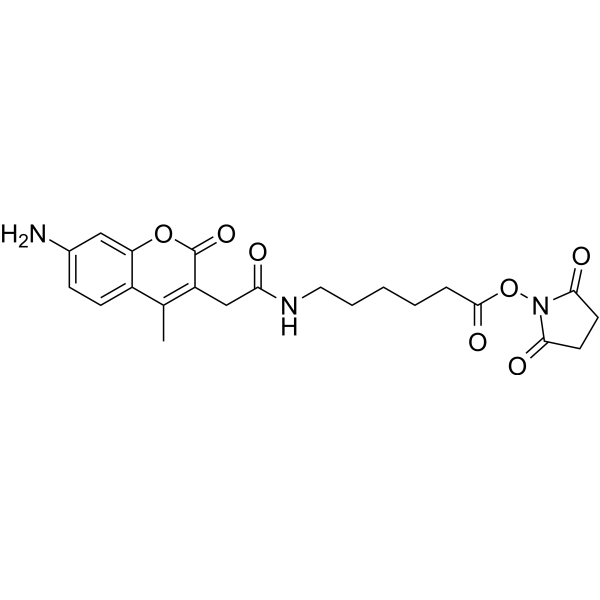
AMCA-X-SE is a coumarin derivative that generates fixed blue fluorescence and an NHS-activated ester that forms stable amide bonds with primary amine groups. It is used as a reactive dye for labeling amino groups of peptides, proteins, and oligonucleotides. Maximum excitation/emission wavelength: 354/442 nm .
|
-
-
- HY-W437745
-
|
|
Fluorescent Dye
|
Others
|
|
Desthiobiotin-NHS ester is a biotinylated biochemical assay reagent that reacts with amine groups (such as lysine residues) of proteins or other biomolecules to form stable amide bonds. Desthiobiotin-NHS ester can be used as probes for metalloproteins .
|
-
-
- HY-120957
-
|
AMC-AA; 7-Amino-4-methyl coumarin-arachidonamide
|
Endogenous Metabolite
|
Metabolic Disease
|
|
AMC arachidonoyl amide (AMC-AA) is one of several fatty acid amides which can be used to measure fatty acid amide hydrolase (FAAH) activity.1 FAAH is a relatively unselective enzyme in that it accepts a variety of amide head groups other than the ethanolamine of its nominal endogenous substrate anandamide.2 Exposure of AMC-AA to FAAH activity results in the release of the fluorescent aminomethyl coumarin that absorbs at 360 nm and emits at 465 nm. This allows the fast and convenient measurement of FAAH activity using a simple cuvette or microplate fluorometer.
|
-
-
- HY-174921A
-
|
|
Biochemical Assay Reagents
|
Others
|
|
Maleimide-PEG2000-COOH is a PEG derivative composed of Maleimide (HY-W007324), PEG units and carboxyl (-COOH). Carboxyl can easily form a stable amide bond with amino groups or an ester bond with hydroxyl groups. Maleimide forms a stable thioether bond with sulfhydryl (-SH) .
|
-
-
- HY-W717743
-
-
-
- HY-140923
-
|
|
PROTAC Linkers
|
Cancer
|
|
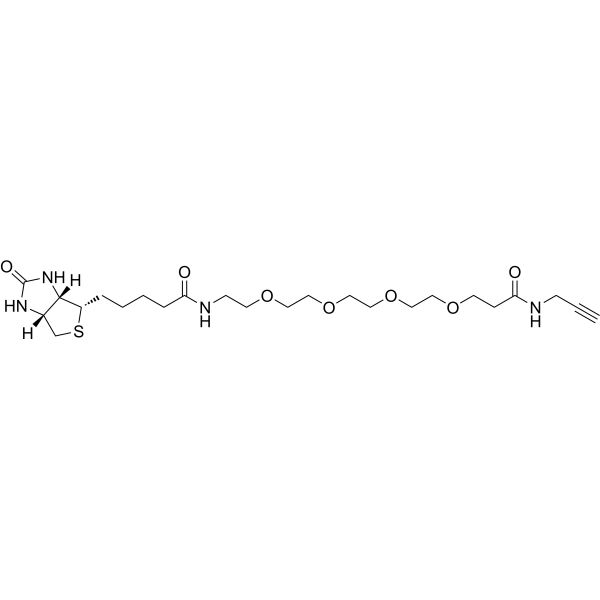
Biotin-PEG4-amide-Alkyne is a PEG-based PROTAC linker that can be used in the synthesis of PROTACs . Biotin-PEG4-amide-Alkyne is a click chemistry reagent, it contains an Alkyne group and can undergo copper-catalyzed azide-alkyne cycloaddition (CuAAc) with molecules containing Azide groups.
|
-
-
- HY-140914
-
|
|
PROTAC Linkers
|
Cancer
|
|
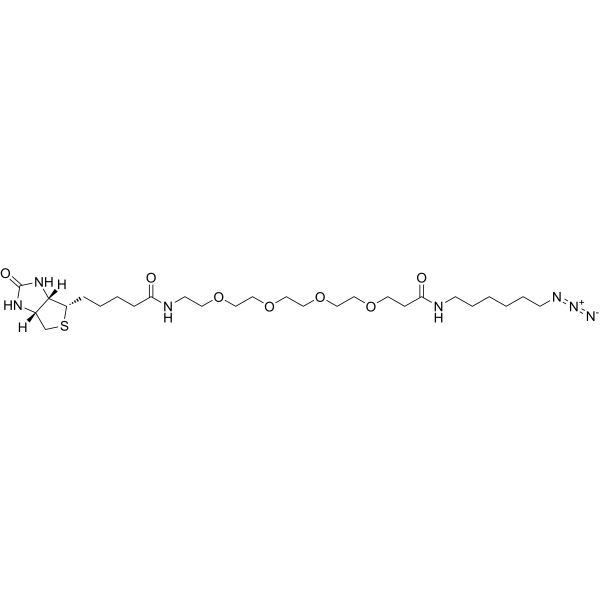
Biotin-PEG4-Amide-C6-Azide is a PEG-based PROTAC linker that can be used in the synthesis of PROTACs . Biotin-PEG4-Amide-C6-Azide is a click chemistry reagent, it contains an Azide group and can undergo copper-catalyzed azide-alkyne cycloaddition reaction (CuAAc) with molecules containing Alkyne groups. It can also undergo strain-promoted alkyne-azide cycloaddition (SPAAC) reactions with molecules containing DBCO or BCN groups.
|
-
-
- HY-W591461
-
|
|
Liposome
|
Cancer
|
|
DSPE-PEG-COOH, MW 2000 is a phospholipid polyPEG which can be used to prepare liposomes or nanoparticles. The terminal carboxylic acid can react with primary amine groups to form a stable amide bond.
|
-
-
- HY-W1123939C
-
|
|
Biochemical Assay Reagents
|
Others
|
|
Silane-PEG5000-COOH can be used to modify proteins, peptides and other materials with active groups. The carboxyl group (-COOH) can easily form a stable amide bond with the amino group, and can also form an ester bond with the hydroxyl group. Silane-functionalized PEG (Silane-PEG-X) can be used to modify glass, silicon, etc .
|
-
-
- HY-W1048918A
-
|
mPEG5000-COOH
|
Biochemical Assay Reagents
|
Others
|
|
mPEG5000-CM (mPEG5000-COOH) has a reactive carboxyl group (-COOH) attached to the terminal site of the structure, which can form a stable amide bond with the amino group or an ester bond with the hydroxyl group. mPEG5000-CM can be used for drug delivery .
|
-
-
- HY-W015987
-
|
Fmoc-NH2
|
Biochemical Assay Reagents
|
Others
|
|
9-Fluorenylmethyl carbamate (Fmoc-NH2) is an amide compound with an Fmoc protecting group, which can be used as a photobase initiator to prepare organosilane-based proton exchange membranes .
|
-
-
- HY-W1048549A
-
|
HOOC-PEG2000-Thiol
|
Biochemical Assay Reagents
|
Others
|
|
HOOC-PEG2000-SH (HOOC-PEG2000-Thiol) is a reactive thiol PEG derivative with a terminal carboxyl group. The carboxyl group can react with amine or hydroxyl groups to form a stable amide bond or an unstable ester bond. The PEG linkage between the thiol and carboxyl groups has good water solubility, flexible linker distance and higher stability .
|
-
-
- HY-P4920
-
|
|
Fluorescent Dye
|
Others
|
|
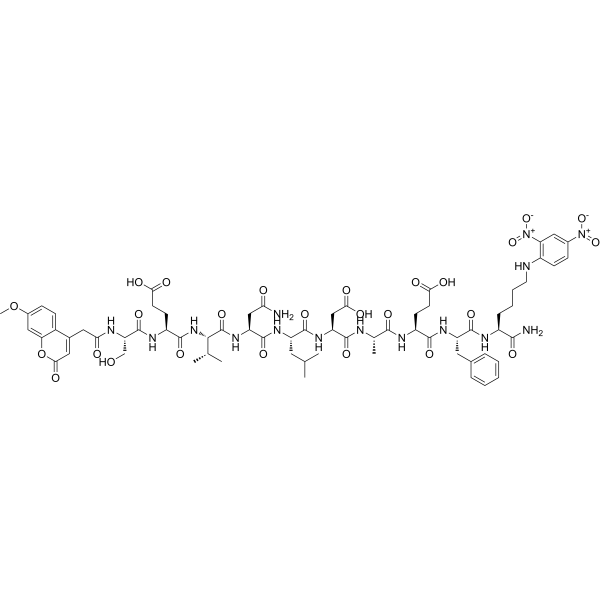
Mca-SEVNLDAEFK(Dnp)-NH2 contains a highly fluorescent 7-methoxycoumarin group that is efficiently quenched by resonance energy transfer to the 2,4-dinitrophenyl group. It can be used to measure the activities of peptidases that are capable of cleaving an amide bond between the fluorescent group and the quencher group, causing an increase in fluorescence, such as can be used to measure the activity of BACE-1 .
|
-
-
- HY-131890
-
|
|
E3 Ligase Ligand-Linker Conjugates
|
Cancer
|
|
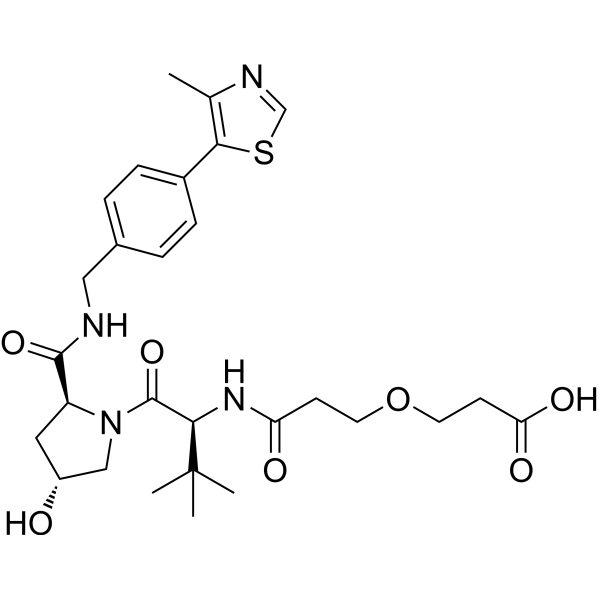
VH032 amide-PEG1-acid (Linker 10) is an E3 ligase ligand-linker conjugate comprising an E3 ligase ligand and a PEG1 linker terminated with a carboxylic acid group. VH032 amide-PEG1-acid can be used for the synthesis of CDK4/6-targeting PROTACs .
|
-
-
- HY-W190877
-
|
SH-PEG1-COOH
|
Biochemical Assay Reagents
|
Others
|
|
Thiol-PEG1-acid (SH-PEG1-COOH) is a PEG derivative consisting of a thiol (-SH), 1 PEG unit, and a carboxyl (-COOH). The thiol is a highly reactive chemical group that can react specifically with a variety of molecules to form stable covalent bonds. The carboxyl group can easily form stable amide bonds with amino groups, and can also form ester bonds with hydroxyl groups.
|
-
-
- HY-W105727
-
|
|
PROTAC Linkers
|
Cancer
|
|
9-Aminononanoic acid can be used as a PROTAC linker and other conjugation in the synthesis of PROTACs. 9-Aminononanoic acid is an alkane chain with terminal carboxlic acid and amine groups. The amino group (NH2) is reactive with carboxylic acids, activated NHS esters, carbonyls (ketone, aldehyde) etc. The terminal carboxylic acid can react with primary amine groups of activated NHS ester to form a stable amide bond.
|
-
-
- HY-P4332
-
|
|
Fluorescent Dye
Ser/Thr Protease
|
Cardiovascular Disease
|
|
Boc-Glu(OBzl)-Ala-Arg-AMC is a fluorogenic substrate for coagulation factor XIa and trypsin. The cleavage of the amide bond between arginine and the methylcoumarin amide group releases fluorescent 7-Amino-4-methylcoumarin (HY-D0027) .
|
-
-
- HY-W099632
-
|
|
Biochemical Assay Reagents
|
Infection
Inflammation/Immunology
|
|
2-Hexyldecanoic acid is a lipid containing one carboxylic acid group and two non-polar tails. In the presence of EDC, HATU and DCC, carboxylic acid groups can undergo continuous amide coupling reactions with amine-containing biomolecules to form stable amide bonds. 2-Hexyldecanoic acid can be used as an aerolysin inhibitor to prevent bacterial pathogens. 2-Hexyldecanoic acid can cause contact dermatitis .
|
-
-
- HY-133883
-
|
|
Fluorescent Dye
|
Others
|
|
Cyanine7.5 amine is a near-infrared Cy7.5-based dye and also a substrate for amide bond coupling (Ex/Em = 788 nm/808 nm). Cyanine7.5 amine contains a free amino group and can be used for coupling with activated carboxylic acid derivatives .
|
-
-
- HY-133436
-
|
|
ADC Linker
|
Cancer
|
|
Boc-aminooxy-amide-PEG4-propargyl is a non-cleavable 4 unit PEG ADC linker used in the synthesis of antibody-drug conjugates (ADCs) . Boc-aminooxy-amide-PEG4-propargyl is a click chemistry reagent, it contains an Alkyne group and can undergo copper-catalyzed azide-alkyne cycloaddition (CuAAc) with molecules containing Azide groups.
|
-
-
- HY-125541
-
|
|
ADC Linker
PROTAC Linkers
|
Cancer
|
|
DBCO-Amide-PEG5-acid is a PEG-based PROTAC linker can be used in the synthesis of PROTACs. DBCO-Amide-PEG5-acid is a cleavable ADC linker used in the synthesis of antibody-drug conjugates (ADCs) . DBCO-NHCO-PEG4-acid is a click chemistry reagent, it contains a DBCO group that can undergo strain-promoted alkyne-azide cycloaddition (SPAAC) with molecules containing Azide groups.
|
-
-
- HY-W1048549C
-
|
HOOC-PEG5000-Thiol
|
Biochemical Assay Reagents
|
Others
|
|
HOOC-PEG5000-SH (HOOC-PEG5000-Thiol) is a reactive thiol PEG derivative with a terminal carboxyl group. The carboxyl group can react with amine or hydroxyl groups to form a stable amide bond or an unstable ester bond. The PEG linkage between the thiol and carboxyl groups has good water solubility, flexible linker distance and higher stability .
|
-
-
- HY-W591402
-
|
|
ADC Linker
|
Cancer
|
|
3,4-Dibromo-Mal-PEG4-acid is a site specific ADC linker with a dibromomaleimide group and an acid group. The dibromomaleimide group allows for two points of substitution due to the two bromine atoms. The carboxylic acid can react with primary amines in the presence of EDC and HATU to form a stable amide bond. The hydrophilic PEG linker increases the water solubility of compounds in aqueous media.
|
-
-
- HY-118599
-
|
|
Prostaglandin Receptor
|
Others
|
|
Prostaglandin F2α ethyl amide is an analog of Prostaglandin F2α (HY-12956). Prostaglandin F2α ethyl amide is supposed to be potent lowering intraocular pressure (IOP) for its N-ethyl amide group, like Bimatoprost (HY-B0191) .
|
-
-
- HY-42780
-
|
|
Ligands for E3 Ligase
|
Cancer
|
|
Thalidomide-O-amido-C8-NHBoc contains a Thalidomide group, an amide, an alkylC8 chain, and a carbamate protecting group.
|
-
-
- HY-138318
-
|
|
PROTAC Linkers
|
Cancer
|
|
DBCO-PEG3-amide-N-Fmoc is a PEG-based PROTAC linker that can be used in the synthesis of PROTACs . DBCO-PEG3-amide-N-Fmoc is a click chemistry reagent, it contains a DBCO group that can undergo strain-promoted alkyne-azide cycloaddition (SPAAC) with molecules containing Azide groups.
|
-
-
- HY-W800846
-
|
|
Biochemical Assay Reagents
|
Others
|
|
Fmoc-Amido-Tri-(carboxyethoxymethyl)-methane is a multifunctional reagent containing three carboxylic acids and a primary amine that is Fmoc-protected. The carboxylic acids can react with primary amine groups to form stable amide bonds. The Fmoc protecting group can be removed using piperidine, freeing up the amine for a variety of uses such as coupling with carboxylic acids to form amide bonds.
|
-
-
- HY-P4333
-
|
|
Fluorescent Dye
|
Cardiovascular Disease
|
|
Boc-Glu(OBzl)-Gly-Arg-AMC is a fluorogenic substrate for factors IXa and XIIa. The cleavage of the amide bond between arginine and the methylcoumarin amide group releases fluorescent 7-Amino-4-methylcoumarin (HY-D0027) .
|
-
-
- HY-W800682
-
|
|
Biochemical Assay Reagents
|
Others
|
|
Bis-Sulfone-PEG4-acid is a reagent with a sulfone and an acid. The sulfone group can be conjugated with thiol groups of proteins. The terminal acid reacts with primary amines with the help of activators (EDC or HATU) to from stable amide bonds.
|
-
-
- HY-135717
-
|
|
Biochemical Assay Reagents
|
Cancer
|
|
Norbiotinamine is an alternative to biotin. Norbiotinamine can be coupled with a carboxylic group of amino acids to give inverse peptides, having the amide linkage oriented in the opposite direction .
|
-
-
- HY-135717A
-
|
|
Biochemical Assay Reagents
|
Cancer
|
|
Norbiotinamine hydrochloride is an alternative to biotin. Norbiotinamine can be coupled with a carboxylic group of amino acids to give inverse peptides, having the amide linkage oriented in the opposite direction .
|
-
-
- HY-140019
-
|
|
PROTAC Linkers
|
Cancer
|
|
Azido-PEG3-amide-C3-triethoxysilane is a PEG-based PROTAC linker that can be used in the synthesis of PROTACs . Azido-PEG3-amide-C3-triethoxysilane is a click chemistry reagent, it contains an Azide group and can undergo copper-catalyzed azide-alkyne cycloaddition reaction (CuAAc) with molecules containing Alkyne groups. It can also undergo strain-promoted alkyne-azide cycloaddition (SPAAC) reactions with molecules containing DBCO or BCN groups.
|
-
-
- HY-W800676
-
|
|
Biochemical Assay Reagents
|
Others
|
|
DBCO-N-bis(PEG4-acid) is a branched click chemistry reagent. The DBCO group enables copper-free Click Chemistry reactions. carboxylic acid groups allows for reactions with primary amine groups using activators such as EDC or HATU to form a stable amide bond.
|
-
-
- HY-174364E
-
|
|
Biochemical Assay Reagents
|
Others
|
|
Alkyne-PEG20000-COOH is a heterobifunctional PEG crosslinker that can be used to attach functional PEG to biomolecules, particles, and other material surfaces. The carboxyl group can react with the amine group to form a stable amide bond .
|
-
-
- HY-174364C
-
|
|
Biochemical Assay Reagents
|
Others
|
|
Alkyne-PEG5000-COOH is a heterobifunctional PEG crosslinker that can be used to attach functional PEG to biomolecules, particles, and other material surfaces. The carboxyl group can react with the amine group to form a stable amide bond .
|
-
-
- HY-116918
-
|
N-Acetyldiphenylamine
|
Drug Intermediate
|
Others
|
|
N,N-Diphenylacetamide (N-Acetyldiphenylamine) has N,N-disubstituted amide group and can be used as a mono- as well as a bidentate ligand generating four-membered chelate rings .
|
-
-
- HY-W190958
-
|
|
Biochemical Assay Reagents
|
Others
|
|
Boc-NH-Tri-(carbonylethoxymethyl)-methane is a branched PEG linker with a Boc-protected amino and three terminal carboxilic acid groups. The Boc group can be deprotected under mild acidic conditions to form the free amine. The terminal carboxylic acid groups can react with primary amine groups in the presence of activators (e.g. EDC, or HATU) to form a stable amide bond.
|
-
-
- HY-W572763
-
|
|
Biochemical Assay Reagents
|
Others
|
|
Tos-PEG6-acid is a PEG linker containing a tosyl group and a terminal carboxylic acid. The hydrophilic PEG spacer increases solubility in aqueous media. The tosyl group is a very good leaving group for nucleophilic substitution reactions. The terminal carboxylic acid can react with primary amine groups in the presence of activators (e.g. HATU) to form a stable amide bond.
|
-
-
- HY-W1123939
-
|
|
Biochemical Assay Reagents
|
Others
|
|
Silane-PEG-COOH (MW 1000) can be used to modify proteins, peptides and other materials with active groups. The carboxyl group (-COOH) can easily form a stable amide bond with the amino group, and can also form an ester bond with the hydroxyl group. Silane-functionalized PEG (Silane-PEG-X) can be used to modify glass, silicon, etc .
|
-
-
- HY-W143822
-
|
|
Biochemical Assay Reagents
|
Others
|
|
6-(Tritylthio)hexanoic acid is a linker with a Tst group and a terminal carboxylic acid. The Tst group can be deprotected under acidic conditions to obtain the free thiol which can be used for further conjugations. The terminal carboxylic acid can react with primary amine groups in the presence of activators (e.g. EDC, or HATU) to form a stable amide bond.
|
-
-
- HY-W1048918
-
|
mPEG1000-COOH
|
Biochemical Assay Reagents
|
Others
|
|
mPEG1000-CM (mPEG1000-COOH) has a reactive carboxyl group (-COOH) attached to the terminal site of the structure, which can form a stable amide bond with the amino group or an ester bond with the hydroxyl group. mPEG1000-CM can be used for drug delivery .
|
-
-
- HY-160773A
-
|
|
Biochemical Assay Reagents
|
Others
|
|
DBCO-C3-amide-PEG6-NHS ester is a click chemistry PEG reagent containing an NHS ester that reacts specifically with primary amines, such as side chains of lysine residues or aminosilane-coated surfaces, under neutral or slightly alkaline conditions. , efficient reaction to form covalent bonds. DBCO-C3-amide-PEG6-NHS ester also contains a DBCO group that can undergo strain-promoted alkyne-azide cycloaddition (SPAAC) with molecules containing Azide groups .
|
-
-
- HY-D1366A
-
|
|
Fluorescent Dye
|
Others
|
|
Sulfo-Cyanine5.5 carboxylic acid potassium is a fluorescent dye with excitation/emission wavelengths at 673/707 nm. The introduction of the sulfite group enhances the hydrophilic properties of the compound. The terminal carboxylic acid can react with primary amine groups in the presence of activators such as EDC and HATU, to form stable amide bonds.
|
-
-
- HY-W1048549E
-
|
HOOC-PEG20000-Thiol
|
Biochemical Assay Reagents
|
Others
|
|
HOOC-PEG20000-SH (HOOC-PEG20000-Thiol) is a reactive thiol PEG derivative with a terminal carboxyl group. The carboxyl group can react with amine or hydroxyl groups to form a stable amide bond or an unstable ester bond. The PEG linkage between the thiol and carboxyl groups has good water solubility, flexible linker distance and higher stability .
|
-
-
- HY-23629
-
|
|
PROTAC Linkers
|
Cancer
|
|
16-Aminohexadecanoic acid is an alkane chain with terminal carboxlic acid and amine groups. 16-Aminohexadecanoic acid can be used as a PROTAC linker in the synthesis of PROTACs. The amino group (NH2) is reactive with carboxylic acids, activated NHS esters, carbonyls (ketone, aldehyde) etc. The terminal carboxylic acid can react with primary amine groups of activated NHS ester to form a stable amide bond.
|
-
- HY-W401143
-
|
|
PROTAC Linkers
|
Cancer
|
|
15-Aminopentadecanoic Acid can be used as a PROTAC linker in the synthesis of PROTACs. 15-Aminopentadecanoic Acid is an alkane chain with terminal carboxlic acid and amine groups. The amino group (NH2) is reactive with carboxylic acids, activated NHS esters, carbonyls (ketone, aldehyde) etc. The terminal carboxylic acid can react with primary amine groups of activated NHS ester to form a stable amide bond.
|
-
- HY-141065
-
|
|
PROTAC Linkers
|
Cancer
|
|
N-(azide-PEG3)-N'-(Amine-C3-Amide-PEG4)-Cy5 is a PEG-based PROTAC linker that can be used in the synthesis of PROTACs . N-(azide-PEG3)-N'-(Amine-C3-Amide-PEG4)-Cy5 is a click chemistry reagent, it contains an Azide group and can undergo copper-catalyzed azide-alkyne cycloaddition reaction (CuAAc) with molecules containing Alkyne groups. It can also undergo strain-promoted alkyne-azide cycloaddition (SPAAC) reactions with molecules containing DBCO or BCN groups.
|
-
- HY-W286613
-
|
|
Biochemical Assay Reagents
|
Others
|
|
N-Boc-Biocytin is a biotin PEG linker containing a carboxylic group and Boc-protected amine. Reaction of carboxylic with primary amino (-NH2) forms stable, irreversible amide bonds. The Boc group can be deprotected under acidic condition to obtain the free amine which can be used for further conjugations.
|
-
- HY-174921B
-
|
|
Biochemical Assay Reagents
|
Others
|
|
Maleimide-PEG3400-COOH is a PEG derivative composed of Maleimide (HY-W007324), PEG units and carboxyl (-COOH). Carboxyl can easily form a stable amide bond with amino groups or an ester bond with hydroxyl groups. Maleimide forms a stable thioether bond with sulfhydryl (-SH) .
|
-
- HY-174921C
-
|
|
Biochemical Assay Reagents
|
Others
|
|
Maleimide-PEG5000-COOH is a PEG derivative composed of Maleimide (HY-W007324), PEG units and carboxyl (-COOH). Carboxyl can easily form a stable amide bond with amino groups or an ester bond with hydroxyl groups. Maleimide forms a stable thioether bond with sulfhydryl (-SH) .
|
-
- HY-174921
-
|
|
Biochemical Assay Reagents
|
Others
|
|
Maleimide-PEG1000-COOH is a PEG derivative composed of Maleimide (HY-W007324), PEG units and carboxyl (-COOH). Carboxyl can easily form a stable amide bond with amino groups or an ester bond with hydroxyl groups. Maleimide forms a stable thioether bond with sulfhydryl (-SH) .
|
-
- HY-D2477
-
|
|
Fluorescent Dye
|
Others
|
|
Sulfo-QSY21-NHS is a fluorescent dye, which contains a NHS group that can react with amine groups (-NH2) in proteins or other molecules to form stable amide bonds. Sulfo-QSY21-NHS can be used in the synthesis of activity-based probes (ABPs) .
|
-
- HY-D3200
-
|
|
Fluorescent Dye
Cuproptosis
|
Others
|
|
Dns-LLC is a cell-permeable Cu +-selective fluorescent probe that forms a 1:1 complex with Cu +. The thiol group of Dns-LLC plays a key binding role, while the sulfonamide and amide groups jointly contribute to the stabilization of the complex. Upon binding to Cu + in aqueous buffer solutions, Dns-LLC generates a turn-on fluorescence response, which can be used for the detection of Cu + in the Golgi apparatus .
|
-
- HY-W800648
-
|
|
Biochemical Assay Reagents
|
Others
|
|
Mal-PEG2-Amide is a PEG linker with a maleimide group which can react with a thiol group to form a covalent bond, enabling the connection of biomolecule with a thiol.
|
-
- HY-P1859A
-
|
|
Biochemical Assay Reagents
|
Others
|
|
MCA-SEVNLDAEFR-K(Dnp)-RR, amide (acetate) is synthesized from MCA-SEVNLDAEFR-K(Dnp)-RR, amide (HY-P1859) by losing the H of the -OH group of acetic acid. MCA-SEVNLDAEFR-K(Dnp)-RR, amide is a FRET-based substrate.
|
-
- HY-161974
-
-
- HY-W671472
-
|
|
Biochemical Assay Reagents
|
Others
|
|
10-Oxononadecanedioic acid is a long alkane linker with two terminal carboxylic acid groups. The terminal carboxylic acid groups can react with primary amine groups in the presence of activators (e.g. HATU) to form a stable amide bond.
|
-
- HY-100138R
-
|
|
Radionuclide-Drug Conjugates (RDCs)
ADC Linker
Reference Standards
|
Cancer
|
|
2-Aminoethyl-mono-amide-DOTA-tris(tBu ester) (Standard) is the analytical standard of 2-Aminoethyl-mono-amide-DOTA-tris(tBu ester) (HY-100138). This product is intended for research and analytical applications. 2-Aminoethyl-mono-amide-DOTA-tris(tBu ester) is a metal chelator precursor containing a DOTA macrocyclic structure. DOTA can form highly stable complexes with metal ions (such as 68Ga, 177Lu) through four nitrogen atoms and four carboxylic acid groups to mediate targeted delivery of radionuclides. The tert-butyl ester group (tBu ester) of 2-Aminoethyl-mono-amide-DOTA-tris(tBu ester) also protects the carboxylic acid group during synthesis, and forms a free carboxyl group after deprotection reaction for coupling with targeting molecules (such as antibodies, peptides). 2-Aminoethyl-mono-amide-DOTA-tris(tBu ester) may be combined with tumor pre-targeting systems through bioorthogonal reactions (such as reverse electron demand Diels-Alder reaction) to study radioactive imaging or therapy of tumor tissues, and is mainly used in tumor pre-targeting research in the field of nuclear medicine .
|
-
- HY-W105737
-
|
|
Biochemical Assay Reagents
|
Others
|
|
18-Methoxy-18-oxooctadecanoic acid is a long alkane linker with a terminal carboxylic acid group. The terminal carboxylic acid group can react with primary amine groups in the presence of activators (e.g. HATU) to form a stable amide bond.
|
-
- HY-W190912
-
|
|
Biochemical Assay Reagents
|
Others
|
|
AZD-PEG2-PFP is a PEG linker containing an AZD group and a PFP ester group, an activated ester that reacts with primary amines to form amide bonds. The hydrophilic PEG spacer increases solubility in aqueous media.
|
-
- HY-W190947
-
|
|
Biochemical Assay Reagents
|
Others
|
|
Iodoacetamido-PEG8-acid is a PEG reagent containing an Iodoacetamide group and a carboxlic acid moiety. The terminal carboxylic acid can react with primary amine groups in the presence of activators (e.g. EDC, or HATU) to form a stable amide bond. The iodoacetamide group is an alkylating agent that can be used to bind covalently with the thiol group.
|
-
- HY-174364B
-
|
|
Biochemical Assay Reagents
|
Others
|
|
Alkyne-PEG3400-COOH is a heterobifunctional PEG crosslinker that can be used to attach functional PEG to biomolecules, particles, and other material surfaces. The carboxyl group can react with the amine group to form a stable amide bond .
|
-
- HY-174364H
-
|
|
Biochemical Assay Reagents
|
Others
|
|
Alkyne-PEG40000-COOH is a heterobifunctional PEG crosslinker that can be used to attach functional PEG to biomolecules, particles, and other material surfaces. The carboxyl group can react with the amine group to form a stable amide bond .
|
-
- HY-174364
-
|
|
Biochemical Assay Reagents
|
Others
|
|
Alkyne-PEG1000-COOH is a heterobifunctional PEG crosslinker that can be used to attach functional PEG to biomolecules, particles, and other material surfaces. The carboxyl group can react with the amine group to form a stable amide bond .
|
-
- HY-174364D
-
|
|
Biochemical Assay Reagents
|
Others
|
|
Alkyne-PEG10000-COOH is a heterobifunctional PEG crosslinker that can be used to attach functional PEG to biomolecules, particles, and other material surfaces. The carboxyl group can react with the amine group to form a stable amide bond .
|
-
- HY-174364A
-
|
|
Biochemical Assay Reagents
|
Others
|
|
Alkyne-PEG2000-COOH is a heterobifunctional PEG crosslinker that can be used to attach functional PEG to biomolecules, particles, and other material surfaces. The carboxyl group can react with the amine group to form a stable amide bond .
|
-
- HY-174904
-
|
|
Biochemical Assay Reagents
|
Others
|
|
Dde Biotin-PEG4-COOH is a PEG derivative composed of Biotin, 5 PEG units, and a carboxyl group (-COOH). Biotin can form a stable non-covalent bond with streptavidin. The carboxyl group can easily form a stable amide bond with the amino group, and can also form an ester bond with the hydroxyl group.
|
-
- HY-W099632R
-
|
|
Biochemical Assay Reagents
Reference Standards
|
Others
|
|
Dipotassium glycyrrhizinate (Standard) is the analytical standard of Dipotassium glycyrrhizinate. This product is intended for research and analytical applications. 2-Hexyldecanoic acid is a lipid containing one carboxylic acid group and two non-polar tails. In the presence of EDC, HATU and DCC, carboxylic acid groups can undergo continuous amide coupling reactions with amine-containing biomolecules to form stable amide bonds. 2-Hexyldecanoic acid can be used as an aerolysin inhibitor to prevent bacterial pathogens. 2-Hexyldecanoic acid can cause contact dermatitis.
|
-
- HY-W700975
-
|
|
Biochemical Assay Reagents
|
Others
|
|
12-Ketostearic acid sodium is a synthetic membrane probe that binds to the hydrophobic regions in lipid bilayer membranes. The terminal carboxylic acid can react with primary amine groups to form a stable amide bond.
|
-
- HY-W800688
-
|
|
Biochemical Assay Reagents
|
Others
|
|
Acid-PEG5-Amide-Tri(3-methoxypropanamide-PEG4-Azide) Methane is a branched PEG linker with a terminal carboxylic acid group and three terminal azides. The azide groups enables PEGylation via Click Chemistry.
|
-
- HY-173578
-
|
|
Biochemical Assay Reagents
|
Others
|
|
N-(2-Poc-ethyl)betulin amide is a triterpenoid with antiviral and antitumor activities. N-(2-Poc-ethyl)betulin amide contains a Poc (prop-2-yn-1-yloxycarbonyl) alkynyl protecting group, which allows for bioorthogonal reactions (such as click chemistry) and is used for targeted delivery and fluorescent labeling .
|
-
- HY-W160298
-
|
|
Biochemical Assay Reagents
|
Others
|
|
N-Cbz-7-Aminoheptanoic acid is a six carbon linker containing an carboxylic acid (CO2H) group and a benzyl (Cbz) protecting group. The terminal carboxylic acid is reactive with primary amine groups in the presence of activators (e.g. EDC, or HATU) forming a stable amide bond. The benzyl protecting group can be removed via hydrogenolysis to form a free amine.
|
-
- HY-W1123939B
-
|
|
Biochemical Assay Reagents
|
Others
|
|
Silane-PEG3400-COOH can be used to modify proteins, peptides and other materials with active groups. The carboxyl group (-COOH) can easily form a stable amide bond with the amino group, and can also form an ester bond with the hydroxyl group. Silane-functionalized PEG (Silane-PEG-X) can be used to modify glass, silicon, etc .
|
-
- HY-W1048918B
-
|
mPEG10000-COOH
|
Biochemical Assay Reagents
|
Others
|
|
mPEG10000-CM (mPEG10000-COOH) has a reactive carboxyl group (-COOH) attached to the terminal site of the structure, which can form a stable amide bond with the amino group or an ester bond with the hydroxyl group. mPEG10000-CM can be used for drug delivery .
|
-
- HY-W1048918D
-
|
mPEG40000-COOH
|
Biochemical Assay Reagents
|
Others
|
|
mPEG40000-CM (mPEG40000-COOH) has a reactive carboxyl group (-COOH) attached to the terminal site of the structure, which can form a stable amide bond with the amino group or an ester bond with the hydroxyl group. mPEG40000-CM can be used for drug delivery .
|
-
- HY-W1048918E
-
|
mPEG3400-COOH
|
Biochemical Assay Reagents
|
Others
|
|
mPEG3400-CM (mPEG3400-COOH) has a reactive carboxyl group (-COOH) attached to the terminal site of the structure, which can form a stable amide bond with the amino group or an ester bond with the hydroxyl group. mPEG3400-CM can be used for drug delivery .
|
-
- HY-W1048918C
-
|
mPEG20000-COOH
|
Biochemical Assay Reagents
|
Others
|
|
mPEG20000-CM (mPEG20000-COOH) has a reactive carboxyl group (-COOH) attached to the terminal site of the structure, which can form a stable amide bond with the amino group or an ester bond with the hydroxyl group. mPEG20000-CM can be used for drug delivery .
|
-
- HY-W800653
-
|
|
Biochemical Assay Reagents
|
Others
|
|
N-(Azido-PEG3)-NH-PEG3-t-butyl ester is a click chemistry reagent with a terminal azide group and secondary amine NH group. NH group is reactive with NHS ester, The terminal carboxylic acid can react with primary amine groups in the presence of activators (e.g. EDC, or HATU) to form a stable amide bond. The azide group can participate in Click Chemistry.
|
-
- HY-W190950
-
|
|
Biochemical Assay Reagents
|
Others
|
|
AZD-PEG5-PFP is a PEG linker containing an AZD group and a PFP ester group, an activated ester that reacts with primary amines to form amide bonds. PFP ester has been found to be more stable than other amine reactive groups because it is less likely to undergo hydrolysis. The hydrophilic PEG spacer increases solubility in aqueous media.
|
-
- HY-W800610
-
|
|
Biochemical Assay Reagents
|
Others
|
|
AZD-PEG13-PFP is a PEG linker containing an AZD group and a PFP ester group, an activated ester that reacts with primary amines to form amide bonds. PFP ester has been found to be more stable than other amine reactive groups because it is less likely to undergo hydrolysis. The hydrophilic PEG spacer increases solubility in aqueous media.
|
-
- HY-W190910
-
|
|
Biochemical Assay Reagents
|
Others
|
|
AZD-PEG2-acid is a PEG linker containing an AZD group and a terminal carboxylic acid. The hydrophilic PEG spacer increases solubility in aqueous media. The terminal carboxylic acid can react with primary amine groups in the presence of activators (e.g. EDC, or HATU) to form a stable amide bond.
|
-
- HY-W1048549D
-
|
HOOC-PEG10000-Thiol
|
Biochemical Assay Reagents
|
Others
|
|
HOOC-PEG10000-SH (HOOC-PEG10000-Thiol) is a reactive thiol PEG derivative with a terminal carboxyl group. The carboxyl group can react with amine or hydroxyl groups to form a stable amide bond or an unstable ester bond. The PEG linkage between the thiol and carboxyl groups has good water solubility, flexible linker distance and higher stability .
|
-
- HY-W1048549B
-
|
HOOC-PEG3400-Thiol
|
Biochemical Assay Reagents
|
Others
|
|
HOOC-PEG3400-SH (HOOC-PEG3400-Thiol) is a reactive thiol PEG derivative with a terminal carboxyl group. The carboxyl group can react with amine or hydroxyl groups to form a stable amide bond or an unstable ester bond. The PEG linkage between the thiol and carboxyl groups has good water solubility, flexible linker distance and higher stability .
|
-
- HY-W1052117A
-
|
|
Biochemical Assay Reagents
|
Others
|
|
DMPE-PEG3400-COOH is a conjugate composed of DMPE, a PEG chain, and a terminal carboxyl group (-COOH). The carboxyl group in DMPE-PEG3400-COOH can form an amide bond with a primary amine via EDC/NHS activation, enabling targeted modification of liposomes/nanoparticles.
|
-
- HY-W1052873C
-
|
|
Biochemical Assay Reagents
|
Others
|
|
DPPE-PEG1000-COOH is a conjugate composed of DPPE, a PEG chain, and a terminal carboxyl group (-COOH). The carboxyl group in DPPE-PEG1000-COOH can form an amide bond with a primary amine via EDC/NHS activation, enabling targeted modification of liposomes/nanoparticles.
|
-
- HY-W1052117
-
|
|
Biochemical Assay Reagents
|
Others
|
|
DMPE-PEG2000-COOH is a conjugate composed of DMPE, a PEG chain, and a terminal carboxyl group (-COOH). The carboxyl group in DMPE-PEG2000-COOH can form an amide bond with a primary amine via EDC/NHS activation, enabling targeted modification of liposomes/nanoparticles.
|
-
- HY-W1052873
-
|
|
Biochemical Assay Reagents
|
Others
|
|
DPPE-PEG2000-COOH is a conjugate composed of DPPE, a PEG chain, and a terminal carboxyl group (-COOH). The carboxyl group in DPPE-PEG2000-COOH can form an amide bond with a primary amine via EDC/NHS activation, enabling targeted modification of liposomes/nanoparticles.
|
-
- HY-W1052117D
-
|
|
Biochemical Assay Reagents
|
Others
|
|
DMPE-PEG1000-COOH is a conjugate composed of DMPE, a PEG chain, and a terminal carboxyl group (-COOH). The carboxyl group in DMPE-PEG1000-COOH can form an amide bond with a primary amine via EDC/NHS activation, enabling targeted modification of liposomes/nanoparticles.
|
-
- HY-W1052873D
-
|
|
Biochemical Assay Reagents
|
Others
|
|
DPPE-PEG10000-COOH is a conjugate composed of DPPE, a PEG chain, and a terminal carboxyl group (-COOH). The carboxyl group in DPPE-PEG10000-COOH can form an amide bond with a primary amine via EDC/NHS activation, enabling targeted modification of liposomes/nanoparticles.
|
-
- HY-W1052873B
-
|
|
Biochemical Assay Reagents
|
Others
|
|
DPPE-PEG5000-COOH is a conjugate composed of DPPE, a PEG chain, and a terminal carboxyl group (-COOH). The carboxyl group in DPPE-PEG5000-COOH can form an amide bond with a primary amine via EDC/NHS activation, enabling targeted modification of liposomes/nanoparticles.
|
-
- HY-W1052873A
-
|
|
Biochemical Assay Reagents
|
Others
|
|
DPPE-PEG3400-COOH is a conjugate composed of DPPE, a PEG chain, and a terminal carboxyl group (-COOH). The carboxyl group in DPPE-PEG3400-COOH can form an amide bond with a primary amine via EDC/NHS activation, enabling targeted modification of liposomes/nanoparticles.
|
-
- HY-W1052117C
-
|
|
Biochemical Assay Reagents
|
Others
|
|
DMPE-PEG1000-COOH is a conjugate composed of DMPE, a PEG chain, and a terminal carboxyl group (-COOH). The carboxyl group in DMPE-PEG1000-COOH can form an amide bond with a primary amine via EDC/NHS activation, enabling targeted modification of liposomes/nanoparticles.
|
-
- HY-W1052117B
-
|
|
Biochemical Assay Reagents
|
Others
|
|
DMPE-PEG5000-COOH is a conjugate composed of DMPE, a PEG chain, and a terminal carboxyl group (-COOH). The carboxyl group in DMPE-PEG5000-COOH can form an amide bond with a primary amine via EDC/NHS activation, enabling targeted modification of liposomes/nanoparticles.
|
-
- HY-W800722
-
|
|
Biochemical Assay Reagents
|
Others
|
|
N-(PEG1-acid)-L-Lysine-amido-Mal is a PEG based linker with terminal malimide and carboxylic acid groups. The hydrophilic PEG spacer increases solubility in aqueous media. The maleimide group will react with a thiol group to form a covalent bond, enabling the connection of biomolecule with a thiol. The terminal carboxylic acid can react with primary amine groups in the presence of activators (e.g. EDC, or HATU) to form a stable amide bond.
|
-
- HY-W800706
-
|
|
Biochemical Assay Reagents
|
Others
|
|
Azidobutanamide-tri-(carboxyethoxymethyl)-methane is a aqueous soluble PEG linker with an azide group with three terminal carboxylic acids. The azide group can react with alkyne, BCN, DBCO via Click Chemistry to yield a stable triazole linkage. The terminal carboxylic acids can react with primary amine groups in the presence of activators (e.g. EDC, or HATU) to form a stable amide bond.
|
-
- HY-W888710C
-
|
Folate-PEG1000-COOH
|
Biochemical Assay Reagents
|
Others
|
|
FA-PEG1000-COOH (Folate-PEG1000-COOH) is a Folic acid (HY-16637)-modified PEG derivative containing a carboxyl group (-COOH). The carboxyl group can easily form a stable amide bond with an amino group, or an ester bond with a hydroxyl group. Folic acid (-FA) has a high affinity for the folate receptor and can be used to target cell membrane receptors for drug delivery .
|
-
- HY-W888710H
-
|
Folate-PEG5000-COOH
|
Biochemical Assay Reagents
|
Others
|
|
FA-PEG5000-COOH (Folate-PEG5000-COOH) is a Folic acid (HY-16637)-modified PEG derivative containing a carboxyl group (-COOH). The carboxyl group can easily form a stable amide bond with an amino group, or an ester bond with a hydroxyl group. Folic acid (-FA) has a high affinity for the folate receptor and can be used to target cell membrane receptors for drug delivery .
|
-
- HY-W888710I
-
|
Folate-PEG10000-COOH
|
Biochemical Assay Reagents
|
Others
|
|
FA-PEG10000-COOH (Folate-PEG10000-COOH) is a Folic acid (HY-16637)-modified PEG derivative containing a carboxyl group (-COOH). The carboxyl group can easily form a stable amide bond with an amino group, or an ester bond with a hydroxyl group. Folic acid (-FA) has a high affinity for the folate receptor and can be used to target cell membrane receptors for drug delivery .
|
-
- HY-W888710A
-
|
Folate-PEG400-COOH
|
Biochemical Assay Reagents
|
Others
|
|
FA-PEG400-COOH (Folate-PEG400-COOH) is a Folic acid (HY-16637)-modified PEG derivative containing a carboxyl group (-COOH). The carboxyl group can easily form a stable amide bond with an amino group, or an ester bond with a hydroxyl group. Folic acid (-FA) has a high affinity for the folate receptor and can be used to target cell membrane receptors for drug delivery .
|
-
- HY-W888710D
-
|
Folate-PEG2000-COOH
|
Biochemical Assay Reagents
|
Others
|
|
FA-PEG2000-COOH (Folate-PEG2000-COOH) is a Folic acid (HY-16637)-modified PEG derivative containing a carboxyl group (-COOH). The carboxyl group can easily form a stable amide bond with an amino group, or an ester bond with a hydroxyl group. Folic acid (-FA) has a high affinity for the folate receptor and can be used to target cell membrane receptors for drug delivery .
|
-
- HY-W888710E
-
|
Folate-PEG3400-COOH
|
Biochemical Assay Reagents
|
Others
|
|
FA-PEG3400-COOH (Folate-PEG3400-COOH) is a Folic acid (HY-16637)-modified PEG derivative containing a carboxyl group (-COOH). The carboxyl group can easily form a stable amide bond with an amino group, or an ester bond with a hydroxyl group. Folic acid (-FA) has a high affinity for the folate receptor and can be used to target cell membrane receptors for drug delivery .
|
-
- HY-W888710B
-
|
Folate-PEG600-COOH
|
Biochemical Assay Reagents
|
Others
|
|
FA-PEG600-COOH (Folate-PEG600-COOH) is a Folic acid (HY-16637)-modified PEG derivative containing a carboxyl group (-COOH). The carboxyl group can easily form a stable amide bond with an amino group, or an ester bond with a hydroxyl group. Folic acid (-FA) has a high affinity for the folate receptor and can be used to target cell membrane receptors for drug delivery .
|
-
- HY-140531A
-
|
|
Biochemical Assay Reagents
|
Others
|
|
N-(Biotin-PEG4)-N-bis(PEG4-acid) hydrochloride is a branched biotinylation reagent for labeling. The carboxylic acid groups can react with primary amines in the presence of EDC and HATU to form stable amide bonds.
|
-
- HY-D2764
-
|
|
Fluorescent Dye
|
Others
|
|
Difluorocarboxyfluorescein cadaverine, 5-isomer is a carbonyl reactive building block used to modify carboxylic groups in the presence of activators (e.g. EDC, or DCC) or activated esters (e.g. NHS esters) through a stable amide bond.
|
-
- HY-141893
-
|
|
Phosphoramidites
DNA/RNA Synthesis
|
Infection
|
|
3-Cyanovinylcarbazole phosphoramidite is an antiviral agent that inhibits the synthesis of viral DNA. The modified nucleoside in the compound is synthesized by modifying the ribonucleotide with cyano group at the C-3 position, and can be used as a phosphoric acid amide for DNA synthesis .
|
-
- HY-133053
-
|
Hydroxy-PEG8-acid
|
Biochemical Assay Reagents
|
Others
|
|
HO-PEG8-CH2CH2COOH (Hydroxy-PEG8-acid) is a PEG derivative containing a hydroxyl group with a terminal carboxylic acid. The terminal carboxylic acid can be reacted with primary amine groups in the presence of activators to form a stable amide bond .
|
-
- HY-W510032
-
|
Monoethyl nonanedioate; Ethyl hydrogen azelaate
|
Biochemical Assay Reagents
|
Infection
|
|
9-Ethoxy-9-oxononanoic acid is a C-11 fatty acid that has an ethyl ester group at the end of the saturated tail. The carboxylic acid can react with primary amine groups in the presence of activators (e.g. EDC, or HATU) to form a stable amide bond. Azelaic Acid Monoethyl Ester has antifungal activity against Cladosporium herbarum.
|
-
- HY-W105744
-
|
|
PROTAC Linkers
|
Cancer
|
|
10-Aminodecanoic acid is an alkane chain with terminal carboxlic acid and amine groups. 10-Aminodecanoic acid can be used as a PROTAC linker in the synthesis of PROTACs and other conjugation applications. The amino group (NH2) is reactive with carboxylic acids, activated NHS esters, carbonyls (ketone, aldehyde) etc. The terminal carboxylic acid can react with primary amine groups of activated NHS ester to form a stable amide bond.
|
-
- HY-D2751
-
|
|
Fluorescent Dye
|
Others
|
|
BP Fluor 488 Cadaverine is a carboxyl/carbonyl reactive building block used widely to modify carboxylic groups in the presence of activators (e.g. EDC or DCC) or activated esters (e.g. NHS esters) through a stable amide bond.
|
-
- HY-157006A
-
|
|
Biochemical Assay Reagents
|
Others
|
|
TCO-PEG3-NH2 is a click chemistry reagent, it contains a TCO group that can undergo an inverse electron demand Diels-Alder reaction (iEDDA) with molecules containing Tetrazine groups. The amino group of TCO-PEG3-NH2 can react with compounds containing carboxyl, ester, or other reactive groups to form stable amide bonds, enabling site-specific conjugation or modification of biomolecules.
|
-
- HY-140895B
-
|
Biotin-PEG10000-NH2
|
Biochemical Assay Reagents
|
Others
|
|
Biotin-PEG10000-Amine (Biotin-PEG10000-NH2) is a biotin PEG polymer containing a free amine group (-NH2). The amine group is reactive with an activated NHS ester via formation of an amide bond. Biotin-labeled compounds can then be linked to avidin or streptavidin for further purification or detection .
|
-
- HY-W190865
-
|
Biotin-PEG5-COOH
|
Biochemical Assay Reagents
|
Others
|
|
Biotin-PEG5-acid (Biotin-PEG5-COOH) is a biotin-PEG compound containing a carboxyl group (-COOH) that can be used to react with an amine group (NH2) to form a stable amide bond. Biotin-PEG5-acid can be used for protein labeling and drug delivery research .
|
-
- HY-W190934
-
|
|
Biochemical Assay Reagents
|
Others
|
|
Fmoc-Ala-Pro-OH is a linker with an Fmoc-protected amine and a terminal carboxylic acid. The Fmoc group can be deprotected under basic condition to obtain the free amine which can be used for further conjugations. The terminal carboxylic acid can be reacted with primary amine groups in the presence of activators (e.g. EDC, or HATU) to form a stable amide bond.
|
-
- HY-140895D
-
|
Biotin-PEG40000-NH2
|
Biochemical Assay Reagents
|
Others
|
|
Biotin-PEG40000-Amine (Biotin-PEG40000-NH2) is a biotin PEG polymer containing a free amine group (-NH2). The amine group is reactive with an activated NHS ester via formation of an amide bond. Biotin-labeled compounds can then be linked to avidin or streptavidin for further purification or detection .
|
-
- HY-116027A
-
|
Biotin-PEG10-COOH
|
Biochemical Assay Reagents
|
Others
|
|
Biotin-PEG10-acid (Biotin-PEG10-COOH) is a biotin-PEG compound containing a carboxyl group (-COOH) that can be used to react with an amine group (NH2) to form a stable amide bond. Biotin-PEG10-acid can be used for protein labeling and drug delivery research .
|
-
- HY-116027B
-
|
Biotin-PEG11-COOH
|
Biochemical Assay Reagents
|
Others
|
|
Biotin-PEG11-acid (Biotin-PEG11-COOH) is a biotin-PEG compound containing a carboxyl group (-COOH) that can be used to react with an amine group (NH2) to form a stable amide bond. Biotin-PEG11-acid can be used for protein labeling and drug delivery research .
|
-
- HY-140895A
-
|
Biotin-PEG5000-NH2
|
Biochemical Assay Reagents
|
Others
|
|
Biotin-PEG5000-Amine (Biotin-PEG5000-NH2) is a biotin PEG polymer containing a free amine group (-NH2). The amine group is reactive with an activated NHS ester via formation of an amide bond. Biotin-labeled compounds can then be linked to avidin or streptavidin for further purification or detection .
|
-
- HY-140015A
-
|
|
PROTAC Linkers
|
Cancer
|
|
(S)-TCO-PEG3-acid is a click chemistry PEG linker with a terminal carboxylic acid(COOH) group. The terminal carboxylic acid is reactive with primary amine groups to form a stable amide bond. (S)-TCO-PEG3-acid is a PEG-based PROTAC linker can be used in the synthesis of PROTACs.
|
-
- HY-140895C
-
|
Biotin-PEG20000-NH2
|
Biochemical Assay Reagents
|
Others
|
|
Biotin-PEG20000-Amine (Biotin-PEG20000-NH2) is a biotin PEG polymer containing a free amine group (-NH2). The amine group is reactive with an activated NHS ester via formation of an amide bond. Biotin-labeled compounds can then be linked to avidin or streptavidin for further purification or detection .
|
-
- HY-W1048547A
-
|
HOOC-PEG2000-Amine
|
Biochemical Assay Reagents
|
Others
|
|
HOOC-PEG2000-NH2 (HOOC-PEG2000-Amine) is a heterobifunctional PEG crosslinker that can be used to attach functional PEG to biomolecules, particles, and other surface materials. The carboxyl group reacts with the amine group to form a stable amide bond. It can also react with the hydroxyl group to form an unstable ester bond. On the other hand, the amine group can be used to react with many amine-reactive groups, such as succinimidyl NHS esters, aldehydes, etc .
|
-
- HY-W800667
-
|
|
Biochemical Assay Reagents
|
Others
|
|
Hydroxy-PEG4-acid sodium is a PEG linker containing a hydroxyl group with a terminal carboxylic acid (as sodium salt form). The free acid form is not stable due to the reaction of OH with PEG-COOH group to form polymer. The sodium salt form is stable for storage and shipping. The terminal carboxylic acid can react with primary amine groups in the presence of activators (e.g. EDC, or HATU) to form a stable amide bond. The hydrophilic PEG spacer increases solubility in aqueous media. The hydroxyl group enables further derivatization or replacement with other reactive functional groups.
|
-
- HY-W1048547E
-
|
HOOC-PEG20000-Amine
|
Biochemical Assay Reagents
|
Others
|
|
HOOC-PEG20000-NH2 (HOOC-PEG20000-Amine) is a heterobifunctional PEG crosslinker that can be used to attach functional PEG to biomolecules, particles, and other surface materials. The carboxyl group reacts with the amine group to form a stable amide bond. It can also react with the hydroxyl group to form an unstable ester bond. On the other hand, the amine group can be used to react with many amine-reactive groups, such as succinimidyl NHS esters, aldehydes, etc .
|
-
- HY-W1048547I
-
|
HOOC-PEG3400-Amine
|
Biochemical Assay Reagents
|
Others
|
|
HOOC-PEG3400-NH2 (HOOC-PEG3400-Amine) is a heterobifunctional PEG crosslinker that can be used to attach functional PEG to biomolecules, particles, and other surface materials. The carboxyl group reacts with the amine group to form a stable amide bond. It can also react with the hydroxyl group to form an unstable ester bond. On the other hand, the amine group can be used to react with many amine-reactive groups, such as succinimidyl NHS esters, aldehydes, etc .
|
-
- HY-W1048547H
-
|
HOOC-PEG1000-Amine
|
Biochemical Assay Reagents
|
Others
|
|
HOOC-PEG1000-NH2 (HOOC-PEG1000-Amine) is a heterobifunctional PEG crosslinker that can be used to attach functional PEG to biomolecules, particles, and other surface materials. The carboxyl group reacts with the amine group to form a stable amide bond. It can also react with the hydroxyl group to form an unstable ester bond. On the other hand, the amine group can be used to react with many amine-reactive groups, such as succinimidyl NHS esters, aldehydes, etc .
|
-
- HY-W1048547C
-
|
HOOC-PEG5000-Amine
|
Biochemical Assay Reagents
|
Others
|
|
HOOC-PEG5000-NH2 (HOOC-PEG5000-Amine) is a heterobifunctional PEG crosslinker that can be used to attach functional PEG to biomolecules, particles, and other surface materials. The carboxyl group reacts with the amine group to form a stable amide bond. It can also react with the hydroxyl group to form an unstable ester bond. On the other hand, the amine group can be used to react with many amine-reactive groups, such as succinimidyl NHS esters, aldehydes, etc .
|
-
- HY-W1048547J
-
|
HOOC-PEG40000-Amine
|
PROTAC Linkers
|
Others
|
|
HOOC-PEG40000-NH2 (HOOC-PEG40000-Amine) is a heterobifunctional PEG crosslinker that can be used to attach functional PEG to biomolecules, particles, and other surface materials. The carboxyl group reacts with the amine group to form a stable amide bond. It can also react with the hydroxyl group to form an unstable ester bond. On the other hand, the amine group can be used to react with many amine-reactive groups, such as succinimidyl NHS esters, aldehydes, etc .
|
-
- HY-W1048547D
-
|
HOOC-PEG10000-Amine
|
Biochemical Assay Reagents
|
Others
|
|
HOOC-PEG10000-NH2 (HOOC-PEG10000-Amine) is a heterobifunctional PEG crosslinker that can be used to attach functional PEG to biomolecules, particles, and other surface materials. The carboxyl group reacts with the amine group to form a stable amide bond. It can also react with the hydroxyl group to form an unstable ester bond. On the other hand, the amine group can be used to react with many amine-reactive groups, such as succinimidyl NHS esters, aldehydes, etc .
|
-
- HY-131699
-
|
|
Biochemical Assay Reagents
|
Others
|
|
t-Butyl ester-PEG4-CH2COOH is a PEG linker containing a t-butyl group with a terminal carboxylic acid. The terminal carboxylic acid can react with primary amine groups in the presence of activators (e.g. HATU) to form a stable amide bond. The hydrophilic PEG spacer increases solubility in aqueous media. The t-butyl group can be deprotected under acidic conditions.
|
-
- HY-W403327
-
|
|
Biochemical Assay Reagents
|
Others
|
|
CbzNH-PEG4-CH2COOH is a PEG linker containing an carboxylic acid (CO2H) group and a benzyl (Cbz) protecting group. The hydrophilic PEG spacer increases the water solubility of a compound in aqueous media. The terminal carboxylic acid is reactive with primary amine groups in the presence of activators (e.g. HATU) forming a stable amide bond. The benzyl protecting group can be removed via hydrogenolysis to form a free amine.
|
-
- HY-W800825
-
|
|
Liposome
|
Cancer
|
|
Octadecanedioic Acid Mono-L-carnitine ester is a cationic lipid which may be used in combination with other lipids in the formation of lipid nanoparticles (LNPs). Its terminal carboxylic acid can react with primary amine groups in the presence of activators (e.g. HATU) to form a stable amide bond.
|
-
- HY-W097128
-
|
|
PROTAC Linkers
|
Cancer
|
|
Fmoc-12-aminododecanoic acid is an alkane chain with terminal Fmoc-protected amine and carboxylic acid groups. The compound can be used as a PROTAC linker in the synthesis of PROTACs. The Fmoc group can be deprotected under basic condition to obtain the free amine which can be used for further conjugations. The terminal carboxylic acid can react with primary amine groups in the presence of activators (e.g. EDC, or HATU) to form a stable amide bond.
|
-
- HY-W005828
-
|
|
PROTAC Linkers
|
Cancer
|
|
9-(Boc-amino)nonanoic Acid is an alkane chain with terminal carboxlic acid and Boc-protected amino groups. 9-(Boc-amino)nonanoic acid can be used as a PROTAC linker in the synthesis of PROTACs. The terminal carboxylic acid can react with primary amine groups in the presence of activators (e.g. EDC, or HATU) to form a stable amide bond. The Boc group can be deprotected under mild acidic conditions to form the free amine.
|
-
- HY-W800813
-
|
|
Biochemical Assay Reagents
|
Others
|
|
Carboxy-Amido-PEG5-N-Boc is a PEG linker containing a terminal carboxylic acid and Boc-protected amino group. The hydrophilic PEG spacer increases solubility in aqueous media. The terminal carboxylic acid can react with primary amine groups in the presence of activators (e.g. EDC, HATU) to form a stable amide bond. The Boc group can be deprotected under mild acidic conditions to form the free amine.
|
-
- HY-W591982
-
|
|
Biochemical Assay Reagents
|
Others
|
|
t-Boc-N-amido-PEG12-acid is a PEG linker containing a terminal carboxylic acid and Boc-protected amino group. The hydrophilic PEG spacer increases solubility in aqueous media. The terminal carboxylic acid can react with primary amine groups in the presence of activators (e.g. EDC, or HATU) to form a stable amide bond. The Boc group can be deprotected under mild acidic conditions to form the free amine.
|
-
- HY-W1048549J
-
|
HOOC-PEG40000-Thiol
|
Biochemical Assay Reagents
|
Others
|
|
HOOC-PEG40000-SH (HOOC-PEG40000-Thiol) is a reactive thiol PEG derivative with a terminal carboxyl group. The carboxyl group can react with amine or hydroxyl groups to form a stable amide bond or an unstable ester bond. The reaction of the carboxyl group allows the amine or hydroxyl group to be converted into a free thiol with a linear PEG linkage. The generated thiol group can be used to modify the surface of gold nanoparticles or participate in other PEGylation reactions. The PEG linkage between the thiol and carboxyl groups has good water solubility, flexible linker distance and higher stability .
|
-
- HY-W1048549H
-
|
HOOC-PEG1000-Thiol
|
Biochemical Assay Reagents
|
Others
|
|
HOOC-PEG1000-SH (HOOC-PEG1000-Thiol) is a reactive thiol PEG derivative with a terminal carboxyl group. The carboxyl group can react with amine or hydroxyl groups to form a stable amide bond or an unstable ester bond. The reaction of the carboxyl group allows the amine or hydroxyl group to be converted into a free thiol with a linear PEG linkage. The generated thiol group can be used to modify the surface of gold nanoparticles or participate in other PEGylation reactions. The PEG linkage between the thiol and carboxyl groups has good water solubility, flexible linker distance and higher stability .
|
-
- HY-W591967
-
|
|
PROTAC Linkers
|
Cancer
|
|
N-Boc-15-aminopentadecanoic acid is an alkane chain with terminal carboxlic acid and Boc-protected amino groups. N-Boc-15-aminopentadecanoic acid can be used as a PROTAC linker in the synthesis of PROTACs. The terminal carboxylic acid can react with primary amine groups in the presence of activators (e.g. EDC, or HATU) to form a stable amide bond. The Boc group can be deprotected under mild acidic conditions to form the free amine.
|
-
- HY-W012001
-
|
|
PROTAC Linkers
|
Cancer
|
|
Boc-7-Aminoheptanoic acid can be used as a PROTAC linker in the synthesis of PROTACs and other conjugation applications. Boc-7-Aminoheptanoic acid is an alkane chain with terminal carboxlic acid and Boc-protected amino groups. The terminal carboxylic acid can react with primary amine groups in the presence of activators (e.g. EDC, or HATU) to form a stable amide bond. The Boc group can be deprotected under mild acidic conditions to form the free amine.
|
-
- HY-W101723
-
|
|
PROTAC Linkers
|
Cancer
|
|
Boc-12-Ado-OH can be used as a PROTAC linker in the synthesis of PROTACs. Boc-12-Ado-OH is an alkane chain with terminal carboxlic acid and Boc-protected amino groups. The terminal carboxylic acid can react with primary amine groups in the presence of activators (e.g. EDC, or HATU) to form a stable amide bond. The Boc group can be deprotected under mild acidic conditions to form the free amine.
|
-
- HY-W111228
-
|
|
PROTAC Linkers
|
Cancer
|
|
Fmoc-9-aminononanoic acid is an alkane chain with terminal Fmoc-protected amine and carboxylic acid groups. The compound can be used as a PROTAC linker in the synthesis of PROTACs and and other conjugation applications. The Fmoc group can be deprotected under basic condition to obtain the free amine which can be used for further conjugations. The terminal carboxylic acid can react with primary amine groups in the presence of activators (e.g. EDC, or HATU) to form a stable amide bond.
|
-
- HY-W089232
-
|
|
PROTAC Linkers
|
Cancer
|
|
Boc-10-Aminodecanoic acid can be used as a PROTAC linker in the synthesis of PROTACs and other conjugation applications. Boc-10-Aminodecanoic acid is an alkane chain with terminal carboxlic acid and Boc-protected amino groups. The terminal carboxylic acid can react with primary amine groups in the presence of activators (e.g. EDC, or HATU) to form a stable amide bond. The Boc group can be deprotected under mild acidic conditions to form the free amine.
|
-
- HY-400361
-
|
|
Biochemical Assay Reagents
|
Others
|
|
BocNH-PEG2-CH2COONHS ester is a PEG linker containing a terminal carboxylic acid and Boc-protected amino group. The hydrophilic PEG spacer increases solubility in aqueous media. The terminal carboxylic acid can react with primary amine groups in the presence of activators (e.g. EDC, HATU) to form a stable amide bond. The Boc group can be deprotected under mild acidic conditions to form the free amine.
|
-
- HY-W1048526C
-
|
8-Arm PEG10000-amine HCL salt
|
Biochemical Assay Reagents
|
Others
|
|
8-Arm PEG10000-NH2 (8-Arm PEG10000-amine) HCL is a multi-arm PEG derivative with amino groups at each end of the eight arms. The reactive primary amine or NH2 groups can react rapidly with activated carboxylic acids such as NHS esters to form stable amide bonds .
|
-
- HY-W1048525C
-
|
8-Arm PEG10000-Amine
|
Biochemical Assay Reagents
|
Others
|
|
8-Arm PEG10000-NH2 (8-Arm PEG10000-Amine) is a multi-arm PEG derivative with amino groups at each end of the eight arms. The reactive primary amine or NH2 groups can react rapidly with activated carboxylic acids such as NHS esters to form stable amide bonds .
|
-
- HY-W1048526B
-
|
8-Arm PEG40000-amine HCL salt
|
Biochemical Assay Reagents
|
Others
|
|
8-Arm PEG40000-NH2 (8-Arm PEG40000-amine) HCL is a multi-arm PEG derivative with amino groups at each end of the eight arms. The reactive primary amine or NH2 groups can react rapidly with activated carboxylic acids such as NHS esters to form stable amide bonds .
|
-
- HY-W1048526A
-
|
8-Arm PEG20000-amine HCL salt
|
Biochemical Assay Reagents
|
Others
|
|
8-Arm PEG20000-NH2 (8-Arm PEG20000-amine) HCL is a multi-arm PEG derivative with amino groups at each end of the eight arms. The reactive primary amine or NH2 groups can react rapidly with activated carboxylic acids such as NHS esters to form stable amide bonds .
|
-
- HY-W1048525
-
|
8-Arm PEG5000-Amine
|
Biochemical Assay Reagents
|
Others
|
|
8-Arm PEG5000-NH2 (8-Arm PEG5000-Amine) is a multi-arm PEG derivative with amino groups at each end of the eight arms. The reactive primary amine or NH2 groups can react rapidly with activated carboxylic acids such as NHS esters to form stable amide bonds .
|
-
- HY-W1048526
-
|
8-Arm PEG5000-amine HCL salt
|
Biochemical Assay Reagents
|
Others
|
|
8-Arm PEG5000-NH2 (8-Arm PEG5000-amine) HCL is a multi-arm PEG derivative with amino groups at each end of the eight arms. The reactive primary amine or NH2 groups can react rapidly with activated carboxylic acids such as NHS esters to form stable amide bonds .
|
-
- HY-W1048525A
-
|
8-Arm PEG20000-Amine
|
Biochemical Assay Reagents
|
Others
|
|
8-Arm PEG20000-NH2 (8-Arm PEG20000-Amine) is a multi-arm PEG derivative with amino groups at each end of the eight arms. The reactive primary amine or NH2 groups can react rapidly with activated carboxylic acids such as NHS esters to form stable amide bonds .
|
-
- HY-W1048525B
-
|
8-Arm PEG40000-Amine
|
Biochemical Assay Reagents
|
Others
|
|
8-Arm PEG40000-NH2 (8-Arm PEG40000-Amine) is a multi-arm PEG derivative with amino groups at each end of the eight arms. The reactive primary amine or NH2 groups can react rapidly with activated carboxylic acids such as NHS esters to form stable amide bonds .
|
-
- HY-172270D
-
|
|
Liposome
|
Cancer
|
|
DSPE-PEG1000-PTP is synthesised by conjugating the amino group of plectin-1 peptide (PTP) with DSPE-PEG-NHS ester via amide bonds. DSPE-PEG1000-PTP can be used to construct drug delivery vectors .
|
-
- HY-172270C
-
|
|
Liposome
|
Cancer
|
|
DSPE-PEG1000-PTP is synthesised by conjugating the amino group of plectin-1 peptide (PTP) with DSPE-PEG-NHS ester via amide bonds. DSPE-PEG1000-PTP can be used to construct drug delivery vectors .
|
-
- HY-W190752
-
|
|
Biochemical Assay Reagents
|
Others
|
|
m-PEG13-acid is a PEG linker containing a terminal carboxylic acid. The terminal carboxylic acid can react with primary amine groups in the presence of activators (e.g. EDC, or HATU) to form a stable amide bond. The hydrophilic PEG spacer increases solubility in aqueous media.
|
-
- HY-172270
-
|
|
Liposome
|
Cancer
|
|
DSPE-PEG1000-PTP is synthesised by conjugating the amino group of plectin-1 peptide (PTP) with DSPE-PEG-NHS ester via amide bonds. DSPE-PEG1000-PTP can be used to construct drug delivery vectors .
|
-
- HY-176088
-
|
|
Others
|
Others
|
|
(S)-(-)-Eicosapentaenyl-1'-hydroxy-2'-propylamide is a homologue of EPEA. (S)-(-)-Eicosapentaenyl-1'-hydroxy-2'-propylamide consists of an (S)-α-methyl group attached to the methylene carbon adjacent to the amide nitrogen atom.
|
-
- HY-172270A
-
|
|
Liposome
|
Cancer
|
|
DSPE-PEG1000-PTP is synthesised by conjugating the amino group of plectin-1 peptide (PTP) with DSPE-PEG-NHS ester via amide bonds. DSPE-PEG1000-PTP can be used to construct drug delivery vectors .
|
-
- HY-129934S
-
|
Lat-NEt-d4
|
Isotope-Labeled Compounds
Prostaglandin Receptor
|
Endocrinology
|
|
Latanoprost ethyl amide-d4 (Lat-NEt-d4) is deuterium labeled Latanoprost ethyl amide. Latanoprost ethyl amide (Lat-NEt) is a latanoprost analog in which the C-1 carboxyl group has been modified to an N-ethyl amide. Prostaglandin esters have been shown to have ocular hypotensive activity.1 Prostaglandin N-ethyl amides were recently introduced as alternative prostaglandin ocular hypotensive prodrugs. Although it has been claimed that prostaglandin ethyl amides are not converted to the free acids in vivo, studies in our laboratories have shown that bovine and human corneal tissue converts the N-ethyl amides of various prostaglandins to the free acids with a conversion rate of about 2.5 μg/g corneal tissue/hr. Lat-NEt would be expected to show the typical intraocular effects of Latanoprost free acid, but with the much slower hydrolysis pharmacokinetics of the prostaglandin N-amides .
|
-
- HY-W451406D
-
|
|
PROTAC Linkers
|
Others
|
|
NH2-PEG10000-NH2 is a polyethylene glycol derivative containing two primary amine groups. The amino group can react quickly with activated carboxylic acid or carboxyl groups such as NHS esters to form stable amide bonds. The PEGylation of NH2-PEG-NH2 can increase solubility and stability, and reduce the immunogenicity of peptides and proteins, so it is mostly used to modify proteins, peptides and other substances.
|
-
- HY-W591968
-
|
|
PROTAC Linkers
|
Cancer
|
|
14-(Fmoc-amino)-tetradecanoic acid can be used as a PROTAC linker in the synthesis of PROTACs. 14-(Fmoc-amino)-tetradecanoic acid is an alkane chain with terminal Fmoc-protected amine and carboxylic acid groups. The Fmoc group can be deprotected under basic condition to obtain the free amine which can be used for further conjugations. The terminal carboxylic acid can react with primary amine groups in the presence of activators (e.g. EDC, or HATU) to form a stable amide bond.
|
-
- HY-W009030
-
|
|
PROTAC Linkers
|
Cancer
|
|
N-Fmoc-8-aminooctanoic acid can be used as a PROTAC linker in the synthesis of PROTACs. N-Fmoc-8-aminooctanoic acid is an alkane chain with terminal Fmoc-protected amine and carboxylic acid groups. The Fmoc group can be deprotected under basic condition to obtain the free amine which can be used for further conjugations. The terminal carboxylic acid can react with primary amine groups in the presence of activators (e.g. EDC, or HATU) to form a stable amide bond.
|
-
- HY-W451406C
-
|
|
PROTAC Linkers
|
Others
|
|
NH2-PEG2000-NH2 is a polyethylene glycol derivative containing two primary amine groups. The amino group can react quickly with activated carboxylic acid or carboxyl groups such as NHS esters to form stable amide bonds. The PEGylation of NH2-PEG-NH2 can increase solubility and stability, and reduce the immunogenicity of peptides and proteins, so it is mostly used to modify proteins, peptides and other substances.
|
-
- HY-W451406A
-
|
|
PROTAC Linkers
|
Others
|
|
NH2-PEG5000-NH2 is a polyethylene glycol derivative containing two primary amine groups. The amino group can react quickly with activated carboxylic acid or carboxyl groups such as NHS esters to form stable amide bonds. The PEGylation of NH2-PEG-NH2 can increase solubility and stability, and reduce the immunogenicity of peptides and proteins, so it is mostly used to modify proteins, peptides and other substances.
|
-
- HY-W009056
-
|
|
PROTAC Linkers
|
Cancer
|
|
Fmoc-7-amino-heptanoic acid is an alkane chain with terminal Fmoc-protected amine and carboxylic acid groups. Fmoc-7-amino-heptanoic acid can be used as a PROTAC linker in the synthesis of PROTACs. The Fmoc group can be deprotected under basic condition to obtain the free amine which can be used for further conjugations. The terminal carboxylic acid can react with primary amine groups in the presence of activators (e.g. EDC, or HATU) to form a stable amide bond.
|
-
- HY-W097110
-
|
|
PROTAC Linkers
|
Cancer
|
|
Fmoc-11-aminoundecanoic acid can be used as a PROTAC linker in the synthesis of PROTACs and other conjugation applications. Fmoc-11-aminoundecanoic acid is an alkane chain with terminal Fmoc-protected amine and carboxylic acid groups. The Fmoc group can be deprotected under basic condition to obtain the free amine which can be used for further conjugations. The terminal carboxylic acid can react with primary amine groups in the presence of activators (e.g. EDC, or HATU) to form a stable amide bond.
|
-
- HY-W1048555A
-
|
|
Biochemical Assay Reagents
|
Others
|
|
Mal-PEG2000-SCM is a heterobifunctional PEG crosslinker bearing maleimide and succinimidyl carboxymethyl ester functional groups. MMal-PEG2000-SCM conjugates the F3 peptide to nanoparticles: the SCM group reacts with amino groups on the nanoparticle surface to form amide groups, while the MAL group reacts with thiol groups of the F3 peptide to form carbon-sulfur bonds. Mal-PEG-SCM enables unidirectional addition of linkers, ensuring that appropriate functional groups are available for RGD incorporation. Mal-PEG2000-SCM can be used in the development of nanoparticles targeting specific tumor cells .
|
-
- HY-151821
-
|
|
ADC Linker
|
Others
|
|
Sulfo DBCO-PEG3-acid is a click chemistry reagent containing an azide group. Sulfo DBCO-PEG3-acid is an analog of DBCO-Acid with PEG linker and a DBCO group. The DBCO groups is commonly used for copper-free Click Chemistry reactions due to its strain promoted high energy. The hydrophilic PEG chain and sulfo group increase water solubility. The terminal carboxylic acid can react with primary amine groups in the presence of activators (e.g. EDC, or HATU) to form a stable amide bond. Reagent grade, for research use only .
|
-
- HY-172291
-
|
|
ADC Linker
|
Cancer
|
|
Mal-amide-PEG8-Val-Cit-PAB-PNP is a cleavable ADC linker featuring a maleimide, a PEG spacer, a Val-Cit dipeptide, a PAB. and a PNP carbonate. Maleimide is a thiol-specific covalent linker which is used to label cysteine residues in proteins while the PNP group acts as a highly activated leaving group. Val-Cit linkers are cleaved by cytoplasmic peptidases.
|
-
- HY-119716
-
|
|
|
Neurological Disease
|
|
Cyheptamide is an orally active anticonvulsant and antiepileptic agent. Cyheptamide exhibits moderate acute toxicity in animal models, with lethal doses varying by species specificity. Cyheptamide can be used in studies related to convulsions and epilepsy .
|
-
- HY-W1048843B
-
|
4-Arm PEG10000-amine
|
Biochemical Assay Reagents
|
Others
|
|
4-Arm PEG10000-NH2 (4-Arm PEG10000-amine) is a multi-arm PEG derivative with amine groups at each end of four arms attached to a pentaerythritol core. The reactive primary amine or NH2 groups can react rapidly with activated carboxylic acids such as NHS esters to form stable amide bonds .
|
-
- HY-W1048519B
-
|
4-Arm PEG20000-amine HCL salt
|
Biochemical Assay Reagents
|
Others
|
|
4-Arm PEG20000-NH2 (4-Arm PEG20000-amine) hydrochloride is a multi-arm PEG derivative with amine groups at each end of four arms attached to a pentaerythritol core. The reactive primary amine or NH2 groups can react rapidly with activated carboxylic acids such as NHS esters to form stable amide bonds .
|
-
- HY-B1142
-
|
(±)-α-Lipoamide; DL-Lipoamide; DL-6,8-Thioctamide
|
NO Synthase
|
Others
|
|
Lipoamide ((±)-α-Lipoamide) is a monocarboxylic acid derivative of a neutral amide, formed by the condensation of the carboxyl group of lipoic acid and ammonia. Lipoamide protects against oxidative stress-mediated neuronal cell damage and also acts as a coenzyme to transfer acetyl groups and hydrogen during pyruvate deacylation. Lipoamide also stimulates mitochondrial biogenesis in adipocytes through the endothelial NO synthase-cGMP-protein kinase G signaling pathway .
|
-
- HY-W1048843D
-
|
4-Arm PEG40000-amine
|
Biochemical Assay Reagents
|
Others
|
|
4-Arm PEG40000-NH2 (4-Arm PEG40000-amine) is a multi-arm PEG derivative with amine groups at each end of four arms attached to a pentaerythritol core. The reactive primary amine or NH2 groups can react rapidly with activated carboxylic acids such as NHS esters to form stable amide bonds .
|
-
- HY-W1048519A
-
|
4-Arm PEG10000-amine HCL salt
|
Biochemical Assay Reagents
|
Others
|
|
4-Arm PEG10000-NH2 (4-Arm PEG100000-amine) hydrochloride is a multi-arm PEG derivative with amine groups at each end of four arms attached to a pentaerythritol core. The reactive primary amine or NH2 groups can react rapidly with activated carboxylic acids such as NHS esters to form stable amide bonds .
|
-
- HY-W1048519
-
|
4-Arm PEG5000-amine HCL salt
|
Biochemical Assay Reagents
|
Others
|
|
4-Arm PEG5000-NH2 (4-Arm PEG5000-amine) hydrochloride is a multi-arm PEG derivative with amine groups at each end of four arms attached to a pentaerythritol core. The reactive primary amine or NH2 groups can react rapidly with activated carboxylic acids such as NHS esters to form stable amide bonds .
|
-
- HY-W1048843C
-
|
4-Arm PEG20000-amine
|
Biochemical Assay Reagents
|
Others
|
|
4-Arm PEG20000-NH2 (4-Arm PEG20000-amine) is a multi-arm PEG derivative with amine groups at each end of four arms attached to a pentaerythritol core. The reactive primary amine or NH2 groups can react rapidly with activated carboxylic acids such as NHS esters to form stable amide bonds .
|
-
- HY-W1048519C
-
|
4-Arm PEG40000-amine HCL salt
|
Biochemical Assay Reagents
|
Others
|
|
4-Arm PEG40000-NH2 (4-Arm PEG40000-amine) hydrochloride is a multi-arm PEG derivative with amine groups at each end of four arms attached to a pentaerythritol core. The reactive primary amine or NH2 groups can react rapidly with activated carboxylic acids such as NHS esters to form stable amide bonds .
|
-
- HY-W1048843A
-
|
4-Arm PEG5000-amine
|
Biochemical Assay Reagents
|
Others
|
|
4-Arm PEG5000-NH2 (4-Arm PEG5000-amine) is a multi-arm PEG derivative with amine groups at each end of four arms attached to a pentaerythritol core. The reactive primary amine or NH2 groups can react rapidly with activated carboxylic acids such as NHS esters to form stable amide bonds .
|
-
- HY-W800713
-
|
|
Biochemical Assay Reagents
|
Others
|
|
SPDP-Gly-Pro-acid is a linker with SPDP and carboxylic acid moieties. The SPDP is an amine and thiol reactive crosslinker. It is also membrane permeable, allowing it to participate in intracellular crosslinking reactions. The terminal carboxylic acid can react with primary amine groups in the presence of activators (e.g. EDC, or HATU) to form a stable amide bond.
|
-
- HY-148840
-
|
|
Biochemical Assay Reagents
|
Others
|
|
Sulfo DBCO-PEG3-NHS ester is a click chemistry reagent containing an azide group. Sulfo DBCO-PEG3-NHS ester is an analog of DBCO-Acid with PEG linker and a DBCO group. The DBCO group is commonly used for copper-free Click Chemistry reactions due to its strain promoted high energy. The hydrophilic PEG chain and sulfo group increase water solubility. The terminal carboxylic acid can react with primary amine groups in the presence of activators (e.g. EDC, or HATU) to form a stable amide bond. Reagent grade, for research use only .
|
-
- HY-151647
-
|
|
Biochemical Assay Reagents
|
Others
|
|
3-Azidopropanoic acid-PFP ester is an azidopropanoic acid linker that contains an activated PFP ester. The azide group can undergo copper-catalyzed Click Chemistry reactions with alkynes, DBCO and BCN to form triazole linkages. The activated PFP ester can react with amine groups to form stable amide bonds . 3-Azidopropanoic acid-PFP ester is a click chemistry reagent, it contains an Azide group and can undergo copper-catalyzed azide-alkyne cycloaddition reaction (CuAAc) with molecules containing Alkyne groups. It can also undergo strain-promoted alkyne-azide cycloaddition (SPAAC) reactions with molecules containing DBCO or BCN groups.
|
-
- HY-148840A
-
|
|
Biochemical Assay Reagents
|
Others
|
|
Sulfo DBCO-PEG3-NHS ester TEA is a click chemistry reagent containing an azide group. Sulfo DBCO-PEG3-NHS ester (TEA) is an analog of DBCO-Acid with PEG linker and a DBCO group. The DBCO group is commonly used for copper-free Click Chemistry reactions due to its strain promoted high energy. The hydrophilic PEG chain and sulfo group increase water solubility. The terminal carboxylic acid can react with primary amine groups in the presence of activators (e.g. EDC, or HATU) to form a stable amide bond. Reagent grade, for research use only .
|
-
- HY-130695
-
|
|
ADC Linker
|
Cancer
|
|
N-(Amino-PEG5)-N-bis(PEG4-acid) is a PEG derivative containing an amino group with two terminal carboxylic acids. The amino group is reactive with carboxylic acids, activated NHS esters. The terminal carboxylic acids can react with primary amine groups in the presence of activators to form a stable amide bond. N-(Amino-PEG5)-N-bis(PEG4-acid) can be useful in the development of antibody drug conjugates (ADCs) .
|
-
- HY-W800721
-
|
|
Biochemical Assay Reagents
|
Others
|
|
Methyltetrazine-amido-bis-(carboxyethoxymethyl)-methane is a click chemistry PEG reagent which contains three carboxylic acid groups and a methyltetrazine group. This reagent can react with TCO-containing compounds to form a stable covalent bond without the catalysis of Cu or elevated temperatures. The inverse-electron demand Diels-Alder cycloaddition reaction of TCO with tetrazines is the fastest bioorthogonal reaction with exceptional selectivity. The terminal carboxylic acid can react with primary amine groups in the presence of activators (e.g. EDC, or HATU) to form a stable amide bond.
|
-
- HY-W800709
-
|
|
Biochemical Assay Reagents
|
Others
|
|
N-(acid-PEG10)-N-bis(PEG10-azide) is a very popular PEG reagent containing a terminal carboxylic acid and two azide groups. The hydrophilic PEG spacer increases solubility in aqueous media. The azide groups can react with alkyne, BCN, DBCO via Click Chemistry to yield a stable triazole linkage. The terminal carboxylic acid can react with primary amine groups in the presence of activators (e.g. EDC, or HATU) to form a stable amide bond.
|
-
- HY-W041856
-
|
Boc-8-aminooctanoic acid
|
PROTAC Linkers
|
Cancer
|
|
N-Boc-8-amino-octanoic acid (Boc-8-aminooctanoic acid) can be used as a PROTAC linker in the synthesis of PROTACs. N-Boc-8-amino-octanoic acid is an alkane chain with terminal carboxlic acid and Boc-protected amino groups. The terminal carboxylic acid can react with primary amine groups in the presence of activators (e.g. EDC, or HATU) to form a stable amide bond. The Boc group can be deprotected under mild acidic conditions to form the free amine.
|
-
- HY-114867
-
|
15(R)-17-phenyl trinor PGF2α ethyl amide
|
Prostaglandin Receptor
|
Endocrinology
|
|
(15R)-Bimatoprost (15(R)-17-phenyl trinor PGF2α ethyl amide) is a prostaglandin analog used to study glaucoma and ocular hypertension. (15R)-Bimatoprost is an isomer of Bimatoprost with an inverted (β) hydroxyl group on C-15 .
|
-
- HY-W190951
-
|
|
Biochemical Assay Reagents
|
Others
|
|
3-((2-(2,2,2-Trifluoroacetamido)ethyl)disulfanyl)propanoic acid is a cleavable linker containing a carboxylic acid. The terminal carboxylic acid can be reacted with primary amine groups in the presence of activators (e.g. EDC, or HATU) to form a stable amide bond. The disulfide bond can be cleaved via reduction reactions.
|
-
- HY-D2895E
-
|
Rhodamine B-PEG5000-NH2
|
Fluorescent Dye
|
Others
|
|
RB-PEG5000-NH2 (Rhodamine B-PEG5000-NH2) is a fluorescent dye composed of Rhodamine B (HY-Y0016), PEG and an amino group. The reactive primary amine or NH2 groups can react rapidly with activated carboxylic acids such as NHS esters to form stable amide bonds (Ex/Em=546/610 nm) .
|
-
- HY-D2895A
-
|
Rhodamine B-PEG600-NH2
|
Fluorescent Dye
|
Others
|
|
RB-PEG600-NH2 (Rhodamine B-PEG600-NH2) is a fluorescent dye composed of Rhodamine B (HY-Y0016), PEG and an amino group. The reactive primary amine or NH2 groups can react rapidly with activated carboxylic acids such as NHS esters to form stable amide bonds (Ex/Em=546/610 nm) .
|
-
- HY-D2895C
-
|
Rhodamine B-PEG2000-NH2
|
Fluorescent Dye
|
Others
|
|
RB-PEG2000-NH2 (Rhodamine B-PEG2000-NH2) is a fluorescent dye composed of Rhodamine B (HY-Y0016), PEG and an amino group. The reactive primary amine or NH2 groups can react rapidly with activated carboxylic acids such as NHS esters to form stable amide bonds (Ex/Em=546/610 nm) .
|
-
- HY-D2895H
-
|
Rhodamine B-PEG10000-NH2
|
Fluorescent Dye
|
Others
|
|
RB-PEG10000-NH2 (Rhodamine B-PEG10000-NH2) is a fluorescent dye composed of Rhodamine B (HY-Y0016), PEG and an amino group. The reactive primary amine or NH2 groups can react rapidly with activated carboxylic acids such as NHS esters to form stable amide bonds (Ex/Em=546/610 nm) .
|
-
- HY-D2895D
-
|
Rhodamine B-PEG3400-NH2
|
Fluorescent Dye
|
Others
|
|
RB-PEG3400-NH2 (Rhodamine B-PEG3400-NH2) is a fluorescent dye composed of Rhodamine B (HY-Y0016), PEG and an amino group. The reactive primary amine or NH2 groups can react rapidly with activated carboxylic acids such as NHS esters to form stable amide bonds (Ex/Em=546/610 nm) .
|
-
- HY-D2895B
-
|
Rhodamine B-PEG1000-NH2
|
Fluorescent Dye
|
Others
|
|
RB-PEG1000-NH2 (Rhodamine B-PEG1000-NH2) is a fluorescent dye composed of Rhodamine B (HY-Y0016), PEG and an amino group. The reactive primary amine or NH2 groups can react rapidly with activated carboxylic acids such as NHS esters to form stable amide bonds (Ex/Em=546/610 nm) .
|
-
- HY-D2895
-
|
Rhodamine B-PEG400-NH2
|
Fluorescent Dye
|
Others
|
|
RB-PEG400-NH2 (Rhodamine B-PEG400-NH2) is a fluorescent dye composed of Rhodamine B (HY-Y0016), PEG and an amino group. The reactive primary amine or NH2 groups can react rapidly with activated carboxylic acids such as NHS esters to form stable amide bonds (Ex/Em=546/610 nm) .
|
-
- HY-P2932A
-
|
|
Cholecystokinin Receptor
|
Neurological Disease
|
|
Cholecystokinin-33 free acid is an analogue of Cholecystokinin (HY-P2932). C-terminal amidation is important for binding of Cholecystokinin to its receptors, and removing the amide group would decrease Cholecystokinin activity. Cholecystokinin-33 free acid can be used to study C-terminal amidation of Cholecystokinin-33 .
|
-
- HY-141161A
-
|
|
PROTAC Linkers
|
Cancer
|
|
(S)-TCO-PEG8-acid is a click chemistry PEG linker with a terminal carboxylic acid(COOH) group. The terminal carboxylic acid is reactive with primary amine groups to form a stable amide bond. (S)-TCO-PEG8-acid is a PEG-based PROTAC linker can be used in the synthesis of PROTACs. (S)-TCO-PEG8-acid is longer than (S)-TCO-PEG3-acid .
|
-
- HY-P1883
-
|
|
Fluorescent Dye
|
Infection
|
|
Bacterial Sortase Substrate III, Abz/DNP is a fluorescent peptide substrate. Bacterial Sortase Substrate III, Abz/DNP undergoes cleavage catalyzed by Staphylococcus aureus sortase A (SrtAΔN24) and Streptococcus pyogenes sortase A (SrtAΔN81), and catalyzes the formation of an amide bond between the carboxyl group of threonine and the amino group of the cell wall cross-bridge. Cleavage of this substrate can be detected at Ex/Em=320 nm/420 nm .
|
-
- HY-D3049
-
|
|
Fluorescent Dye
|
Others
|
|
5(6)-carbonylated rhodamine 110 NHS ester is a reactive ester fluorescent reagent based on 5(6)-carbonylated rhodamine 110. NHS ester is a highly reactive ester capable of covalently coupling with primary amine groups in molecules such as proteins, peptides, amino sugars, and nucleic acids to form stable amide bonds (Ex/Em = 502/527 nm).
|
-
- HY-W011118
-
|
|
Radionuclide-Drug Conjugates (RDCs)
|
Cancer
|
|
DTPA anhydride is a bifunctional chelator whose anhydride can react with amino groups in proteins (such as lysine residues) to form stable amide bonds. DTPA anhydride can also bind to radionuclides to synthesize radionuclide-labeled drug conjugates (RDCs). RDCs have the ability to specifically target biomolecules and can be used in medical imaging or therapy.
|
-
- HY-W800718
-
|
|
Biochemical Assay Reagents
|
Others
|
|
Methyltetrazine-amido-Tri-(acid-PEG1-ethoxymethyl)-methane is a click chemistry PEG reagent which contains three carboxylic acid groups and a methyltetrazine group. This reagent can react with TCO-containing compounds to form a stable covalent bond without the catalysis of Cu or elevated temperatures. The inverse-electron demand Diels-Alder cycloaddition reaction of TCO with tetrazines is the fastest bioorthogonal reaction with exceptional selectivity. The terminal carboxylic acid can react with primary amine groups in the presence of activators (e.g. EDC, or HATU) to form a stable amide bond.
|
-
- HY-151820
-
|
|
ADC Linker
|
Others
|
|
DBCO-PEG24-acid is a click chemistry reagent. DBCO-PEG24-acid is an analog of DBCO-Acid with PEG linker and a DBCO group. The DBCO groups is commonly used for copper-free Click Chemistry reactions due to its strain promoted high energy. The hydrophilic PEG chain allows for increased water solubility. The terminal carboxylic acid can react with primary amine groups in the presence of activators (e.g. EDC, or HATU) to form a stable amide bond. Reagent grade, for research use only .
|
-
- HY-79647
-
|
N-(Fmoc-oxy)succinimide
|
Biochemical Assay Reagents
|
Others
|
|
Fmoc-OSu (N-(Fmoc-oxy)succinimide) is an acylating agent that targets amino groups (-NH2). It can selectively protect the amino groups of amino acids by covalently binding with primary or secondary amines through nucleophilic substitution reactions. Fmoc-OSu forms a stable amide bond with the amino group to avoid side reactions of the amino group in peptide synthesis. It can also be used as a fluorescent labeling reagent to react with glycosylamines for efficient labeling of N-sugar chains. Fmoc-OSu can be used as an Fmoc protection strategy in peptide synthesis, and as a fluorescent labeling and analysis method for N-sugar chains .
|
-
- HY-P1883A
-
|
|
Fluorescent Dye
|
Infection
|
|
Bacterial Sortase Substrate III, Abz/DNP TFA is a fluorescent peptide substrate. Bacterial Sortase Substrate III, Abz/DNP TFA undergoes cleavage catalyzed by Staphylococcus aureus sortase A (SrtAΔN24) and Streptococcus pyogenes sortase A (SrtAΔN81), and catalyzes the formation of an amide bond between the carboxyl group of threonine and the amino group of the cell wall cross-bridge. Cleavage of this substrate can be detected at Ex/Em=320 nm/420 nm .
|
-
- HY-D3050
-
|
|
Fluorescent Dye
|
Others
|
|
5(6)-carbonylated rhodamine 110 X NHS ester is a reactive ester fluorescent reagent based on 5(6)-carbonylated rhodamine 110 X. NHS ester is a highly reactive ester capable of covalently coupling with primary amine groups in molecules such as proteins, peptides, amino sugars, and nucleic acids to form stable amide bonds (Ex/Em = 496/522 nm).
|
-
- HY-176947
-
|
|
Drug Intermediate
|
Cancer
|
|
Demethyl-sapanisertib-C2-amide-PEG7-C2-N3 (Compound 10c) is an azide group linker used for coupling, which can be employed in the synthesis of "Rapa-Link" compounds, such as M-1111 (HY-176948), an mTOR inhibitor .
|
-
- HY-D3053
-
|
|
Fluorescent Dye
|
Others
|
|
5(6)-Rhodamine 6G NHS ester is a reactive ester fluorescent reagent based on Rhodamine 6G (HY-D0309). NHS ester is a highly reactive ester capable of covalently coupling with primary amine groups in molecules such as proteins, peptides, amino sugars, and nucleic acids to form stable amide bonds (Ex/Em = 526/547 nm).
|
-
- HY-120971
-
|
DepNA
|
Endogenous Metabolite
|
Metabolic Disease
|
|
N-Decanoyl p-nitroaniline (DepNA) is one of several nitroaniline fatty acid amides which can be used to measure fatty acid amide hydrolase (FAAH) activity.1 FAAH is a relatively unselective enzyme in that it accepts a variety of amide head groups other than the ethanolamine of its endogenous substrate anandamide (AEA). It also will hydrolyze fatty acid amides with fewer carbons and fewer double bonds than arachidonate. Exposure of DepNA to FAAH activity results in the release of the yellow colorimetric dye p-nitroaniline (ε=13,500 at 410 nm). This allows the fast and convenient measurement of FAAH activity using a 96 well plate spectrophotometer.
|
-
- HY-157745
-
|
mPEG40000-SC; mPEG40000-Succinimidyl ester
|
Biochemical Assay Reagents
|
Others
|
|
m-PEG-NHS ester (mPEG-SC; mPEG-Succinimidyl ester) (MW 40000) is a polyethylene glycol derivative. m-PEG-NHS ester serves as a modifying agent that reacts with free amino groups on the surface of protein or polypeptide molecules to form stable amide bonds, thereby covalently linking PEG chains to biomacromolecules, improving their antigenicity and immunogenicity, and facilitating the preparation of injectable formulations .
|
-
- HY-20128S
-
|
|
Isotope-Labeled Compounds
Drug Intermediate
|
Others
|
|
Piperazin-2-one-d6 is the deuterium labeled Piperazin-2-one (HY-20128). Piperazin-2-one is a piperazine ring derivative containing amide and ester carbonyl groups. As an important intermediate, Piperazin-2-one can be used for the synthesis of various active compounds .
|
-
- HY-182833A
-
|
|
Biochemical Assay Reagents
|
Others
|
|
DPPE-PEG2000-NHS is a conjugate composed of DPPE, PEG chains, and terminal active esters (NHS). The NHS ester in DMPE-PEG2000-NHS can rapidly covalently react with molecules containing primary amines (such as proteins, peptides, and small molecules modified with amino groups) to form stable amide bonds, enabling targeted modification of liposomes/nanoparticles.
|
-
- HY-183016C
-
|
|
Biochemical Assay Reagents
|
Others
|
|
DMPE-PEG5000-NHS is a conjugate composed of DMPE, PEG chains, and terminal active esters (NHS). The NHS ester in DMPE-PEG5000-NHS can rapidly covalently react with molecules containing primary amines (such as proteins, peptides, and small molecules modified with amino groups) to form stable amide bonds, enabling targeted modification of liposomes/nanoparticles.
|
-
- HY-183016B
-
|
|
Biochemical Assay Reagents
|
Others
|
|
DMPE-PEG3400-NHS is a conjugate composed of DMPE, PEG chains, and terminal active esters (NHS). The NHS ester in DMPE-PEG3400-NHS can rapidly covalently react with molecules containing primary amines (such as proteins, peptides, and small molecules modified with amino groups) to form stable amide bonds, enabling targeted modification of liposomes/nanoparticles.
|
-
- HY-183016
-
|
|
Biochemical Assay Reagents
|
Others
|
|
DMPE-PEG1000-NHS is a conjugate composed of DMPE, PEG chains, and terminal active esters (NHS). The NHS ester in DMPE-PEG1000-NHS can rapidly covalently react with molecules containing primary amines (such as proteins, peptides, and small molecules modified with amino groups) to form stable amide bonds, enabling targeted modification of liposomes/nanoparticles.
|
-
- HY-W440807
-
|
|
Liposome
|
Others
|
|
Oleoyl-Gly-Lys-(m-PEG11)-NH2 is a PEG-lipid molecule featuring an oleoyl amide linked to a Gly-Lys dipeptide and a methoxy PEG11 chain on the C-terminus of the lysine. The lysine primary amine may be used in a wide variety of reactions with carboxylic acids, NHS esters, and carbonyl groups. The PEG linker provides aqueous solubility.
|
-
- HY-182833
-
|
|
Biochemical Assay Reagents
|
Others
|
|
DPPE-PEG1000-NHS is a conjugate composed of DPPE, PEG chains, and terminal active esters (NHS). The NHS ester in DMPE-PEG1000-NHS can rapidly covalently react with molecules containing primary amines (such as proteins, peptides, and small molecules modified with amino groups) to form stable amide bonds, enabling targeted modification of liposomes/nanoparticles.
|
-
- HY-182833D
-
|
|
Biochemical Assay Reagents
|
Others
|
|
DPPE-PEG10000-NHS is a conjugate composed of DPPE, PEG chains, and terminal active esters (NHS). The NHS ester in DMPE-PEG10000-NHS can rapidly covalently react with molecules containing primary amines (such as proteins, peptides, and small molecules modified with amino groups) to form stable amide bonds, enabling targeted modification of liposomes/nanoparticles.
|
-
- HY-182833B
-
|
|
Biochemical Assay Reagents
|
Others
|
|
DPPE-PEG3400-NHS is a conjugate composed of DPPE, PEG chains, and terminal active esters (NHS). The NHS ester in DMPE-PEG3400-NHS can rapidly covalently react with molecules containing primary amines (such as proteins, peptides, and small molecules modified with amino groups) to form stable amide bonds, enabling targeted modification of liposomes/nanoparticles.
|
-
- HY-182833C
-
|
|
Biochemical Assay Reagents
|
Others
|
|
DPPE-PEG5000-NHS is a conjugate composed of DPPE, PEG chains, and terminal active esters (NHS). The NHS ester in DMPE-PEG5000-NHS can rapidly covalently react with molecules containing primary amines (such as proteins, peptides, and small molecules modified with amino groups) to form stable amide bonds, enabling targeted modification of liposomes/nanoparticles.
|
-
- HY-183016A
-
|
|
Biochemical Assay Reagents
|
Others
|
|
DMPE-PEG2000-NHS is a conjugate composed of DMPE, PEG chains, and terminal active esters (NHS). The NHS ester in DMPE-PEG2000-NHS can rapidly covalently react with molecules containing primary amines (such as proteins, peptides, and small molecules modified with amino groups) to form stable amide bonds, enabling targeted modification of liposomes/nanoparticles.
|
-
- HY-183016D
-
|
|
Biochemical Assay Reagents
|
Others
|
|
DMPE-PEG10000-NHS is a conjugate composed of DMPE, PEG chains, and terminal active esters (NHS). The NHS ester in DMPE-PEG10000-NHS can rapidly covalently react with molecules containing primary amines (such as proteins, peptides, and small molecules modified with amino groups) to form stable amide bonds, enabling targeted modification of liposomes/nanoparticles.
|
-
- HY-W1048558A
-
|
mPEG2000-COOH
|
Biochemical Assay Reagents
|
Others
|
|
mPEG2000-CM (mPEG2000-COOH) is a carboxyl-terminated monomethoxy polyethylene glycol. mPEG2000-CM bears a reactive carboxyl group (-COOH) at its structural terminal site, which can form stable amide bonds with amino groups and ester bonds with hydroxyl groups. mPEG2000-CM binds to PCA-g-PCL copolymers via electrostatic interaction to form polyion complex micelles with a hydrophilic PEG surface, which enhances the stability of micelles in aqueous media. mPEG2000-CM can be used for drug delivery .
|
-
- HY-W591390
-
|
|
Biochemical Assay Reagents
|
Others
|
|
6-Azidohexanoic Acid STP Ester is an amine-reactive, water-soluble labeling reagent with an azide group and a terminal 4-Sulfo-2,3,5,6-tetrafluorophenyl (STP) group. 6-Azidohexanoic Acid STP Ester is used to modify proteins, antibodies, and other amine-containing biopolymers in aqueous media. The azide group can react with alkyne, BCN, DBCO via Click Chemistry to yield a stable triazole linkage. STP esters can react with primary amines, forming covalent amide bonds, and typically display much better stability toward hydrolysis in aqueous media, resulting in more efficiency and better reproducible labeling of biopolymers.
|
-
- HY-115428A
-
|
|
Others
|
Others
|
|
(S)-(-)-Linoleyl-1'-Hydroxy-2'-Propylamide is a homologue of linoleylethanolamide (LOEA). (S)-(-)-Linoleyl-1'-Hydroxy-2'-Propylamide is a derivative of linoleylethanolamide (LOEA). (S)-(-)-Linoleyl-1'-Hydroxy-2'-Propylamide has an (S)-α-methyl group added to the methylene carbon adjacent to the amide nitrogen .
|
-
- HY-152919
-
|
|
ADC Linker
|
Cancer
|
|
Mal-amide-PEG8-Val-Cit-PAB-OH is a cleavable ADC linker featuring a maleimide, a hydrophilic PEG spacer, a Val-Cit dipeptide, and a PAB functional group. Maleimide is used to covalently bind free thiols on the cysteine residues of proteins. The Val-Cit dipeptide is cleaved by cellular proteases within the cell to allow for efficient payload delivery with the help of the PAB structure.
|
-
- HY-151833
-
|
|
ADC Linker
|
Others
|
|
Methyltetrazine-amido-N-bis(PEG4-acid) is a click chemistry reagent containing an azide group. Methyltetrazine-amido-N-bis(PEG4-acid) is a PEG derivative that contains a methyltetrazine group and two acid groups. This reagent can react with TCO-containing compounds to form a stable covalent bond without the catalysis of Cu or elevated temperatures. The inverse-electron demand Diels-Alder cycloaddition reaction of TCO with tetrazines is the fastest bioorthogonal reaction with exceptional selectivity. The terminal carboxylic acid can react with primary amine groups in the presence of activators (e.g. EDC, or HATU) to form a stable amide bond. PEG linker increases the water solubility of the compound. Reagent grade, for research use only . Methyltetrazine-amido-N-bis(PEG4-acid) is a click chemistry reagent, it contains a Tetrazine group that can undergo an inverse electron demand Diels-Alder reaction (iEDDA) with molecules containing TCO groups.
|
-
- HY-Y0623
-
|
HOSu; 1-Hydroxy-2,5-pyrrolidinedione
|
Biochemical Assay Reagents
|
Others
|
|
N-Hydroxysuccinimide (HOSu; 1-Hydroxy-2,5-pyrrolidinedione) is a covalent crosslinker commonly used in bioconjugation technology with a primary amine group. N-Hydroxysuccinimide reacts with amino groups (-NH2) to form a stable amide bond, which can modify amino-containing biomolecules. N-Hydroxysuccinimide can be used, for example, for protein labeling with fluorescent dyes and enzymes, surface activation of chromatography supports, microbeads, nanoparticles and microarray slides, and chemical synthesis of peptides. N-Hydroxysuccinimide has a wide range of applications in biomaterial synthesis (such as collagen, chitosan crosslinking), drug delivery systems (such as hydrogel preparation) and tissue engineering .
|
-
- HY-203300D
-
|
|
Biochemical Assay Reagents
|
Others
|
|
DOPE-PEG1000-NHS is a conjugate composed of DOPE, PEG chains, and terminal active ester (NHS). The NHS ester in DOPE-PEG1000-NHS can rapidly covalently react with molecules containing primary amines (such as proteins, peptide chains, and small molecules modified with amino groups) to form stable amide bonds, suitable for the construction of carriers requiring membrane fusion properties or pH-sensitive release (such as gene delivery systems).
|
-
- HY-203300B
-
|
|
Biochemical Assay Reagents
|
Others
|
|
DOPE-PEG3400-NHS is a conjugate composed of DOPE, PEG chains, and terminal active ester (NHS). The NHS ester in DOPE-PEG3400-NHS can rapidly covalently react with molecules containing primary amines (such as proteins, peptide chains, and small molecules modified with amino groups) to form stable amide bonds, suitable for the construction of carriers requiring membrane fusion properties or pH-sensitive release (such as gene delivery systems).
|
-
- HY-203300A
-
|
|
Biochemical Assay Reagents
|
Others
|
|
DOPE-PEG1000-NHS is a conjugate composed of DOPE, PEG chains, and terminal active ester (NHS). The NHS ester in DOPE-PEG1000-NHS can rapidly covalently react with molecules containing primary amines (such as proteins, peptide chains, and small molecules modified with amino groups) to form stable amide bonds, suitable for the construction of carriers requiring membrane fusion properties or pH-sensitive release (such as gene delivery systems).
|
-
- HY-203300C
-
|
|
Biochemical Assay Reagents
|
Others
|
|
DOPE-PEG5000-NHS is a conjugate composed of DOPE, PEG chains, and terminal active ester (NHS). The NHS ester in DOPE-PEG5000-NHS can rapidly covalently react with molecules containing primary amines (such as proteins, peptide chains, and small molecules modified with amino groups) to form stable amide bonds, suitable for the construction of carriers requiring membrane fusion properties or pH-sensitive release (such as gene delivery systems).
|
-
- HY-203300
-
|
|
Biochemical Assay Reagents
|
Others
|
|
DOPE-PEG2000-NHS is a conjugate composed of DOPE, PEG chains, and terminal active ester (NHS). The NHS ester in DOPE-PEG2000-NHS can rapidly covalently react with molecules containing primary amines (such as proteins, peptide chains, and small molecules modified with amino groups) to form stable amide bonds, suitable for the construction of carriers requiring membrane fusion properties or pH-sensitive release (such as gene delivery systems).
|
-
- HY-129934
-
|
Lat-NEt
|
Prostaglandin Receptor
|
Endocrinology
|
|
Latanoprost ethyl amide (Lat-NEt) is a latanoprost analog in which the C-1 carboxyl group has been modified to an N-ethyl amide. Prostaglandin esters have been shown to have ocular hypotensive activity.1 Prostaglandin N-ethyl amides were recently introduced as alternative prostaglandin ocular hypotensive prodrugs. Although it has been claimed that prostaglandin ethyl amides are not converted to the free acids in vivo, studies in our laboratories have shown that bovine and human corneal tissue converts the N-ethyl amides of various prostaglandins to the free acids with a conversion rate of about 2.5 μg/g corneal tissue/hr. Lat-NEt would be expected to show the typical intraocular effects of Latanoprost free acid, but with the much slower hydrolysis pharmacokinetics of the prostaglandin N-amides.
|
-
- HY-Y1168
-
DMTMM
2 Publications Verification
4-(4,6-Dimethoxy-1,3,5-triazin-2-yl)-4-methylmorpholinium chloride
|
Biochemical Assay Reagents
|
Neurological Disease
Cancer
|
|
DMTMM (4-(4,6-dimethoxy-1,3,5-triazine-2-yl)-4-methylmorpholinium chloride) is a coupling agent. DMTMM can activate carboxyl groups and promote the formation of amide bonds. DMTMM plays an important role in promoting the chemical modification of biomacromolecules such as polysaccharides and proteins. DMTMM can be used for research of tissue engineering, breast cancer, corneal regeneration, and biomaterials .
|
-
- HY-W016586R
-
|
AT-125 (Standard); U-42126 (Standard)
|
Reference Standards
Parasite
γ-Glutamyl Transferase (GGT)
|
Infection
Cancer
|
|
Articaine (Standard) is the analytical standard of Articaine. This product is intended for research and analytical applications. Articaine (Hoe-045 free base) is an amide agent that can suppress or relieve pain. containing an ester group, reversibly binding to the α-subunit of the voltage-gated sodium channels within the inner cavity of the nerve, can provide effective pain relief. Articaine ameliorates LPS-induced acute kidney injury via inhibition of NF-κB activation and the NLRP3 inflammasome pathway .
|
-
- HY-181169
-
|
|
Cyclin G-associated Kinase (GAK)
|
Cancer
|
|
GAK-IN-3 is a cyclin G-associated kinase (GAK) inhibitor with an IC50 of 207 nM and a Ki of 66 nM. GAK-IN-3 inhibits kinase activity in the nanomolar range by binding to GAK’s ATP-binding site. GAK-IN-3 acts as a cytotoxic agent that reduces viability of Ewing sarcoma cells. GAK-IN-3 can be used for the research of ewing sarcoma .
|
-
- HY-W1048843AG
-
|
4-Arm PEG5000-amine
|
Biochemical Assay Reagents
|
Others
|
|
4-Arm PEG5000-NH2 (GMP) (4-Arm PEG5000-amine (GMP)) is 4-Arm PEG-NH2 (HY-W1048843A) produced by using GMP guidelines. GMP small molecules works appropriately as an auxiliary reagent for cell therapy manufacture. 4-Arm PEG5000-NH2 is a multi-arm PEG derivative with amine groups at each end of four arms attached to a pentaerythritol core. The reactive primary amine or NH2 groups can react rapidly with activated carboxylic acids such as NHS esters to form stable amide bonds .
|
-
- HY-117401
-
|
|
Fluorescent Dye
|
Others
|
|
5-Dodecanoylaminofluorescein is an amphipathic (amphoteric) fluorescent probe (Ex/Em = 485 nm/515-535 nm), which consists of a hydrophilic fluorescein core and a hydrophobic dodecanoyl group (C12 fatty acid chain) linked by an amide bond. 5-Dodecanoylaminofluorescein is mainly used as an interface-localized radical trapping/indicator probe. Dodecanoylaminofluorescein can be used for the determination of the antioxidant properties of emulsions, or can serve as a lipophilic drug model for the study of passive skin penetration when encapsulated in tyrosine-derived nanospheres .
|
-
- HY-W010712
-
|
|
Amino Acid Derivatives
|
Others
|
|
Fmoc-His(Trt)-OH is a histidine derivative with a trityl (Trt) group protecting the His side chain. Fmoc-His(Trt)-OH also has an Fmoc group protecting the α-NH2 group. Fmoc-His(Trt)-OH can be used in solid-phase peptide synthesis to prevent racemization and byproduct formation. Fmoc-His(Trt)-OH acts as a protected histidine precursor in solid-phase peptide synthesis (SPPS), participating in peptide chain construction through amide bond formation. Fmoc-His(Trt)-OH can be precisely incorporated into the target peptide sequence, ensuring correct peptide chain synthesis and reducing impurity formation. Fmoc-His(Trt)-OH is mainly used in the solid-phase synthesis research of pharmaceutical peptides and bioactive peptides, and is particularly suitable for the preparation of peptide drugs requiring precise control of histidine configuration .
|
-
- HY-W1048843AGL
-
|
4-Arm PEG5000-amine (GMP Like)
|
Biochemical Assay Reagents
|
Others
|
|
4-Arm PEG5000-NH2 (GMP Like) (4-Arm PEG5000-amine (GMP Like)) is 4-Arm PEG-NH2 (HY-W1048843A) produced by using GMP like guidelines. GMP like small molecules works appropriately as an auxiliary reagent for cell therapy manufacture. 4-Arm PEG5000-NH2 is a multi-arm PEG derivative with amine groups at each end of four arms attached to a pentaerythritol core. The reactive primary amine or NH2 groups can react rapidly with activated carboxylic acids such as NHS esters to form stable amide bonds .
|
-
- HY-121029
-
|
KRP-104
|
Histone Methyltransferase
|
Metabolic Disease
|
|
Bisegliptin (KRP-104) is a small molecule compound with antidiabetic activity. Bisegliptin is metabolized mainly by converting the cyano group to the carboxylic acid form, and DPP-4 plays a partial role in its metabolism. The carboxylic acid metabolite of bisegliptin can be detected both in vivo and in vitro. In rat experiments, the plasma concentration of the carboxylic acid metabolite of bisegliptin was affected by other DPP inhibitors, showing the complexity of its metabolic process. The amide intermediate of bisegliptin was detected both in vivo and in vitro, and its conversion rate was significantly faster than that of the parent compound when incubated with DPP-4 .
|
-
- HY-115004
-
|
|
FAAH
|
Neurological Disease
|
|
MM-433593 is a potent and selective inhibitor of fatty acid amide hydrolase-1 (FAAH-1) that is orally administered to inhibit pain, inflammation, and related disorders. Pharmacokinetic studies of MM-433593 in macaques revealed a biphasic elimination profile with a rapid distribution phase and a slower elimination phase, with a systemic clearance of 8-11 mL/min/kg. MM-433593 exhibits moderate oral bioavailability (14-21%) and its metabolism primarily involves oxidation of the methyl group on the indole ring, resulting in a variety of sulfate, glucuronide, or glutathione-conjugated metabolites .
|
-
- HY-151686
-
|
|
Biochemical Assay Reagents
|
Others
|
|
Bz-(Me)Tz-NHS is a methyltetrazine carboxylic acid NHS ester that enables conjugation of the tetrazine moiety to the 5' end of oligonucleotides via amide coupling reaction, and it is used in oligonucleotide template-mediated fluorescent bioorthogonal cycloaddition reactions. Bz-(Me) Tz-NHS is applicable to click chemistry-related studies .
|
-
- HY-D2765
-
|
|
Biochemical Assay Reagents
|
Others
|
|
BP Fluor 405 Cadaverine is a carbonyl-reactive building block used to modify carboxylic groups in the presence of activators (e.g. EDC or DCC) or activated esters (e.g. NHS esters) through a stable amide bond. Another common application for BP Fluor 405 Cadaverine is cell fixing by treatment with formaldehyde or glutaraldehyde.
BP Fluor 405 is a water-soluble, blue-fluorescent dye that is often used in multi-color applications, including flow cytometry and super-resolution microscopy using STORM. Its excitation is ideally suited for the 407 nm spectral line of the krypton laser or the 408 nm violet laser diode.
|
-
- HY-151738
-
|
|
ADC Linker
|
Others
|
|
Fmoc-Aeg(N3)-OH is a click chemistry reagent containing an Azide. Alkylating the Nitrogen of an amide bond results in peptoid structures, which leads to conformational restrains, like N-methylation and allows backbone derivatisation. Altering cytotoxicity, bacterial cell selectivity and receptor pharmacology through formation of peptoid derivatives have been published for Cilengitide, Piscidin 1, and MC3, MC4 and MC5 receptor agonist. This building block enables design of macrocycles through intermolecular crosslinking or backbone stabilization through intermolecular ring-closure. This compound is a potential building block for the construction of (customized) peptide nucleic acids (PNAs) and for peptoid synthesis . Fmoc-Aeg(N3)-OH is a click chemistry reagent, it contains an Azide group and can undergo copper-catalyzed azide-alkyne cycloaddition reaction (CuAAc) with molecules containing Alkyne groups. It can also undergo strain-promoted alkyne-azide cycloaddition (SPAAC) reactions with molecules containing DBCO or BCN groups.
|
-
- HY-W243460
-
|
|
Biochemical Assay Reagents
|
Others
|
|
EDTA copper (II) disodium salt, 97% is a negatively charged copper (II)-ethylenediaminetetraacetic acid chelate and also an adsorption substrate. EDTA copper (II) disodium salt, 97% forms amide bonds with chitosan amino groups in weakly acidic (pH 3-5) solutions, while it forms the CuEDTA (OH) 3− hydroxyl complex in strongly alkaline (pH > 12) solutions. EDTA copper (II) disodium salt, 97% can be adsorbed onto granular activated carbon, with electrostatic interactions dominating its pH-dependent adsorption behavior. EDTA copper (II) disodium salt, 97% can be used to eliminate the inhibition of enzyme-catalyzed reactions caused by trace heavy metals .
|
-
- HY-D2772
-
|
|
Biochemical Assay Reagents
|
Others
|
|
5-TAMRA cadaverine can used to modify carboxylic acid group in the presence of activators (e.g. EDC, or DCC) or activated esters (e.g. NHS esters) through a stable amide bond. It also can be reversibly coupled to aldehydes and ketones to form a Schiff base – which can be reduced to a generate stable amine derivative by sodium borohydride (NaBH4) or sodium cyanoborohydride (NaCNH3).
Although the mixed isomers of 5(6)-TAMRA cadaverine is a preferred, routinely used orange-fluorescent dye for staining proteins, it is rearly used for labeling peptides and nucleotides. Purification of 5(6)-TAMRA labeled peptide and nucleotides might be troublesome due to significant signal broadening in HPLC purification. Peptides and nucleotides labeled with a single isomer TAMRA usually give better resolution in HPLC purification that is often required in the conjugation processes.
|
-
- HY-112624K
-
|
Dextran 5; Dextran D5; Dextran T5(MW 4500-5500)
|
Apoptosis
Autophagy
|
Others
|
|
Dextran T5 (MW 5,000) is a sulfated polysaccharide anti-apoptotic and autophagic agent. Dextran T5 (MW 5,000) has sulfated groups and interacts with cell membranes by mimicking endogenous glycosaminoglycans, inhibiting the mitochondrial apoptotic pathway and delaying DNA fragmentation to exert anti-apoptotic activity. Dextran T5 (MW 5,000) also promotes the conversion of LC3-I to LC3-II and the formation of autophagosomes to activate the autophagic pathway. Dextran T5 (MW 5,000) can prolong the survival cycle of CHO cells and increase the production of recombinant erythropoietin (EPO). The Dextran series of compounds are also natural polysaccharide drug carriers that can be connected to drugs through covalent bonding methods such as ester bonds, amide bonds or click chemistry, or self-assembled to form carriers such as nanoparticles and hydrogels. Dextran is biodegradable and biocompatible, and can achieve targeted delivery and controlled release of drugs. Dextran derivatives can prolong drug half-life, increase local concentration and reduce immune clearance activity. The Dextran series of compounds are also natural polysaccharide drug carriers that can be connected to drugs through covalent bonding methods such as ester bonds, amide bonds or click chemistry, or self-assembled to form carriers such as nanoparticles and hydrogels. Dextran is biodegradable and biocompatible, and can achieve targeted delivery and controlled release of drugs. Dextran derivatives can prolong the half-life of drugs, increase local concentrations, and reduce the activity of immune clearance .
|
-
- HY-N3097R
-
-
- HY-W591424
-
|
mPEG2000-SC; mPEG2000-Succinimidyl ester
|
Biochemical Assay Reagents
MMP
|
Cancer
|
|
m-PEG2000-NHS ester (mPEG2000-SC) is a reagent with both cell adhesion inhibition and peptide conjugation functions. The NHS ester group of m-PEG2000-NHS ester forms stable amide bonds with primary amine-containing molecules (e.g., the N-terminus of MMP-2-cleavable octapeptide) to generate mPEG-peptide intermediates for liposome surface modification. When m-PEG2000-NHS ester is immobilized on a cystamine-modified gold surface, it can construct an in vitro model for cell adhesion kinetic studies, and higher PEG density and thicker layers correlate with lower cell adhesion rates. m-PEG2000-NHS ester can synthesize MMP-2-responsive PEGylated lipid conjugates to achieve MMP-triggered dePEGylation in the tumor microenvironment. m-PEG2000-NHS ester can be used in studies related to colon cancer and other conditions .
|
-
- HY-N3097
-
-
-
-
HY-L907
-
|
|
12,417 compounds
|
|
The most prominent mechanism of action of kinase inhibitors is their competition with ATP by binding to the hinge region of the kinase protein. Once the kinase is blocked by an inhibitor, it loses the ability to transfer phosphate groups from ATP to other molecules, resulting in the loss of kinase activity.
The hinge-binding region of kinase inhibitors mimics the interaction pattern between the ATP nucleobase and the kinase. MCE extracted thousands of kinase inhibitors from the ChEMBL database and isolated their molecular fragments. In certain cases, the amino and amide groups on the molecular fragments are crucial for binding in the hinge region. Therefore, we enhanced the diversity of the collected results by adding these two groups to unoccupied positions on the ring system. Subsequently, the fragments were assessed for their hinge region binding ability via docking at distinct kinases, we also applied pharmacophore constraints to ensure interactions with key amino acids in the kinase hinge region, ultimately obtaining kinase-related molecular fragments.
MCE provides over 12,417 kinase fragment molecules that meet the above requirements and are available off the shelf, serving as an effective tool for screening and developing drugs targeting kinases.
|
| Cat. No. |
Product Name |
Type |
-
- HY-118562
-
|
|
Fluorescent Dye
|
|
Dansyl amide is a fluorescent dye that is used in biochemistry and chemistry to label substances with the fluorescent dansyl group (Ex/Em: 360 nm/465 nm) .
|
-
- HY-117401
-
|
|
Fluorescent Dye
|
|
5-Dodecanoylaminofluorescein is an amphipathic (amphoteric) fluorescent probe (Ex/Em = 485 nm/515-535 nm), which consists of a hydrophilic fluorescein core and a hydrophobic dodecanoyl group (C12 fatty acid chain) linked by an amide bond. 5-Dodecanoylaminofluorescein is mainly used as an interface-localized radical trapping/indicator probe. Dodecanoylaminofluorescein can be used for the determination of the antioxidant properties of emulsions, or can serve as a lipophilic drug model for the study of passive skin penetration when encapsulated in tyrosine-derived nanospheres .
|
-
- HY-D1085
-
|
|
Fluorescent Dye
|
|
AMCA-X-SE is a coumarin derivative that generates fixed blue fluorescence and an NHS-activated ester that forms stable amide bonds with primary amine groups. It is used as a reactive dye for labeling amino groups of peptides, proteins, and oligonucleotides. Maximum excitation/emission wavelength: 354/442 nm .
|
-
- HY-D2751
-
|
|
Fluorescent Dye
|
|
BP Fluor 488 Cadaverine is a carboxyl/carbonyl reactive building block used widely to modify carboxylic groups in the presence of activators (e.g. EDC or DCC) or activated esters (e.g. NHS esters) through a stable amide bond.
|
-
- HY-133883
-
|
|
Fluorescent Dye
|
|
Cyanine7.5 amine is a near-infrared Cy7.5-based dye and also a substrate for amide bond coupling (Ex/Em = 788 nm/808 nm). Cyanine7.5 amine contains a free amino group and can be used for coupling with activated carboxylic acid derivatives .
|
-
- HY-W1048843AGL
-
|
4-Arm PEG5000-amine (GMP Like)
|
Fluorescent Dye
|
|
4-Arm PEG5000-NH2 (GMP Like) (4-Arm PEG5000-amine (GMP Like)) is 4-Arm PEG-NH2 (HY-W1048843A) produced by using GMP like guidelines. GMP like small molecules works appropriately as an auxiliary reagent for cell therapy manufacture. 4-Arm PEG5000-NH2 is a multi-arm PEG derivative with amine groups at each end of four arms attached to a pentaerythritol core. The reactive primary amine or NH2 groups can react rapidly with activated carboxylic acids such as NHS esters to form stable amide bonds .
|
-
- HY-D2772
-
|
|
Fluorescent Dye
|
|
5-TAMRA cadaverine can used to modify carboxylic acid group in the presence of activators (e.g. EDC, or DCC) or activated esters (e.g. NHS esters) through a stable amide bond. It also can be reversibly coupled to aldehydes and ketones to form a Schiff base – which can be reduced to a generate stable amine derivative by sodium borohydride (NaBH4) or sodium cyanoborohydride (NaCNH3).
Although the mixed isomers of 5(6)-TAMRA cadaverine is a preferred, routinely used orange-fluorescent dye for staining proteins, it is rearly used for labeling peptides and nucleotides. Purification of 5(6)-TAMRA labeled peptide and nucleotides might be troublesome due to significant signal broadening in HPLC purification. Peptides and nucleotides labeled with a single isomer TAMRA usually give better resolution in HPLC purification that is often required in the conjugation processes.
|
-
- HY-D1366A
-
|
|
Fluorescent Dye
|
|
Sulfo-Cyanine5.5 carboxylic acid potassium is a fluorescent dye with excitation/emission wavelengths at 673/707 nm. The introduction of the sulfite group enhances the hydrophilic properties of the compound. The terminal carboxylic acid can react with primary amine groups in the presence of activators such as EDC and HATU, to form stable amide bonds.
|
-
- HY-D2477
-
|
|
Fluorescent Dye
|
|
Sulfo-QSY21-NHS is a fluorescent dye, which contains a NHS group that can react with amine groups (-NH2) in proteins or other molecules to form stable amide bonds. Sulfo-QSY21-NHS can be used in the synthesis of activity-based probes (ABPs) .
|
-
- HY-D2764
-
|
|
Fluorescent Dye
|
|
Difluorocarboxyfluorescein cadaverine, 5-isomer is a carbonyl reactive building block used to modify carboxylic groups in the presence of activators (e.g. EDC, or DCC) or activated esters (e.g. NHS esters) through a stable amide bond.
|
-
- HY-D2895A
-
|
Rhodamine B-PEG600-NH2
|
Fluorescent Dye
|
|
RB-PEG600-NH2 (Rhodamine B-PEG600-NH2) is a fluorescent dye composed of Rhodamine B (HY-Y0016), PEG and an amino group. The reactive primary amine or NH2 groups can react rapidly with activated carboxylic acids such as NHS esters to form stable amide bonds (Ex/Em=546/610 nm) .
|
-
- HY-D2895H
-
|
Rhodamine B-PEG10000-NH2
|
Fluorescent Dye
|
|
RB-PEG10000-NH2 (Rhodamine B-PEG10000-NH2) is a fluorescent dye composed of Rhodamine B (HY-Y0016), PEG and an amino group. The reactive primary amine or NH2 groups can react rapidly with activated carboxylic acids such as NHS esters to form stable amide bonds (Ex/Em=546/610 nm) .
|
-
- HY-D2895D
-
|
Rhodamine B-PEG3400-NH2
|
Fluorescent Dye
|
|
RB-PEG3400-NH2 (Rhodamine B-PEG3400-NH2) is a fluorescent dye composed of Rhodamine B (HY-Y0016), PEG and an amino group. The reactive primary amine or NH2 groups can react rapidly with activated carboxylic acids such as NHS esters to form stable amide bonds (Ex/Em=546/610 nm) .
|
-
- HY-D2895B
-
|
Rhodamine B-PEG1000-NH2
|
Fluorescent Dye
|
|
RB-PEG1000-NH2 (Rhodamine B-PEG1000-NH2) is a fluorescent dye composed of Rhodamine B (HY-Y0016), PEG and an amino group. The reactive primary amine or NH2 groups can react rapidly with activated carboxylic acids such as NHS esters to form stable amide bonds (Ex/Em=546/610 nm) .
|
-
- HY-D2895
-
|
Rhodamine B-PEG400-NH2
|
Fluorescent Dye
|
|
RB-PEG400-NH2 (Rhodamine B-PEG400-NH2) is a fluorescent dye composed of Rhodamine B (HY-Y0016), PEG and an amino group. The reactive primary amine or NH2 groups can react rapidly with activated carboxylic acids such as NHS esters to form stable amide bonds (Ex/Em=546/610 nm) .
|
-
- HY-120971
-
|
DepNA
|
Fluorescent Dye
|
|
N-Decanoyl p-nitroaniline (DepNA) is one of several nitroaniline fatty acid amides which can be used to measure fatty acid amide hydrolase (FAAH) activity.1 FAAH is a relatively unselective enzyme in that it accepts a variety of amide head groups other than the ethanolamine of its endogenous substrate anandamide (AEA). It also will hydrolyze fatty acid amides with fewer carbons and fewer double bonds than arachidonate. Exposure of DepNA to FAAH activity results in the release of the yellow colorimetric dye p-nitroaniline (ε=13,500 at 410 nm). This allows the fast and convenient measurement of FAAH activity using a 96 well plate spectrophotometer.
|
-
- HY-D2765
-
|
|
Fluorescent Dye
|
|
BP Fluor 405 Cadaverine is a carbonyl-reactive building block used to modify carboxylic groups in the presence of activators (e.g. EDC or DCC) or activated esters (e.g. NHS esters) through a stable amide bond. Another common application for BP Fluor 405 Cadaverine is cell fixing by treatment with formaldehyde or glutaraldehyde.
BP Fluor 405 is a water-soluble, blue-fluorescent dye that is often used in multi-color applications, including flow cytometry and super-resolution microscopy using STORM. Its excitation is ideally suited for the 407 nm spectral line of the krypton laser or the 408 nm violet laser diode.
|
-
- HY-D3200
-
|
|
Fluorescent Dye
|
|
Dns-LLC is a cell-permeable Cu +-selective fluorescent probe that forms a 1:1 complex with Cu +. The thiol group of Dns-LLC plays a key binding role, while the sulfonamide and amide groups jointly contribute to the stabilization of the complex. Upon binding to Cu + in aqueous buffer solutions, Dns-LLC generates a turn-on fluorescence response, which can be used for the detection of Cu + in the Golgi apparatus .
|
-
- HY-D2895E
-
|
Rhodamine B-PEG5000-NH2
|
Fluorescent Dye
|
|
RB-PEG5000-NH2 (Rhodamine B-PEG5000-NH2) is a fluorescent dye composed of Rhodamine B (HY-Y0016), PEG and an amino group. The reactive primary amine or NH2 groups can react rapidly with activated carboxylic acids such as NHS esters to form stable amide bonds (Ex/Em=546/610 nm) .
|
-
- HY-D2895C
-
|
Rhodamine B-PEG2000-NH2
|
Fluorescent Dye
|
|
RB-PEG2000-NH2 (Rhodamine B-PEG2000-NH2) is a fluorescent dye composed of Rhodamine B (HY-Y0016), PEG and an amino group. The reactive primary amine or NH2 groups can react rapidly with activated carboxylic acids such as NHS esters to form stable amide bonds (Ex/Em=546/610 nm) .
|
-
- HY-D3049
-
|
|
Fluorescent Dye
|
|
5(6)-carbonylated rhodamine 110 NHS ester is a reactive ester fluorescent reagent based on 5(6)-carbonylated rhodamine 110. NHS ester is a highly reactive ester capable of covalently coupling with primary amine groups in molecules such as proteins, peptides, amino sugars, and nucleic acids to form stable amide bonds (Ex/Em = 502/527 nm).
|
-
- HY-D3050
-
|
|
Fluorescent Dye
|
|
5(6)-carbonylated rhodamine 110 X NHS ester is a reactive ester fluorescent reagent based on 5(6)-carbonylated rhodamine 110 X. NHS ester is a highly reactive ester capable of covalently coupling with primary amine groups in molecules such as proteins, peptides, amino sugars, and nucleic acids to form stable amide bonds (Ex/Em = 496/522 nm).
|
-
- HY-D3053
-
|
|
Fluorescent Dye
|
|
5(6)-Rhodamine 6G NHS ester is a reactive ester fluorescent reagent based on Rhodamine 6G (HY-D0309). NHS ester is a highly reactive ester capable of covalently coupling with primary amine groups in molecules such as proteins, peptides, amino sugars, and nucleic acids to form stable amide bonds (Ex/Em = 526/547 nm).
|
-
- HY-W1048843AG
-
|
4-Arm PEG5000-amine
|
Fluorescent Dye
|
|
4-Arm PEG5000-NH2 (GMP) (4-Arm PEG5000-amine (GMP)) is 4-Arm PEG-NH2 (HY-W1048843A) produced by using GMP guidelines. GMP small molecules works appropriately as an auxiliary reagent for cell therapy manufacture. 4-Arm PEG5000-NH2 is a multi-arm PEG derivative with amine groups at each end of four arms attached to a pentaerythritol core. The reactive primary amine or NH2 groups can react rapidly with activated carboxylic acids such as NHS esters to form stable amide bonds .
|
| Cat. No. |
Product Name |
Type |
-
- HY-Y0623
-
|
HOSu; 1-Hydroxy-2,5-pyrrolidinedione
|
Biochemical Assay Reagents
|
|
N-Hydroxysuccinimide (HOSu; 1-Hydroxy-2,5-pyrrolidinedione) is a covalent crosslinker commonly used in bioconjugation technology with a primary amine group. N-Hydroxysuccinimide reacts with amino groups (-NH2) to form a stable amide bond, which can modify amino-containing biomolecules. N-Hydroxysuccinimide can be used, for example, for protein labeling with fluorescent dyes and enzymes, surface activation of chromatography supports, microbeads, nanoparticles and microarray slides, and chemical synthesis of peptides. N-Hydroxysuccinimide has a wide range of applications in biomaterial synthesis (such as collagen, chitosan crosslinking), drug delivery systems (such as hydrogel preparation) and tissue engineering .
|
-
- HY-79647
-
|
N-(Fmoc-oxy)succinimide
|
Biochemical Assay Reagents
|
|
Fmoc-OSu (N-(Fmoc-oxy)succinimide) is an acylating agent that targets amino groups (-NH2). It can selectively protect the amino groups of amino acids by covalently binding with primary or secondary amines through nucleophilic substitution reactions. Fmoc-OSu forms a stable amide bond with the amino group to avoid side reactions of the amino group in peptide synthesis. It can also be used as a fluorescent labeling reagent to react with glycosylamines for efficient labeling of N-sugar chains. Fmoc-OSu can be used as an Fmoc protection strategy in peptide synthesis, and as a fluorescent labeling and analysis method for N-sugar chains .
|
-
- HY-20128
-
|
|
Biochemical Assay Reagents
|
|
Piperazin-2-one is a piperazine ring derivative containing amide and ester carbonyl groups. As an important intermediate, Piperazin-2-one can be used for the synthesis of various active compounds .
|
-
- HY-W1048558A
-
|
mPEG2000-COOH
|
Biochemical Assay Reagents
|
|
mPEG2000-CM (mPEG2000-COOH) is a carboxyl-terminated monomethoxy polyethylene glycol. mPEG2000-CM bears a reactive carboxyl group (-COOH) at its structural terminal site, which can form stable amide bonds with amino groups and ester bonds with hydroxyl groups. mPEG2000-CM binds to PCA-g-PCL copolymers via electrostatic interaction to form polyion complex micelles with a hydrophilic PEG surface, which enhances the stability of micelles in aqueous media. mPEG2000-CM can be used for drug delivery .
|
-
- HY-W437745
-
|
|
Biochemical Assay Reagents
|
|
Desthiobiotin-NHS ester is a biotinylated biochemical assay reagent that reacts with amine groups (such as lysine residues) of proteins or other biomolecules to form stable amide bonds. Desthiobiotin-NHS ester can be used as probes for metalloproteins .
|
-
- HY-174921A
-
|
|
Biochemical Assay Reagents
|
|
Maleimide-PEG2000-COOH is a PEG derivative composed of Maleimide (HY-W007324), PEG units and carboxyl (-COOH). Carboxyl can easily form a stable amide bond with amino groups or an ester bond with hydroxyl groups. Maleimide forms a stable thioether bond with sulfhydryl (-SH) .
|
-
- HY-W717743
-
|
|
Biochemical Assay Reagents
|
|
DOTAM-mono-acid is a chelator with DOTAM as its core. DOTAM-mono-acid contains a carboxylic acid group that can be activated to form an amide bond with the N-terminus of a peptide. DOTAM-mono-acid can form peptide conjugates for radiometal labeling .
|
-
- HY-W1123939C
-
|
|
Biochemical Assay Reagents
|
|
Silane-PEG5000-COOH can be used to modify proteins, peptides and other materials with active groups. The carboxyl group (-COOH) can easily form a stable amide bond with the amino group, and can also form an ester bond with the hydroxyl group. Silane-functionalized PEG (Silane-PEG-X) can be used to modify glass, silicon, etc .
|
-
- HY-W1048918A
-
|
mPEG5000-COOH
|
Biochemical Assay Reagents
|
|
mPEG5000-CM (mPEG5000-COOH) has a reactive carboxyl group (-COOH) attached to the terminal site of the structure, which can form a stable amide bond with the amino group or an ester bond with the hydroxyl group. mPEG5000-CM can be used for drug delivery .
|
-
- HY-W1048549A
-
|
HOOC-PEG2000-Thiol
|
Biochemical Assay Reagents
|
|
HOOC-PEG2000-SH (HOOC-PEG2000-Thiol) is a reactive thiol PEG derivative with a terminal carboxyl group. The carboxyl group can react with amine or hydroxyl groups to form a stable amide bond or an unstable ester bond. The PEG linkage between the thiol and carboxyl groups has good water solubility, flexible linker distance and higher stability .
|
-
- HY-W1048525
-
|
8-Arm PEG5000-Amine
|
Biochemical Assay Reagents
|
|
8-Arm PEG5000-NH2 (8-Arm PEG5000-Amine) is a multi-arm PEG derivative with amino groups at each end of the eight arms. The reactive primary amine or NH2 groups can react rapidly with activated carboxylic acids such as NHS esters to form stable amide bonds .
|
-
- HY-W1048555A
-
|
|
Biochemical Assay Reagents
|
|
Mal-PEG2000-SCM is a heterobifunctional PEG crosslinker bearing maleimide and succinimidyl carboxymethyl ester functional groups. MMal-PEG2000-SCM conjugates the F3 peptide to nanoparticles: the SCM group reacts with amino groups on the nanoparticle surface to form amide groups, while the MAL group reacts with thiol groups of the F3 peptide to form carbon-sulfur bonds. Mal-PEG-SCM enables unidirectional addition of linkers, ensuring that appropriate functional groups are available for RGD incorporation. Mal-PEG2000-SCM can be used in the development of nanoparticles targeting specific tumor cells .
|
-
- HY-W1048843A
-
|
4-Arm PEG5000-amine
|
Biochemical Assay Reagents
|
|
4-Arm PEG5000-NH2 (4-Arm PEG5000-amine) is a multi-arm PEG derivative with amine groups at each end of four arms attached to a pentaerythritol core. The reactive primary amine or NH2 groups can react rapidly with activated carboxylic acids such as NHS esters to form stable amide bonds .
|
-
- HY-W190877
-
|
SH-PEG1-COOH
|
Biochemical Assay Reagents
|
|
Thiol-PEG1-acid (SH-PEG1-COOH) is a PEG derivative consisting of a thiol (-SH), 1 PEG unit, and a carboxyl (-COOH). The thiol is a highly reactive chemical group that can react specifically with a variety of molecules to form stable covalent bonds. The carboxyl group can easily form stable amide bonds with amino groups, and can also form ester bonds with hydroxyl groups.
|
-
- HY-W1048843B
-
|
4-Arm PEG10000-amine
|
Biochemical Assay Reagents
|
|
4-Arm PEG10000-NH2 (4-Arm PEG10000-amine) is a multi-arm PEG derivative with amine groups at each end of four arms attached to a pentaerythritol core. The reactive primary amine or NH2 groups can react rapidly with activated carboxylic acids such as NHS esters to form stable amide bonds .
|
-
- HY-W1048519A
-
|
4-Arm PEG10000-amine HCL salt
|
Biochemical Assay Reagents
|
|
4-Arm PEG10000-NH2 (4-Arm PEG100000-amine) hydrochloride is a multi-arm PEG derivative with amine groups at each end of four arms attached to a pentaerythritol core. The reactive primary amine or NH2 groups can react rapidly with activated carboxylic acids such as NHS esters to form stable amide bonds .
|
-
- HY-W1048549C
-
|
HOOC-PEG5000-Thiol
|
Biochemical Assay Reagents
|
|
HOOC-PEG5000-SH (HOOC-PEG5000-Thiol) is a reactive thiol PEG derivative with a terminal carboxyl group. The carboxyl group can react with amine or hydroxyl groups to form a stable amide bond or an unstable ester bond. The PEG linkage between the thiol and carboxyl groups has good water solubility, flexible linker distance and higher stability .
|
-
- HY-116027A
-
|
Biotin-PEG10-COOH
|
Biochemical Assay Reagents
|
|
Biotin-PEG10-acid (Biotin-PEG10-COOH) is a biotin-PEG compound containing a carboxyl group (-COOH) that can be used to react with an amine group (NH2) to form a stable amide bond. Biotin-PEG10-acid can be used for protein labeling and drug delivery research .
|
-
- HY-W1048547J
-
|
HOOC-PEG40000-Amine
|
Biochemical Assay Reagents
|
|
HOOC-PEG40000-NH2 (HOOC-PEG40000-Amine) is a heterobifunctional PEG crosslinker that can be used to attach functional PEG to biomolecules, particles, and other surface materials. The carboxyl group reacts with the amine group to form a stable amide bond. It can also react with the hydroxyl group to form an unstable ester bond. On the other hand, the amine group can be used to react with many amine-reactive groups, such as succinimidyl NHS esters, aldehydes, etc .
|
-
- HY-174364E
-
|
|
Biochemical Assay Reagents
|
|
Alkyne-PEG20000-COOH is a heterobifunctional PEG crosslinker that can be used to attach functional PEG to biomolecules, particles, and other material surfaces. The carboxyl group can react with the amine group to form a stable amide bond .
|
-
- HY-174364C
-
|
|
Biochemical Assay Reagents
|
|
Alkyne-PEG5000-COOH is a heterobifunctional PEG crosslinker that can be used to attach functional PEG to biomolecules, particles, and other material surfaces. The carboxyl group can react with the amine group to form a stable amide bond .
|
-
- HY-W1123939
-
|
|
Biochemical Assay Reagents
|
|
Silane-PEG-COOH (MW 1000) can be used to modify proteins, peptides and other materials with active groups. The carboxyl group (-COOH) can easily form a stable amide bond with the amino group, and can also form an ester bond with the hydroxyl group. Silane-functionalized PEG (Silane-PEG-X) can be used to modify glass, silicon, etc .
|
-
- HY-W1048918
-
|
mPEG1000-COOH
|
Biochemical Assay Reagents
|
|
mPEG1000-CM (mPEG1000-COOH) has a reactive carboxyl group (-COOH) attached to the terminal site of the structure, which can form a stable amide bond with the amino group or an ester bond with the hydroxyl group. mPEG1000-CM can be used for drug delivery .
|
-
- HY-W1048549E
-
|
HOOC-PEG20000-Thiol
|
Biochemical Assay Reagents
|
|
HOOC-PEG20000-SH (HOOC-PEG20000-Thiol) is a reactive thiol PEG derivative with a terminal carboxyl group. The carboxyl group can react with amine or hydroxyl groups to form a stable amide bond or an unstable ester bond. The PEG linkage between the thiol and carboxyl groups has good water solubility, flexible linker distance and higher stability .
|
-
- HY-174921B
-
|
|
Biochemical Assay Reagents
|
|
Maleimide-PEG3400-COOH is a PEG derivative composed of Maleimide (HY-W007324), PEG units and carboxyl (-COOH). Carboxyl can easily form a stable amide bond with amino groups or an ester bond with hydroxyl groups. Maleimide forms a stable thioether bond with sulfhydryl (-SH) .
|
-
- HY-174921C
-
|
|
Biochemical Assay Reagents
|
|
Maleimide-PEG5000-COOH is a PEG derivative composed of Maleimide (HY-W007324), PEG units and carboxyl (-COOH). Carboxyl can easily form a stable amide bond with amino groups or an ester bond with hydroxyl groups. Maleimide forms a stable thioether bond with sulfhydryl (-SH) .
|
-
- HY-174921
-
|
|
Biochemical Assay Reagents
|
|
Maleimide-PEG1000-COOH is a PEG derivative composed of Maleimide (HY-W007324), PEG units and carboxyl (-COOH). Carboxyl can easily form a stable amide bond with amino groups or an ester bond with hydroxyl groups. Maleimide forms a stable thioether bond with sulfhydryl (-SH) .
|
-
- HY-W888710D
-
|
Folate-PEG2000-COOH
|
Biochemical Assay Reagents
|
|
FA-PEG2000-COOH (Folate-PEG2000-COOH) is a Folic acid (HY-16637)-modified PEG derivative containing a carboxyl group (-COOH). The carboxyl group can easily form a stable amide bond with an amino group, or an ester bond with a hydroxyl group. Folic acid (-FA) has a high affinity for the folate receptor and can be used to target cell membrane receptors for drug delivery .
|
-
- HY-W888710E
-
|
Folate-PEG3400-COOH
|
Biochemical Assay Reagents
|
|
FA-PEG3400-COOH (Folate-PEG3400-COOH) is a Folic acid (HY-16637)-modified PEG derivative containing a carboxyl group (-COOH). The carboxyl group can easily form a stable amide bond with an amino group, or an ester bond with a hydroxyl group. Folic acid (-FA) has a high affinity for the folate receptor and can be used to target cell membrane receptors for drug delivery .
|
-
- HY-140895B
-
|
Biotin-PEG10000-NH2
|
Biochemical Assay Reagents
|
|
Biotin-PEG10000-Amine (Biotin-PEG10000-NH2) is a biotin PEG polymer containing a free amine group (-NH2). The amine group is reactive with an activated NHS ester via formation of an amide bond. Biotin-labeled compounds can then be linked to avidin or streptavidin for further purification or detection .
|
-
- HY-W190865
-
|
Biotin-PEG5-COOH
|
Biochemical Assay Reagents
|
|
Biotin-PEG5-acid (Biotin-PEG5-COOH) is a biotin-PEG compound containing a carboxyl group (-COOH) that can be used to react with an amine group (NH2) to form a stable amide bond. Biotin-PEG5-acid can be used for protein labeling and drug delivery research .
|
-
- HY-140895D
-
|
Biotin-PEG40000-NH2
|
Biochemical Assay Reagents
|
|
Biotin-PEG40000-Amine (Biotin-PEG40000-NH2) is a biotin PEG polymer containing a free amine group (-NH2). The amine group is reactive with an activated NHS ester via formation of an amide bond. Biotin-labeled compounds can then be linked to avidin or streptavidin for further purification or detection .
|
-
- HY-116027B
-
|
Biotin-PEG11-COOH
|
Biochemical Assay Reagents
|
|
Biotin-PEG11-acid (Biotin-PEG11-COOH) is a biotin-PEG compound containing a carboxyl group (-COOH) that can be used to react with an amine group (NH2) to form a stable amide bond. Biotin-PEG11-acid can be used for protein labeling and drug delivery research .
|
-
- HY-140895C
-
|
Biotin-PEG20000-NH2
|
Biochemical Assay Reagents
|
|
Biotin-PEG20000-Amine (Biotin-PEG20000-NH2) is a biotin PEG polymer containing a free amine group (-NH2). The amine group is reactive with an activated NHS ester via formation of an amide bond. Biotin-labeled compounds can then be linked to avidin or streptavidin for further purification or detection .
|
-
- HY-W1048526A
-
|
8-Arm PEG20000-amine HCL salt
|
Biochemical Assay Reagents
|
|
8-Arm PEG20000-NH2 (8-Arm PEG20000-amine) HCL is a multi-arm PEG derivative with amino groups at each end of the eight arms. The reactive primary amine or NH2 groups can react rapidly with activated carboxylic acids such as NHS esters to form stable amide bonds .
|
-
- HY-W1048526
-
|
8-Arm PEG5000-amine HCL salt
|
Biochemical Assay Reagents
|
|
8-Arm PEG5000-NH2 (8-Arm PEG5000-amine) HCL is a multi-arm PEG derivative with amino groups at each end of the eight arms. The reactive primary amine or NH2 groups can react rapidly with activated carboxylic acids such as NHS esters to form stable amide bonds .
|
-
- HY-W1048525B
-
|
8-Arm PEG40000-Amine
|
Biochemical Assay Reagents
|
|
8-Arm PEG40000-NH2 (8-Arm PEG40000-Amine) is a multi-arm PEG derivative with amino groups at each end of the eight arms. The reactive primary amine or NH2 groups can react rapidly with activated carboxylic acids such as NHS esters to form stable amide bonds .
|
-
- HY-172270D
-
|
|
Biochemical Assay Reagents
|
|
DSPE-PEG1000-PTP is synthesised by conjugating the amino group of plectin-1 peptide (PTP) with DSPE-PEG-NHS ester via amide bonds. DSPE-PEG1000-PTP can be used to construct drug delivery vectors .
|
-
- HY-172270
-
|
|
Biochemical Assay Reagents
|
|
DSPE-PEG1000-PTP is synthesised by conjugating the amino group of plectin-1 peptide (PTP) with DSPE-PEG-NHS ester via amide bonds. DSPE-PEG1000-PTP can be used to construct drug delivery vectors .
|
-
- HY-172270A
-
|
|
Biochemical Assay Reagents
|
|
DSPE-PEG1000-PTP is synthesised by conjugating the amino group of plectin-1 peptide (PTP) with DSPE-PEG-NHS ester via amide bonds. DSPE-PEG1000-PTP can be used to construct drug delivery vectors .
|
-
- HY-W1048519B
-
|
4-Arm PEG20000-amine HCL salt
|
Biochemical Assay Reagents
|
|
4-Arm PEG20000-NH2 (4-Arm PEG20000-amine) hydrochloride is a multi-arm PEG derivative with amine groups at each end of four arms attached to a pentaerythritol core. The reactive primary amine or NH2 groups can react rapidly with activated carboxylic acids such as NHS esters to form stable amide bonds .
|
-
- HY-W1048519
-
|
4-Arm PEG5000-amine HCL salt
|
Biochemical Assay Reagents
|
|
4-Arm PEG5000-NH2 (4-Arm PEG5000-amine) hydrochloride is a multi-arm PEG derivative with amine groups at each end of four arms attached to a pentaerythritol core. The reactive primary amine or NH2 groups can react rapidly with activated carboxylic acids such as NHS esters to form stable amide bonds .
|
-
- HY-174364B
-
|
|
Biochemical Assay Reagents
|
|
Alkyne-PEG3400-COOH is a heterobifunctional PEG crosslinker that can be used to attach functional PEG to biomolecules, particles, and other material surfaces. The carboxyl group can react with the amine group to form a stable amide bond .
|
-
- HY-174364H
-
|
|
Biochemical Assay Reagents
|
|
Alkyne-PEG40000-COOH is a heterobifunctional PEG crosslinker that can be used to attach functional PEG to biomolecules, particles, and other material surfaces. The carboxyl group can react with the amine group to form a stable amide bond .
|
-
- HY-174364
-
|
|
Biochemical Assay Reagents
|
|
Alkyne-PEG1000-COOH is a heterobifunctional PEG crosslinker that can be used to attach functional PEG to biomolecules, particles, and other material surfaces. The carboxyl group can react with the amine group to form a stable amide bond .
|
-
- HY-174364D
-
|
|
Biochemical Assay Reagents
|
|
Alkyne-PEG10000-COOH is a heterobifunctional PEG crosslinker that can be used to attach functional PEG to biomolecules, particles, and other material surfaces. The carboxyl group can react with the amine group to form a stable amide bond .
|
-
- HY-174364A
-
|
|
Biochemical Assay Reagents
|
|
Alkyne-PEG2000-COOH is a heterobifunctional PEG crosslinker that can be used to attach functional PEG to biomolecules, particles, and other material surfaces. The carboxyl group can react with the amine group to form a stable amide bond .
|
-
- HY-174904
-
|
|
Biochemical Assay Reagents
|
|
Dde Biotin-PEG4-COOH is a PEG derivative composed of Biotin, 5 PEG units, and a carboxyl group (-COOH). Biotin can form a stable non-covalent bond with streptavidin. The carboxyl group can easily form a stable amide bond with the amino group, and can also form an ester bond with the hydroxyl group.
|
-
- HY-W1123939B
-
|
|
Biochemical Assay Reagents
|
|
Silane-PEG3400-COOH can be used to modify proteins, peptides and other materials with active groups. The carboxyl group (-COOH) can easily form a stable amide bond with the amino group, and can also form an ester bond with the hydroxyl group. Silane-functionalized PEG (Silane-PEG-X) can be used to modify glass, silicon, etc .
|
-
- HY-W1048918B
-
|
mPEG10000-COOH
|
Biochemical Assay Reagents
|
|
mPEG10000-CM (mPEG10000-COOH) has a reactive carboxyl group (-COOH) attached to the terminal site of the structure, which can form a stable amide bond with the amino group or an ester bond with the hydroxyl group. mPEG10000-CM can be used for drug delivery .
|
- HY-W1048918D
-
|
mPEG40000-COOH
|
Biochemical Assay Reagents
|
|
mPEG40000-CM (mPEG40000-COOH) has a reactive carboxyl group (-COOH) attached to the terminal site of the structure, which can form a stable amide bond with the amino group or an ester bond with the hydroxyl group. mPEG40000-CM can be used for drug delivery .
|
- HY-W1048918E
-
|
mPEG3400-COOH
|
Biochemical Assay Reagents
|
|
mPEG3400-CM (mPEG3400-COOH) has a reactive carboxyl group (-COOH) attached to the terminal site of the structure, which can form a stable amide bond with the amino group or an ester bond with the hydroxyl group. mPEG3400-CM can be used for drug delivery .
|
- HY-W1048918C
-
|
mPEG20000-COOH
|
Biochemical Assay Reagents
|
|
mPEG20000-CM (mPEG20000-COOH) has a reactive carboxyl group (-COOH) attached to the terminal site of the structure, which can form a stable amide bond with the amino group or an ester bond with the hydroxyl group. mPEG20000-CM can be used for drug delivery .
|
- HY-W1048549D
-
|
HOOC-PEG10000-Thiol
|
Biochemical Assay Reagents
|
|
HOOC-PEG10000-SH (HOOC-PEG10000-Thiol) is a reactive thiol PEG derivative with a terminal carboxyl group. The carboxyl group can react with amine or hydroxyl groups to form a stable amide bond or an unstable ester bond. The PEG linkage between the thiol and carboxyl groups has good water solubility, flexible linker distance and higher stability .
|
- HY-W1048549B
-
|
HOOC-PEG3400-Thiol
|
Biochemical Assay Reagents
|
|
HOOC-PEG3400-SH (HOOC-PEG3400-Thiol) is a reactive thiol PEG derivative with a terminal carboxyl group. The carboxyl group can react with amine or hydroxyl groups to form a stable amide bond or an unstable ester bond. The PEG linkage between the thiol and carboxyl groups has good water solubility, flexible linker distance and higher stability .
|
- HY-W1052117A
-
|
|
Biochemical Assay Reagents
|
|
DMPE-PEG3400-COOH is a conjugate composed of DMPE, a PEG chain, and a terminal carboxyl group (-COOH). The carboxyl group in DMPE-PEG3400-COOH can form an amide bond with a primary amine via EDC/NHS activation, enabling targeted modification of liposomes/nanoparticles.
|
- HY-W1052873C
-
|
|
Biochemical Assay Reagents
|
|
DPPE-PEG1000-COOH is a conjugate composed of DPPE, a PEG chain, and a terminal carboxyl group (-COOH). The carboxyl group in DPPE-PEG1000-COOH can form an amide bond with a primary amine via EDC/NHS activation, enabling targeted modification of liposomes/nanoparticles.
|
- HY-W1052117
-
|
|
Biochemical Assay Reagents
|
|
DMPE-PEG2000-COOH is a conjugate composed of DMPE, a PEG chain, and a terminal carboxyl group (-COOH). The carboxyl group in DMPE-PEG2000-COOH can form an amide bond with a primary amine via EDC/NHS activation, enabling targeted modification of liposomes/nanoparticles.
|
- HY-W1052873
-
|
|
Biochemical Assay Reagents
|
|
DPPE-PEG2000-COOH is a conjugate composed of DPPE, a PEG chain, and a terminal carboxyl group (-COOH). The carboxyl group in DPPE-PEG2000-COOH can form an amide bond with a primary amine via EDC/NHS activation, enabling targeted modification of liposomes/nanoparticles.
|
- HY-W1052117D
-
|
|
Biochemical Assay Reagents
|
|
DMPE-PEG1000-COOH is a conjugate composed of DMPE, a PEG chain, and a terminal carboxyl group (-COOH). The carboxyl group in DMPE-PEG1000-COOH can form an amide bond with a primary amine via EDC/NHS activation, enabling targeted modification of liposomes/nanoparticles.
|
- HY-W1052873D
-
|
|
Biochemical Assay Reagents
|
|
DPPE-PEG10000-COOH is a conjugate composed of DPPE, a PEG chain, and a terminal carboxyl group (-COOH). The carboxyl group in DPPE-PEG10000-COOH can form an amide bond with a primary amine via EDC/NHS activation, enabling targeted modification of liposomes/nanoparticles.
|
- HY-W1052873B
-
|
|
Biochemical Assay Reagents
|
|
DPPE-PEG5000-COOH is a conjugate composed of DPPE, a PEG chain, and a terminal carboxyl group (-COOH). The carboxyl group in DPPE-PEG5000-COOH can form an amide bond with a primary amine via EDC/NHS activation, enabling targeted modification of liposomes/nanoparticles.
|
- HY-W1052873A
-
|
|
Biochemical Assay Reagents
|
|
DPPE-PEG3400-COOH is a conjugate composed of DPPE, a PEG chain, and a terminal carboxyl group (-COOH). The carboxyl group in DPPE-PEG3400-COOH can form an amide bond with a primary amine via EDC/NHS activation, enabling targeted modification of liposomes/nanoparticles.
|
- HY-W1052117C
-
|
|
Biochemical Assay Reagents
|
|
DMPE-PEG1000-COOH is a conjugate composed of DMPE, a PEG chain, and a terminal carboxyl group (-COOH). The carboxyl group in DMPE-PEG1000-COOH can form an amide bond with a primary amine via EDC/NHS activation, enabling targeted modification of liposomes/nanoparticles.
|
- HY-W1052117B
-
|
|
Biochemical Assay Reagents
|
|
DMPE-PEG5000-COOH is a conjugate composed of DMPE, a PEG chain, and a terminal carboxyl group (-COOH). The carboxyl group in DMPE-PEG5000-COOH can form an amide bond with a primary amine via EDC/NHS activation, enabling targeted modification of liposomes/nanoparticles.
|
- HY-W888710C
-
|
Folate-PEG1000-COOH
|
Biochemical Assay Reagents
|
|
FA-PEG1000-COOH (Folate-PEG1000-COOH) is a Folic acid (HY-16637)-modified PEG derivative containing a carboxyl group (-COOH). The carboxyl group can easily form a stable amide bond with an amino group, or an ester bond with a hydroxyl group. Folic acid (-FA) has a high affinity for the folate receptor and can be used to target cell membrane receptors for drug delivery .
|
- HY-W888710H
-
|
Folate-PEG5000-COOH
|
Biochemical Assay Reagents
|
|
FA-PEG5000-COOH (Folate-PEG5000-COOH) is a Folic acid (HY-16637)-modified PEG derivative containing a carboxyl group (-COOH). The carboxyl group can easily form a stable amide bond with an amino group, or an ester bond with a hydroxyl group. Folic acid (-FA) has a high affinity for the folate receptor and can be used to target cell membrane receptors for drug delivery .
|
- HY-W888710I
-
|
Folate-PEG10000-COOH
|
Biochemical Assay Reagents
|
|
FA-PEG10000-COOH (Folate-PEG10000-COOH) is a Folic acid (HY-16637)-modified PEG derivative containing a carboxyl group (-COOH). The carboxyl group can easily form a stable amide bond with an amino group, or an ester bond with a hydroxyl group. Folic acid (-FA) has a high affinity for the folate receptor and can be used to target cell membrane receptors for drug delivery .
|
- HY-W888710A
-
|
Folate-PEG400-COOH
|
Biochemical Assay Reagents
|
|
FA-PEG400-COOH (Folate-PEG400-COOH) is a Folic acid (HY-16637)-modified PEG derivative containing a carboxyl group (-COOH). The carboxyl group can easily form a stable amide bond with an amino group, or an ester bond with a hydroxyl group. Folic acid (-FA) has a high affinity for the folate receptor and can be used to target cell membrane receptors for drug delivery .
|
- HY-W888710B
-
|
Folate-PEG600-COOH
|
Biochemical Assay Reagents
|
|
FA-PEG600-COOH (Folate-PEG600-COOH) is a Folic acid (HY-16637)-modified PEG derivative containing a carboxyl group (-COOH). The carboxyl group can easily form a stable amide bond with an amino group, or an ester bond with a hydroxyl group. Folic acid (-FA) has a high affinity for the folate receptor and can be used to target cell membrane receptors for drug delivery .
|
- HY-140895A
-
|
Biotin-PEG5000-NH2
|
Biochemical Assay Reagents
|
|
Biotin-PEG5000-Amine (Biotin-PEG5000-NH2) is a biotin PEG polymer containing a free amine group (-NH2). The amine group is reactive with an activated NHS ester via formation of an amide bond. Biotin-labeled compounds can then be linked to avidin or streptavidin for further purification or detection .
|
- HY-W1048547A
-
|
HOOC-PEG2000-Amine
|
Biochemical Assay Reagents
|
|
HOOC-PEG2000-NH2 (HOOC-PEG2000-Amine) is a heterobifunctional PEG crosslinker that can be used to attach functional PEG to biomolecules, particles, and other surface materials. The carboxyl group reacts with the amine group to form a stable amide bond. It can also react with the hydroxyl group to form an unstable ester bond. On the other hand, the amine group can be used to react with many amine-reactive groups, such as succinimidyl NHS esters, aldehydes, etc .
|
- HY-W1048547E
-
|
HOOC-PEG20000-Amine
|
Biochemical Assay Reagents
|
|
HOOC-PEG20000-NH2 (HOOC-PEG20000-Amine) is a heterobifunctional PEG crosslinker that can be used to attach functional PEG to biomolecules, particles, and other surface materials. The carboxyl group reacts with the amine group to form a stable amide bond. It can also react with the hydroxyl group to form an unstable ester bond. On the other hand, the amine group can be used to react with many amine-reactive groups, such as succinimidyl NHS esters, aldehydes, etc .
|
- HY-W1048547I
-
|
HOOC-PEG3400-Amine
|
Biochemical Assay Reagents
|
|
HOOC-PEG3400-NH2 (HOOC-PEG3400-Amine) is a heterobifunctional PEG crosslinker that can be used to attach functional PEG to biomolecules, particles, and other surface materials. The carboxyl group reacts with the amine group to form a stable amide bond. It can also react with the hydroxyl group to form an unstable ester bond. On the other hand, the amine group can be used to react with many amine-reactive groups, such as succinimidyl NHS esters, aldehydes, etc .
|
- HY-W1048547H
-
|
HOOC-PEG1000-Amine
|
Biochemical Assay Reagents
|
|
HOOC-PEG1000-NH2 (HOOC-PEG1000-Amine) is a heterobifunctional PEG crosslinker that can be used to attach functional PEG to biomolecules, particles, and other surface materials. The carboxyl group reacts with the amine group to form a stable amide bond. It can also react with the hydroxyl group to form an unstable ester bond. On the other hand, the amine group can be used to react with many amine-reactive groups, such as succinimidyl NHS esters, aldehydes, etc .
|
- HY-W1048547C
-
|
HOOC-PEG5000-Amine
|
Biochemical Assay Reagents
|
|
HOOC-PEG5000-NH2 (HOOC-PEG5000-Amine) is a heterobifunctional PEG crosslinker that can be used to attach functional PEG to biomolecules, particles, and other surface materials. The carboxyl group reacts with the amine group to form a stable amide bond. It can also react with the hydroxyl group to form an unstable ester bond. On the other hand, the amine group can be used to react with many amine-reactive groups, such as succinimidyl NHS esters, aldehydes, etc .
|
- HY-W1048547D
-
|
HOOC-PEG10000-Amine
|
Biochemical Assay Reagents
|
|
HOOC-PEG10000-NH2 (HOOC-PEG10000-Amine) is a heterobifunctional PEG crosslinker that can be used to attach functional PEG to biomolecules, particles, and other surface materials. The carboxyl group reacts with the amine group to form a stable amide bond. It can also react with the hydroxyl group to form an unstable ester bond. On the other hand, the amine group can be used to react with many amine-reactive groups, such as succinimidyl NHS esters, aldehydes, etc .
|
- HY-W1048549H
-
|
HOOC-PEG1000-Thiol
|
Biochemical Assay Reagents
|
|
HOOC-PEG1000-SH (HOOC-PEG1000-Thiol) is a reactive thiol PEG derivative with a terminal carboxyl group. The carboxyl group can react with amine or hydroxyl groups to form a stable amide bond or an unstable ester bond. The reaction of the carboxyl group allows the amine or hydroxyl group to be converted into a free thiol with a linear PEG linkage. The generated thiol group can be used to modify the surface of gold nanoparticles or participate in other PEGylation reactions. The PEG linkage between the thiol and carboxyl groups has good water solubility, flexible linker distance and higher stability .
|
- HY-W1048549J
-
|
HOOC-PEG40000-Thiol
|
Biochemical Assay Reagents
|
|
HOOC-PEG40000-SH (HOOC-PEG40000-Thiol) is a reactive thiol PEG derivative with a terminal carboxyl group. The carboxyl group can react with amine or hydroxyl groups to form a stable amide bond or an unstable ester bond. The reaction of the carboxyl group allows the amine or hydroxyl group to be converted into a free thiol with a linear PEG linkage. The generated thiol group can be used to modify the surface of gold nanoparticles or participate in other PEGylation reactions. The PEG linkage between the thiol and carboxyl groups has good water solubility, flexible linker distance and higher stability .
|
- HY-W1048526C
-
|
8-Arm PEG10000-amine HCL salt
|
Biochemical Assay Reagents
|
|
8-Arm PEG10000-NH2 (8-Arm PEG10000-amine) HCL is a multi-arm PEG derivative with amino groups at each end of the eight arms. The reactive primary amine or NH2 groups can react rapidly with activated carboxylic acids such as NHS esters to form stable amide bonds .
|
- HY-W1048525C
-
|
8-Arm PEG10000-Amine
|
Biochemical Assay Reagents
|
|
8-Arm PEG10000-NH2 (8-Arm PEG10000-Amine) is a multi-arm PEG derivative with amino groups at each end of the eight arms. The reactive primary amine or NH2 groups can react rapidly with activated carboxylic acids such as NHS esters to form stable amide bonds .
|
- HY-W1048526B
-
|
8-Arm PEG40000-amine HCL salt
|
Biochemical Assay Reagents
|
|
8-Arm PEG40000-NH2 (8-Arm PEG40000-amine) HCL is a multi-arm PEG derivative with amino groups at each end of the eight arms. The reactive primary amine or NH2 groups can react rapidly with activated carboxylic acids such as NHS esters to form stable amide bonds .
|
- HY-W1048525A
-
|
8-Arm PEG20000-Amine
|
Biochemical Assay Reagents
|
|
8-Arm PEG20000-NH2 (8-Arm PEG20000-Amine) is a multi-arm PEG derivative with amino groups at each end of the eight arms. The reactive primary amine or NH2 groups can react rapidly with activated carboxylic acids such as NHS esters to form stable amide bonds .
|
- HY-172270C
-
|
|
Biochemical Assay Reagents
|
|
DSPE-PEG1000-PTP is synthesised by conjugating the amino group of plectin-1 peptide (PTP) with DSPE-PEG-NHS ester via amide bonds. DSPE-PEG1000-PTP can be used to construct drug delivery vectors .
|
- HY-W1048843C
-
|
4-Arm PEG20000-amine
|
Biochemical Assay Reagents
|
|
4-Arm PEG20000-NH2 (4-Arm PEG20000-amine) is a multi-arm PEG derivative with amine groups at each end of four arms attached to a pentaerythritol core. The reactive primary amine or NH2 groups can react rapidly with activated carboxylic acids such as NHS esters to form stable amide bonds .
|
- HY-W1048843D
-
|
4-Arm PEG40000-amine
|
Biochemical Assay Reagents
|
|
4-Arm PEG40000-NH2 (4-Arm PEG40000-amine) is a multi-arm PEG derivative with amine groups at each end of four arms attached to a pentaerythritol core. The reactive primary amine or NH2 groups can react rapidly with activated carboxylic acids such as NHS esters to form stable amide bonds .
|
- HY-W1048519C
-
|
4-Arm PEG40000-amine HCL salt
|
Biochemical Assay Reagents
|
|
4-Arm PEG40000-NH2 (4-Arm PEG40000-amine) hydrochloride is a multi-arm PEG derivative with amine groups at each end of four arms attached to a pentaerythritol core. The reactive primary amine or NH2 groups can react rapidly with activated carboxylic acids such as NHS esters to form stable amide bonds .
|
- HY-182833A
-
|
|
Biochemical Assay Reagents
|
|
DPPE-PEG2000-NHS is a conjugate composed of DPPE, PEG chains, and terminal active esters (NHS). The NHS ester in DMPE-PEG2000-NHS can rapidly covalently react with molecules containing primary amines (such as proteins, peptides, and small molecules modified with amino groups) to form stable amide bonds, enabling targeted modification of liposomes/nanoparticles.
|
- HY-183016C
-
|
|
Biochemical Assay Reagents
|
|
DMPE-PEG5000-NHS is a conjugate composed of DMPE, PEG chains, and terminal active esters (NHS). The NHS ester in DMPE-PEG5000-NHS can rapidly covalently react with molecules containing primary amines (such as proteins, peptides, and small molecules modified with amino groups) to form stable amide bonds, enabling targeted modification of liposomes/nanoparticles.
|
- HY-183016B
-
|
|
Biochemical Assay Reagents
|
|
DMPE-PEG3400-NHS is a conjugate composed of DMPE, PEG chains, and terminal active esters (NHS). The NHS ester in DMPE-PEG3400-NHS can rapidly covalently react with molecules containing primary amines (such as proteins, peptides, and small molecules modified with amino groups) to form stable amide bonds, enabling targeted modification of liposomes/nanoparticles.
|
- HY-183016
-
|
|
Biochemical Assay Reagents
|
|
DMPE-PEG1000-NHS is a conjugate composed of DMPE, PEG chains, and terminal active esters (NHS). The NHS ester in DMPE-PEG1000-NHS can rapidly covalently react with molecules containing primary amines (such as proteins, peptides, and small molecules modified with amino groups) to form stable amide bonds, enabling targeted modification of liposomes/nanoparticles.
|
- HY-182833
-
|
|
Biochemical Assay Reagents
|
|
DPPE-PEG1000-NHS is a conjugate composed of DPPE, PEG chains, and terminal active esters (NHS). The NHS ester in DMPE-PEG1000-NHS can rapidly covalently react with molecules containing primary amines (such as proteins, peptides, and small molecules modified with amino groups) to form stable amide bonds, enabling targeted modification of liposomes/nanoparticles.
|
- HY-182833D
-
|
|
Biochemical Assay Reagents
|
|
DPPE-PEG10000-NHS is a conjugate composed of DPPE, PEG chains, and terminal active esters (NHS). The NHS ester in DMPE-PEG10000-NHS can rapidly covalently react with molecules containing primary amines (such as proteins, peptides, and small molecules modified with amino groups) to form stable amide bonds, enabling targeted modification of liposomes/nanoparticles.
|
- HY-182833B
-
|
|
Biochemical Assay Reagents
|
|
DPPE-PEG3400-NHS is a conjugate composed of DPPE, PEG chains, and terminal active esters (NHS). The NHS ester in DMPE-PEG3400-NHS can rapidly covalently react with molecules containing primary amines (such as proteins, peptides, and small molecules modified with amino groups) to form stable amide bonds, enabling targeted modification of liposomes/nanoparticles.
|
- HY-182833C
-
|
|
Biochemical Assay Reagents
|
|
DPPE-PEG5000-NHS is a conjugate composed of DPPE, PEG chains, and terminal active esters (NHS). The NHS ester in DMPE-PEG5000-NHS can rapidly covalently react with molecules containing primary amines (such as proteins, peptides, and small molecules modified with amino groups) to form stable amide bonds, enabling targeted modification of liposomes/nanoparticles.
|
- HY-183016A
-
|
|
Biochemical Assay Reagents
|
|
DMPE-PEG2000-NHS is a conjugate composed of DMPE, PEG chains, and terminal active esters (NHS). The NHS ester in DMPE-PEG2000-NHS can rapidly covalently react with molecules containing primary amines (such as proteins, peptides, and small molecules modified with amino groups) to form stable amide bonds, enabling targeted modification of liposomes/nanoparticles.
|
- HY-183016D
-
|
|
Biochemical Assay Reagents
|
|
DMPE-PEG10000-NHS is a conjugate composed of DMPE, PEG chains, and terminal active esters (NHS). The NHS ester in DMPE-PEG10000-NHS can rapidly covalently react with molecules containing primary amines (such as proteins, peptides, and small molecules modified with amino groups) to form stable amide bonds, enabling targeted modification of liposomes/nanoparticles.
|
- HY-203300D
-
|
|
Biochemical Assay Reagents
|
|
DOPE-PEG1000-NHS is a conjugate composed of DOPE, PEG chains, and terminal active ester (NHS). The NHS ester in DOPE-PEG1000-NHS can rapidly covalently react with molecules containing primary amines (such as proteins, peptide chains, and small molecules modified with amino groups) to form stable amide bonds, suitable for the construction of carriers requiring membrane fusion properties or pH-sensitive release (such as gene delivery systems).
|
- HY-203300B
-
|
|
Biochemical Assay Reagents
|
|
DOPE-PEG3400-NHS is a conjugate composed of DOPE, PEG chains, and terminal active ester (NHS). The NHS ester in DOPE-PEG3400-NHS can rapidly covalently react with molecules containing primary amines (such as proteins, peptide chains, and small molecules modified with amino groups) to form stable amide bonds, suitable for the construction of carriers requiring membrane fusion properties or pH-sensitive release (such as gene delivery systems).
|
- HY-203300A
-
|
|
Biochemical Assay Reagents
|
|
DOPE-PEG1000-NHS is a conjugate composed of DOPE, PEG chains, and terminal active ester (NHS). The NHS ester in DOPE-PEG1000-NHS can rapidly covalently react with molecules containing primary amines (such as proteins, peptide chains, and small molecules modified with amino groups) to form stable amide bonds, suitable for the construction of carriers requiring membrane fusion properties or pH-sensitive release (such as gene delivery systems).
|
- HY-203300C
-
|
|
Biochemical Assay Reagents
|
|
DOPE-PEG5000-NHS is a conjugate composed of DOPE, PEG chains, and terminal active ester (NHS). The NHS ester in DOPE-PEG5000-NHS can rapidly covalently react with molecules containing primary amines (such as proteins, peptide chains, and small molecules modified with amino groups) to form stable amide bonds, suitable for the construction of carriers requiring membrane fusion properties or pH-sensitive release (such as gene delivery systems).
|
- HY-203300
-
|
|
Biochemical Assay Reagents
|
|
DOPE-PEG2000-NHS is a conjugate composed of DOPE, PEG chains, and terminal active ester (NHS). The NHS ester in DOPE-PEG2000-NHS can rapidly covalently react with molecules containing primary amines (such as proteins, peptide chains, and small molecules modified with amino groups) to form stable amide bonds, suitable for the construction of carriers requiring membrane fusion properties or pH-sensitive release (such as gene delivery systems).
|
- HY-Y1168
-
DMTMM
2 Publications Verification
4-(4,6-Dimethoxy-1,3,5-triazin-2-yl)-4-methylmorpholinium chloride
|
Biochemical Assay Reagents
|
|
DMTMM (4-(4,6-dimethoxy-1,3,5-triazine-2-yl)-4-methylmorpholinium chloride) is a coupling agent. DMTMM can activate carboxyl groups and promote the formation of amide bonds. DMTMM plays an important role in promoting the chemical modification of biomacromolecules such as polysaccharides and proteins. DMTMM can be used for research of tissue engineering, breast cancer, corneal regeneration, and biomaterials .
|
- HY-W1048843AG
-
|
4-Arm PEG5000-amine
|
Biochemical Assay Reagents
|
|
4-Arm PEG5000-NH2 (GMP) (4-Arm PEG5000-amine (GMP)) is 4-Arm PEG-NH2 (HY-W1048843A) produced by using GMP guidelines. GMP small molecules works appropriately as an auxiliary reagent for cell therapy manufacture. 4-Arm PEG5000-NH2 is a multi-arm PEG derivative with amine groups at each end of four arms attached to a pentaerythritol core. The reactive primary amine or NH2 groups can react rapidly with activated carboxylic acids such as NHS esters to form stable amide bonds .
|
- HY-W1048843AGL
-
|
4-Arm PEG5000-amine (GMP Like)
|
Biochemical Assay Reagents
|
|
4-Arm PEG5000-NH2 (GMP Like) (4-Arm PEG5000-amine (GMP Like)) is 4-Arm PEG-NH2 (HY-W1048843A) produced by using GMP like guidelines. GMP like small molecules works appropriately as an auxiliary reagent for cell therapy manufacture. 4-Arm PEG5000-NH2 is a multi-arm PEG derivative with amine groups at each end of four arms attached to a pentaerythritol core. The reactive primary amine or NH2 groups can react rapidly with activated carboxylic acids such as NHS esters to form stable amide bonds .
|
- HY-112624K
-
|
Dextran 5; Dextran D5; Dextran T5(MW 4500-5500)
|
Biochemical Assay Reagents
|
|
Dextran T5 (MW 5,000) is a sulfated polysaccharide anti-apoptotic and autophagic agent. Dextran T5 (MW 5,000) has sulfated groups and interacts with cell membranes by mimicking endogenous glycosaminoglycans, inhibiting the mitochondrial apoptotic pathway and delaying DNA fragmentation to exert anti-apoptotic activity. Dextran T5 (MW 5,000) also promotes the conversion of LC3-I to LC3-II and the formation of autophagosomes to activate the autophagic pathway. Dextran T5 (MW 5,000) can prolong the survival cycle of CHO cells and increase the production of recombinant erythropoietin (EPO). The Dextran series of compounds are also natural polysaccharide drug carriers that can be connected to drugs through covalent bonding methods such as ester bonds, amide bonds or click chemistry, or self-assembled to form carriers such as nanoparticles and hydrogels. Dextran is biodegradable and biocompatible, and can achieve targeted delivery and controlled release of drugs. Dextran derivatives can prolong drug half-life, increase local concentration and reduce immune clearance activity. The Dextran series of compounds are also natural polysaccharide drug carriers that can be connected to drugs through covalent bonding methods such as ester bonds, amide bonds or click chemistry, or self-assembled to form carriers such as nanoparticles and hydrogels. Dextran is biodegradable and biocompatible, and can achieve targeted delivery and controlled release of drugs. Dextran derivatives can prolong the half-life of drugs, increase local concentrations, and reduce the activity of immune clearance .
|
- HY-W591424
-
|
mPEG2000-SC; mPEG2000-Succinimidyl ester
|
Biochemical Assay Reagents
|
|
m-PEG2000-NHS ester (mPEG2000-SC) is a reagent with both cell adhesion inhibition and peptide conjugation functions. The NHS ester group of m-PEG2000-NHS ester forms stable amide bonds with primary amine-containing molecules (e.g., the N-terminus of MMP-2-cleavable octapeptide) to generate mPEG-peptide intermediates for liposome surface modification. When m-PEG2000-NHS ester is immobilized on a cystamine-modified gold surface, it can construct an in vitro model for cell adhesion kinetic studies, and higher PEG density and thicker layers correlate with lower cell adhesion rates. m-PEG2000-NHS ester can synthesize MMP-2-responsive PEGylated lipid conjugates to achieve MMP-triggered dePEGylation in the tumor microenvironment. m-PEG2000-NHS ester can be used in studies related to colon cancer and other conditions .
|
| Cat. No. |
Product Name |
Target |
Research Area |
-
- HY-W010712
-
|
|
Amino Acid Derivatives
|
Others
|
|
Fmoc-His(Trt)-OH is a histidine derivative with a trityl (Trt) group protecting the His side chain. Fmoc-His(Trt)-OH also has an Fmoc group protecting the α-NH2 group. Fmoc-His(Trt)-OH can be used in solid-phase peptide synthesis to prevent racemization and byproduct formation. Fmoc-His(Trt)-OH acts as a protected histidine precursor in solid-phase peptide synthesis (SPPS), participating in peptide chain construction through amide bond formation. Fmoc-His(Trt)-OH can be precisely incorporated into the target peptide sequence, ensuring correct peptide chain synthesis and reducing impurity formation. Fmoc-His(Trt)-OH is mainly used in the solid-phase synthesis research of pharmaceutical peptides and bioactive peptides, and is particularly suitable for the preparation of peptide drugs requiring precise control of histidine configuration .
|
-
- HY-P1883A
-
|
|
Fluorescent Dye
|
Infection
|
|
Bacterial Sortase Substrate III, Abz/DNP TFA is a fluorescent peptide substrate. Bacterial Sortase Substrate III, Abz/DNP TFA undergoes cleavage catalyzed by Staphylococcus aureus sortase A (SrtAΔN24) and Streptococcus pyogenes sortase A (SrtAΔN81), and catalyzes the formation of an amide bond between the carboxyl group of threonine and the amino group of the cell wall cross-bridge. Cleavage of this substrate can be detected at Ex/Em=320 nm/420 nm .
|
-
- HY-P5481
-
|
|
Peptides
|
Others
|
|
DABCYL-LPETG-EDANS is a biological active peptide. (This 5-amino acid peptide is a sortase substrate, C-terminal sorting signal. Sortase cleaves surface proteins at the LPXTG motif and catalyzes the formation of an amide bond between the carboxyl group of threonine and the amino group of cell-wall crossbridges. Sortases are a family of Gram-positive transpeptidases responsible for anchoring surface protein virulence factors to the peptidoglycan cell wall layer. Cleavage of this FRET substrate by sortase reveals the fluorescent signal, Abs/Em = 340/490 nm.)
|
-
- HY-W015987
-
|
Fmoc-NH2
|
Biochemical Assay Reagents
|
Others
|
|
9-Fluorenylmethyl carbamate (Fmoc-NH2) is an amide compound with an Fmoc protecting group, which can be used as a photobase initiator to prepare organosilane-based proton exchange membranes .
|
-
- HY-P4920
-
|
|
Fluorescent Dye
|
Others
|
|
Mca-SEVNLDAEFK(Dnp)-NH2 contains a highly fluorescent 7-methoxycoumarin group that is efficiently quenched by resonance energy transfer to the 2,4-dinitrophenyl group. It can be used to measure the activities of peptidases that are capable of cleaving an amide bond between the fluorescent group and the quencher group, causing an increase in fluorescence, such as can be used to measure the activity of BACE-1 .
|
-
- HY-P4332
-
|
|
Fluorescent Dye
Ser/Thr Protease
|
Cardiovascular Disease
|
|
Boc-Glu(OBzl)-Ala-Arg-AMC is a fluorogenic substrate for coagulation factor XIa and trypsin. The cleavage of the amide bond between arginine and the methylcoumarin amide group releases fluorescent 7-Amino-4-methylcoumarin (HY-D0027) .
|
-
- HY-P2932A
-
|
|
Cholecystokinin Receptor
|
Neurological Disease
|
|
Cholecystokinin-33 free acid is an analogue of Cholecystokinin (HY-P2932). C-terminal amidation is important for binding of Cholecystokinin to its receptors, and removing the amide group would decrease Cholecystokinin activity. Cholecystokinin-33 free acid can be used to study C-terminal amidation of Cholecystokinin-33 .
|
-
- HY-P1883
-
|
|
Fluorescent Dye
|
Infection
|
|
Bacterial Sortase Substrate III, Abz/DNP is a fluorescent peptide substrate. Bacterial Sortase Substrate III, Abz/DNP undergoes cleavage catalyzed by Staphylococcus aureus sortase A (SrtAΔN24) and Streptococcus pyogenes sortase A (SrtAΔN81), and catalyzes the formation of an amide bond between the carboxyl group of threonine and the amino group of the cell wall cross-bridge. Cleavage of this substrate can be detected at Ex/Em=320 nm/420 nm .
|
-
- HY-P4333
-
|
|
Fluorescent Dye
|
Cardiovascular Disease
|
|
Boc-Glu(OBzl)-Gly-Arg-AMC is a fluorogenic substrate for factors IXa and XIIa. The cleavage of the amide bond between arginine and the methylcoumarin amide group releases fluorescent 7-Amino-4-methylcoumarin (HY-D0027) .
|
-
- HY-P1859A
-
|
|
Biochemical Assay Reagents
|
Others
|
|
MCA-SEVNLDAEFR-K(Dnp)-RR, amide (acetate) is synthesized from MCA-SEVNLDAEFR-K(Dnp)-RR, amide (HY-P1859) by losing the H of the -OH group of acetic acid. MCA-SEVNLDAEFR-K(Dnp)-RR, amide is a FRET-based substrate.
|
-
- HY-K0226
-
|
|
|
MCE CHO Magnetic Beads (200 nm, 10 mg/mL) contain CHO functional groups, which react with primary amines on proteins or other molecules to form stable amide linkages,can covalently immobilize proteins for the affinity purification of antibodies, antigens and other biomolecules.
|
-
- HY-K0227
-
|
|
|
MCE NHS Magnetic Beads (200 nm, 10 mg/mL) contain N-hydroxysuccinimide (NHS) functional groups, which react with primary amines on proteins or
other molecules to form stable amide linkages,can covalently immobilize proteins for the affinity purification of antibodies, antigens and other
biomolecules.
|
| Cat. No. |
Product Name |
Category |
Target |
Chemical Structure |
| Cat. No. |
Product Name |
Chemical Structure |
-
- HY-20128S
-
|
|
|
Piperazin-2-one-d6 is the deuterium labeled Piperazin-2-one (HY-20128). Piperazin-2-one is a piperazine ring derivative containing amide and ester carbonyl groups. As an important intermediate, Piperazin-2-one can be used for the synthesis of various active compounds .
|
-
-
- HY-129934S
-
|
|
|
Latanoprost ethyl amide-d4 (Lat-NEt-d4) is deuterium labeled Latanoprost ethyl amide. Latanoprost ethyl amide (Lat-NEt) is a latanoprost analog in which the C-1 carboxyl group has been modified to an N-ethyl amide. Prostaglandin esters have been shown to have ocular hypotensive activity.1 Prostaglandin N-ethyl amides were recently introduced as alternative prostaglandin ocular hypotensive prodrugs. Although it has been claimed that prostaglandin ethyl amides are not converted to the free acids in vivo, studies in our laboratories have shown that bovine and human corneal tissue converts the N-ethyl amides of various prostaglandins to the free acids with a conversion rate of about 2.5 μg/g corneal tissue/hr. Lat-NEt would be expected to show the typical intraocular effects of Latanoprost free acid, but with the much slower hydrolysis pharmacokinetics of the prostaglandin N-amides .
|
-
| Cat. No. |
Product Name |
|
Classification |
-
- HY-140923
-
|
|
|
PROTAC Synthesis
Alkynes
|
|
Biotin-PEG4-amide-Alkyne is a PEG-based PROTAC linker that can be used in the synthesis of PROTACs . Biotin-PEG4-amide-Alkyne is a click chemistry reagent, it contains an Alkyne group and can undergo copper-catalyzed azide-alkyne cycloaddition (CuAAc) with molecules containing Azide groups.
|
-
- HY-140914
-
|
|
|
PROTAC Synthesis
Azide
|
|
Biotin-PEG4-Amide-C6-Azide is a PEG-based PROTAC linker that can be used in the synthesis of PROTACs . Biotin-PEG4-Amide-C6-Azide is a click chemistry reagent, it contains an Azide group and can undergo copper-catalyzed azide-alkyne cycloaddition reaction (CuAAc) with molecules containing Alkyne groups. It can also undergo strain-promoted alkyne-azide cycloaddition (SPAAC) reactions with molecules containing DBCO or BCN groups.
|
-
- HY-151821
-
|
|
|
DBCO
|
|
Sulfo DBCO-PEG3-acid is a click chemistry reagent containing an azide group. Sulfo DBCO-PEG3-acid is an analog of DBCO-Acid with PEG linker and a DBCO group. The DBCO groups is commonly used for copper-free Click Chemistry reactions due to its strain promoted high energy. The hydrophilic PEG chain and sulfo group increase water solubility. The terminal carboxylic acid can react with primary amine groups in the presence of activators (e.g. EDC, or HATU) to form a stable amide bond. Reagent grade, for research use only .
|
-
- HY-151647
-
|
|
|
Azide
|
|
3-Azidopropanoic acid-PFP ester is an azidopropanoic acid linker that contains an activated PFP ester. The azide group can undergo copper-catalyzed Click Chemistry reactions with alkynes, DBCO and BCN to form triazole linkages. The activated PFP ester can react with amine groups to form stable amide bonds . 3-Azidopropanoic acid-PFP ester is a click chemistry reagent, it contains an Azide group and can undergo copper-catalyzed azide-alkyne cycloaddition reaction (CuAAc) with molecules containing Alkyne groups. It can also undergo strain-promoted alkyne-azide cycloaddition (SPAAC) reactions with molecules containing DBCO or BCN groups.
|
-
- HY-133436
-
|
|
|
Alkynes
ADC Synthesis
|
|
Boc-aminooxy-amide-PEG4-propargyl is a non-cleavable 4 unit PEG ADC linker used in the synthesis of antibody-drug conjugates (ADCs) . Boc-aminooxy-amide-PEG4-propargyl is a click chemistry reagent, it contains an Alkyne group and can undergo copper-catalyzed azide-alkyne cycloaddition (CuAAc) with molecules containing Azide groups.
|
-
- HY-125541
-
|
|
|
ADC Synthesis
DBCO
PROTAC Synthesis
|
|
DBCO-Amide-PEG5-acid is a PEG-based PROTAC linker can be used in the synthesis of PROTACs. DBCO-Amide-PEG5-acid is a cleavable ADC linker used in the synthesis of antibody-drug conjugates (ADCs) . DBCO-NHCO-PEG4-acid is a click chemistry reagent, it contains a DBCO group that can undergo strain-promoted alkyne-azide cycloaddition (SPAAC) with molecules containing Azide groups.
|
-
- HY-148840
-
|
|
|
DBCO
|
|
Sulfo DBCO-PEG3-NHS ester is a click chemistry reagent containing an azide group. Sulfo DBCO-PEG3-NHS ester is an analog of DBCO-Acid with PEG linker and a DBCO group. The DBCO group is commonly used for copper-free Click Chemistry reactions due to its strain promoted high energy. The hydrophilic PEG chain and sulfo group increase water solubility. The terminal carboxylic acid can react with primary amine groups in the presence of activators (e.g. EDC, or HATU) to form a stable amide bond. Reagent grade, for research use only .
|
-
- HY-151820
-
|
|
|
DBCO
|
|
DBCO-PEG24-acid is a click chemistry reagent. DBCO-PEG24-acid is an analog of DBCO-Acid with PEG linker and a DBCO group. The DBCO groups is commonly used for copper-free Click Chemistry reactions due to its strain promoted high energy. The hydrophilic PEG chain allows for increased water solubility. The terminal carboxylic acid can react with primary amine groups in the presence of activators (e.g. EDC, or HATU) to form a stable amide bond. Reagent grade, for research use only .
|
-
- HY-151686
-
|
|
|
Tetrazine
|
|
Bz-(Me)Tz-NHS is a methyltetrazine carboxylic acid NHS ester that enables conjugation of the tetrazine moiety to the 5' end of oligonucleotides via amide coupling reaction, and it is used in oligonucleotide template-mediated fluorescent bioorthogonal cycloaddition reactions. Bz-(Me) Tz-NHS is applicable to click chemistry-related studies .
|
-
- HY-151738
-
|
|
|
Azide
|
|
Fmoc-Aeg(N3)-OH is a click chemistry reagent containing an Azide. Alkylating the Nitrogen of an amide bond results in peptoid structures, which leads to conformational restrains, like N-methylation and allows backbone derivatisation. Altering cytotoxicity, bacterial cell selectivity and receptor pharmacology through formation of peptoid derivatives have been published for Cilengitide, Piscidin 1, and MC3, MC4 and MC5 receptor agonist. This building block enables design of macrocycles through intermolecular crosslinking or backbone stabilization through intermolecular ring-closure. This compound is a potential building block for the construction of (customized) peptide nucleic acids (PNAs) and for peptoid synthesis . Fmoc-Aeg(N3)-OH is a click chemistry reagent, it contains an Azide group and can undergo copper-catalyzed azide-alkyne cycloaddition reaction (CuAAc) with molecules containing Alkyne groups. It can also undergo strain-promoted alkyne-azide cycloaddition (SPAAC) reactions with molecules containing DBCO or BCN groups.
|
-
- HY-138318
-
|
|
|
PROTAC Synthesis
DBCO
|
|
DBCO-PEG3-amide-N-Fmoc is a PEG-based PROTAC linker that can be used in the synthesis of PROTACs . DBCO-PEG3-amide-N-Fmoc is a click chemistry reagent, it contains a DBCO group that can undergo strain-promoted alkyne-azide cycloaddition (SPAAC) with molecules containing Azide groups.
|
-
- HY-140019
-
|
|
|
PROTAC Synthesis
Azide
|
|
Azido-PEG3-amide-C3-triethoxysilane is a PEG-based PROTAC linker that can be used in the synthesis of PROTACs . Azido-PEG3-amide-C3-triethoxysilane is a click chemistry reagent, it contains an Azide group and can undergo copper-catalyzed azide-alkyne cycloaddition reaction (CuAAc) with molecules containing Alkyne groups. It can also undergo strain-promoted alkyne-azide cycloaddition (SPAAC) reactions with molecules containing DBCO or BCN groups.
|
-
- HY-W800676
-
|
|
|
DBCO
|
|
DBCO-N-bis(PEG4-acid) is a branched click chemistry reagent. The DBCO group enables copper-free Click Chemistry reactions. carboxylic acid groups allows for reactions with primary amine groups using activators such as EDC or HATU to form a stable amide bond.
|
-
- HY-160773A
-
|
|
|
DBCO
|
|
DBCO-C3-amide-PEG6-NHS ester is a click chemistry PEG reagent containing an NHS ester that reacts specifically with primary amines, such as side chains of lysine residues or aminosilane-coated surfaces, under neutral or slightly alkaline conditions. , efficient reaction to form covalent bonds. DBCO-C3-amide-PEG6-NHS ester also contains a DBCO group that can undergo strain-promoted alkyne-azide cycloaddition (SPAAC) with molecules containing Azide groups .
|
-
- HY-141065
-
|
|
|
Azide
PROTAC Synthesis
|
|
N-(azide-PEG3)-N'-(Amine-C3-Amide-PEG4)-Cy5 is a PEG-based PROTAC linker that can be used in the synthesis of PROTACs . N-(azide-PEG3)-N'-(Amine-C3-Amide-PEG4)-Cy5 is a click chemistry reagent, it contains an Azide group and can undergo copper-catalyzed azide-alkyne cycloaddition reaction (CuAAc) with molecules containing Alkyne groups. It can also undergo strain-promoted alkyne-azide cycloaddition (SPAAC) reactions with molecules containing DBCO or BCN groups.
|
-
- HY-148840A
-
|
|
|
DBCO
|
|
Sulfo DBCO-PEG3-NHS ester TEA is a click chemistry reagent containing an azide group. Sulfo DBCO-PEG3-NHS ester (TEA) is an analog of DBCO-Acid with PEG linker and a DBCO group. The DBCO group is commonly used for copper-free Click Chemistry reactions due to its strain promoted high energy. The hydrophilic PEG chain and sulfo group increase water solubility. The terminal carboxylic acid can react with primary amine groups in the presence of activators (e.g. EDC, or HATU) to form a stable amide bond. Reagent grade, for research use only .
|
-
- HY-W591390
-
|
|
|
Azide
|
|
6-Azidohexanoic Acid STP Ester is an amine-reactive, water-soluble labeling reagent with an azide group and a terminal 4-Sulfo-2,3,5,6-tetrafluorophenyl (STP) group. 6-Azidohexanoic Acid STP Ester is used to modify proteins, antibodies, and other amine-containing biopolymers in aqueous media. The azide group can react with alkyne, BCN, DBCO via Click Chemistry to yield a stable triazole linkage. STP esters can react with primary amines, forming covalent amide bonds, and typically display much better stability toward hydrolysis in aqueous media, resulting in more efficiency and better reproducible labeling of biopolymers.
|
-
- HY-151833
-
|
|
|
Tetrazine
|
|
Methyltetrazine-amido-N-bis(PEG4-acid) is a click chemistry reagent containing an azide group. Methyltetrazine-amido-N-bis(PEG4-acid) is a PEG derivative that contains a methyltetrazine group and two acid groups. This reagent can react with TCO-containing compounds to form a stable covalent bond without the catalysis of Cu or elevated temperatures. The inverse-electron demand Diels-Alder cycloaddition reaction of TCO with tetrazines is the fastest bioorthogonal reaction with exceptional selectivity. The terminal carboxylic acid can react with primary amine groups in the presence of activators (e.g. EDC, or HATU) to form a stable amide bond. PEG linker increases the water solubility of the compound. Reagent grade, for research use only . Methyltetrazine-amido-N-bis(PEG4-acid) is a click chemistry reagent, it contains a Tetrazine group that can undergo an inverse electron demand Diels-Alder reaction (iEDDA) with molecules containing TCO groups.
|
-
- HY-W800653
-
|
|
|
Azide
|
|
N-(Azido-PEG3)-NH-PEG3-t-butyl ester is a click chemistry reagent with a terminal azide group and secondary amine NH group. NH group is reactive with NHS ester, The terminal carboxylic acid can react with primary amine groups in the presence of activators (e.g. EDC, or HATU) to form a stable amide bond. The azide group can participate in Click Chemistry.
|
-
- HY-176947
-
|
|
|
Azide
|
|
Demethyl-sapanisertib-C2-amide-PEG7-C2-N3 (Compound 10c) is an azide group linker used for coupling, which can be employed in the synthesis of "Rapa-Link" compounds, such as M-1111 (HY-176948), an mTOR inhibitor .
|
| Cat. No. |
Product Name |
|
Classification |
-
- HY-W591424
-
|
mPEG2000-SC; mPEG2000-Succinimidyl ester
|
|
Polymers
|
|
m-PEG2000-NHS ester (mPEG2000-SC) is a reagent with both cell adhesion inhibition and peptide conjugation functions. The NHS ester group of m-PEG2000-NHS ester forms stable amide bonds with primary amine-containing molecules (e.g., the N-terminus of MMP-2-cleavable octapeptide) to generate mPEG-peptide intermediates for liposome surface modification. When m-PEG2000-NHS ester is immobilized on a cystamine-modified gold surface, it can construct an in vitro model for cell adhesion kinetic studies, and higher PEG density and thicker layers correlate with lower cell adhesion rates. m-PEG2000-NHS ester can synthesize MMP-2-responsive PEGylated lipid conjugates to achieve MMP-triggered dePEGylation in the tumor microenvironment. m-PEG2000-NHS ester can be used in studies related to colon cancer and other conditions .
|
-
- HY-157745
-
|
mPEG40000-SC; mPEG40000-Succinimidyl ester
|
|
Polymers
|
|
m-PEG-NHS ester (mPEG-SC; mPEG-Succinimidyl ester) (MW 40000) is a polyethylene glycol derivative. m-PEG-NHS ester serves as a modifying agent that reacts with free amino groups on the surface of protein or polypeptide molecules to form stable amide bonds, thereby covalently linking PEG chains to biomacromolecules, improving their antigenicity and immunogenicity, and facilitating the preparation of injectable formulations .
|
-
- HY-W591461
-
|
|
|
Pegylated Lipids
|
|
DSPE-PEG-COOH, MW 2000 is a phospholipid polyPEG which can be used to prepare liposomes or nanoparticles. The terminal carboxylic acid can react with primary amine groups to form a stable amide bond.
|
-
- HY-141893
-
|
|
|
Phosphoramidites
Other Phosphoramidite
|
|
3-Cyanovinylcarbazole phosphoramidite is an antiviral agent that inhibits the synthesis of viral DNA. The modified nucleoside in the compound is synthesized by modifying the ribonucleotide with cyano group at the C-3 position, and can be used as a phosphoric acid amide for DNA synthesis .
|
-
- HY-W800825
-
|
|
|
Cationic Lipids
|
|
Octadecanedioic Acid Mono-L-carnitine ester is a cationic lipid which may be used in combination with other lipids in the formation of lipid nanoparticles (LNPs). Its terminal carboxylic acid can react with primary amine groups in the presence of activators (e.g. HATU) to form a stable amide bond.
|
-
- HY-172270D
-
|
|
|
Pegylated Lipids
|
|
DSPE-PEG1000-PTP is synthesised by conjugating the amino group of plectin-1 peptide (PTP) with DSPE-PEG-NHS ester via amide bonds. DSPE-PEG1000-PTP can be used to construct drug delivery vectors .
|
-
- HY-172270
-
|
|
|
Pegylated Lipids
|
|
DSPE-PEG1000-PTP is synthesised by conjugating the amino group of plectin-1 peptide (PTP) with DSPE-PEG-NHS ester via amide bonds. DSPE-PEG1000-PTP can be used to construct drug delivery vectors .
|
-
- HY-172270A
-
|
|
|
Pegylated Lipids
|
|
DSPE-PEG1000-PTP is synthesised by conjugating the amino group of plectin-1 peptide (PTP) with DSPE-PEG-NHS ester via amide bonds. DSPE-PEG1000-PTP can be used to construct drug delivery vectors .
|
-
- HY-W440807
-
|
|
|
Pegylated Lipids
|
|
Oleoyl-Gly-Lys-(m-PEG11)-NH2 is a PEG-lipid molecule featuring an oleoyl amide linked to a Gly-Lys dipeptide and a methoxy PEG11 chain on the C-terminus of the lysine. The lysine primary amine may be used in a wide variety of reactions with carboxylic acids, NHS esters, and carbonyl groups. The PEG linker provides aqueous solubility.
|
-
- HY-172270C
-
|
|
|
Pegylated Lipids
|
|
DSPE-PEG1000-PTP is synthesised by conjugating the amino group of plectin-1 peptide (PTP) with DSPE-PEG-NHS ester via amide bonds. DSPE-PEG1000-PTP can be used to construct drug delivery vectors .
|
| Cat. No. |
Product Name |
Target |
Research Areas |
Chemical Structure |
-
- HY-W1048843AG
-
|
4-Arm PEG5000-amine
|
Biochemical Assay Reagents
|
Others
|
|
4-Arm PEG5000-NH2 (GMP) (4-Arm PEG5000-amine (GMP)) is 4-Arm PEG-NH2 (HY-W1048843A) produced by using GMP guidelines. GMP small molecules works appropriately as an auxiliary reagent for cell therapy manufacture. 4-Arm PEG5000-NH2 is a multi-arm PEG derivative with amine groups at each end of four arms attached to a pentaerythritol core. The reactive primary amine or NH2 groups can react rapidly with activated carboxylic acids such as NHS esters to form stable amide bonds .
|
-
-
- HY-W1048843AGL
-
|
4-Arm PEG5000-amine (GMP Like)
|
Biochemical Assay Reagents
|
Others
|
|
4-Arm PEG5000-NH2 (GMP Like) (4-Arm PEG5000-amine (GMP Like)) is 4-Arm PEG-NH2 (HY-W1048843A) produced by using GMP like guidelines. GMP like small molecules works appropriately as an auxiliary reagent for cell therapy manufacture. 4-Arm PEG5000-NH2 is a multi-arm PEG derivative with amine groups at each end of four arms attached to a pentaerythritol core. The reactive primary amine or NH2 groups can react rapidly with activated carboxylic acids such as NHS esters to form stable amide bonds .
|
-
Your information is safe with us. * Required Fields.
Inquiry Information
- Product Name:
- Cat. No.:
- Quantity:
- MCE Japan Authorized Agent:

