1. Search Result
Search Result
Results for "

autoxidation

" in MedChemExpress (MCE) Product Catalog:

15

Inhibitors & Agonists

1

Fluorescent Dye

4

Natural
Products

1

Isotope-Labeled Compounds

Cat. No. Product Name Target Research Areas Chemical Structure
  • HY-D1459

    Fluorescent Dye Metabolic Disease
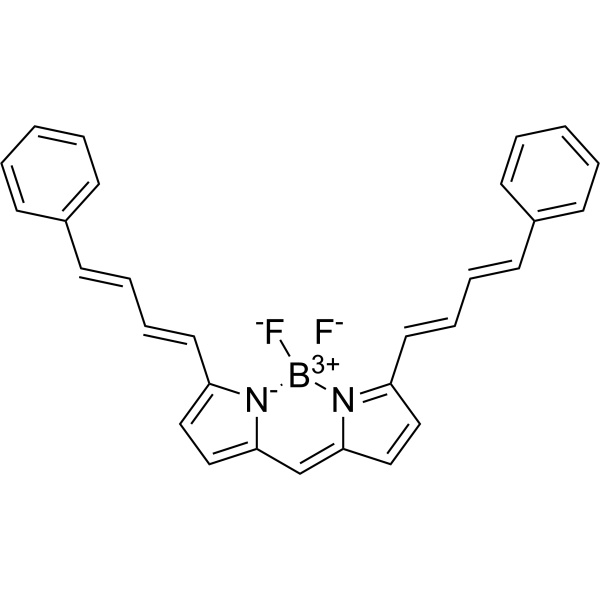
    BODIPY 665/676 is a lipophilic radical-sensitive fluorescent probe that can be used to study radical-driven lipid autoxidation (Ex/Em=665/676 nm) .
    BODIPY 665/676
  • HY-130289

    4-Hydroxy docosahexaenoic acid; (±)4-HDoHE

    PPAR Metabolic Disease Inflammation/Immunology
    (±)4-HDHA (4-Hydroxy docosahexaenoic acid) is an autoxidation product of Docosahexaenoic acid (HY-B2167) (DHA). (±)4-HDHA is a PPARγ agonist, antidiabetic and anti-inflammatory agent .
    (±)4-HDHA
  • HY-N3102

    p-Hydroxycinnamyl alcohol

    Others Others
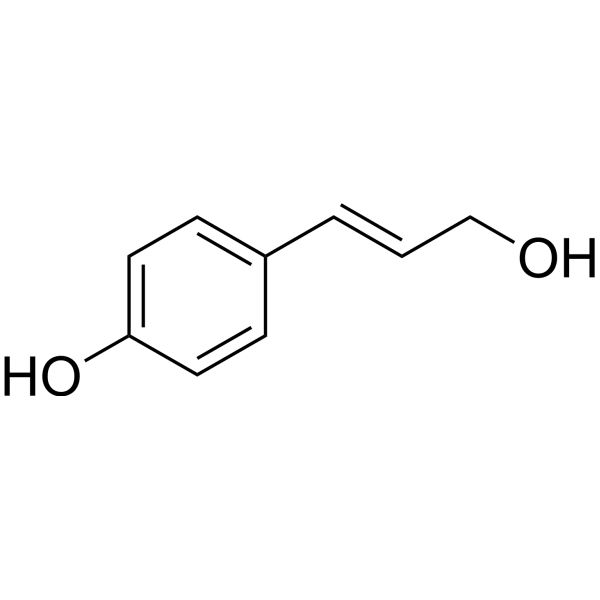
    p-Coumaryl alcohol is an antioxidant that can be isolated from Alpinia officinarum Hance. p-Coumaryl alcohol has inhibitory effect during the autoxidation of methyl linoleate .
    p-Coumaryl alcohol
  • HY-W587878

    Cytochrome P450 Pyruvate Kinase Fungal Apoptosis Insecticide Infection Cancer
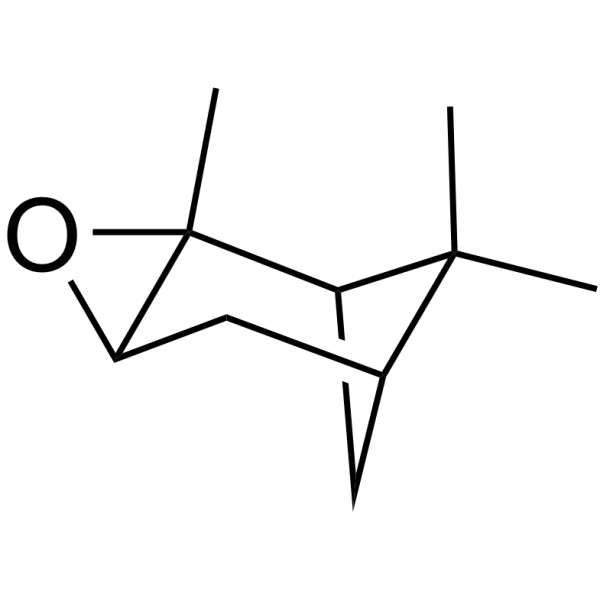
    Thujopsene is the inhibitor for cytochrome P450, that inhibits CYP2B6, CYP3A4, CYP2C19, CYP2C8, CYP2C9 with IC50s of 1.3, 12.6, 13.6, 29.8, and 44.9 μM, respectively. Thujopsene binds to PKM2, inhibits the metabolism pathway of cancer cell, induces apoptosis in MKN45, thereby exhibiting antitumor efficacy. Thujopsene exhibits anti-termite and antifungal activities through autoxidation .
    Thujopsene
  • HY-W129155

    Drug Intermediate Others
    9,10-Dihydroacridine is a chain-terminating antioxidant that can inhibit lipid peroxidation by capturing peroxide free radicals (LOO•) .
    9,10-Dihydroacridine
  • HY-116663

    (±)20-HDoHE

    Endogenous Metabolite Neurological Disease
    (±)20-HDHA ((±)20-HDoHE) is a racemic mixture and is an autoxidation product of Docosahexaenoic acid (DHA). (±)20-HDHA is also formed by peroxidation process in human platelets and rat brain homogenate .
    (±)20-HDHA
  • HY-130238

    (±)8-HDoHE; 8-hydroxy Docosahexaenoic acid; (±)8-HDoHE

    Endogenous Metabolite Metabolic Disease
    (±)8-HDHA is an autoxidation product of docosahexaenoic acid (DHA) in vitro. It is also produced from incubations of DHA in rat liver, brain, and intestinal microsomes. (±)8-HDHA is a potential marker of oxidative stress in brain and retina where DHA is an abundant polyunsaturated fatty acid.
    (±)8-HDHA
  • HY-130288

    (±)13-HDoHE; 13-hydroxy Docosahexaenoic acid; (±)13-HDoHE

    Lipoxygenase Inflammation/Immunology
    (±)13-HDHA is an autoxidation product of docosahexaenoic acid (DHA) in vitro. It is also produced from incubations of DHA in rat liver, brain, and intestinal microsomes. Fresh water hydra is shown to metabolize DHA to 13(R)-HDHA, presumably via the 11R-lipoxygenase activity. (±)13-HDHA is a potential marker of oxidative stress in brain and retina where DHA is an abundant polyunsaturated fatty acid.
    (±)13-HDHA
  • HY-W140598S

    Isotope-Labeled Compounds Others
    Triphenylsulfonium-d5 chloride is deuterium labeled Triphenylsulfonium chloride. Triphenylsulfonium chloride is an autoxidation catalyst .
    Triphenylsulfonium-d5 chloride
  • HY-N16406

    SOD Metabolic Disease
    Auroglaucin is a potent antioxidant. Auroglaucin shows 1,1-diphenyl-2-picrylhydrazyl (DPPH) radical scavenging capacity and superoxide radical scavenging activity with EC50 value of 74.6, 12.3 µM, respectively. Auroglaucin shows low activity for inhibiting the autoxidation of docosahexaenoic acid (DHA) .
    Auroglaucin
  • HY-138241

    Fluorescent Dye Others
    PBD-BODIPY is a probe for the spectrophotometric measurement of autoxidation reactions. Co-autoxidation of the PBD-BODIPY signal carrier and a hydrocarbon co-substrate can be quantified by monitoring loss of absorbance at 591 nm. PBD-BODIPY has been used to measure the activity of radical-trapping antioxidants in cell-free assays. It has also been used as a fluorescent probe for the detection of epoxidation activity.
    PBD-BODIPY
  • HY-130287

    (±)16-HDoHE; 16-hydroxy Docosahexaenoic acid; (±)16-HDoHE

    Endogenous Metabolite Metabolic Disease
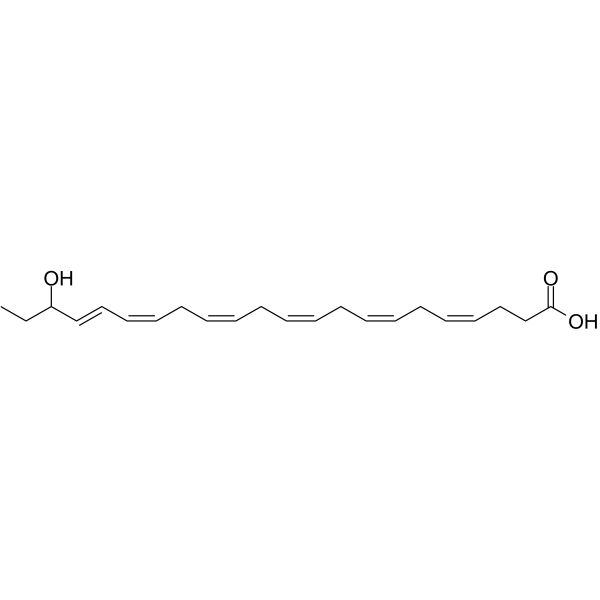
    (±)16-HDHA is an autoxidation product of docosahexaenoic acid (DHA) in vitro. It is also produced from incubations of DHA in rat liver, brain, and intestinal microsomes. (±)16-HDHA is a potential marker of oxidative stress in brain and retina where DHA is an abundant polyunsaturated fatty acid.
    (±)16-HDHA
  • HY-112678

    HIF/HIF Prolyl-Hydroxylase Cardiovascular Disease
    TM6008 is a potent and orally active prolyl hydroxylase (PHD) inhibitor. TM6008 chelats transition metal (copper) and inhibits the autoxidation of ascorbic acid with an IC50 value is 0.57 μM. TM6008  exerts organ protection against ischemia in vivo and can be used for cerebrovascular disease research .
    TM6008
  • HY-N11884

    Endogenous Metabolite Inflammation/Immunology
    Ubiquinone Q3 is an isoprenoid-chain ubiquinone homologue found in Saccharomyces cerevisiae, Escherichia coli, and Rhodospirillum rubrum. Ubiquinone Q3 has antioxidant activity and traps lipid peroxyl radicals .
    Ubiquinone Q3
  • HY-182603

    Drug Derivative Reactive Oxygen Species (ROS) HCV Infection Inflammation/Immunology
    BO-653 is an orally active anti-atherosclerotic antioxidant that exhibits high binding affinity for LDL. BO-653 scavenges linoleic acid peroxyl radicals, inhibits lipid peroxidation during the auto-oxidation of linoleic acid, and potently suppresses LDL oxidation. BO-653 inhibits Hepatitis C Virus (HCV) replication in a concentration-dependent manner, with an IC50 of 36.0 μM against the HCV subgenomic replicon in FLR3-1 cells. BO-653 demonstrates significant anti-atherosclerotic effects in various animal models, including the Watanabe heritable hyperlipidemic rabbit. BO-653 is suitable for use in research related to atherosclerosis and Hepatitis C Virus infection .
    BO-653

Inquiry Online

Your information is safe with us. * Required Fields.

Salutation


Country or Region *

Applicant Name *


Organization Name *

Department *


Email Address *


Product Name *

Cat. No.


Requested quantity *

Phone Number *


Remarks

Inquiry Online

Inquiry Information

Product Name:
Cat. No.:
Quantity:
MCE Japan Authorized Agent:

