



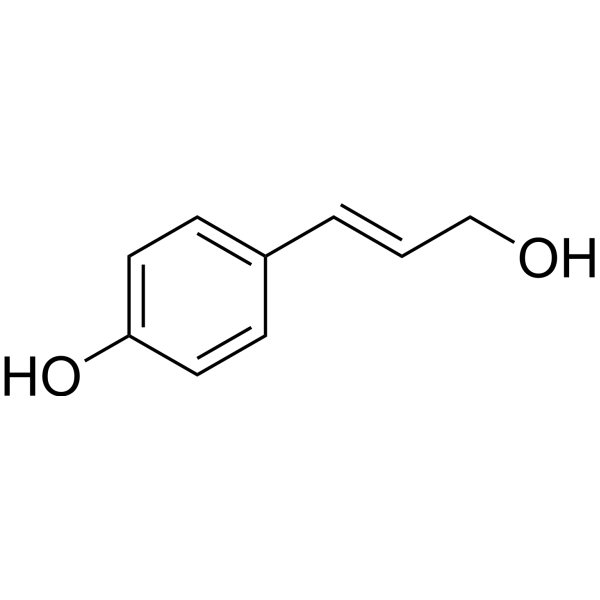
p-Coumaryl alcohol

Based on 1 Customer Validation
p-Coumaryl alcohol is an antioxidant that can be isolated from Alpinia officinarum Hance. p-Coumaryl alcohol has inhibitory effect during the autoxidation of methyl linoleate.
For research use only. We do not sell to patients.
- CAS No.: 3690-05-9
- Formula: C9H10O2
- Molecular Weight:150.17
-
Storage:
4°C, stored under nitrogen
* In solvent : -80°C, 6 months; -20°C, 1 month (stored under nitrogen)

To place orders, for customer services and technical support, please contact: MedChemExpress USA
Tel: 609-228-6898 E-mail: [email protected] [email protected]


-
 Biological Activity
-
Chemical Information
- Purity & Documentation
- References
-
 Help & FAQs




Biological Activity
Description
Cellular Effect
|
Cell Line

|
Type | Value | Description | References |
|---|---|---|---|---|
| B16-4A5 | IC50 |
>100 μM
Compound: 10
|
Antimelanogenic activity in theophylline-stimulated mouse B16-4A5 cells assessed as inhibition of melanogenesis after 72 hrs relative to control
Antimelanogenic activity in theophylline-stimulated mouse B16-4A5 cells assessed as inhibition of melanogenesis after 72 hrs relative to control
|
[PMID: 27756508] |


Chemical Information
-
CAS No. 3690-05-9
-
Appearance Solid
-
Molecular Weight 150.17
-
Formula C9H10O2
-
Color White to off-white
-
SMILES
OC/C=C/C1=CC=C(O)C=C1
-
Synonyms
p-Hydroxycinnamyl alcohol
-
Structure Classification
-
Initial Source
-
Shipping
Room temperature in continental US; may vary elsewhere.
-
Storage
4°C, stored under nitrogen
* In solvent : -80°C, 6 months; -20°C, 1 month (stored under nitrogen)


Purity & Documentation
-
Data Sheet (264 KB)
-
SDS (393 KB)
- English - EN (393 KB)
- Français - FR (393 KB)
- Deutsch - DE (393 KB)
- Norwegian - NO (393 KB)
- Español - ES (393 KB)
- Swedish - SV (393 KB)
- Italian - IT (393 KB)
- Korean - KR (393 KB)
- Portuguese - PT (393 KB)
-
Handling Instructions (2659 KB)
References
[1]. Ly TN, et al. Isolation and characterization of some antioxidative compounds from the rhizomes of smaller galanga (Alpinia officinarum Hance). J Agric Food Chem. 2003 Aug 13;51(17):4924-9. [Content Brief]
[2]. Chien DS, et al. Ocular penetration and bioconversion of prostaglandin F2alpha prodrugs in rabbit cornea and conjunctiva. J Pharm Sci. 1997 Oct;86(10):1180-6. [Content Brief]

Calculators
Concentration (start) × Volume (start) = Concentration (final) × Volume (final)


p-Coumaryl alcohol Related Classifications
HY-N3102 Related Classifications
 Powered by Bioz