



(±)20-HDHA

Based on 1 Customer Validation
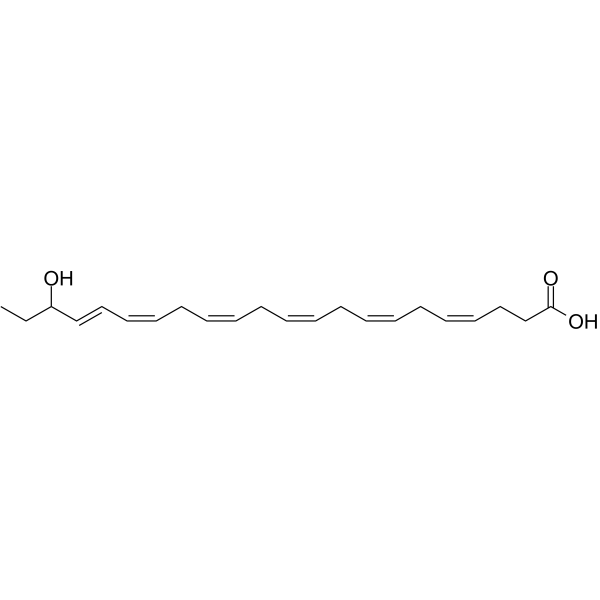
(±)20-HDHA ((±)20-HDoHE) is a racemic mixture and is an autoxidation product of Docosahexaenoic acid (DHA). (±)20-HDHA is also formed by peroxidation process in human platelets and rat brain homogenate.
For research use only. We do not sell to patients.
- Purity : 97.0%
- CAS No.: 90906-41-5
- Formula: C22H32O3
- Molecular Weight:344.49
-
Storage:
Solution, -20°C, 2 years

To place orders, for customer services and technical support, please contact: MedChemExpress USA
Tel: 609-228-6898 E-mail: [email protected] [email protected]


-
 Biological Activity
-
Chemical Information
- Purity & Documentation
- References
-
 Help & FAQs


All Endogenous Metabolite Isoforms
More

Biological Activity
Description
In Vitro
Numerous reports demonstrate the beneficial effects of fish oil on human diseases such as arthritis, Alzheimer’s disease, lung fibrosis, and inflammatory bowel diseases. As an essential omega-3 polyunsaturated fatty acid, Docosahexaenoic acid (DHA) is a major component of fish oil[3].
MedChemExpress (MCE) has not independently confirmed the accuracy of these methods. They are for reference only. .


Chemical Information
-
CAS No. 90906-41-5
-
Appearance Liquid
-
Molecular Weight 344.49
-
Formula C22H32O3
-
Color Colorless to light yellow
-
SMILES
CCC(O)/C=C/C=C\C/C=C\C/C=C\C/C=C\C/C=C\CCC(O)=O
-
Synonyms
(±)20-HDoHE
-
Structure Classification
-
Initial Source
-
Shipping
Room temperature in continental US; may vary elsewhere.
-
Storage
Solution, -20°C, 2 years


Purity & Documentation
-
Data Sheet (263 KB)
-
SDS (393 KB)
- English - EN (393 KB)
- Français - FR (393 KB)
- Deutsch - DE (393 KB)
- Norwegian - NO (393 KB)
- Español - ES (393 KB)
- Swedish - SV (393 KB)
- Italian - IT (393 KB)
- Korean - KR (393 KB)
- Portuguese - PT (393 KB)
-
Handling Instructions (2659 KB)
References
[1]. VanRollins M, et al. Autooxidation of docosahexaenoic acid: analysis of ten isomers of hydroxydocosahexaenoate. J Lipid Res. 1984 May;25(5):507-17. [Content Brief]
[2]. Kim HY, et al. Stereochemical analysis of hydroxylated docosahexaenoates produced by human platelets and rat brain homogenate. Prostaglandins. 1990 Nov;40(5):473-90. [Content Brief]
[3]. Hong S, et al. Resolvin D1, protectin D1, and related docosahexaenoic acid-derived products: Analysis via electrospray/low energy tandem mass spectrometry based on spectra and fragmentation mechanisms. J Am Soc Mass Spectrom. 2007 Jan;18(1):128-44. [Content Brief]

Calculators
Concentration (start) × Volume (start) = Concentration (final) × Volume (final)


(±)20-HDHA Related Classifications
HY-116663 Related Classifications
 Powered by Bioz