6 Results for "

biodegradable films

" in MedChemExpress (MCE) Product Catalog:
Products (6)

6 Results for "biodegradable films" in MCE Product Catalog:

1
1 Cited Publications
Cat. No.: HY-W127758
CAS No.: 9005-32-7
Alginic acid is a natural polysaccharide, which has been widely concerned and applied due to its excellent water solubility, film formation, biodegradability and biocompatibility. Alginic acid induces oxidative stress-mediated hormone secretion disorder, apoptosis and autophagy in mouse granulosa cells and ovaries. Alginic acid has an inhibitory effect on histamine release. Anti-anaphylactic and anti-inflammatory properties .
loading...
    loading...
Cat. No.: HY-W392100A
CAS No.: 36890-68-3
Synonyms: PCL-diol (MW 530)
Polycaprolactone diol (MW 530) (PCL-diol (MW 530)) is a poly (ε-caprolactone) diol with an average molecular weight of 530 g·mol −1, which serves as a monomer for biodegradable network elastic polyesters. Network polyester films undergo enzymatic hydrolysis by Rhizopus delemar lipase .
loading...
    loading...
Cat. No.: HY-W133963
CAS No.: 9063-38-1
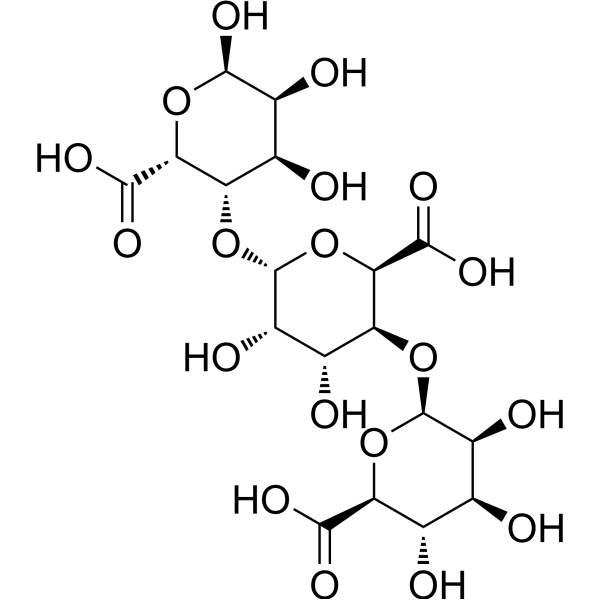
Carboxyl methylstarch sodium is an anionic polymer prepared by carboxymethylation of starch, with properties of stability, thickening ability and film-forming capacity . Carboxyl methylstarch sodium exhibits metal adsorption activity and can remove copper ions and cadmium ions from aqueous solutions. Carboxyl methylstarch sodium can serve as a hydrophilic shell component for AIE-active luminescent polymer nanoprobes to achieve high water dispersibility. Carboxyl methylstarch sodium can bind to vancomycin without altering the in vitro antibacterial activity of vancomycin. Carboxyl methylstarch sodium possesses biodegradable, non-toxic and environmentally friendly characteristics. Carboxyl methylstarch sodium can be applied to relevant researches in various fields such as food, medicine and industry .
loading...
    loading...
Cat. No.: HY-Y0850U2
CAS No.: 9002-89-5
Synonyms: Polyvinyl alcohol (Mw 130000, 87-89% hydrolyzed, ~2700 polymerization); Poly(Ethenol) (Mw 130000, 87-89% hydrolyzed, ~2700 polymerization)
PVA (Polyvinyl alcohol; Poly(Ethenol)) (Mw 130000, 87-89% hydrolyzed, ~2700 polymerization) is a non-toxic, biodegradable, and highly biocompatible semicrystalline synthetic polymer. PVA (Mw 130000, 87-89% hydrolyzed, ~2700 polymerization) acts as a coating agent to improve tableting performance, and can be cross-linked with sodium trimetaphosphate to prepare tubular vascular grafts or form hydrogels for use as artificial articular cartilage and sustained-release matrices for growth factors. PVA (Mw 130000, 87-89% hydrolyzed, ~2700 polymerization) enhances the redox cycle of iron species in photo-assisted Fenton reactions to simultaneously generate hydrogen peroxide and degrade pollutants, enabling integrated sustainable waste management and water treatment. PVA (Mw 130000, 87-89% hydrolyzed, ~2700 polymerization) is used in the manufacture of biodegradable films and in studies of dry or minimally invasive ex vivo wounds, but cannot form freeze-thaw cross-linked solid sheets for wound dressings .
loading...
    loading...
Cat. No.: HY-Y0850U8
CAS No.: 9002-89-5
Synonyms: Polyvinyl alcohol (Mw 47000, 98-99% hydrolyzed, ~1000 polymerization); Poly(Ethenol) (Mw 47000, 98-99% hydrolyzed, ~1000 polymerization)
PVA (Polyvinyl alcohol; Poly(Ethenol)) (Mw 47000, 98-99% hydrolyzed, ~1000 polymerization) is a semicrystalline synthetic polymer with excellent biocompatibility and biodegradability, which is non-toxic and non-mutagenic upon oral administration in the human body. PVA (Mw 47000, 98-99% hydrolyzed, ~1000 polymerization) can serve as an excipient, inhibitor or coating agent to prepare solid dispersions by absorbing water and inhibiting drug crystal nucleation and growth, and can encapsulate insulin-like growth factor-1. PVA (Mw 47000, 98-99% hydrolyzed, ~1000 polymerization) can form physically crosslinked cryogels and degradable films, and is widely used in the construction of vascular grafts, the synthesis of articular cartilage, and studies on dry or minimally invasive ex vivo wounds. PVA (Mw 47000, 98-99% hydrolyzed, ~1000 polymerization) also promotes hydrogen peroxide generation and enhances the redox cycle of iron species, thus acting as a sacrificial agent to effectively degrade pollutants .
loading...
    loading...
Cat. No.: HY-W115746A
CAS No.: 9004-57-3
Ethyl cellulose (viscosity 10 cP) is a non-toxic, biodegradable polymer with unique properties such as oleogel formation, active ingredient delivery, and film-forming ability in the food and pharmaceutical fields. Ethyl cellulose (viscosity 10 cP) can serve as a pharmaceutical excipient, including as a coating agent, flavoring agent, and tablet filler .
loading...
    loading...

