

1. Search Result
Search Result
Results for "

biological macromolecules

" in MedChemExpress (MCE) Product Catalog:

9

Inhibitors & Agonists

1

Fluorescent Dyes

1

Biochemical Assay Reagents

1

MCE Kits

2

Natural
Products

1

Isotope-Labeled Compounds

Cat. No. Product Name Target Research Areas Chemical Structure
  • HY-D0215

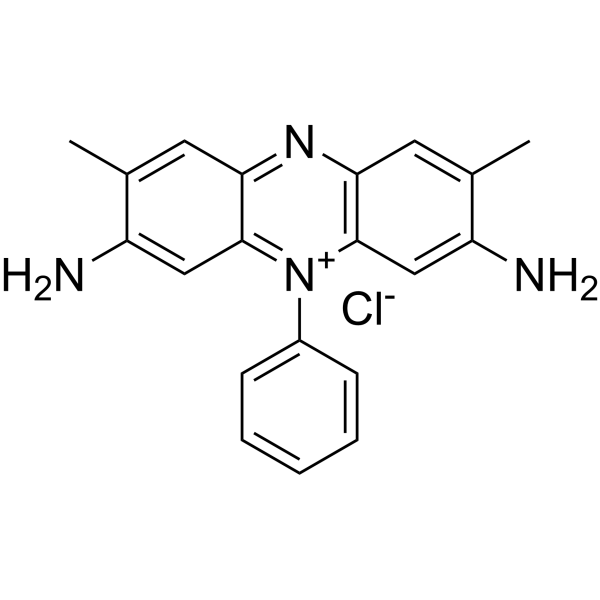
    Safranine T

    Fluorescent Dye Bacterial Infection Metabolic Disease
    Safranin (Safranin T) is an important and classical phenazinium dye. Safranin has been extensively used in the academic field as a spectroscopic probe and indicator. Safranin possesses a planar structure and cationic charge. Safranin can readily intercalate into biological macromolecules, including DNA and proteins. Safranin has antibacterial effects against gram-positive bacteria (S. aureus). Safranin can be used as a redox indicator in the determination of metal ion concentration .
    Safranin
  • HY-W006371

    Endogenous Metabolite Drug Intermediate Metabolic Disease
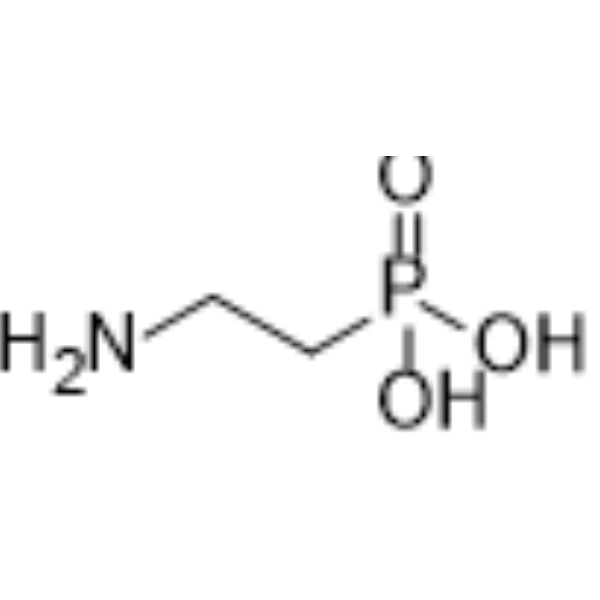
    (2-Aminoethyl)phosphonic acid is an endogenous metabolite and amino acid analog. (2-Aminoethyl)phosphonic acid can be used for the synthesis of biological macromolecules and the preparation of hydrogels .
    (2-Aminoethyl)phosphonic acid
  • HY-141452

    Malondialdehyde

    Endogenous Metabolite Neurological Disease
    Propanedial (Malondialdehyde) (13.88 mM in water) is one of the final products of lipid peroxidation. Propanedial causes protein inactivation, DNA damage and cross-linking by forming stable covalent adducts with biological macromolecules, which is the main mechanism for its cytotoxicity and genotoxicity. Propanedial production increases with the elevation of free radicals. Propanedial is a key biomarker for evaluating the level of cellular oxidative stress [1][2][3].
    Propanedial (13.88 mM in water)
  • HY-156045B

    Biochemical Assay Reagents Others
    Cross-linked dextran G 150 is a hydrophilic gel based on molecular size exclusion and targeted for the separation of macromolecules. Cross-linked dextran G 150 functions through the gel permeation mechanism, where the cross-linked structure forms a three-dimensional network with specific pore diameters, achieving separation based on the molecular volumetric flow. Cross-linked dextran G 150 can be used to regulate the distribution coefficient of permeating solutes and maintain the permeation balance, such as in gel filtration chromatography for the purification and analysis of biological macromolecules like proteins and nucleic acids. Cross-linked dextran G 150 can also be used as a gel filtration filler (particle size range: 40-120 μm; spherical protein separation range: 5-300 kDa) .
    Cross-linked dextran G 150
  • HY-157236

    Biochemical Assay Reagents Others
    AEX Anion-exchange resin 1 is a strong anion exchange chromatography resin, based on monodisperse polystyrene/divinylbenzene (PS-DVB), with a particle size of 50 μm and an ionic ligand of –CH2N + (CH3)3. AEX Anion-exchange resin 1 can be used for the separation and purification of biological macromolecules such as proteins, antibodies, and viral vaccines.
    AEX Anion-exchange resin 1
  • HY-W006371R

    Reference Standards Endogenous Metabolite Drug Intermediate Metabolic Disease
    (2-Aminoethyl)phosphonic acid (Standard) is the analytical standard of (2-Aminoethyl)phosphonic acid (HY-W006371). This product is intended for research and analytical applications. (2-Aminoethyl)phosphonic acid is an endogenous metabolite and amino acid analog. (2-Aminoethyl)phosphonic acid can be used for the synthesis of biological macromolecules and the preparation of hydrogels.
    (2-Aminoethyl)phosphonic acid (Standard)
  • HY-W738478

    Fluorescent Dye Others
    AOI 987 is an oxazine dye and fluorescent molecule. AOI 987 can bind to biological macromolecules .
    AOI 987
  • HY-119869

    DNA/RNA Synthesis Cancer
    Anaxirone is an anti-tumor agent. The epoxy group in its structure can interfere with the proliferation of tumor cells by alkylating biological macromolecules such as DNA. Anaxirone has dose-limiting toxicity (DLT) and gastrointestinal toxicity. Anaxirone can be used for research on solid tumors such as non-small cell lung cancer (NSCLC) .
    Anaxirone
  • HY-W006371S

    Isotope-Labeled Compounds Endogenous Metabolite Drug Intermediate Metabolic Disease
    (2-Aminoethyl)phosphonic acid-d4 is the deuterium labeled (2-Aminoethyl)phosphonic acid (HY-W006371). (2-Aminoethyl)phosphonic acid is an endogenous metabolite and amino acid analog. (2-Aminoethyl)phosphonic acid can be used for the synthesis of biological macromolecules and the preparation of hydrogels .
    (2-Aminoethyl)phosphonic acid-d4

Inquiry Online

Your information is safe with us. * Required Fields.

Salutation


Country or Region *

Applicant Name *


Organization Name *

Department *


Email Address *


Product Name *

Cat. No.


Requested quantity *

Phone Number *


Remarks

Inquiry Online

Inquiry Information

Product Name:
Cat. No.:
Quantity:
MCE Japan Authorized Agent:

